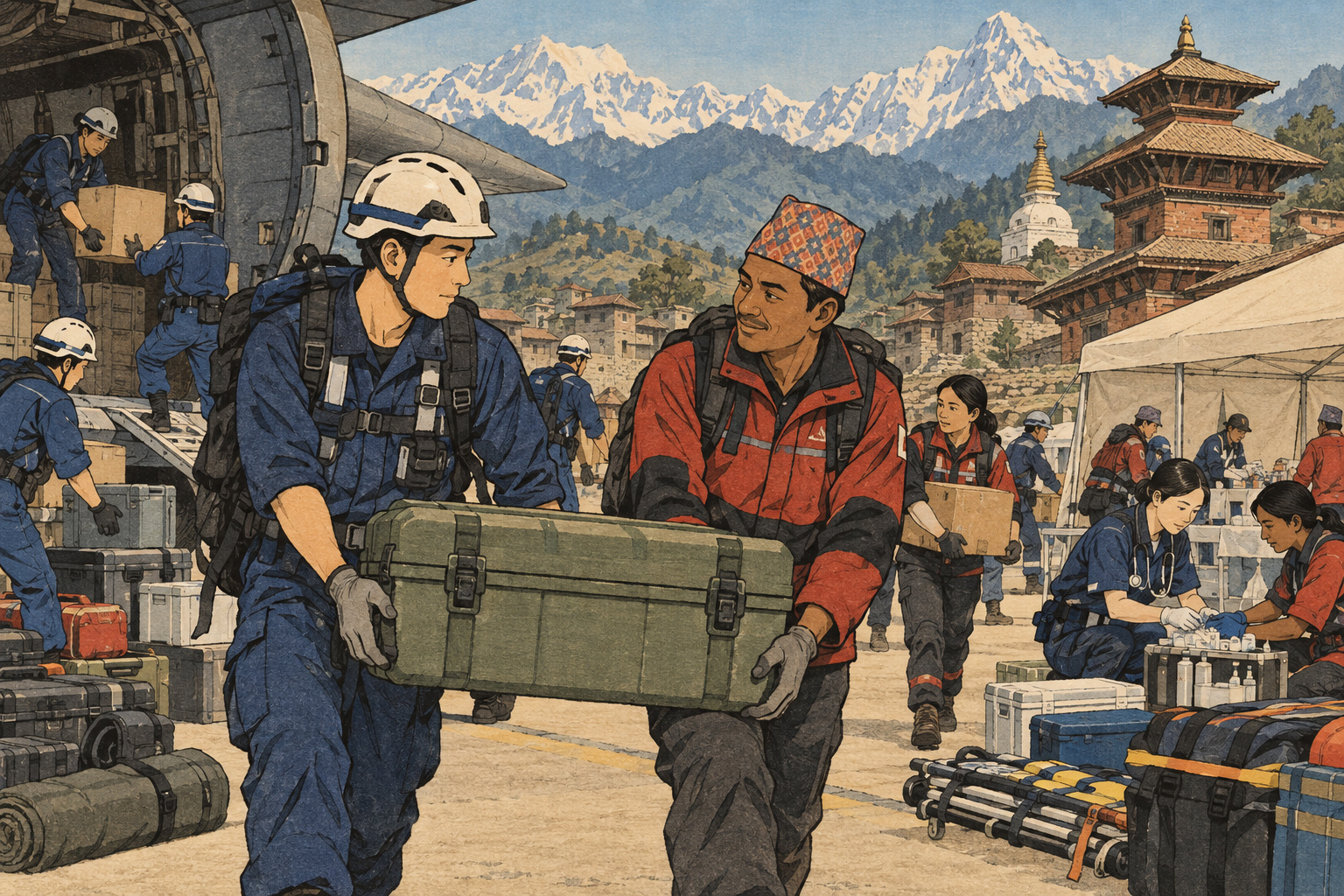
A catastrophe is first counted. The dead, the missing and the displaced become numbers large enough to express the scale of loss. For a family, however, a number is not an answer. Was the person found? Can the family bring them home? Can a death be formally registered, mourning begin, and the legal and practical tasks of a shattered life move forward?
That is the human purpose behind Japan’s latest emergency deployment to Nepal. Large-scale flash flooding and mudslides struck the Nepal–China border area on the morning of August 26, local time. Japanese government releases identify Nepal’s Rasuwa District among the affected areas. As of September 3, Japan’s Foreign Ministry reported, the toll on the Nepalese side stood at 1,204 dead, 4,216 missing and approximately 310,000 affected. Those are dated emergency figures, not permanent totals.
Nepal Police was already building the identification process. In a September 2 public notice, it asked relatives of missing Nepalese and foreign nationals to provide fresh blood samples for DNA comparison. Close first-degree relatives—parents or children—were preferred; siblings could provide samples when none were available. Relatives abroad were given a route to submit a DNA profile, an ante-mortem information form and a photograph through an official address.
Japan’s experts are entering that vast system of collection, recording and comparison. Their work begins where the headline image of emergency relief often ends.
This is an expert team, not a generic “relief team”
Japan Disaster Relief, or JDR, is an umbrella for different kinds of response. Japan can deploy a rescue team for search, extraction and immediate aid; a medical team for clinical care; an expert team for specialized advice and operations; a Self-Defense Forces unit when particularly necessary; or an infectious-disease response team. A request from the affected government and an assessment of need determine the form.
The deployment announced for Nepal is an expert team whose official purpose is support for identification. Japanese media reporting on government briefings said personnel came from the Foreign Ministry, police and JICA, and that the planned work included helping Nepalese authorities collect and record information needed for identification. Reports described a deployment of approximately two weeks. The Foreign Ministry and JICA launch notices themselves did not publish a complete roster, exact headcount, equipment list or site-by-site plan.
Medical work sits on a separate track. Foreign Minister Toshimitsu Motegi said on September 3 that a JICA assessment group had arrived the previous day to identify medical needs and that Japan would consider appropriate support in light of that work. An assessment team’s arrival should not be rewritten as the formal deployment of a JDR medical team or as the start of treatment.
| Assistance channel | Verified position through September 3 |
|---|---|
| Emergency supplies | Tents, blankets and other items approved on August 28; Motegi said they were handed to Nepal’s government on September 2. |
| JDR expert team | Dispatch decided September 3 and scheduled for September 4; assigned to support victim identification. |
| Medical assistance | A JICA group arrived September 2 to assess needs. A formal JDR medical-team deployment was not announced in the sources reviewed. |
| Support through international organizations | Under preparation or consideration at the time; recipient organization and amount were not stated. |
Identification is a chain of evidence
Disaster victim identification is commonly shortened to DVI. INTERPOL organizes the process into four broad phases. Teams examine the scene and recover remains and property. Specialists collect post-mortem data, which may include fingerprints, dental information, DNA and distinctive physical features. Investigators gather ante-mortem information from families and records. Finally, qualified teams compare and reconcile the two sets.
The science is only one part. Every set of remains, sample, image and personal effect must be recorded under a consistent identifier. The record must show who collected it, where it was kept and when it changed hands. Translations and spellings must be reconciled. A DNA result connected to the wrong scene number or the wrong relative is not a technical success.
Floods and mudslides make that chain unusually difficult. Remains may travel far from a home or workplace. Personal possessions can be separated or destroyed. Visual identification becomes unreliable. When travelers, migrant workers or cross-border populations are among the missing, dental charts, fingerprints and family samples may be held in several countries and recorded in different languages.
DNA can be matched directly to a known sample from the missing person, or indirectly through biological relatives. Fingerprints and dental records provide other primary routes. INTERPOL stresses that remains be treated with respect and that the process remain transparent enough to keep next of kin informed.
The task demands speed without haste
Identification work is time-sensitive. Environmental conditions change human remains. Mortuary and storage capacity can become overwhelmed. Displaced families move, communications fail and records become harder to obtain. Delay extends uncertainty for relatives and postpones death registration, repatriation, funerals and legal procedures.
Yet speed cannot come at the cost of a false identification. An incorrect notification can devastate a second family and contaminate later comparisons. The operational goal is controlled urgency: standardized forms, disciplined labeling, duplicate checks, secure storage, clear authority, culturally informed family liaison and review before a conclusion is released.
Japan’s official announcements describe assistance to Nepal’s identification work. They do not say that the Japanese team will take sovereign control of identification, conduct every DNA test or issue final determinations. Those distinctions matter. Nepalese authorities own the process and communicate its results; visiting experts must fit their methods to that system.
Data responsibility follows the samples. DNA profiles, medical and dental records, family relationships and photographs are exceptionally sensitive. Emergency conditions do not erase questions about collection purpose, authorized access, cross-border transfer, retention and eventual destruction. The public sources reviewed for this article do not set out how data accessed or generated during the Japanese mission will be governed. That is a legitimate subject for an end-of-mission account.
Nepal remembers Japan’s 2015 response
For JDR, Nepal is familiar ground. After the magnitude 7.8 earthquake of April 25, 2015, Japan deployed a 70-member rescue team, a first medical contingent of 46, a second of 34, and one member of the United Nations Disaster Assessment and Coordination system. The Self-Defense Forces sent a medical unit of about 110 people and airlift and related personnel numbering about 160. JICA also supplied 350 tents and 2,500 blankets, valued at ¥25 million.
The medical mission marked a development in Japan’s capability. JICA says Nepal was the first deployment of an expanded medical team able to add modules such as surgery and dialysis. It performed the JDR medical team’s first general-anesthesia surgery in a field setting. Japan then continued from emergency response into recovery, reconstruction and disaster-risk-reduction cooperation.
The 2026 disaster and mission should not be conflated with 2015. One was a major earthquake; the latest crisis began with flash flooding and mudslides. The earlier response was a large combination of rescue, medical, military, coordination and material assistance. The current dispatched unit is a specialized identification-support team.
The continuity lies in the method: respond to a Nepalese request, assess what function is missing, and combine people, goods and later support rather than treating “aid” as a single standardized package.
April 2015 · Japan combines rescue, medical, UN coordination, SDF and material assistance after Nepal’s earthquake
August 26, 2026 · Flash flooding and mudslides strike the Nepal–China border area
August 28 · Japan approves tents, blankets and other emergency supplies
September 2 · Supplies are handed over; a medical-needs assessment group arrives
September 3 · Japan decides to send a JDR expert team for identification support
September 4 · The expert team deploys and is reported to arrive in Kathmandu
A system built around the affected country’s request
JICA traces Japan’s international emergency-relief activity to a 1979 operation assisting Cambodian refugees. A registration and standby system for medical personnel began in 1982. The 1987 Law Concerning Dispatch of the Japan Disaster Relief Team, generally called the JDR Law, established the modern legal structure. An infectious-disease response team was added in 2015 after the West African Ebola experience, bringing today’s personnel options to five.
As of September 1, 2026, JICA’s published statistics counted 176 personnel deployments since 1987: 21 rescue teams, 67 medical teams, six infectious-disease teams, 56 expert teams and 26 SDF units, including transport missions. It also counted 622 instances of emergency-relief supplies. The figures reveal a system much broader than dramatic urban search and rescue. Technical deployments can address disaster management, structural safety, pollution, logistics, disease control and, as in Nepal, identification.
The request principle is operational, not ceremonial. Foreign units that arrive without integration can congest airports, compete for transport, duplicate work and break the affected country’s command system. A government request defines the needed capacity and provides the legal and administrative route for visiting specialists to join the response. Both Japan’s Foreign Ministry and JICA explicitly cite Nepal’s request in the September 3 decision.
Technical assistance must remain Nepalese-led
An international expert team is not valuable because it exports “the Japanese way.” Its value depends on whether it strengthens a system the responsible Nepalese institutions can use. Nepal Police had already established channels for family samples and international submissions. Visiting personnel need to understand that workflow, identify the gaps requested by their counterparts and leave records and procedures that can be sustained after the visitors depart.
Names may have several spellings. Family structures, funeral traditions and beliefs about handling remains affect how information is requested and how trust is earned. International forms can standardize fields, but they cannot replace interpreters, local liaison officers and culturally competent conversations. Families are not merely suppliers of ante-mortem data; they are people to whom the system owes explanation.
Japan’s own nationals are part of the picture. Japanese government statements said five Japanese citizens remained out of contact, and Prime Minister Sanae Takaichi asked Nepal’s prime minister, Balendra Shah, for maximum cooperation in search and rescue. Protecting citizens abroad is a legitimate state responsibility. The stated purpose of the JDR deployment, however, is broader support for Nepal’s identification operation, not an exclusive Japanese search. Applying the same disciplined process across nationalities is essential to the team’s credibility.
Seventy years of relations meet a severe test
Japan and Nepal established diplomatic relations on September 1, 1956. The year 2026 marks the 70th anniversary. Japan’s Foreign Ministry describes ties built through development cooperation, exchanges between people and the mountain connection symbolized by a Japanese expedition’s first ascent of Manaslu in the same year diplomatic relations began.
That history gives the deployment context, but an anniversary must not turn survivors and bereaved families into scenery for a diplomatic narrative. The relevant measure of friendship is whether the requested work is performed accurately, respectfully and in a way that leaves Nepalese institutions stronger.
Arrival receives the most attention in emergency diplomacy. Departure should receive scrutiny too. An accountable closeout would explain what functions the team performed, what could not be completed, how information and equipment were handed over, and how sensitive data will be retained or destroyed. It would avoid disclosing private case information while still allowing the public to understand what the mission achieved.
It should also connect emergency response to preparedness. Common forms, trained family-liaison staff, agreements for international dental and DNA information, secure databases and exercises cannot be improvised after a mass-casualty event. Technical humanitarian cooperation is most durable when the next exchange happens before the next disaster.
Humanitarian work continues after hope changes form
Japan.co.jp’s assessment is that this mission illustrates a less visible national capability. Japan’s contribution is not simply transport capacity or quantities of supplies. It is the ability to assemble specialists from different institutions, fit them into a partner government’s operation and apply disciplined documentation under extreme conditions.
The limits must be stated just as clearly. The September 3 Japanese releases did not publish the team’s complete composition, detailed equipment, assigned locations, case target or anticipated number of identifications. Their casualty figures were a snapshot. They did not establish the physical cause of the flash flood and mudslides. The medical assessment did not itself amount to a medical-team deployment.
What is established is substantial enough. Tents and blankets reached Nepal’s government. Medical needs were being assessed. A requested expert team traveled to support a national identification effort already collecting family DNA and ante-mortem information.
Rescue seeks to bring a person home alive. When that hope can no longer be fulfilled, humanitarian responsibility does not end; its form changes. It becomes the precise work of recovering a name, returning remains, protecting records and allowing a family to know. In Nepal, that is the responsibility Japan’s experts have been asked to share.
- Japan Disaster Relief (JDR): Japan’s framework for providing personnel assistance after a request from an affected government.
- Expert team: Specialists providing technical advice or operational support. This mission’s stated assignment is victim-identification support.
- DVI: Disaster victim identification, organized around scene work, post-mortem data, ante-mortem data and reconciliation.
- Ante-mortem / post-mortem data: identifying information recorded before death and corresponding information collected from human remains.
- Ministry of Foreign Affairs of Japan, “Dispatch of the Japan Disaster Relief Expert Team in Response to the Flash Flood in Nepal” — decision, request and identification mission.
- JICA, Nepal expert-team dispatch notice — September 4 deployment and disaster figures (Japanese).
- Foreign Ministry record of Foreign Minister Toshimitsu Motegi’s September 3 news conference — supply handover, medical-needs assessment and expert deployment (Japanese).
- Foreign Ministry emergency-supplies announcement — tents, blankets and other relief items (Japanese).
- Nepal Police, “Public Notice Regarding DNA Testing for International and National Missing Persons” — family sampling and international submission procedures.
- INTERPOL, “Disaster Victim Identification” — the four DVI phases and principal identifying data.
- FNN report on the team’s arrival in Kathmandu and TV Asahi report on the government briefing — arrival, planned duration and reported scope (Japanese).
- JICA, “2015 Nepal Earthquake” — previous rescue, medical, SDF and material assistance (Japanese).
- JICA overview of international emergency relief and deployment statistics — legal history, team types and totals (Japanese).
- Foreign Ministry Nepal basic data — diplomatic relations and the 70th anniversary (Japanese).
Editorial method: This edition distinguishes official Japanese and Nepalese facts, international technical guidance, reported arrival and composition details, and Japan.co.jp analysis. It does not infer the team’s undisclosed roster, equipment, case results or the physical cause of the disaster. It was written independently in English rather than translated sentence by sentence from the Japanese report.