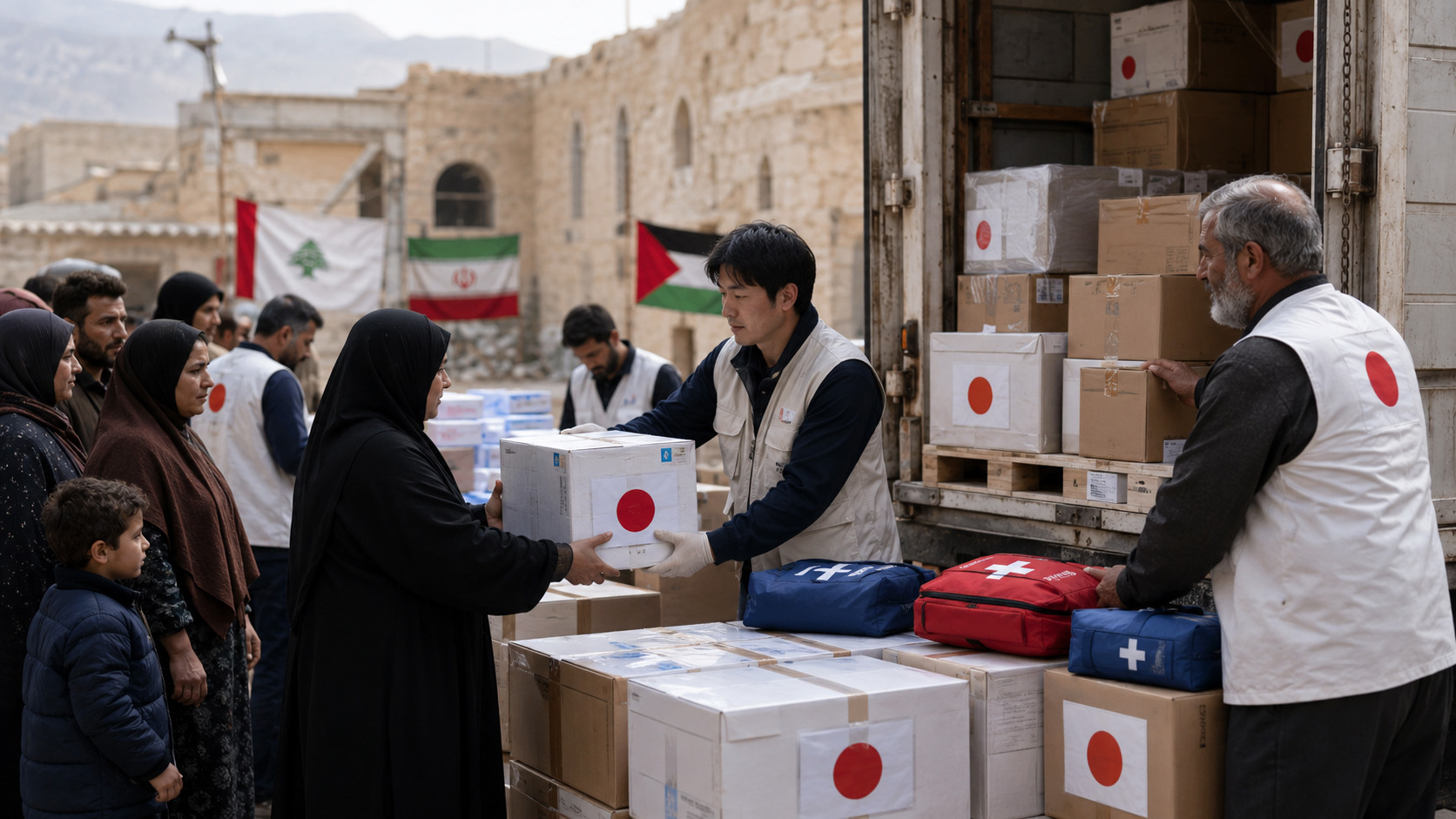
Japan’s Foreign Ministry announced on June 26 that the government will provide a $15 million emergency grant to Iran, Lebanon and Palestine, including the West Bank, in response to a worsening humanitarian situation. The aid will support health, medical care and food assistance through international organizations, the International Committee of the Red Cross and the International Federation of Red Cross and Red Crescent Societies. In global crisis terms, $15 million is not a giant number. But the announcement matters because it shows the particular way Japan still tries to act in the Middle East: not as a military power, but as a humanitarian donor, a diplomatic listener and a country whose own economic security is tied to regional stability.
A modest sum with a larger message
The Foreign Ministry’s statement is short. Japan will provide an emergency grant of $15 million to Iran, Lebanon and Palestine, including the West Bank, in fields such as health, medical care and food, using international organizations, the ICRC and IFRC. The wording is administrative. The context is not. Behind the statement are war, displacement, sanctions, medical shortages, food insecurity, international law, energy security and the long postwar habit of Japanese diplomacy.
Japan is not a military power in the Middle East. It is not a local actor. But Japan is deeply exposed to the region. It imports energy from the broader Middle East, watches the Strait of Hormuz with anxiety, and has spent decades describing its diplomacy through terms such as human security, international cooperation and rule-based stability. That makes Middle East conflict both a foreign news story and an economic story for Japan. Oil prices, shipping risk, inflation, the yen, electricity bills and corporate costs all connect distant fighting to daily life in Japan.
Why Iran, Lebanon and Palestine?
The selection of Iran, Lebanon and Palestine is not random. It reflects a crisis that crosses borders, political systems, armed groups, civilian populations, hospitals, food supply chains and displaced communities. Iran is a regional power tied to nuclear diplomacy, sanctions, maritime security and the balance of power. Lebanon has endured economic collapse, political paralysis, displacement pressure and repeated waves of conflict. Palestine, including the West Bank, faces chronic stress on movement, health care, livelihoods and access to basic services.
Japan’s package is designed as humanitarian assistance rather than a political endorsement of one party. That is typical of Japanese diplomacy. The official vocabulary is not fiery. It is health, medical care, food, international organizations and Red Cross channels. Some will argue that stronger political language is needed in moments of crisis. But in operational humanitarian work, neutrality can be a condition for access. A truck that carries medicine often needs a different language from a diplomatic podium.
Japan’s old diplomatic phrase: human security
When Japan speaks about assistance like this, an older phrase often sits in the background: human security. The idea is that security does not belong only to states. It also belongs to individuals whose lives, health, dignity and livelihoods are threatened. After the Cold War, Japan strengthened a style of engagement built around development, medicine, disaster response, education, infrastructure and humanitarian assistance. Official development assistance became one of the central instruments of that approach.
In the Middle East, Japan has tried to maintain relationships across difficult lines. It has kept channels with Iran while remaining a U.S. ally. It has supported Palestinians while maintaining ties with Israel. It has worked with Arab governments while trying to avoid becoming a combatant in the region’s conflicts. This style is sometimes frustratingly cautious, but it also leaves Japan with one advantage: it often still has people to talk to.
Why the Red Cross channels matter
The MOFA announcement specifically mentions the ICRC and IFRC. That matters. The ICRC has a special role in conflict zones, working on international humanitarian law, wounded people, detainees, missing persons, civilian protection and medical access. The IFRC works through national Red Cross and Red Crescent networks on disasters, displacement, health, relief goods and community-level support. Delivering aid through such channels can be more neutral and more operationally realistic than direct bilateral assistance.
That does not make the work simple. In conflict zones, aid delivery faces access restrictions, insecurity, checkpoints, sanctions complications, shortages of fuel and supplies, banking problems, damaged communications and danger to local staff. Deciding to fund relief and actually getting help to the people who need it are two different stages. That is why experienced humanitarian channels matter.
Lebanon is not a one-time concern
Japan has supported Lebanon before. In October 2024, the government announced a $10 million emergency grant in response to Lebanon’s deteriorating humanitarian situation. The World Food Programme has also described Japan as a continuing supporter of food assistance in Lebanon. This new package should therefore be read not as a sudden one-off, but as part of a continuing Japanese response to regional instability.
Lebanon’s burden is layered. The country has faced political dysfunction, currency collapse, banking crisis, infrastructure breakdown, refugee pressure and conflict. When violence and displacement are added to that, hospitals, municipalities, schools, food distribution systems, electricity and fuel supplies come under immediate pressure. Medical and food assistance are not only compassionate. They help prevent basic social systems from breaking further.
The difficulty of helping Iran
Humanitarian assistance for Iran is especially delicate. Iran is tied to sanctions, nuclear diplomacy, regional security, the Strait of Hormuz and global energy markets. Japan has a historic relationship with Iran, but it is also a U.S. ally. That means Japan’s Iran diplomacy is often a narrow bridge. Humanitarian assistance is one of the few languages that can cross it.
Medical supplies, food assistance and health services are needed by civilians regardless of political dispute. But sanctions and financial restrictions can complicate transfers, procurement and logistics. That is one reason international organizations are important. The assistance must be clearly humanitarian, transparent, accountable and practically deliverable.
Palestine and Japan’s long position
Palestinian assistance has long been a feature of Japan’s Middle East diplomacy. Japan has supported humanitarian needs, economic foundations, administrative capacity and refugee-related work while also maintaining relations with Israel. Its official vocabulary has often included a two-state solution, international law, humanitarian access and civilian protection.
This announcement specifies Palestine including the West Bank. That is important. Even when Gaza dominates global attention, the West Bank faces serious challenges around movement, health services, food access, economic activity and the daily insecurity of civilian life. Naming the West Bank helps direct funding toward a specific set of humanitarian needs that can otherwise be overshadowed.
Why this matters to readers in Japan
For Japanese readers, Middle East humanitarian aid can feel distant. It is not. First, there is energy. Japan depends heavily on imported energy from the wider region, and any tension around the Strait of Hormuz quickly affects market psychology. Second, there is inflation. Energy prices and shipping costs touch electricity, gasoline, logistics and food. Third, there is diplomacy. Japan’s ability to show up internationally through humanitarian channels is part of the country’s postwar identity.
Fourth, Japan is itself a disaster country. Earthquakes, tsunami, typhoons and floods have taught Japan what medical care, shelter, food, hygiene, logistics and dignity mean after disaster. Japan has received help and has sent help. Humanitarian assistance abroad is not just foreign policy spending. It is also the export of a national memory: people in crisis need systems that work, not only sympathy.
The route says as much as the amount
The $15 million figure will not transform Middle East politics. But the route of the money says a great deal. International organizations. ICRC. IFRC. Health. Medical care. Food. These are the nouns of Japan’s chosen role. Japan is not presenting itself as the side that decides victory. It is presenting itself as the side that tries to keep civilians alive while politics fails them.
There are limits to this approach. Japan cannot single-handedly produce a ceasefire. Humanitarian aid cannot solve the political causes of war. Fifteen million dollars cannot meet the full scale of need across Iran, Lebanon and Palestine. But useful aid is still useful. A supply of medicine today is not a theory. A food package today is not a communique. A functioning clinic today is not a speech.
Humanitarian aid as the last shared language
When conflicts harden, political language hardens too. Enemy, sanctions, retaliation, deterrence, victory, defeat. Humanitarian aid is often the last language that can still be spoken across lines. Sick children need treatment. Hospitals need medicine. Displaced families need food. Ambulances need fuel. Those facts are difficult to deny even when everything else is disputed.
Japan’s decision is a choice to use that language. Japan does not have a magic solution for the Middle East. But it has funding, institutional trust, humanitarian experience and a postwar vocabulary of non-military engagement. In a crisis like this, those tools are worth using.
A quiet but serious closer
This is not the loudest story in the news cycle. It is not a market crash, a dramatic summit handshake or a military strike. The Foreign Ministry statement is brief and formal. Yet it contains a core element of Japan’s foreign policy: there is a crisis, civilians are suffering, medical care and food are needed, and Japan will fund help through international channels.
Placed at the end of a Japan.co.jp edition filled with storms, earthquakes, yen pressure, robots and tourism data, the story has a useful weight. Japan is an island country, but it is not separate from the world. Air routes, sea lanes, energy, diplomacy, disaster and humanitarian relief are all connected.
Fifteen million dollars may not change the world. But it can change a hospital shift, a food line, a clinic shelf or a family’s day in displacement. Japanese diplomacy is sometimes criticized for being too quiet. But quiet aid can still matter. In this Middle East crisis, Japan’s chosen response was not a declaration of triumph. It was money meant to keep people alive.
Sources and references
This article draws on public information from Japan’s Ministry of Foreign Affairs, Jiji/Nippon.com, Arab News Japan, the ICRC, IFRC, WFP, the Prime Minister’s Office of Japan and past MOFA emergency-grant announcements. Aid amount, target areas and implementing channels reflect information available at publication time and may be adjusted through coordination with humanitarian partners.
- Ministry of Foreign Affairs of Japan: Emergency Grant in Response to the Deterioration of the Humanitarian Situation in Iran, Lebanon and Palestine.
- Nippon.com / Jiji Press: Japan to provide $15 million in aid to Iran, Lebanon and Palestine.
- Arab News Japan: Japan announces emergency humanitarian grant.
- MOFA: 2024 emergency grant in response to the humanitarian situation in Lebanon.
- World Food Programme: Japan’s food assistance in Lebanon.