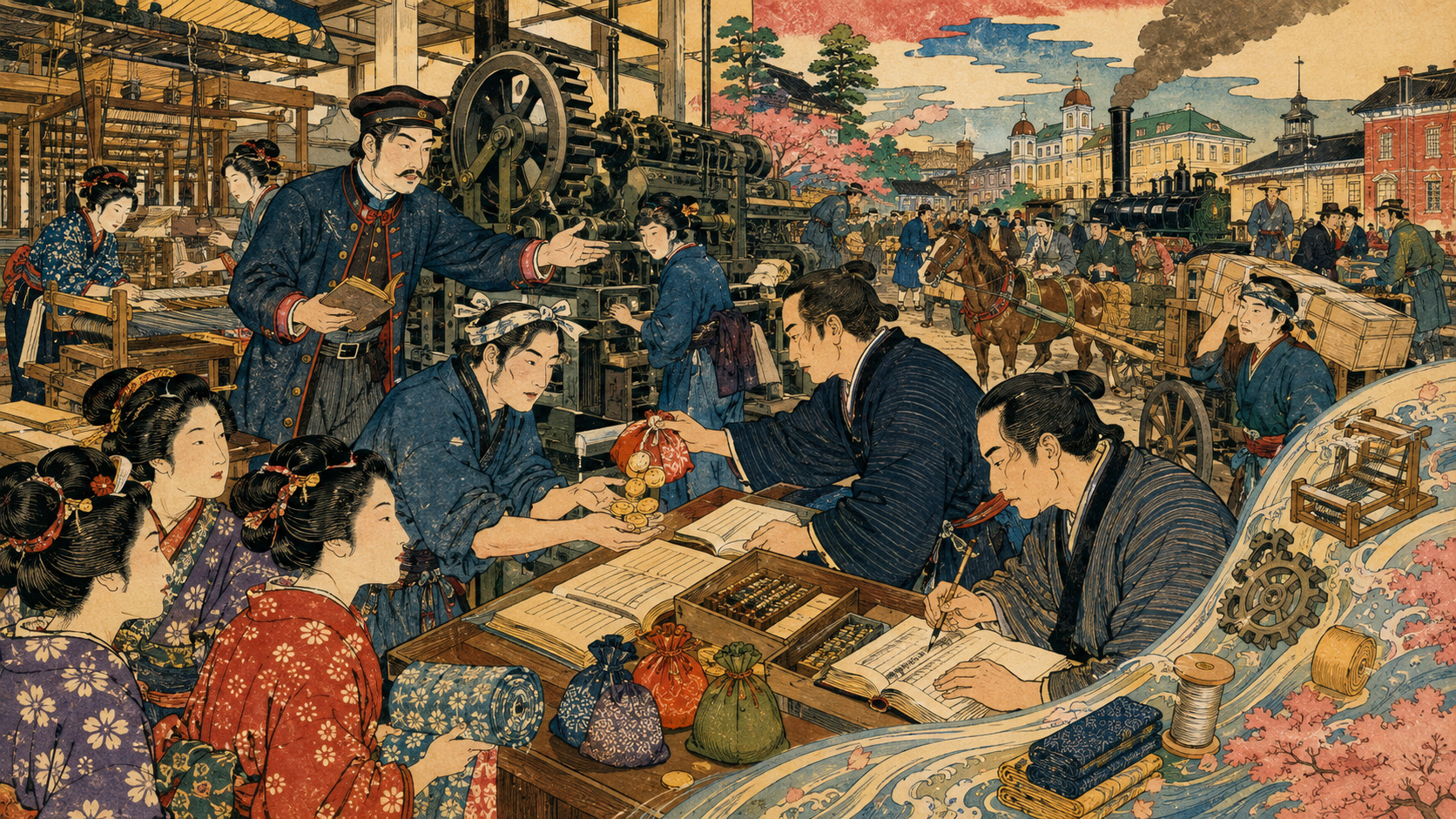
When the Japanese government issued its first Economic Survey in 1947, the country was measuring scarcity. Cities were burned, prices were surging, and food, coal and industrial materials were short. The report—later counted as the first in the economic-white-paper series—described households, companies and the state as all running deficits. Trains could exist without enough fuel; factories without raw materials; higher wages without greater purchasing power. Statistics turned postwar deprivation into a national diagnosis.
Seventy-nine years later, on July 24, 2026, the Cabinet Office released the 80th annual report. Its subtitle, translated here as “Challenges toward a full-fledged transition to a growth-oriented economy,” sounds removed from the ruins of 1947. Japan now has low unemployment, strong aggregate corporate profits and labor shortages across much of the country. Yet the new paper revolves around questions that echo the first one. When pay rises on paper, are households truly better off? When companies have money, does it become equipment, software, research and more capable workers?
The white paper’s answer is neither triumph nor doom. Wages and prices, frozen by long deflationary habits, are moving again. But the bridge from motion to lasting growth is still narrow. That bridge is productivity.
A white paper is a diagnosis, not a prophecy
Japan’s economic white papers do more than forecast a business cycle. They select the data through which the government understands the country, identify causal chains, and put a name to each era’s central difficulty. Read in sequence, their titles form an intellectual history of postwar Japan.
The 1956 paper produced the series’ most famous line: “The postwar period is over.” Often remembered as a declaration of victory, it was closer to a warning. Recovery to prewar output levels could no longer be the engine. Further growth would require modernization. Between 1955 and 1972, real growth averaged 9.3% as imported technology, an educated workforce, mass production, urbanization and high investment offered a legible route for catching up.
The 1973 oil shock bent that route. The 1975 paper searched for a “new stable-growth path.” The 1993 edition, “Lessons of the Bubble and Challenges for New Development,” examined the extraordinary social cost left by an asset boom. After the 2001 government reorganization, the publication became the Annual Report on the Japanese Economy and Public Finance, and “No growth without reform” became the era’s slogan.
More recently, the 2023 paper observed that “prices and wages began to move.” The 2024 edition looked toward “a vibrant new economic stage.” In 2025, the stated objective became a growth economy initiated by wage increases. The phrase “full-fledged transition” in 2026 carries a deliberate qualification: Japan may have entered the crossing, but it has not reached the other side.
The 5.01% headline, opened up
The brightest figure in the report is 5.01%. That was the final average pay increase in the 2026 spring labor negotiations, including regular increments. Unions at companies with fewer than 300 employees achieved 4.69%. Hourly pay for short-time workers rose 6.18%. The importance is not simply that major manufacturers granted another large raise, but that the movement spread further into smaller employers and hourly work.
Still, 5.01% does not mean every worker’s base wage increased by that amount. After removing regular increments linked to age or tenure, the base-pay increase was about 3.50% overall and 3.51% among smaller unions. That smaller-company base increases nearly matched the overall result matters greatly. Small and midsize businesses employ roughly 70% of Japan’s workers; without them, wage growth cannot restore consumption across the country.
Total nominal cash earnings were rising at around 3% year on year. During much of 2025, inflation outran those gains and real wages contracted. In early 2026, continued pay growth and easing inflation finally pushed real wages into positive territory. In May, Japan’s headline consumer-price index rose 1.5% from a year earlier; the index excluding fresh food rose 1.4%, and the measure excluding fresh food and energy rose 1.8%. Because government measures held down fuel costs, the white paper looks across multiple indicators before declaring a change in the underlying trend.
For households, the distinction is the difference between a larger number and a better life. If prices rise faster than pay, a worker can earn more yen and buy less. Positive real wages are therefore a meaningful turn. But a month or two does not establish a regime. Another jump in imported energy or food costs, amplified by a weak yen, can quickly remove the gain.
- Nominal wage: The yen amount on the pay statement. It was growing around 3% in 2026.
- Real wage: Purchasing power after changes in consumer prices. It moved from contraction in 2025 to growth in early 2026.
- Negotiated wage increase: The rate agreed in labor talks, often including regular increments. It must be distinguished from the base-pay increase.
Why productivity is the bridge
A company has to keep paying wages from the value it sells. Subsidies and one-time bonuses can buy time, but they cannot become a permanent pay base. Over the long run, real wages rise when an hour of work produces more value, when companies can charge appropriately for that value, and when the resulting profits return to workers, equipment, skills and research.
Japan’s potential-growth rate shows why that bridge is fragile. In the white paper’s international comparison, average potential growth over the six years from 2020 was 2.4% in the United States, 1.3% in France, 1.2% in Britain and 0.7% in Germany. Japan was about 0.4%. Greater participation by women and older people softened the demographic drag, but participation rates cannot rise forever. Capital deepening and total factor productivity will have to carry more of the next stage.
The report therefore studies corporate balance sheets. Japanese firms built cash buffers in response to the rational lessons of the bubble collapse, the banking crisis, deflation, disasters and the pandemic. But caution can reproduce the low growth it protects against. Money that does not become research, labor-saving equipment, digital systems or worker capability adds resilience without necessarily expanding productive capacity.
Some of the productivity gap is mundane. A company owns machinery it cannot operate because it lacks people. An employee compensates for obsolete equipment. The same customer data is retyped between paper, a spreadsheet and an aging internal system. Add those frictions across millions of workdays and they become a macroeconomic problem.
Investment is not limited to a new semiconductor plant. It can be a hotel automating reservations, a retailer forecasting demand, a logistics company improving dispatch, or a machine shop sharing design changes instantly. Each changes the value created in an hour. The 2026 white paper argues for predictable, long-horizon public and private investment because stop-start policy encourages firms to wait.
But “productivity” must not become a polite synonym for fewer employees. If the benefit of faster work flows only into margins and retained cash, domestic demand does not broaden. Efficiency becomes inclusive growth only when some of its value appears in pay, training, safer work or shorter and more flexible hours. The report finds that companies often rank better treatment of employees at least as highly as capital spending when deciding where funds should go. People and equipment belong in the same investment plan.
AI’s paradox: faster tasks, but a shorter working day?
The white paper’s most contemporary analysis treats artificial intelligence not as magic but as a question of workplace design. In the establishment survey it cites, 31% of workplaces had introduced AI by February 1, 2026. Among adopters, 78% reported benefits. Of those seeing benefits, 91% cited lower burdens or greater efficiency. Generative AI reduced task-completion time by an average 16.7%.
Yet only 25.4% of workers said their total working time had fallen. Frequent AI users even tended to report more overtime. The reason is intuitive: saved time is filled with new assignments, expected output increases, and generated work requires checking and revision. A technology may save an hour, but an organization can immediately occupy it again.
This is an old productivity paradox in new clothing. Technology expands the set of possible outcomes; it does not distribute them. Management and labor decide whether a saved hour becomes additional output, customer attention, training or rest.
Workers do not all want the same result. In the report, 33.9% wanted fewer working hours, while 7.2% wanted more. For people balancing children, elder care, health or education, flexibility within regular employment can matter more than the old binary of full-time permanent work versus nonregular work. Long hours are also associated with lower satisfaction with health. AI should therefore be judged not only by adoption or prompts, but by three outcomes: value, pay and time.
“Labor shortage” is not one shortage
An average active job-openings-to-applicants ratio of 1.18 hides very different markets. Construction, care work, driving, hospitality, medicine and parts of manufacturing have far more openings than applicants, while clerical work can attract a surplus of job seekers. “Japan has no workers” is too crude. Pay, skills, place, schedule and expectations do not match.
The white paper’s analysis suggests that offering wages 10% higher, providing parental-leave arrangements, and supporting training or qualifications all increase the probability of filling a vacancy. The gap will widen between employers that merely say they cannot recruit and those that redesign a job until someone can rationally accept it.
There is another constraint: local employer power. The report finds a relationship between fewer employers in a labor market and lower pay. When workers have little choice, employers gain wage-setting leverage. Long commuting times divide a region into smaller labor markets and strengthen that leverage. Remote work is no cure-all, but it can widen geography—connecting a rural worker to an urban job and an urban company to talent it otherwise could not reach.
Labor scarcity is therefore both pain and pressure. As the model of filling vacancies with low pay and long hours stops working, companies must automate, improve pay, charge enough for their service, invest in skills and offer flexibility. If the transition succeeds, scarcity raises productivity. If it fails, supply constraints close services, limit output and deepen regional inequality.
An economy that can raise prices—and one that only raises prices
Under deflation, Japanese companies struggled to pass higher costs to customers. To protect margins they compressed wages and investment, weakening demand and making the next price increase even harder. The 2026 paper sees that pattern changing. Price pass-through is faster than it was in 2022 among both large and small companies. Firms expecting mild inflation also tend to be more willing to invest.
But raising prices is not itself growth. Passing imported costs directly to households without improving the product, service or wage simply moves real income. The needed cycle is more demanding: fair price pass-through protects margins, those margins finance pay and capacity, better productivity supports value, and stronger real income supports demand. Fair dealing matters because a large buyer that refuses a supplier’s higher price can block that cycle before it reaches a local employer.
This is why the white paper distinguishes an economy that is “not clearly in deflation” from one that has completed a durable exit. Higher prices alone are insufficient. The output gap must improve sustainably, wages and prices must rise on a continuing basis, and the economy must not be poised to fall back. Imported inflation that makes households poorer must not be mistaken for healthy demand.
| Measure | 2026 benchmark | What it means—and does not mean |
|---|---|---|
| Spring wage increase | 5.01% | Includes regular increments; not a universal 5% base-pay raise |
| Base-pay increase | About 3.50% | Raises the wage scale itself; 3.51% among smaller unions |
| Short-time workers | 6.18% | Hourly pay increase, a clue to diffusion among lower-paid work |
| May 2026 CPI | Headline 1.5%; core 1.4% | Includes effects of fuel-price measures; underlying inflation needs several gauges |
| Potential growth | About 0.4% | Six-year average since 2020, not the actual growth rate in one year |
| AI adoption | 31% of workplaces | Use, not automatic improvement in profit, wages or work time |
Eighty reports, a changing Japanese economy
1947 The first Economic Survey makes inflation, food, production, trade and employment legible amid postwar scarcity.
1956 “The postwar period is over”: recovery gives way to modernization-led growth.
1975 After the oil shock, policymakers search for a new stable-growth path.
1985 On the eve of sharp yen appreciation, the report reviews 40 postwar years and structural change.
1993 “Lessons of the Bubble” examines the cost of the collapse in asset prices.
2001 Renamed the Annual Report on the Japanese Economy and Public Finance; “No growth without reform.”
2023 Prices and wages “begin to move” after the long deflationary era.
2025 Wage increases become the stated starting point for a growth-oriented economy.
2026 The 80th report asks what AI, people, investment and pricing must do to complete the transition.
The chronology shows why there is no permanent prescription. When labor was abundant and capital scarce, more factories could drive growth. After the oil shock, energy efficiency and industrial change mattered. After the bubble, bad-debt disposal and institutional repair took priority. Today the population is shrinking, labor is scarce, and many companies have funds. The question is less “How much can Japan add?” than “How productively can it use the people, time and capital it already has?”
The cycle has to work inside small companies
Japan cannot complete this transition inside Tokyo’s largest corporate headquarters. Small and midsize enterprises employ about seven in ten workers and sustain local construction, care, logistics, tourism, retail and manufacturing. The separate 2026 Small and Medium Enterprise White Paper also notes that pay increases are at their highest in nearly 30 years, while warning that productivity is essential under a tightening labor-supply constraint.
The constraint is investment capacity. A large company may be able to raise wages and automate at the same time. A supplier or local shop operating on a thin margin may be forced to choose one. Better price pass-through, fairer transactions, business succession and mergers, and support for digitalization and AI can loosen the trade-off. The government has also set a goal of raising productivity investment by smaller firms to ¥60 trillion over five years.
Buying a machine with a subsidy is not enough. If the workflow is unchanged, data remains fragmented and nobody can use the new system, the equipment becomes an expensive object. Productive investment includes what management stops doing, what employees learn, and what value customers will pay for. It is organizational change, not procurement alone.
What to watch before the 81st report
The success of the 2026 story can be judged through a few linked outcomes. Nominal pay should exceed inflation consistently. Wage gains should spread from large to small companies, from permanent to hourly employees, and from metropolitan centers to regions. Capital spending should raise value added per hour, not merely replace worn equipment. And when AI makes work faster, some of the gain should return to workers as pay, skill or time.
The warning signs are equally clear. Imported inflation from oil or a weak yen could erase real-wage gains. Five-percent settlements could narrow to a small group of employers. Profits won through price increases could remain as cash. Labor shortages could be covered by more overtime. Under those conditions, “growth-oriented economy” would become a new label for an old stagnation.
A white paper is a map for an argument, not the end of one. Government has to make multiyear public investment predictable while strengthening competition, fair dealing, training and social security. Companies have to connect price increases and profits to wages and productive capacity. Labor unions have to look beyond a headline rate and extend gains to young, nonregular and care workers.
The 1947 report counted what Japan lacked. The 1956 edition asked what the country should build after recovery. The 80th report is also counting something less visible: the time during which money, people and technology remain underused.
Japan has started raising wages. Now productivity must support the promise, and households must receive productivity’s gains. Seventy years after “the postwar period is over,” the next historic phrase will not be proved in a government report. It will appear on pay statements, in working hours, in the equipment of a small factory, and in what a family can put in its shopping basket.
Reporting notes and principal sources
This article uses public information checked through August 7, 2026, 9:02 a.m. JST. The 2026 white paper itself is based primarily on data available through July 1. English renderings of its 2026 title and section descriptions are Japan.co.jp translations, not an official Cabinet Office English edition.
- Cabinet Office: FY2026 Annual Report on the Japanese Economy and Public Finance
- Cabinet Office: 2026 white-paper presentation
- Cabinet Office: complete 2026 white paper
- Cabinet Office: 2026 white-paper conclusion
- Cabinet Office: official English white-paper archive
- Cabinet Office: historical Japanese white-paper archive
- Economic Stabilization Board: 1947 Economic Survey
- Economic Planning Agency: the 1956 “postwar period is over” passage
- Economic Planning Agency: 2000 review of high growth
- Economic Planning Agency: 1985 review of 40 postwar years
- Economic Planning Agency: 1993 “Lessons of the Bubble”
- Cabinet Office: 2018 retrospective on the eras recorded by white papers
- METI: 2026 Small and Medium Enterprise White Paper
- Cabinet Office: Monthly Economic Report, April 2026
- Prime Minister’s Office: SME productivity investment and real-wage goals