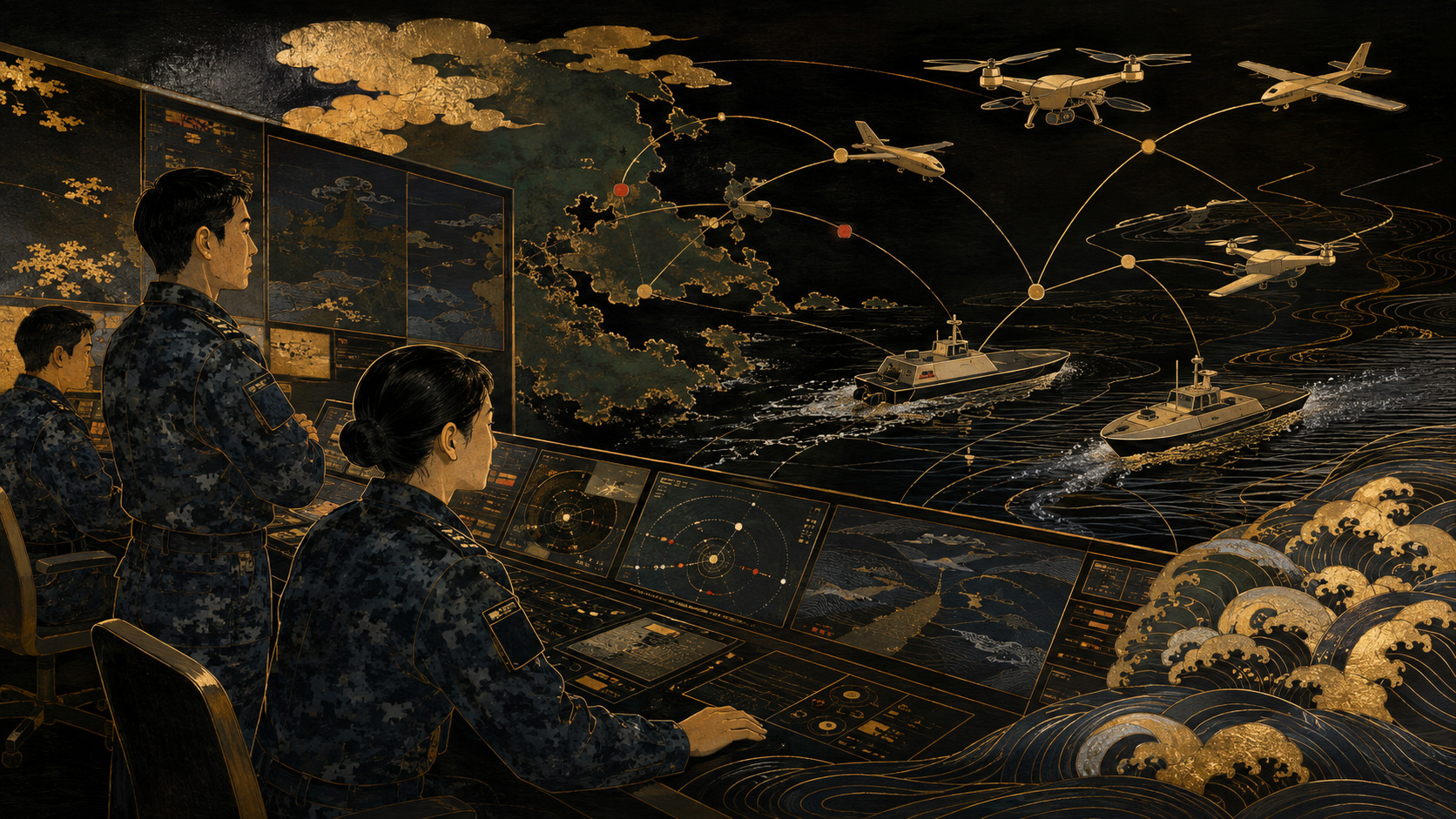
Japan's fiscal 2027 defense request is designed as a network, not merely an arsenal. An uncrewed aircraft detects activity at sea. A protected communications system carries the data. Artificial intelligence helps classify what the sensors found. A human command structure decides what to do, while crewed or uncrewed platforms—and, potentially, a long-range missile—provide the response. The Defense Ministry's record bid seeks to build every link in that chain at once.
The widely reported top line is approximately ¥8.9 trillion, about $55.7 billion at the exchange rate displayed on this page. In its August 31 request overview, the ministry rounds current Defense Buildup Program spending to “about ¥9 trillion” on an expenditure basis and new commitments to “about ¥8 trillion” on a contract basis.
Neither number is complete. Programs affected by the government's early revision of its three national-security documents were submitted as jikō yōkyū—item-only requests with no amount. Some costs related to the 1996 Special Action Committee on Okinawa agreement and the realignment of U.S. forces are also unpriced. The Cabinet's eventual draft can therefore exceed the headline figure even if the Ministry of Finance trims other lines.
A bridge between two defense plans
The request lands at an unusual policy junction. Japan's 2022 National Security Strategy, National Defense Strategy and Defense Buildup Program launched a five-year expansion of approximately ¥43 trillion for fiscal 2023 through fiscal 2027. They also established a counterstrike capability, greatly expanded stand-off defense and made resilience—from ammunition stocks to hardened facilities—a central requirement.
Fiscal 2027 is the final year of that program. The original plan anticipated annual defense spending reaching roughly ¥8.9 trillion by then. The new request therefore arrives close to a destination set four years earlier, rather than appearing as an isolated one-year surge.
But the government is also revising all three documents ahead of schedule. The assessment of the security environment, the force structure, the next investment horizon and its financing are still being negotiated. Projects that could be reshaped by that review lack prices in the request. Fiscal 2027 is simultaneously the closing installment of one plan and the first down payment on another whose boundaries are not public.
December 2022: Japan adopts the three security documents, a roughly ¥43tn five-year buildup and a counterstrike capability.
FY2023–FY2025: Initial-budget spending under the program rises from about ¥6.6tn to ¥7.7tn and then ¥8.5tn.
FY2026: Program expenditures reach ¥8.8093tn; ¥100.1bn is budgeted for the coastal SHIELD uncrewed-defense architecture.
August 31, 2026: The ministry releases its fiscal 2027 bid: about ¥9tn plus multiple item-only requests.
Toward December: The security-document revision and Cabinet budget process are expected to assign priorities and prices.
From individual drones to an uncrewed force
The ministry's ambition is unusually direct. Its Japanese request says uncrewed assets should limit personnel losses and deliver a cost advantage, and sets the goal of transforming the Self-Defense Forces into an organization that uses such systems more extensively than any other. The hardware list shows that this is not a single “drone program.” It spans the air, surface, subsurface and ground domains, and includes surveillance, targeting, attack, interception, transport and research.
The largest disclosed acquisition is 17 MQ-9B SeaGuardian long-endurance uncrewed aircraft, with a ¥292.2 billion contract value plus an item-only request. Other bids include ¥3.6 billion for small shipborne aircraft, ¥8.7 billion for medium-range vertical-takeoff-and-landing aircraft and ¥11.3 billion for target-information collection drones.
Offensive and defensive roles sit side by side. Small attack UAVs carry ¥36.3 billion plus an unpriced component; interceptor UAVs carry ¥7.6 billion plus an unpriced component. Ship-launched attack UAVs and a low-cost stand-off UAV are item-only requests. A small multipurpose uncrewed ground vehicle has ¥9.5 billion plus an item-only component. Research into a module that could launch a stand-off missile from an uncrewed underwater vehicle is unpriced.
The counter-drone layer is equally important. Japan is seeking a short-range air-defense system called CRADS that would combine missiles, guns and lasers; it is item-only. Testing for a shipboard laser is listed at ¥4.7 billion. A high-power microwave demonstration remains unpriced, while countermeasure equipment for bases carries ¥3.8 billion plus an item-only request. The design problem is economic as well as tactical: an expensive interceptor used against a low-cost drone gives the attacker a favorable exchange even when the defense succeeds.
Some projects have already crossed from concept to implementation. The fiscal 2026 budget included ¥100.1 billion for SHIELD, a layered coastal-defense architecture using uncrewed systems, with completion targeted during fiscal 2027. According to the new request, mass-production contracts for a Type I small attack UAV and test contracts for a Type I multipurpose uncrewed surface vessel were signed in March 2026. Tactical research on shipborne UAVs began that month. The new money would help move the concept from trials toward fielded formations.
The AI layer has no total price
The request assigns artificial intelligence seven roles: detecting and identifying targets; collecting and analyzing information; command and control; logistics; uncrewed systems; cybersecurity; and administrative efficiency. The ministry also presents AI as a response to population decline and personnel shortages.
At the center is a decision-support system for Japan's Joint Operations Command and a next-generation platform called the AI Orchestrator. The concept is to control multiple models and select among them according to the difficulty and sensitivity of a task, while retaining Japanese control of highly classified data. A proposed high-classification sovereign cloud and a reinforced Defense Information Infrastructure, or DII, would provide the protected computing and communications environment.
The DII line carries ¥47.8 billion plus an item-only component. The decision-support system, AI Orchestrator and classified cloud are item-only requests. Supply-demand forecasting has ¥300 million plus an item-only component, and research on an uncrewed aircraft that could collaborate with Japan's future fighter has ¥9.7 billion plus an unpriced component.
That disclosure pattern supports two conclusions—and no more. AI is a prominent operational priority, but the published request does not permit a complete AI spending total. And the ministry describes these systems as improving analysis and supporting decisions; the document does not say that software will independently decide when force is used. Rules for human control, model testing, false identification, cybersecurity and accountability remain oversight questions, not details that can be inferred from the equipment list.
Missiles complete the chain
Japan's stand-off program is intended to respond from beyond an adversary's effective range. The fiscal 2027 list includes ¥56.2 billion for the ship-launched improved Type-12 surface-to-ship missile, ¥34.5 billion for the air-launched version, and ¥157.5 billion plus an item-only request for the Type-25 surface-to-ship missile and its ground equipment.
Acquisition and ground systems for a hypersonic guided missile carry ¥167.3 billion plus an unpriced component; a separate development line has ¥14.2 billion plus an unpriced component. The portfolio also includes a high-velocity gliding projectile, a submarine-launched variant and lower-cost stand-off weapons. Several of these lines remain partly or wholly unpriced.
Imported weapons remain part of the mix. Japan requests ¥18 billion for the Joint Strike Missile, ¥5.3 billion plus an item-only component for JASSM, and ¥1.1 billion plus an unpriced component to integrate Tomahawk cruise missiles with Aegis destroyers. A further ¥12.8 billion would integrate the air-launched improved Type-12 with ten F-2 aircraft.
Under the government's stated interpretation, counterstrike capability may be used only after an armed attack has occurred, when there is no other appropriate means, and only to the minimum extent necessary for self-defense; it is not authority for a preemptive strike. That is the government's legal and policy position. Operational accountability still requires answers about how targets are verified, how civilian harm is assessed, who authorizes action and how Japan divides responsibilities with the United States.
Missile procurement also exposes why a platform-only price is inadequate. A long-range weapon depends on timely target information from satellites, aircraft or ships; resilient networks; trained units; magazines; maintenance; and replacement stocks. The full cost lies in the chain, not in the missile line alone.
The less visible half: concrete, production and people
The request's largest disclosed project lines are not all weapons. Renewal of aging facilities carries ¥549.5 billion plus item-only costs. Undergrounding principal command functions has ¥54.8 billion plus an unpriced component. Ammunition-depot construction carries ¥140.1 billion plus an item-only component, while facilities for new units and equipment carry ¥333.4 billion plus unpriced costs.
The logic is resilience. Aircraft and missiles cannot operate if runways, power, fuel, communications or storage are disabled. Dispersal, rapid repair and hardened facilities turn procurement into a capability that can survive first contact. They also produce local effects—from construction and land use to safety and environmental concerns—that require explanation outside the national headline.
Japan is also attempting to reinforce the companies behind its equipment. The request lists ¥53.9 billion for the defense production base and ¥40 billion for a fund supporting equipment transfers. Government-owned, contractor-operated manufacturing facilities and investment in defense-industry reorganization are item-only requests. So are new research links with national institutes and universities, defense-oriented small-business innovation programs, and startup investment.
Public support can preserve critical suppliers that commercial demand alone will not sustain. It can also socialize private business risk. The December review should explain which capabilities are genuinely irreplaceable, what performance taxpayers receive, and how competition and audit will work when secrecy narrows ordinary disclosure.
Personnel policy rounds out the request: pay reform, food, shipboard living conditions, facilities for women, and support for retiring SDF members and their families. The ministry is studying a tentatively named agency for former personnel and family support. Automation changes the work rather than eliminating it; operators, maintainers, cyber specialists, intelligence analysts and commanders remain necessary. Japan's demographic constraint makes workforce design part of the weapon-system design.
Six examples—and six disclosure limits
The table below uses project figures published by the Defense Ministry. Unless noted, they are contract-basis values and may commit payments across several fiscal years. They are evidence of scale, not components to add mechanically to the annual request.
| Capability | Selected project | Published scope | What remains unresolved |
|---|---|---|---|
| Persistent surveillance | MQ-9B SeaGuardian | 17 aircraft; ¥292.2bn | Additional item-only request; contract value is not one-year expenditure. |
| Attack and interception | Small attack UAV / interceptor UAV | ¥36.3bn + item / ¥7.6bn + item | Parts of quantities and configuration are not settled in the public overview. |
| AI and command | Decision support, AI Orchestrator, classified cloud | Item-only requests | No central-system price, so a complete AI total cannot be calculated. |
| Secure networks | Defense Information Infrastructure | ¥47.8bn + item | Total network-and-cloud program cost remains open. |
| Long-range strike | Hypersonic missile acquisition and ground systems | ¥167.3bn + item | Separate development line: ¥14.2bn + item. |
| Base resilience | Renewal of aging facilities | ¥549.5bn + item | Nationwide work with payments extending into future years. |
Japan.co.jp analysis: five tests for the December budget
- A complete bridge: Reconcile annual expenditures, contract commitments, item-only pricing and future-year payments in one disclosure.
- Human control: Define who approves the use of AI-assisted information and uncrewed systems, and who is accountable when they fail.
- A functioning chain: Demonstrate that sensors, networks, munitions, maintenance and trained personnel will arrive on compatible schedules.
- Whole-life affordability: Publish credible operating, training, upgrade and replacement costs—not acquisition prices alone.
- Democratic oversight: Give the Diet and auditors enough information to test value for money while protecting genuinely sensitive data.
What ¥8.9 trillion cannot tell us
The first missing number is the value of all item-only requests after the strategic review. The central AI architecture, some ships and aircraft, low-cost stand-off weapons and several uncrewed systems still lack complete prices. The second is Japan's total future obligation under new multi-year contracts. A single fiscal-year appropriation can look manageable while locking in maintenance and payments far beyond 2027.
The third is the financial path after the current ¥43 trillion program ends. Exchange rates, inflation, wages and imported components can raise the cost of holding capability constant. Expanding the force faster would require a durable revenue decision as well as a strategic one.
Japan's request makes the direction unmistakable: it wants to compensate for demographic pressure and a demanding maritime environment with uncrewed mass, faster information processing and longer reach. The ministry has described the architecture. It has not yet disclosed its final price or completed the rules that will govern it. Those two tasks—not the record alone—will determine whether the wager is credible.
Sources and documents
- Ministry of Defense: Fiscal 2027 budget request overview, August 31, 2026 (Japanese PDF; principal source for totals, priorities and projects)
- Ministry of Defense: Annual budget overviews (Japanese)
- Ministry of Defense: Fiscal 2026 budget overview (Japanese PDF; source for ¥8.8093tn program spending and ¥100.1bn for SHIELD)
- Ministry of Defense: The three strategic documents (Japanese and available translations)
- Ministry of Defense: Expenditure under the Defense Buildup Program (Japanese; source for the approximately ¥43tn five-year level)
- Ministry of Defense: Defense of Japan 2026 (security environment and early strategic-document revision)
- Ministry of Defense: Explanation of counterstrike capability (Japanese)
- Ministry of Finance: Fiscal 2023 defense budget background (Japanese; history of the ¥43tn buildup and intended FY2027 level)
- Cabinet-approved basic policy for fiscal 2027 budget requests (MOF; Japanese PDF)
- Associated Press: “Japan requests record defense budget emphasizing drones and AI”, August 31, 2026 (source for the reported ¥8.9tn rounded figure)
Reporting was checked against material available by 5:30 AM JST on September 1, 2026. Official Japanese organization names, equipment names, policy terms and the ministry's statement on uncrewed assets were verified in Japanese primary sources. The Japanese edition was written independently rather than translated from this report. Project figures follow the ministry's published accounting basis and are generally contract values. The ¥8.9 trillion headline is a press-rounded figure; the ministry's overview states “about ¥9 trillion” on an expenditure basis.
Image rights: © 2026 Japan.co.jp. This AI-assisted editorial illustration may not be republished or reused without prior written permission. For licensing, use the contact page.