Fixing carbon into a cell is not the same as removing carbon from the climate system for the long term.
The ocean does not stop working when sunlight disappears
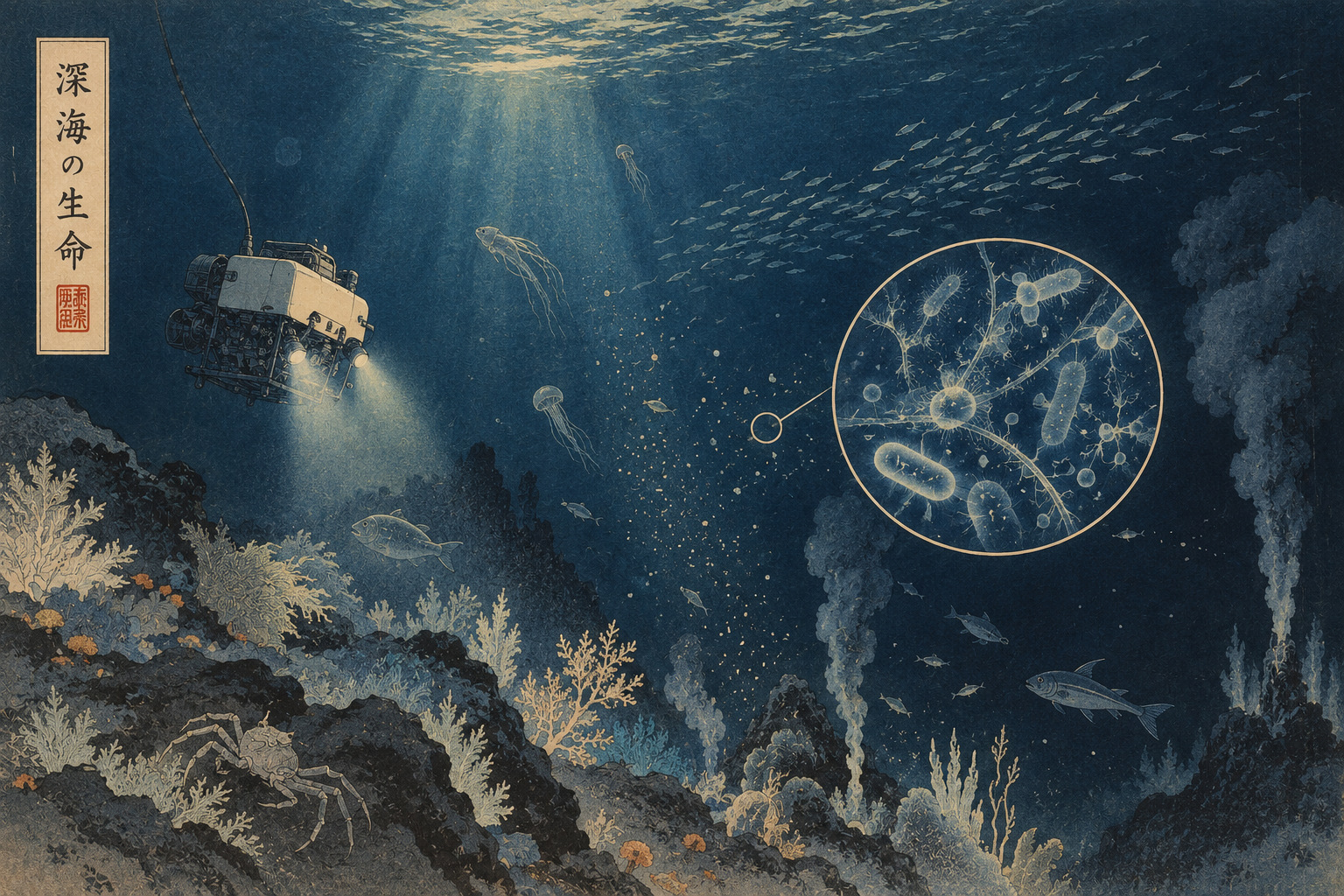
The familiar account of the ocean carbon cycle begins near the surface. Phytoplankton use light to build organic matter, some of which passes through food webs and sinks toward the deep. But far below the sunlit zone, microbes continue to incorporate dissolved inorganic carbon into their own molecules. An international team including Hokkaido University researchers has identified a significant, previously undercounted contributor: bacteria usually described as consumers of organic matter, not primary producers.
An October announcement, a June paper
Hokkaido University announced the research in Japanese on October 14, 2026. Its peer-reviewed paper appeared online in Nature Geoscience on June 15. Associate professor Chie Amano of Hokkaido University’s Faculty of Environmental Earth Science, who conducted the research while a postdoctoral researcher at the University of Vienna, worked with colleagues including Federico Baltar and scientists linked to the University of Vienna and Shanghai Ocean University. The distinction in dates matters: the finding is not a newly published October journal article.
The headline number, properly defined
The researchers estimated that members of the bacterial genus Alteromonas accounted for a median 17% of the dark dissolved-inorganic-carbon fixation assessed in deep-ocean communities. The reported 95% confidence interval is 10–28%. Their approximate global extrapolation was 0.2 petagrams of carbon per year—equivalent to about 200 million metric tonnes of carbon. Neither figure means these organisms capture 17% of humanity’s emissions or permanently store 200 million tonnes of atmospheric carbon annually. Carbon incorporation and durable sequestration are different processes.
How can an organic-matter consumer fix carbon?
The biological distinction is central to the story. Alteromonas is heterotrophic: it relies substantially on existing organic compounds. Yet certain metabolic pathways take dissolved inorganic carbon, including bicarbonate, into molecules a cell needs. These are anaplerotic reactions, which replenish intermediates withdrawn from central pathways such as the tricarboxylic acid cycle. Rather than making the organism a conventional autotroph, this chemistry supports its existing heterotrophic metabolism.
An old biochemical trick gets an ocean-wide measurement
The underlying chemistry is not newly invented. Research dating to the 1960s demonstrated inorganic-carbon incorporation in cultured heterotrophic bacteria. What remained poorly understood was its scale in natural communities, the responsible organisms and the extent to which conventional measurements of dark carbon fixation were mixing different biological processes. The new work advances the question from what can happen in a laboratory to what may matter across ocean basins.
A three-part investigation
First, the scientists interrogated global marine molecular datasets, asking which carbon-fixing enzymes were actively represented in transcripts and proteins. Phosphoenolpyruvate carboxylase, or PEP carboxylase, emerged as an especially important signal in Alteromonas. Next, controlled laboratory incubations of Alteromonas mediterranea demonstrated uptake of radiolabelled bicarbonate into cellular biomass. Finally, the team brought a cell-by-cell method to samples collected in the Atlantic and Pacific oceans, combining microautoradiography with fluorescence-based bacterial identification.
Reading activity one cell at a time
Those field measurements made it possible to identify bacteria that had taken up a carbon tracer and then ask which of them belonged to Alteromonas. Observed contributions varied considerably among locations; the North Atlantic samples generally showed a stronger signal than those from the Pacific. The researchers therefore reported a median with uncertainty rather than claiming that every deep-water region behaves identically. Extrapolating from scattered samples to the entire global ocean remains one of the largest interpretive steps.
A small population with outsized activity
Alteromonas represented roughly 1% of prokaryotic cells on average in the sampled communities, yet accounted for a notable share of the detectable inorganic-carbon-assimilating cells. Abundance, this result reminds us, is not the same as biochemical influence. Fast-growing bacteria that respond to pulses of organic matter, including sinking marine material, may exert an influence greater than their head counts suggest. This helps explain why purely census-based descriptions of microbial life can miss important ecological functions.
Temperature, nutrients and an important denominator
In culture, the contribution of anaplerotic inorganic-carbon incorporation to heterotrophic biomass production ranged from 4.6% to 10.2%. That is not the same measure as the estimated 17% share of field dark carbon fixation. The paper also reports responses to temperature and organic-matter availability, indicating that changing ocean conditions could influence the process. It does not establish a direct forecast of how warming will alter global carbon sequestration.
A second distinction: uptake is not storage
Calling this a new carbon-removal mechanism would distort the evidence. Carbon fixed into bacterial biomass can be respired, consumed or remineralized; it need not remain isolated from the atmosphere over climate-relevant periods. In the reported culture experiments, inorganic-carbon fixation was smaller than respiratory carbon losses. The practical scientific value lies in improving attribution within ocean carbon budgets, not in identifying a ready-made climate technology.
Why the history of deep-ocean research matters
The classic contrast has been between sunlit photosynthesis and dark chemosynthesis, in which certain microbes use chemical energy to incorporate inorganic carbon. This study adds another important player, anaplerosis in organisms dependent on organic food. Earlier work archived at Hokkaido University also examined Alteromonas and the processing of dissolved organic matter. It does not validate this study by itself, but it shows why understanding microbial recycling, not simply identifying a single large carbon sink, is fundamental to ocean science.
What the estimates cannot yet resolve
The single-cell dataset remains limited and dark DIC-positive cells were comparatively uncommon in the observations. The global flux calculation depends on assumptions about per-cell fixation, sample representation and environmental variability. Other heterotrophic groups may also perform anaplerotic fixation, meaning Alteromonas could be only part of a larger accounting problem. Wider sampling across seasons, water masses and depths, plus tighter metabolic measurements, would test the robustness of the extrapolation.
The lesson from the dark water
This is a story about what science has learned to measure. Rather than replacing the standard account of ocean carbon cycling, the research makes it more detailed. A widely distributed heterotrophic bacterium appears to contribute substantially to a process often associated with autotrophic microbes. In the dark ocean, the smallest organisms are continually exchanging and transforming carbon. Understanding their work requires more than finding a spectacular new species: it requires assigning the right amount of carbon to the right biochemical reaction.