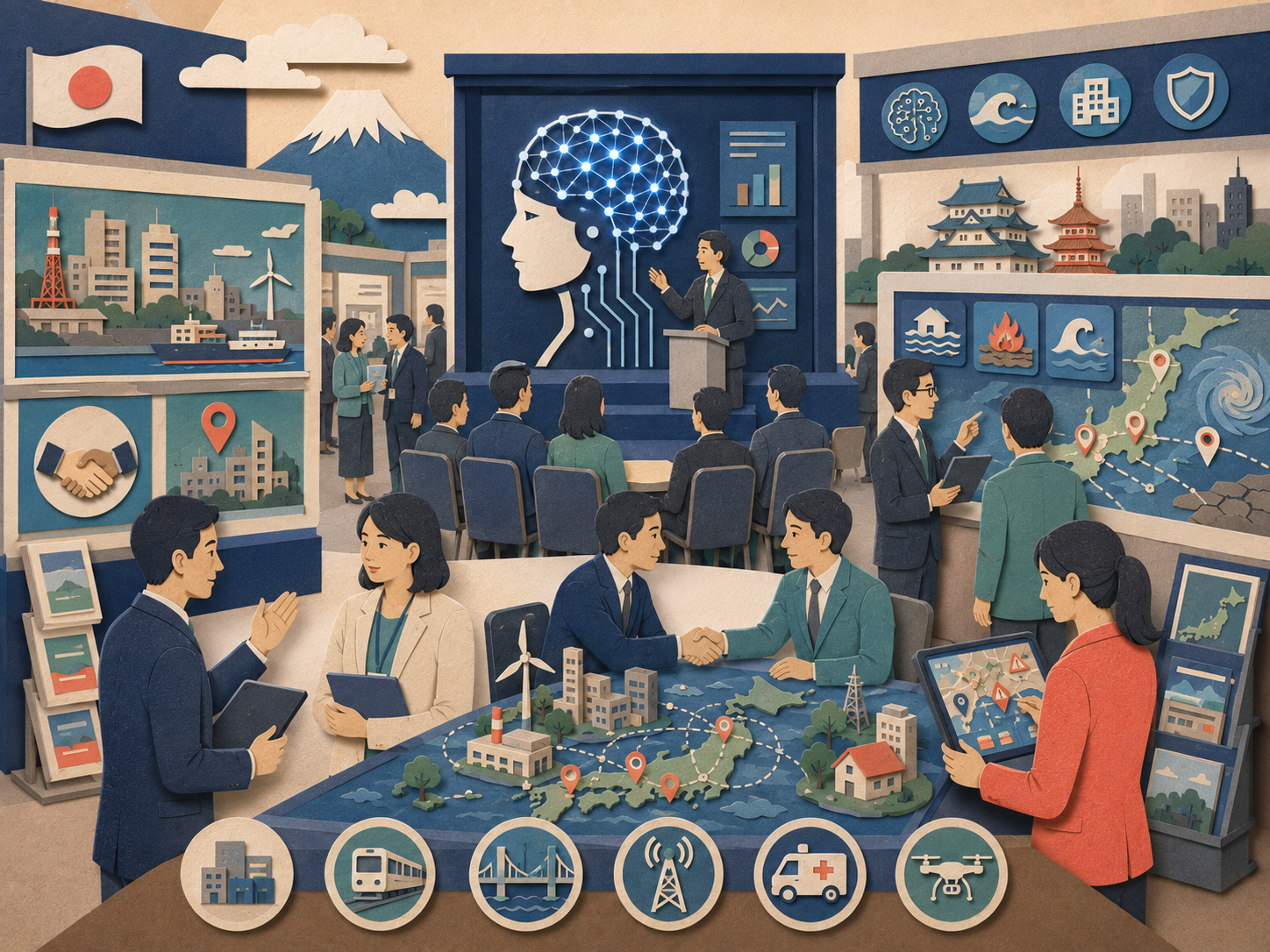
The phrase “corporate location fair” can sound old-fashioned: industrial-park brochures, subsidy charts, prefectural staff in sashes, and a long row of municipal booths waiting for manufacturers to stop by. Those things still exist. But at Tokyo Big Sight’s West Halls 3 and 4 in July 2026, the center of gravity had shifted. Japan’s regions are no longer merely selling space. They are trying to sell the ability to keep a business running — with data, public services, disaster readiness, power, talent and generative AI.
Corporate Location Fair 2026, organized by the Japan Management Association, ran from July 8 to July 10 alongside Local Government Comprehensive Fair 2026. According to the organizer’s announcement, the combined fair featured 168 exhibiting companies and organizations and more than 50 seminars. The program highlighted sessions on generative AI featuring Takayuki Fukatsu of THE GUILD and others, as well as a disaster-DX seminar by the Tokyo Fire Department. On the floor map, corporate location, regional development, internal government management, resident counters, smart city services, safety, welfare and child-focused policy were no longer separate worlds. They were parts of one regional operating system.
That is the story. Corporate location is no longer only a question of where a factory should be built. Data centers need power, cooling and redundant networks. Semiconductor and pharmaceutical plants need water, logistics, skilled workers and business-continuity plans. Tourism and service companies need multilingual digital administration, transit information, payment systems and emergency communication. Local governments are not just offering land and incentives. They are offering trust.
Three changes visible on the exhibition floor
The first change is that corporate location is moving from cheapness to strength. In the past, local governments often led with land price, tax incentives and highway access. Those still matter. But companies now ask harder questions. Can the region secure power? Can it recruit workers? Can it process permits quickly? Can local officials work digitally? Can the municipality handle floods, earthquakes, heat waves, fires and communication outages? Inflation, labor shortages, supply-chain redesign and climate risk have pushed location strategy back into the center of corporate management.
The second change is that generative AI has become a local-government issue. By 2026, generative AI is no longer only a corporate marketing or back-office tool. It is entering the public sector through document drafting, meeting minutes, resident inquiries, policy search, procurement support and emergency information triage. Japan’s Digital Agency has described a large-scale pilot beginning in May 2026 that would give more than 100,000 government employees access to generative AI. Municipalities cannot treat that as someone else’s transformation.
The third change is that disaster DX is turning from a public-service theme into an industrial-infrastructure theme. Japanese companies must plan around earthquakes, floods, typhoons, fires, blackouts and network disruptions. A municipality’s evacuation data, road status, damage assessment, GIS, resident apps and disaster information systems are not only about protecting residents. They are also about keeping factories, logistics bases, hospitals, data centers and tourism facilities operating. Disaster capability has become part of the location offer.
A long history of location policy
Japan’s corporate location policy grew out of postwar reconstruction and high-speed industrialization. During the economic miracle, port access, railways, roads, industrial water and electricity supported coastal heavy-industry belts. Steel, petrochemicals, automobiles and electronics clustered along the Pacific Belt, helping turn Japan into an export powerhouse. But concentration also produced pollution, congestion and regional disparities. National land policy gradually expanded toward industrial redistribution, technopolis planning, regional science clusters and local industry promotion.
In the 1980s and 1990s, many local governments saw factory recruitment as a path to growth. Industrial parks appeared near expressway interchanges, and prefectures competed to bring in manufacturers. After 2000, overseas production, population decline and municipal fiscal pressure weakened the old model. The 2011 Great East Japan Earthquake then forced companies to look at supply-chain vulnerability and disaster exposure in a new way.
Today’s renewed investment in semiconductors, batteries, pharmaceuticals and data centers gives regions another chance. But this opportunity is different from the old industrial-park race. Companies are not simply looking for a large plot. They are evaluating power grids, renewable energy, industrial water, universities, skilled labor, logistics, disaster response and the digital competence of local administration. The presence of generative AI and disaster DX at a corporate location fair is therefore not a gimmick. It is the new logic of location strategy.
Why the local-government fair matters
Corporate Location Fair 2026 was held together with Local Government Comprehensive Fair 2026. That is not just a scheduling convenience. It reflects the fact that corporate recruitment and municipal management are now deeply connected. Local Government Comprehensive Fair targets national and local agencies, assemblies, boards of education, welfare organizations, public corporations, nonprofits and other public-sector stakeholders. Its exhibition categories include internal management, information systems, smart communities, resident services, tourism, safety, welfare and children’s policy.
When a company chooses a region, it does not only look at the plot of land. It looks at housing, schools, healthcare, childcare, public transport, administrative procedures, emergency services and community life. The quality of resident services becomes corporate recruitment power. Conversely, successful corporate attraction can strengthen employment, tax revenue and local services. The two fairs are dealing with a single loop.
The joint setting points to the end of an old separation: administration for residents on one side, economic development for companies on the other. A city hall that uses AI to reduce paperwork can answer corporate inquiries faster. A disaster-DX platform that helps elderly residents evacuate can also support business continuity. Tourism DX can raise visitor satisfaction, local employment and regional brand value. Internal government reform becomes external regional competitiveness.
What generative AI can actually change
The first municipal use of generative AI is unlikely to be a dazzling “future city.” It will be paperwork. Ordinances, subsidy rules, meeting records, resident inquiries, old policy documents, procurement materials, application guidance and internal knowledge search. Japanese local governments operate through dense legal and administrative texts while facing staff shortages. If AI can reduce the time spent drafting and searching, staff can spend more time on resident support and regional planning.
In corporate location work, generative AI could also become practical. When a company asks about land, zoning, subsidies, utilities, transport, labor, universities and disaster risks, officials must gather information across many departments. Traditionally that meant emails, phone calls and manual document searches. If municipal data and public information can be connected safely, AI can speed up the first response. But the key is not the model alone. It is data readiness.
The failures of public-sector AI usually come less from the technology itself and more from data and responsibility design. Old PDFs, inconsistent terminology, department-by-department ledgers, paper processes, personal data, cybersecurity, audit rules and accountability all matter. To use AI well, a municipality must decide what information it has, what can be automated, what must be verified by humans and who is responsible for the final answer. Generative AI is not a magic wand. It is a mirror that shows whether an administration understands its own information.
Disaster DX as a location condition
Japan’s disaster-prevention system has long been considered one of the world’s most developed. Seismometers, tsunami warnings, drills, fire services, neighborhood associations, disaster radios and hazard maps are part of public life. But population aging, severe rain, typhoons, heat waves, aging infrastructure and the memory of the Noto Peninsula earthquake have made the system more complex. In a modern disaster, the challenge is not only to issue an alert. It is to collect data, understand it, distribute it to the right people and coordinate public agencies, companies, hospitals and transport networks.
The Digital Agency says it is promoting the environment for data use in disaster prevention through cooperation between government and the private sector. Disaster DX service maps and public-private co-creation frameworks are designed to help local governments find, procure and deploy better disaster-prevention services and apps. That matters to corporate location. Companies want to know whether roads will be passable, employees can evacuate, logistics can resume, and factories can restart.
That is why a Tokyo Fire Department disaster-DX seminar belongs in the same conversation as corporate location. Fire and disaster expertise in a major city can inform local governments and companies across the country. Industrial parks, logistics hubs, data centers, hospitals, schools, tourist districts and housing areas do not operate separately during an emergency. The region functions — or fails — as a system.
Location competition in the AI era
Generative AI also changes the physical geography of business. AI looks like software, but behind it are data centers, electricity, cooling, networks, semiconductors and maintenance labor. In Japan, regions beyond Tokyo and Osaka may become attractive for data centers if they can provide power, land, cooling conditions, disaster resilience and network redundancy. But simply saying “we have land” will not be enough. Regions must explain the grid, renewable energy potential, communication backup, emergency plans and community acceptance.
At the same time, AI can reduce some disadvantages of distance. Local governments and small companies can use AI to support document drafting, translation, inquiries, design, demand forecasting, tourism guidance and emergency communication. If a rural company can use the same AI tools as a Tokyo corporation, distance becomes a little less punishing. But the benefit requires digital skills, cybersecurity, data governance and smart procurement.
The fair’s deeper message is that regions are competing to become operational platforms. Can a local government offer not only incentives, but a reliable environment for AI-era business? Can it combine power, data, people, resilience and public services? Can companies choose places not only because they are close to Tokyo, but because they are stable, efficient and prepared?
The second act of regional revitalization
Japan has used the phrase “regional revitalization” for years. The demographic reality remains severe. For many municipalities, attracting companies is still essential for employment and tax revenue. But a new plant or office does not automatically revive a region. The company must connect to schools, universities, local suppliers, housing, transport, culture and disaster systems.
That is why Corporate Location Fair 2026 feels like the second act of regional revitalization. The first act was about bringing jobs to the regions. The second is about building regional functions. AI-ready administration. Disaster-resilient communities. Strong links to research institutions. Places where young people can learn, work and live. Public services that can support foreign workers and visitors. Only by combining these functions can a region become a place where companies put down long roots.
The hard part is that no municipality can build everything alone. A small town cannot maintain a giant DX department by itself. That is why exhibitions, public-private co-creation, joint procurement, regional cooperation, cloud services, standardization and AI guidelines matter. The future of the regions may depend less on a single town winning alone and more on whether regional blocs can share capability.
Reader guide
| Item | Meaning |
|---|---|
| What happened | Corporate Location Fair 2026 and Local Government Comprehensive Fair 2026 ran together at Tokyo Big Sight from July 8 to 10. |
| Scale | The organizer announced 168 combined exhibitors and more than 50 seminars. |
| Key themes | Generative AI, disaster DX, business continuity, regional promotion, municipal management and smart communities. |
| Why it matters | Corporate location is shifting from land-and-subsidy competition to competition over regional capabilities: power, data, talent, disaster resilience and administrative speed. |
| Japan.co.jp view | The next phase of regional revitalization is not only attracting companies; it is designing places where companies can keep operating through technological and environmental shocks. |
Sources and reference material
This article draws on Japan Management Association announcements for Corporate Location Fair 2026 and Local Government Comprehensive Fair 2026, official exhibition pages, Digital Agency materials on generative AI and disaster DX, Japan’s public-private disaster DX framework, and research on AI in disaster response.
- Japan Management Association / PR TIMES: venue map, 168 exhibitors and more than 50 seminars.
- Corporate Location Fair 2026 official site: dates, venue and registration information.
- Local Government Comprehensive Fair 2026 official site: exhibition scope and target audience.
- Digital Agency: government generative-AI pilot and administrative digital-policy context.
- Digital Agency: disaster-prevention data use and public-private collaboration.
- Public-Private Co-Creation Council for Disaster DX: disaster-data collaboration framework.
- AI and Generative AI Transforming Disaster Management: research background on AI for disaster response.