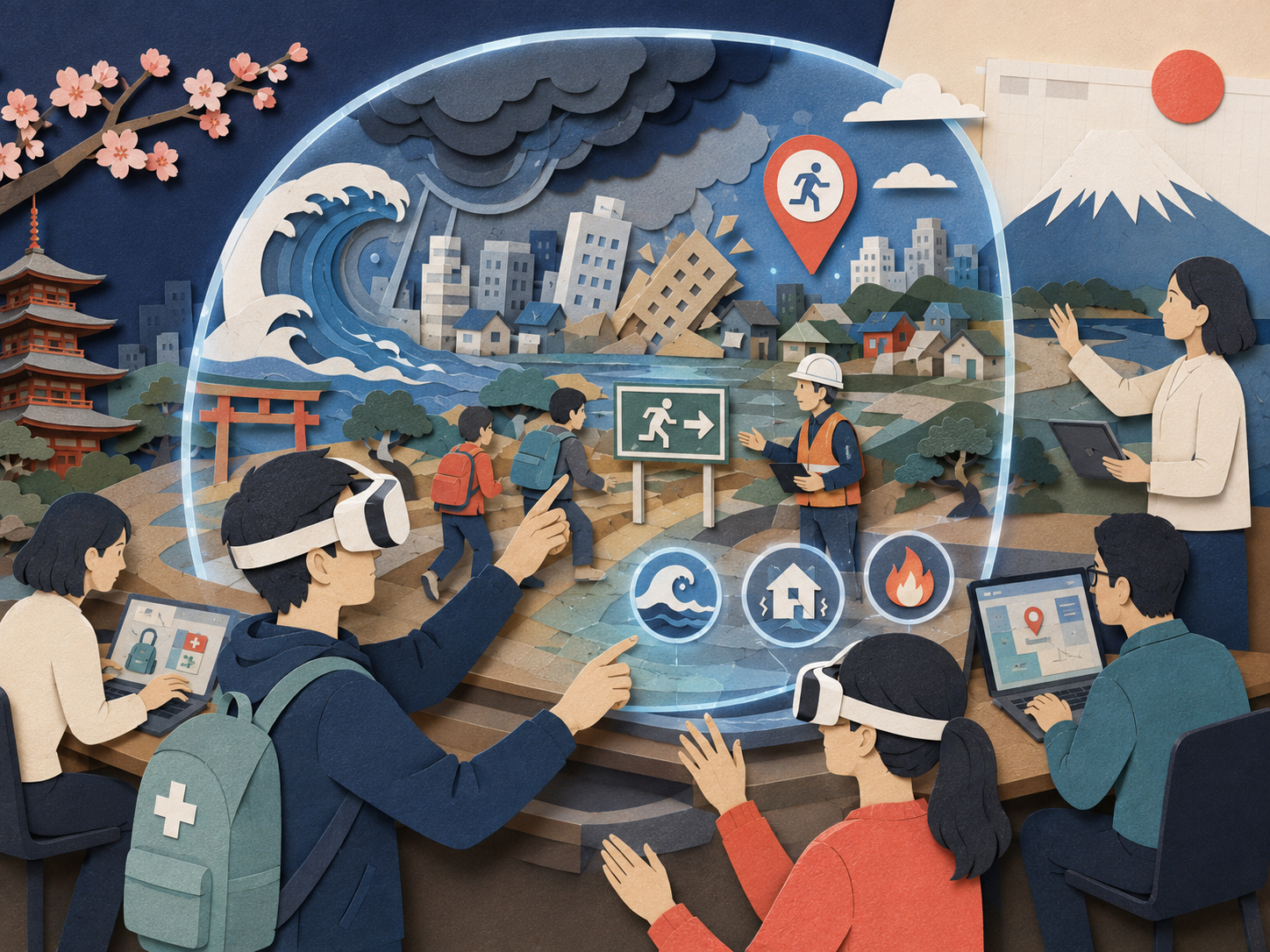
For decades, Japanese disaster training has had a familiar grammar: assemble in the yard, listen to instructions, practice evacuation, hold a fire extinguisher, check the emergency kit, go home with a pamphlet. It is one of the quiet habits of life in an earthquake-and-typhoon country. But in the summer of 2026, another doorway is opening. Fire, smoke, sprinklers, emergency buttons, stored supplies, evacuation choices and preparedness messages are moving into a space where avatars walk, talk and play.
HIKKY’s Virtual Market 2026 Summer, one of the world’s largest metaverse events, will run for 16 days from July 11 to July 26, 2026. The first wave of corporate exhibitors includes Fuji-Q Highland, Aoyama Trading and Nohmi Bosai, with experiences ranging from a VR coaster and hero show to a disaster-prevention game. Nohmi Bosai has separately announced its first Vket exhibit: a virtual booth built around a 3D disaster-prevention action game, public-safety education, emergency-supply displays and a mechanism related to disaster stockpile donation.
At first glance, this is a light summer event story: a virtual fair, a brand booth, a game. But the deeper subject is serious. Japan lives with the risk of a Nankai Trough earthquake, a Tokyo inland earthquake, typhoons, heavy rain, landslides, heat waves and ageing infrastructure. The challenge is not only whether people know disaster rules. It is whether they can imagine danger before it comes, whether younger users will enter preparedness spaces voluntarily, and whether training can become memorable enough to change behavior. That is where metaverse disaster training becomes interesting.
From watching preparedness to doing it
The heart of Nohmi Bosai’s booth is a 3D action game called “Climb! Fire Building.” The scenario is simple and deliberately physical: a building is on fire; players avoid flames and smoke, climb toward the top floor, press a large fire-alarm transmitter and activate sprinklers. The company notes that the game is designed to raise interest in disaster equipment and fire safety, not to replace actual fire instructions, where evacuation and personal safety come first. Still, the design matters because it turns passive infrastructure into something users understand through action.
Disaster education is difficult because it asks people to rehearse an emergency during ordinary life. Alarm buttons, sprinklers, emergency broadcasts, stockpiles and evacuation routes are everywhere, but they are easy to ignore until the moment they are needed. A virtual action game gives those silent devices a story and a motion: press, avoid, search, choose, escape. Once action enters the lesson, disaster prevention is no longer only a poster; it becomes a memory.
The metaverse also allows danger to be simulated safely. Smoke, flames, rising water, broken streets, dark stairwells and congestion cannot be fully recreated in routine school or office drills. In virtual space, risk can be exaggerated without endangering the participant. Failure is allowed. Repetition is possible. Disaster training moves from “hear the correct answer once” toward “practice judgment many times.”
Why Vket is the right stage
Virtual Market, or Vket, has grown as a massive virtual exhibition combining avatars, 3D goods, corporate worlds, entertainment and real-world event tie-ins. Virtual Market 2026 Summer runs online from July 11 to July 26, while VketReal 2026 Summer is scheduled for July 25 and 26 at Bellesalle Akihabara. That hybrid model matters: the virtual experience is not cut off from Tokyo’s real event culture; it loops back into Akihabara.
Vket is not simply a place to view advertisements. It is a venue where users walk through worlds, handle objects, enter brand environments, talk with others and participate in scripted experiences. A VR coaster, virtual fashion experience, financial-service booth or disaster-prevention game all use the same underlying idea: the brand or public message is embedded in an environment rather than placed beside it.
That is why disaster prevention fits. Preparedness is not a list of facts. It is a chain of decisions: where to go, when to leave, what to carry, whom to help, what equipment means, which route remains safe. A virtual event can turn those decisions into an approachable game loop. It puts a public-safety lesson in a place people enter voluntarily.
Japan’s long disaster-prevention culture
Japan’s disaster culture is built on history. The 1923 Great Kanto Earthquake imprinted the danger of urban fire and seismic collapse on modern Japan. After the 1959 Isewan Typhoon, September 1 became Disaster Prevention Day, anchoring annual national and local drills. School evacuation practice, municipal training, company business-continuity planning, volunteer fire corps, emergency bags and hazard maps became part of everyday preparedness.
The 1995 Great Hanshin-Awaji Earthquake changed public understanding of direct urban earthquake damage, infrastructure failure, rescue delays and the power of volunteers. The 2011 Great East Japan Earthquake added tsunami, nuclear accident, wide-area evacuation, information failure and long recovery to the national memory. The 2016 Kumamoto earthquakes, the 2018 western Japan floods and the 2024 Noto Peninsula earthquake underscored ageing communities, isolated settlements and difficult infrastructure recovery.
Preparedness has therefore expanded. It is no longer only about “run, extinguish and stockpile.” It now involves real-time damage assessment, shelter management, vulnerable residents, logistics, communications, mental care, multilingual information, corporate continuity and data sharing. VR and metaverse tools are not toys bolted onto a serious tradition. They are one way to translate a complex national safety system back into something ordinary people can feel and practice.
Digital disaster policy and the information layer
Japan’s Digital Agency describes disaster prevention as an information problem as well as a physical one. During disasters, information must be shared among the national government, local governments and designated public institutions so that damage can be grasped quickly and response decisions can be made effectively. The best emergency system is not only a stockpile or siren; it is a network that helps the right people act on the right information in time.
The World Economic Forum has also framed Japan’s next disaster-resilience period as one shaped by data, artificial intelligence and public-private collaboration, especially as the country invests in resilience and ageing infrastructure. This gives the Vket story a larger context. Disaster prevention is becoming a whole-society technology stack: sensors, satellites, weather data, maps, AI, municipal systems, logistics companies, telecom networks and citizen education.
Virtual disaster training belongs to the citizen-facing side of that stack. Government data platforms help officials make decisions. Metaverse experiences help ordinary people imagine the situation before officials ever need to issue instructions. If residents do not internalize evacuation behavior, even the best information architecture may lose time at the final step.
The serious value of play
Gamifying disaster prevention requires care. Disasters should not be trivialized. Fire, earthquakes and floods are real trauma for many Japanese families. But game mechanics do not necessarily make a subject shallow. At their best, they break hard decisions into steps, allow safe failure, reward attention, and make learners active rather than passive.
Academic research has increasingly examined VR and serious games for emergency training. Studies have argued that immersive training can improve knowledge, self-efficacy and response practice compared with posters or lectures. In 2026, researchers proposed a realistic virtual flood-experience system using 360-degree videos and 3D city models built from 2D building footprints, demonstrating the concept in Memuro, Hokkaido. The point was local imagination: residents can better understand risk when the simulated environment resembles a place they know.
That is the key. Disaster education is weakest when it is generic. People change behavior when they can picture their own station, their own school route, their own apartment stairs, their own shop, their own parents’ town. Metaverse and VR tools can turn abstract risk into a place-based, body-based experience.
A new communications channel for disaster companies
For a company such as Nohmi Bosai, the metaverse booth is not just publicity. Disaster-safety equipment is usually invisible until it is needed. Fire alarms, transmitters, sprinklers, emergency broadcasts and stockpile systems blend into the background of buildings. The industry therefore has to communicate not only products but meaning: why the equipment exists and what role it plays in saving time.
Nohmi Bosai’s Vket booth combines a 3D action game with preparedness education, stockpile displays and donation-related exhibition elements. That makes it a rare direct-to-public moment for a business often seen through the lens of building owners, facility managers and regulators. Disaster equipment is not only for the people who install it. It is for everyone who works, shops, studies or lives inside the buildings it protects.
The format also shows how industrial communication is changing. The older model was the trade-show booth, catalog, product photo and sales representative. The newer model lets users enter a simulated world and learn what the product means. If this works for disaster prevention, it may spread to emergency power, water storage, evacuation shelters, earthquake-proofing, communications, insurance and local-government resilience.
After the metaverse hype, practical uses remain
The word “metaverse” went through a global hype cycle in 2021 and 2022. Some companies overpromised. Hardware adoption moved more slowly than enthusiasts expected. Generative AI replaced the metaverse as the dominant technology story. Yet events such as Vket remain relevant because they are not only selling an abstract future. They are hosting specific communities, creators, corporate experiences and hybrid events.
Disaster prevention gives the metaverse a practical reason to exist. A purely virtual shopping mall may lose novelty. A training environment for situations that are too dangerous, expensive or difficult to repeat in real life has a more durable logic. Fire, flood, earthquake, evacuation, infrastructure and emergency communication are precisely the kinds of scenarios where simulation can supplement real-world drills.
The limits are real. Can older residents use it comfortably? How should designers address VR sickness? Can smartphone or browser versions reach people who do not own headsets? Will game rules accidentally teach behavior that conflicts with real evacuation practice? Can a corporate booth maintain enough public trust? Metaverse disaster training is not a cure-all. Its best role is as an additional entrance, not a replacement for real drills, hazard maps and community planning.
Japan.co.jp view
The arrival of a disaster-prevention game at Vket 2026 Summer may look like a small event note, but it captures a larger Japan story. The country faces natural hazard risk, demographic ageing, regional labor shortages, urban concentration, more foreign residents, old infrastructure and climate stress. Traditional disaster drills matter, but they cannot reach everyone in the same way. New entrances are necessary.
The value of the metaverse is not escape from reality. It is rehearsal for returning to reality with better instincts. If a user learns what a fire-alarm transmitter does, imagines smoke on a stairwell, thinks about emergency supplies, checks an evacuation route, or talks with family about preparedness after playing, the virtual experience has done something real.
Japan’s disaster culture was born from tragedy, but the way it passes memory to the next generation will keep changing. Commands in a schoolyard, paper hazard maps, television specials, smartphone alerts, AI data platforms and avatars running through a 3D fire-safety game are all part of the same long project: helping one more person move one step sooner when the next disaster comes.
Reader guide
| Item | Meaning |
|---|---|
| What is happening | Nohmi Bosai is making its first Virtual Market appearance with a booth built around a 3D disaster-prevention action game and preparedness education. |
| Event timing | Virtual Market 2026 Summer runs July 11–26. VketReal is scheduled for July 25–26 at Bellesalle Akihabara. |
| Why it matters | Japan’s disaster education is expanding from lectures, drills and paper hazard maps into experiential, game-based and digital formats. |
| Historical background | From the Great Kanto Earthquake to Disaster Prevention Day, Hanshin-Awaji, 3/11 and Noto, Japan has built a culture of preparedness through repeated disasters. |
| What to watch | Whether VR and metaverse training can connect to real evacuation behavior, local drills, public-sector disaster DX and multi-generation participation. |
Sources and reference materials
This article draws on announcements about Virtual Market 2026 Summer and Nohmi Bosai’s first Vket exhibit, Japan’s digital disaster-prevention policy, and research on VR and metaverse-based disaster education.
- PR TIMES / HIKKY: announcement of Nohmi Bosai’s first Virtual Market exhibit and disaster-prevention game.
- Nohmi Bosai PR TIMES: details of the booth, preparedness education, stockpile displays and game concept.
- Virtual Market Newsroom: English overview of the first wave of Virtual Market 2026 Summer corporate exhibitors.
- Vket exhibition guidelines: event period, VRChat venue, world count and exhibition formats for 2026 Summer.
- Digital Agency Japan: Japan’s policy view on digital disaster-information sharing.
- World Economic Forum: analysis of Japan’s disaster resilience, data and public-private collaboration.
- Banno et al. 2026: research on a realistic virtual flood-experience system using 360-degree video and 3D city models.