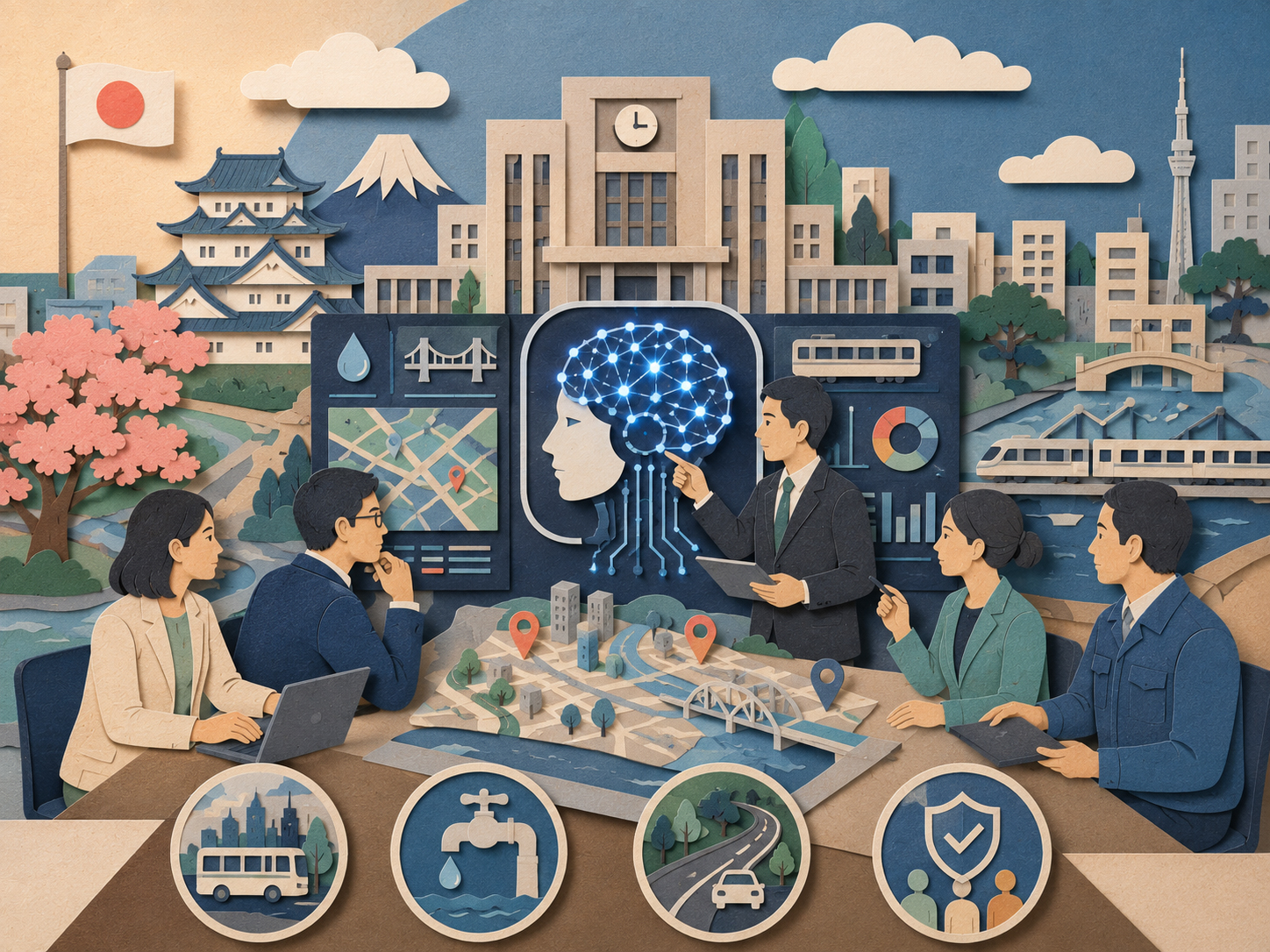
The most important AI story in Japan on July 10 is not only happening inside a chip fab, a robot lab or a Tokyo advertising agency. It is also happening in city halls, town offices, water departments and disaster-prevention rooms. On July 9, 2026, Tokyo Big Sight hosted the Infrastructure AX Strategy Meeting, a government-focused gathering on how artificial intelligence can change the way local governments manage Japan’s public infrastructure.
The theme was direct: “The front line of national infrastructure strategy changed by AI.” The deeper question was even sharper. How does Japan keep roads open, bridges safe, water flowing and evacuation plans credible when local populations are shrinking, veteran engineers are retiring and public assets built during the high-growth era are getting old at the same time?
The meeting was organized by the Local Government Infrastructure AX Summit executive committee and operated by Tenchijin, a company known for satellite-data land analysis and water-infrastructure projects. It was held in conjunction with Local Government Fair 2026, and it targeted local government officials and central government officials. The program included the Cabinet Secretariat’s Digital Administrative and Fiscal Reform Council office, the Ministry of Land, Infrastructure, Transport and Tourism, university researchers, a practitioner from Minami Town in Tokushima Prefecture, and private-sector AX solution pitches.
That mix matters. Japan’s municipal AI debate is moving beyond chatbots and paperwork. The new frontier is infrastructure: bridges, roads, water pipes, public buildings, hazard maps, inspection records, emergency response, population forecasts and the quiet transfer of knowledge from retiring veterans to younger public servants.
What “Infrastructure AX” Means
AX usually stands for AI Transformation. In this context, it means something more specific than a fashionable business slogan. Japan’s local governments have spent years digitizing paper, moving services online and preparing for core-system standardization. Infrastructure AX asks what comes next: how can the data created by DX become operational intelligence?
The answer is not simply “put AI in city hall.” A municipality is not a software startup. It handles resident records, welfare, taxes, schools, water, roads, drainage, disaster warnings and public facilities. It must be accurate, explainable and accountable. But it also has a huge problem: the work is growing more complex while local workforces shrink.
Japan’s infrastructure was built to support one of the world’s most successful postwar development stories. The problem is that much of it is now aging at once. Bridges built in the high-growth years need inspection and repair. Water pipes leak. Roads crack. Public facilities face consolidation. Disaster-prevention plans must account for heat, typhoons, floods, earthquakes and aging residents. At the same time, many small municipalities have fewer technical staff, less budget flexibility and thinner institutional memory.
The Three Layers of the July 9 Meeting
The July 9 program revealed the three layers of Japan’s local-government AI challenge. The first layer is national policy. A keynote from the Cabinet Secretariat’s Digital Administrative and Fiscal Reform Council office placed Infrastructure AX within Japan’s broader administrative reform agenda. Local governments cannot safely and affordably deploy AI at scale if procurement, standards, cloud rules and data-linkage policies remain fragmented.
The second layer is infrastructure science. MLIT’s participation through discussion of SPIVE, the Strategic Platform for Infrastructure Value Enhancement, points to a more analytical future for infrastructure management. Bridges, roads and public facilities produce data: inspection photos, deterioration records, traffic levels, repair histories, ground conditions and maintenance costs. AI can help turn those records into risk forecasts and priority lists, but only if the methods are reliable enough for public use.
The third layer is the municipal front line. The Minami Town case is important precisely because it is not a Tokyo smart-city showcase. It represents the reality of a small municipality where AI and no-code tools may become survival tools. When a town has limited staff, the goal cannot be to create a specialized AI priesthood. The goal is to make tools that ordinary administrative staff can actually use.
The Long Road From e-Government to Municipal AI
Japan did not arrive at local-government AI overnight. Municipal administration developed as a complex, paper-heavy structure covering resident registration, family registers, taxes, health insurance, welfare, childcare, disaster response and public works. The Heisei era brought resident-record networks, e-government initiatives, My Number, electronic applications and local IT systems. But many offices still depended on paper, seals, face-to-face procedures and customized legacy systems.
COVID-19 exposed the cost of that structure. Emergency cash payments, vaccine reservations, public-health work, school closures and business support all revealed how hard it was to deliver fast public service through paper, phone calls and fragmented systems. The 2021 creation of the Digital Agency was one national response to that failure. Its mission was to build a user-oriented, humane digital government that would not leave people behind.
Another major response has been the standardization and unification of local government core business systems. The Digital Agency says the standardization program covers 20 administrative operations and aims to improve resident convenience, raise local-government efficiency, avoid vendor lock-in, use Government Cloud and reduce system operating costs after migration by at least 30 percent versus fiscal 2018. This may sound technical, but it is the foundation for AI. If every municipality’s data and systems are too different, AI solutions cannot spread. If core data becomes more standard, AI tools for disaster response, water management or welfare support can be reused more easily across Japan.
Why Generative AI Changes the Doorway
Before generative AI, municipal AI often meant specialized automation: OCR, RPA, call-center classification, demand forecasting or inspection support. Generative AI is different because it touches the daily work of ordinary staff. It can draft documents, summarize meetings, search internal materials, compare policy language, create first drafts of resident explanations, organize inspection reports and turn old records into searchable knowledge.
The Digital Agency’s Government AI platform, “Gennai,” shows where the central government is heading. The agency says it is building a secure generative-AI environment for government staff and plans to make it available to roughly 180,000 national government employees during fiscal 2026. That is not a local-government deployment by itself, but it matters for municipalities. If central ministries learn how to govern AI use, write procurement rules, manage CAIO structures, develop shared datasets and evaluate domestic language models, those practices can eventually support prefectures, cities, towns and villages.
MIC has also moved from prohibition toward governed use. In December 2025, it published the fourth edition of its local-government AI utilization and implementation guidebook. The update added guidance on generative AI use, practical examples, caution points and a template for local governments to create their own generative-AI system use guidelines. The message is not “do not use AI.” It is “build a way to use it safely.”
The Data Shows a Municipal Divide
The optimistic story is that municipal AI adoption is rising quickly. A January 2026 Japan Research Institute report, based on MIC materials, found that AI adoption across all local governments, including prefectures, rose from 5.8 percent at the end of 2018 to 59.2 percent at the end of 2024. Generative AI adoption at the end of 2024 stood at 32.0 percent.
The difficult story is inequality. According to the same analysis, cities had reached AI adoption rates above 80 percent by the end of 2024, while towns and villages lagged significantly. The generative AI divide was even sharper: prefectures and ordinance-designated cities were around 90 percent, while towns and villages were around 10 percent. Human-resource shortages, budget limits, accuracy concerns and fears about confidential-information leakage remain major obstacles.
This is the core public-policy issue. The municipalities that need AI most may be the least able to adopt it. Small towns face aging infrastructure, disaster risk and staff shortages, but they may lack data specialists, procurement capacity and budget. If Infrastructure AX only helps large cities, it will deepen the regional divide. If it reaches small municipalities, it could become one of the tools Japan uses to keep rural and regional public services viable.
Why Infrastructure Is an AI-Native Problem
Infrastructure management is full of patterns. Bridges deteriorate in measurable ways. Water pipes fail depending on age, material, soil and pressure. Road repairs can be prioritized by traffic, school routes, disaster corridors and deterioration. Resident reports can be classified, deduplicated and routed. Evacuation planning can combine weather, terrain, transportation and demographic data. Public-building consolidation can use population forecasts and maintenance cost projections.
AI is well suited to this kind of decision support. But the phrase “decision support” is important. AI should not decide which bridge closes, which evacuation notice is issued or which pipe is replaced first. Local officials remain responsible because the decision involves local knowledge, resident life, budget, law and politics. AI can organize evidence, forecast risk and expose trade-offs. It cannot bear democratic accountability.
That is why municipal AI must be explainable, auditable and conservative in high-risk fields. An ad-optimization AI can fail and be corrected in the next campaign. A disaster-response AI or bridge-maintenance tool cannot be treated that casually. Municipal AI must be designed for public trust.
Minami Town and the Small-Municipality Test
Minami Town’s role in the meeting points to the most interesting part of the story. The speaker from Minami Town, Tatsuya Ochi, was presented not as an outside consultant but as a municipal practitioner who had worked in agriculture, forestry, fisheries and construction before teaching himself IT skills and pushing internal digitization. The release emphasizes his work to democratize generative AI and no-code tools across the town office.
This is exactly the kind of story Japan needs to watch. Many municipalities do not need a spectacular AI lab. They need a practical way for ordinary staff to summarize past documents, prepare meeting materials, search internal knowledge, draft resident notices, structure inspection notes and automate repetitive tasks without creating new security risks.
Small municipalities may actually be better laboratories than large cities in some respects. Decision chains are shorter, problems are visible, and one practical tool can change many workflows. If a town office can use AI safely and routinely, the model may travel to hundreds of similar communities.
The Risks Are Not Footnotes
The danger of municipal AI is real. Local governments hold intimate data: taxes, welfare, disability records, child support, health, disaster-vulnerable residents, consultations and housing. If staff put sensitive information into unsafe AI tools, public trust will collapse. That is why guidelines, secure environments and training are not optional.
Accuracy is another risk. Generative AI can produce fluent wrong answers. In a municipal setting, a wrong welfare explanation, a mistaken ordinance summary or an inaccurate disaster instruction can harm residents directly. Accountability is also essential. “The AI suggested it” is not an administrative defense. Officials must know who checked the output, what data was used, what record was kept and who approved the final action.
Procurement is a fourth risk. AI tools evolve quickly, while public procurement is slow and rule-bound. Municipalities must write specifications, protect personal information, satisfy security requirements, manage audits and stay within annual budgets. Without shared templates, cloud rules, procurement checklists and common evaluation methods, small governments may be locked out or locked in.
The Historical Meaning
Japanese local administration has always depended on human memory. Veteran staff know which road floods, which pipe is old, which neighborhood needs extra support during an evacuation, which contractor remembers a buried facility, and which past repair was only temporary. That knowledge often lives in people, paper binders, old photos, inspection forms and informal networks.
Population decline weakens that memory network. AI cannot replace local wisdom, but it can help preserve it. It can turn memory into records, records into searchable knowledge, and searchable knowledge into decision support. That is the deeper historical meaning of municipal AI in Japan. It is not just about cutting paperwork. It is about preventing local government from forgetting how to govern.
Since the Meiji period, Japan’s local governments have connected national policy to everyday life. The Reiwa-era AI transition is a redesign of that connector. Standardized systems, Government Cloud, generative AI, satellite data, IoT, resident reports, open data and private-sector tools are beginning to sit on the same table. Tokyo Big Sight’s July 9 meeting was one small room in that larger redesign.
Japan.co.jp View
Japan’s AI headlines often focus on big companies, semiconductors, robots, finance and advertising. But AI’s social test will happen in local government. If AI can help a town office work faster, a water department predict leaks, a disaster team issue clearer alerts, a young civil servant learn from old inspection records, and a resident avoid writing the same information twice, then AI has moved from hype to infrastructure.
The Infrastructure AX Strategy Meeting matters because it frames AI as a municipal operating system, not a novelty. The DX work is not finished. Standardization, cloud migration, security, talent and procurement remain hard. But local governments cannot wait for a perfect future. Bridges age. Pipes leak. Typhoons come. Staff retire. Residents need service today.
Municipal AI will succeed quietly. A repair list becomes easier to justify. A leak is found earlier. A disaster memo is clearer. A meeting summary is ready in minutes. A young official finds the precedent that once lived only in a retired colleague’s memory. That is not glamorous. It is public service. And in Japan’s aging regions, it may be one of the most important forms of AI.
Reader Guide
| Question | Answer |
|---|---|
| What happened? | Japan held an Infrastructure AX Strategy Meeting at Tokyo Big Sight on July 9, 2026, focused on local-government AI and infrastructure management. |
| Why does it matter? | It shows municipal DX moving from digitizing paperwork toward using AI for aging infrastructure, disaster resilience and institutional knowledge transfer. |
| What is AX? | Here, AX means using AI on top of earlier DX foundations—data, cloud, standardized systems and reworked workflows—to support real public operations. |
| What is the biggest risk? | Small municipalities may need AI most but have the fewest people, budgets and security resources to deploy it safely. |
| What should readers watch? | Whether AI becomes a safe everyday tool for ordinary municipal staff, not just a showcase for large cities and vendors. |
Sources and reference material
This article draws on the July 2026 Infrastructure AX Strategy Meeting announcement by Tenchijin/PR TIMES, Local Government Infrastructure AX Summit 2026 materials, Digital Agency materials on local-government core-system standardization and Government AI “Gennai,” National Diet Library Current Awareness coverage of MIC’s local-government AI guidebook, and Japan Research Institute analysis of municipal AI adoption.
- PR TIMES / Tenchijin: Infrastructure AX Strategy Meeting overview, program and speakers.
- Tokyo Shimbun × PR TIMES: Local Government Infrastructure AX Summit 2026 background.
- Digital Agency: local government core business system standardization and Government Cloud policy.
- Digital Agency: Government AI “Gennai.”
- National Diet Library Current Awareness: MIC local-government AI utilization and implementation guidebook, fourth edition.
- Japan Research Institute Research Focus: municipal AI adoption and emerging challenges.