The finest clock in a laboratory can still be blind between glances. It cools a cloud of atoms, arranges their quantum state, asks them whether a laser is on resonance, reads the answer and then begins again. For part of every cycle, no atom is watching the laser. Time does not stop, but the interrogation does.
That blind interval is called dead time. It sounds like housekeeping, a few moments lost while a machine resets. At the frontier of precision measurement it is more serious: frequency noise in the laser can slip through unseen, then reappear in the sampled data at misleading frequencies. The effect slows the rate at which repeated measurements converge. A clock may possess exquisite accuracy yet take longer than researchers would like to reveal it.
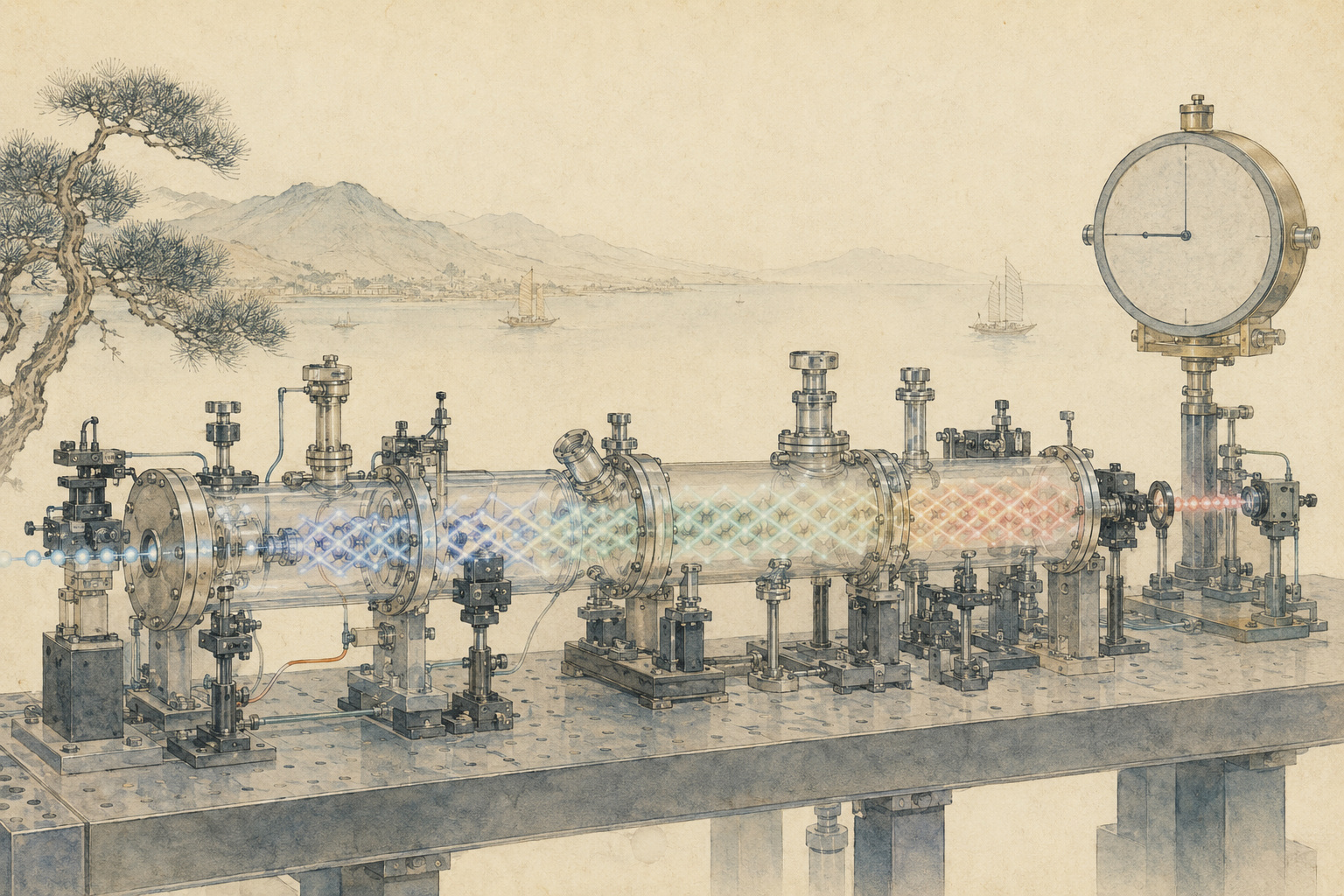
A Japanese research team has now reorganized the work. Instead of making one stationary ensemble perform each step in sequence, the apparatus sends an uninterrupted stream of ultracold strontium atoms through different stations. Upstream atoms are prepared. Atoms in the middle meet the clock laser. Downstream atoms are detected. The stages occur simultaneously on different atoms, much as an assembly line replaces a craftsperson completing one object before starting the next.
The experiment by Koki Nishida, Ryoto Takeuchi, Shigenori Tsuji, Shoichi Okaba and Hidetoshi Katori does not yet amount to a finished, zero-dead-time optical clock. The team demonstrated continuous atom delivery and Fourier-limited clock spectroscopy. Its published measurement still used a 1.22-second detection sequence, and the scientists did not construct the continuous state readout, error signal or feedback loop needed to steer the clock laser without interruption. The phrase “moves toward” carries the weight of the headline.
What an atomic clock actually measures
An atomic clock is often described as counting the ticks of an atom. That shorthand hides the working relationship. The practical oscillator is a laser—or, in a cesium clock, a microwave source. Atoms provide a reproducible resonance against which that oscillator is tested. A control system changes the oscillator frequency, probes atoms on both sides of the resonance, interprets how many changed state and feeds a correction back. The atom is the ruler; the laser is the thing being ruled.
Strontium has a particularly narrow transition between its 1S0 ground state and long-lived 3P0 excited state. Light near 698 nanometers can drive that transition. Because the optical wave oscillates hundreds of trillions of times per second, far above the microwave frequency used to define the cesium second, a tiny fractional change corresponds to a measurable phase or frequency difference. More cycles fit inside the same second, like a ruler with vastly finer graduations.
But atoms move. Laser light used to hold them can shift their energy. The particles can collide. Room-temperature radiation, magnetic fields and stray electric fields all perturb the resonance. A useful clock must isolate, calculate or cancel each effect. Its achievement is not merely producing a narrow line but connecting the observed line to the unperturbed atomic frequency with a defensible uncertainty budget.
The optical lattice clock, proposed by Katori in 2001 and first demonstrated soon afterward, combines two advantages. It measures many neutral atoms at once, improving statistical precision, while trapping them in a standing wave of light so motion-induced Doppler effects are suppressed. The lattice resembles a microscopic egg carton, with atoms confined near the wells. Its wavelength is tuned to a “magic” value at which the trapping light shifts the two clock states almost equally. The trap then largely disappears from the frequency difference that matters.
The batch clock and its missing moments
A conventional optical lattice clock works cyclically. It catches atoms in a magneto-optical trap, cools them, loads them into a lattice, prepares a chosen state, exposes them to the clock laser and detects the result. These steps are exquisitely controlled, but most cannot be performed on the same atoms at the same instant. Strong cooling and detection light would disturb the delicate clock interrogation.
Suppose the atoms monitor the laser for one second, then the apparatus spends another fraction of a second preparing the next sample. During that pause the laser keeps evolving against its reference cavity, but there is no atomic measurement. Sampling converts some high-frequency oscillator noise into lower-frequency measurement noise, much as a movie camera can make a wheel appear to turn backward. In clock science this aliasing is called the Dick effect, after physicist G. John Dick.
Dead time primarily damages short-term stability: how quickly an average settles as measurements accumulate. It is not the same as systematic accuracy, which asks whether the final value is biased away from the ideal atomic frequency. It is not the same as uptime, the fraction of days or months a laboratory clock is available. And it is not synonymous with linewidth, the width of the observed resonance. These quantities interact, but one impressive number cannot stand in for all of them.
| Clock quality | The question it answers | What the 2026 experiment showed |
|---|---|---|
| Linewidth | How sharply did this interrogation resolve the resonance? | A 1.2-hertz-wide line, close to the limit set by the 0.75-second transit. |
| Interrogation duty cycle | Are atoms continuously sensitive to the laser? | A continuous stream remained under interrogation; this is the central advance. |
| Stability | How quickly does noise average away? | Potential improvement was analyzed, but a locked clock’s stability was not demonstrated. |
| Accuracy / uncertainty | How close is the corrected frequency to the unperturbed atom? | No complete clock uncertainty budget or accuracy record was claimed. |
| Uptime | How reliably can the whole clock run over days or months? | Long-term autonomous operation was outside the study. |
Turning time into distance
The new architecture attacks dead time by converting temporal stages into physical places. Strontium-88 begins in an oven at 660 kelvin. A Zeeman slower removes velocity from the thermal beam, and a 461-nanometer magneto-optical trap catches atoms. A weak decay sends some into a metastable state that can be magnetically guided. Further cooling, including a narrow 2.92-micrometer transition and Sisyphus cooling, lowers the stream to tens of microkelvin.
Two counter-propagating lattice beams form a standing-wave pattern at about 813.4 nanometers. Giving the beams slightly different frequencies makes that pattern move. The atoms ride upward in the traveling wells at 16 millimeters per second, held in a roughly 130-microkelvin-deep lattice strengthened inside a triangular ring cavity. The measured flux reaches about 105 atoms every second.
The stream then enters a 12-millimeter spectroscopy chamber. A 698-nanometer clock laser travels along the same axis in the opposite direction. The atoms are confined tightly enough—within the Lamb–Dicke regime—that the motion does not smear the optical resonance in the usual Doppler way. This longitudinal geometry is crucial: a flowing atom does not have to become a blurry atom.
There remains a timing problem. If the clock laser is present along the path, how does each atom receive a precisely bounded interrogation? The team made the transition itself switchable in space. In bosonic strontium-88 the 1S0–3P0 transition is ordinarily forbidden. Two current-carrying wires inside a magnetic shield create a transverse mixing field only in the desired zone. The field admixes a little of an allowed state, opening the clock transition locally. Atoms begin coherent Rabi oscillation when they enter the magnetic window and stop when they leave.
At constant velocity, position is elapsed time: y = ut. A fluorescence image downstream therefore becomes a record of quantum evolution. The ground- and excited-state populations appeared as out-of-phase spatial fringes along the stream. What a conventional experiment would plot against milliseconds, this apparatus could see written in millimeters.
With an interaction length of 12 millimeters and a speed of 16 millimeters per second, the transit lasts 0.75 seconds. A rectangular interrogation of that duration has an expected Fourier-limited full width near 0.886/0.75, or 1.18 hertz. The observed line was 1.2 hertz. That agreement is the experiment’s elegant core: transport, the local magnetic field and the lattice preserved a spectral resolution determined mainly by the intended interaction time.
- Prepare: continuously cool, guide and pump incoming strontium into the ground clock state.
- Carry: load the atoms into the moving 813.4-nanometer magic-wavelength lattice.
- Interrogate: let the 698-nanometer clock laser act only inside a 12-millimeter magnetic window.
- Read: distinguish ground- and excited-state atoms by downstream fluorescence.
- Future step: turn that readout into a continuous error signal and feed it back to the clock laser.
A river, but not yet a finished clock
The atom stream was continuous where the scientific claim says it was: in delivery, transport and clock interrogation. But the spectrum was acquired by holding one laser detuning fixed, performing state-selective fluorescence measurements in a 1,220-millisecond sequence, averaging five acquisitions and then stepping the detuning by 0.1 hertz. The 461-nanometer trap light was briefly turned off during fluorescence to protect the camera signal. That interruption occurred after interrogation, so it does not invalidate the continuous-spectroscopy result. It does show why the apparatus is not yet a complete clock that “never stops.”
A working clock needs an error signal that says not only how many atoms were excited but which way the laser should move. It must deliver that signal repeatedly, without shifts in the line shape creating false corrections, and close a feedback loop. The authors explicitly place a robust error signal and feedback architecture beyond the scope of the paper.
They propose one possible route: overlap the downstream repump and probe beams, rapidly modulate the repump light and time-multiplex the fluorescence from ground- and excited-state populations. The readout could update at around one kilohertz. Yet the servo could not respond usefully at that full rate. Each atom averages the laser over its 0.75-second passage, and the atom must then travel to the detector. That response time and transport delay limit feedback bandwidth and add phase lag.
Detection photons could also travel backward and perturb atoms still being interrogated. Polarization geometry may suppress them; a cavity-based dispersive detector could eventually reduce scattering. These are solvable engineering questions, not footnotes. A precision clock is a system in which every photon, cable, field, collision and delay can become part of the answer.
The imperfections visible in the spectrum
The measured resonance was narrow, but it was not unshifted. The fitted center lay 10.4 hertz below the reference used in the analysis, and the fit required a dephasing rate of 2.3 per second. Known magnetic, laser, blackbody and cooling-light effects explain much of the position. An additional redshift of about 0.8 hertz and extra broadening may come from static electric fields near Kapton-coated wires, atom–atom collisions or both.
Collisions are particularly important in bosonic strontium-88. At peak flux, the team estimated an average occupancy of about 2.5 atoms per lattice site. Interactions at that density can shift and broaden the clock line. The stray 461-nanometer cooling light contributed an estimated shift of about 0.4 hertz and additional decoherence. Atoms also left the lattice through background-gas collisions, parametric heating and Raman scattering.
None of this makes the result a failure. It is the normal transition from demonstrating a new architecture to building a metrological instrument. Future work could lower occupancy with a larger, ring-shaped lattice geometry, suppress stray light by blackening surfaces, move electrical structures away from the atoms, refine state preparation or use the fermionic isotope strontium-87. Each change would have tradeoffs in cooling, transition strength, collisions and complexity.
The crucial intellectual result survives these imperfections: an ultracold atomic stream can move through a lattice and still yield a clock transition near the Fourier limit. Motion did not destroy coherence. Spatially switching the coupling did not erase resolution. The assembly-line principle worked.
From ammonia to an optical river
Timekeeping has repeatedly changed what counts as a stable reference. Earth’s rotation gave civilizations the day but wanders. Pendulums divided the day with mechanical regularity but felt temperature and gravity. Quartz crystals brought frequency into electronics, yet aging and environment still moved them. Atomic clocks shifted the definition from a crafted object or astronomical motion to an invariant quantum transition.
1945–1949 — Isidor Rabi proposed using atomic resonance for timekeeping; the U.S. National Bureau of Standards built an ammonia absorption clock in 1949.
1955 — Louis Essen and Jack Parry operated the first practical cesium atomic clock at Britain’s National Physical Laboratory.
1967 — The SI second was redefined by fixing the cesium-133 ground-state hyperfine transition at 9,192,631,770 cycles.
1970s–1990s — Laser cooling, trapping and Ramsey interrogation transformed control of atoms; frequency-comb techniques later made optical cycles countable against microwave standards.
2001–2005 — Hidetoshi Katori proposed the optical lattice clock, demonstrated strontium spectroscopy in a magic-wavelength lattice and published the foundational high-resolution clock result.
2015 — Independent strontium clocks at the University of Tokyo and RIKEN agreed at the 2 × 10⁻¹⁸ level.
2020 — Transportable Japanese strontium clocks measured gravitational time dilation between the ground and a 450-meter level of Tokyo Skytree.
2024 — The same research line demonstrated continuous generation of an ultracold atomic beam with crossed moving lattices; AIST separately used a high-uptime ytterbium lattice clock to help sustain a 230-day time scale.
2025 — Shimadzu began taking orders for a compact 250-liter optical lattice clock built with Aetherclock.
2026 — Continuous strontium transport was joined to spatially defined, 1.2-hertz clock spectroscopy.
The optical frequency comb is the bridge in this history. Developed around the turn of the century and recognized in the 2005 Nobel Prize in Physics, a comb supplies evenly spaced optical frequencies that link a laser’s hundreds of terahertz to electronically countable signals. Without it, an optical transition could be stable beyond imagination yet difficult to compare with the familiar second.
Katori’s lattice concept answered a different problem: how to interrogate many neutral atoms for a long time without the trapping light spoiling the transition. The “magic wavelength” makes the light shifts of the two clock levels equal to first order. Many atoms provide a strong signal and reduce quantum projection noise; confinement suppresses motion. This combination moved lattice clocks into the 10−18 regime, where a clock’s sensitivity is sufficient to detect the gravitational redshift associated with height differences of centimeters under suitable conditions.
Two alternating clocks—or one continuous stream
The Japanese experiment is not the first attempt to remove dead time. A powerful earlier strategy uses two atomic ensembles. While ensemble A is being interrogated, ensemble B is prepared or detected; then they exchange roles. In 2016, a U.S. National Institute of Standards and Technology team demonstrated a zero-dead-time ytterbium lattice clock with two cold-atom systems sharing a laser. More recently, researchers in China interleaved two strontium ensembles and reported stability reaching 2.9 × 10⁻¹⁹ after 20,000 seconds.
That architecture is like two crews covering alternating shifts. It can eliminate gaps, but it duplicates substantial apparatus and demands careful synchronization and control of offsets between ensembles. Multiplexed clocks also offer valuable differential comparisons and shared-noise rejection, so complexity can bring other advantages.
The flowing architecture is conceptually different. It changes a batch process into a conveyor. Preparation, interrogation and detection are not alternating phases of two clocks; they are permanent locations through which one stream passes. A single stream could approach unity interrogation duty cycle without synchronizing multiple clocks. Whether it can ultimately match the systematic control, atom number and long-term reliability of the best stationary systems is an experimental question.
| Route to no dead time | How it fills the gap | Central tradeoff |
|---|---|---|
| Two interleaved ensembles | One ensemble watches the laser while the other is prepared or detected. | Demonstrated clock operation, but duplicated apparatus and synchronization. |
| Continuous atom stream | Different atoms simultaneously occupy fixed preparation, interrogation and detection zones. | Elegant spatial pipeline; continuous readout, servo and full metrology remain to be built. |
| High-uptime clock + flywheel | An optical clock periodically corrects a hydrogen maser that runs continuously. | Excellent practical time scale, but the atoms themselves still interrogate intermittently. |
Why “continuous” has more than one meaning
National time laboratories already make continuous time from clocks that are not continuously optical. A hydrogen maser can serve as a flywheel: it runs smoothly, while an optical lattice clock periodically measures and corrects its drift. In 2024, Japan’s National Institute of Advanced Industrial Science and Technology reported a 230-day time scale steered with a high-uptime ytterbium optical lattice clock. The optical clock operated 81.6 percent of the period, enough to keep the generated scale within roughly one nanosecond of Coordinated Universal Time.
That is a triumph of system engineering, but it is different from unity atomic-interrogation duty cycle. A time scale can be continuous because a flywheel bridges gaps. A laboratory clock can have high uptime because it runs on most days. A laser can be continuously interrogated because some atom is always sensing it. The 2026 study targets the third meaning.
The distinction matters as optical clocks move from record experiments toward infrastructure. A future optical definition of the second will require not only isolated demonstrations of low uncertainty but routine contributions to international atomic time, reliable comparisons across laboratories, agreed frequency ratios, knowledge of local gravitational potential and continuity with the existing cesium-based scale. The Consultative Committee for Time and Frequency is working toward possible redefinition in 2030 or later, contingent on those conditions.
A clock that converges faster could compare distant laboratories in less time, resolve gravitational potential changes more rapidly and relax some demands on massive, ultrastable laser cavities. The paper suggests pairing a short interrogation zone, offering a wide capture range, with a longer zone that yields finer resolution and lower quantum noise. Such an arrangement could help a compact system acquire and then hold its resonance.
When clocks become sensors of place
Einstein’s general relativity says a clock higher in a gravitational field runs faster than one lower down. At optical-clock precision, this is not philosophy; it is a survey signal. In 2020, Katori’s team carried clocks to Tokyo Skytree and compared the ground with a 450-meter observation level. The frequency difference agreed with conventional height surveying and demonstrated relativistic geodesy outside a metrology laboratory.
A network of robust optical clocks could monitor ground deformation, volcanic inflation, aquifer changes or slow crustal motion by sensing changes in gravitational potential. Such applications demand more than headline accuracy. Field instruments must start reliably, survive vibration and temperature changes, operate autonomously and average down quickly before the landscape itself changes.
Continuous interrogation could help by suppressing aliasing and extracting useful precision sooner. If it also permits a less demanding reference cavity, it might shrink cost and volume. But the present experiment does not yet demonstrate a field clock or a geophysical sensitivity. Its value is architectural: it offers a route by which tomorrow’s clock might become less like a rare laboratory performance and more like an instrument.
The same pipeline may matter beyond clocks. Continuously prepared cold atoms could feed superradiant lasers, neutral-atom quantum processors and atom interferometers. In each case, dead time limits measurement bandwidth or interrupts a computation. Spatially separating preparation, coherent interaction and readout is a general way to keep quantum work moving.
The experiments that must come next
First comes truly uninterrupted state-selective detection. The apparatus must measure the fraction of excited atoms continuously while preventing probe photons from disturbing upstream interrogation. The detector needs enough signal-to-noise at useful bandwidth and a calibration that remains stable as atomic flux changes.
Second comes the clock servo. Researchers must convert the flowing signal into an error with the correct sign, reject line-shape drift and close a loop around the 698-nanometer laser. Only then can they directly compare stability with pulsed operation and measure how much Dick noise has disappeared. A second clock or an independent ultrastable reference will be needed to evaluate it.
Third comes systematic control. Electric-field, density, blackbody, Zeeman, lattice, probe-light and Doppler shifts must be mapped under continuous transport. The unexplained fraction of the observed redshift must be resolved. Atom loss, velocity variation and a changing spatial magnetic profile can all turn into frequency offsets if they distort the line asymmetrically.
Fourth comes duration. A zero-dead-time concept that holds for seconds must operate for days. Ovens deplete; viewports coat; lasers lose lock; magnetic fields drift; moving-lattice cavities change alignment. Automation must detect trouble, recover without human intervention and document every interval that enters the time record.
- Continuous, nondisruptive state readout of both clock populations.
- A robust bidirectional error signal and closed-loop lock to the atomic stream.
- Direct measurement of suppressed Dick-effect noise and improved short-term stability.
- A complete systematic-shift and uncertainty evaluation.
- Independent comparison against another optical clock.
- Long-duration autonomous operation with documented uptime and recovery.
The second as a river
Every atomic clock is an argument that nature repeats itself. A cesium atom in 1967 and one today share the same unperturbed transition. A strontium atom prepared in Tokyo and another in Paris can answer the same optical question. Timekeeping turns that universality into a public utility.
The history of clocks has therefore been a history of removing dependence on circumstance: the variable spin of Earth, friction in gears, aging quartz, thermal atoms rushing through a beam, trapping light that perturbs what it holds, and laser noise that grows while no atom is looking. Each advance has made a previously invisible limitation become the next engineering problem.
Nishida and colleagues have made dead time visible as a matter of geometry. Instead of asking one cloud to stop, prepare, listen and report, they let many atoms carry the same question through space. Position becomes duration. The magnetic window becomes the pulse. A fringe on a camera becomes the history of a quantum oscillation.
For now, the river still reaches a detector that reads in steps, and no feedback loop turns its answer into an uninterrupted clock output. The shifts are not fully tamed. The stability gain remains a prediction to test. Yet the 1.2-hertz line shows that a moving stream can preserve the subtlety on which an optical clock depends.
Reporting note and primary sources
This article is based on information available through August 8, 2026, 6:00 a.m. Japan Standard Time. “Never stops measuring time” describes the intended zero-dead-time clock architecture. The reported experiment demonstrated uninterrupted atom delivery and interrogation, not a complete continuously read, feedback-stabilized clock. The 1.2-hertz linewidth is not a fractional-frequency uncertainty or an accuracy record. Descriptions of geodesy, compact clocks and redefinition of the second are future or broader context, not outcomes demonstrated in this study.
- Nature Communications: Nishida et al., “Spatially defined Rabi spectroscopy for uninterrupted optical clock interrogation”
- Paper DOI: 10.1038/s41467-026-76017-1
- RIKEN: August 7 research announcement and experiment overview
- University of Tokyo: detailed Japanese research release
- JEOL: collaboration announcement
- Physical Review Applied: 2024 continuous ultracold atomic-beam precursor
- Nature: 2005 strontium optical lattice clock at the magic wavelength
- Reviews of Modern Physics: optical lattice clock principles and development
- NIST: optical lattices and the magic-wavelength concept
- NIST / Physical Review Letters: 2016 zero-dead-time optical clock with two ensembles
- Physical Review Applied: 2025 interleaved strontium-ensemble clock
- NIST: brief history of atomic time
- BIPM: the present SI definition of the second
- BIPM: roadmap and conditions for a future redefinition of the second
- Nobel Prize: optical frequency combs and precision spectroscopy
- University of Tokyo: Tokyo Skytree optical-clock test of gravitational redshift
- AIST: 230-day time scale generated with a high-uptime optical lattice clock
- Shimadzu: 2025 order launch for a compact commercial optical lattice clock