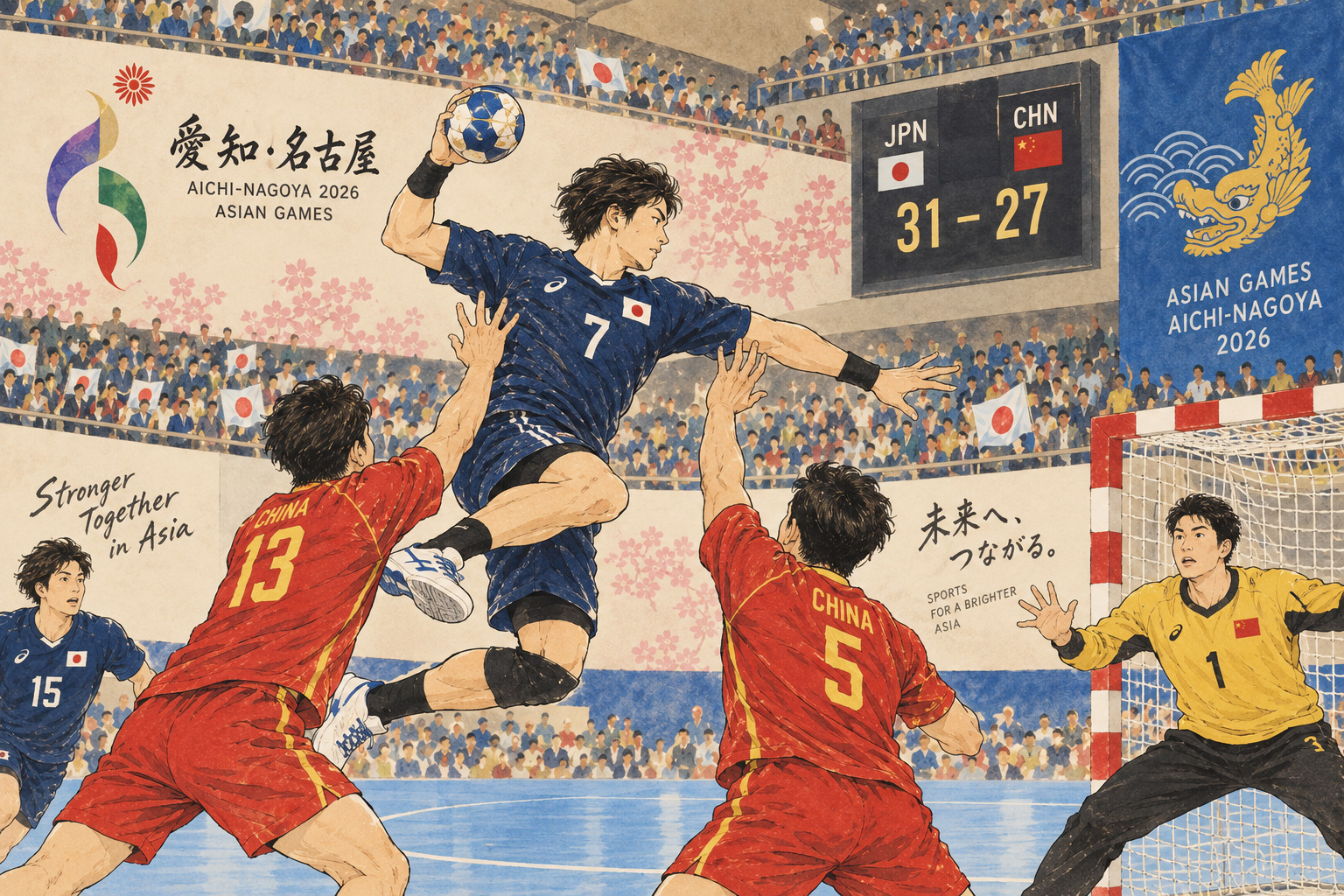
A 31–27 scoreline can make an opening victory look straightforward. Japan's first men's handball match at the Aichi-Nagoya Asian Games was not. Comets Japan led China 16–12 at halftime and stretched the margin to nine at 24–15 eleven minutes into the second half. Then the shots stopped falling, China recovered momentum and the final margin contracted to four. For a host team openly pursuing its first Asian Games men's title, the opening 60 minutes delivered both the win it needed and the flaw it could not ignore. [1]
The match began at 3 p.m. on September 20 at Toyoda Gosei Memorial Gymnasium Entrio in Inazawa, Aichi Prefecture. Naoki Sugioka led Japan with eight goals, Tatsuki Yoshino scored seven and Kota Nakata added five. Japan won the first half 16–12; the second half was level at 15–15. [1][3]
The four-goal halftime lead was not an easy four goals
The Japan Handball Association described China as physically large and powerful. Japan had difficulty with that strength early, but Sugioka, Nakata and others converted enough chances to create a four-goal halftime cushion. [1]
Nakata was perfect: five shots, five goals. Daisuke Tanaka was three from three. Yoshino scored seven from eight and Sugioka eight from 10. In a sport that produces repeated possessions over 60 minutes, efficiency spread across several positions forces a defense to protect more than one scorer. That distribution carried Japan through the opener. [1]
| Player | Goals | Shots |
|---|---|---|
| Naoki Sugioka | 8 | 10 |
| Tatsuki Yoshino | 7 | 8 |
| Kota Nakata | 5 | 5 |
| Daisuke Tanaka | 3 | 3 |
| Jin Watanabe | 3 | 5 |
Statistics are those published by the JHA from the official Games results. [1]
At 24–15, the match appeared over. Then it restarted
Japan adapted to China's movement after halftime, forced mistakes and turned defense into fast breaks. Eleven minutes into the second half, the score was 24–15. A nine-goal lead is large enough to close many handball matches. [1]
Japan did not close it cleanly. Missed shots allowed China to reduce the deficit. The second-half score ended 15–15. In other words, all four goals of the final margin came from Japan's first-half advantage. [1]
Head coach Toni Gerona said afterward that the team played well through the point when it reached the nine-goal lead, then made mistakes in attack and defense and allowed China to take the flow of the game. His larger point was pragmatic: getting the first win mattered most. Goalkeeper Takumi Nakamura similarly emphasized extending the kind of strong spell Japan produced in the opening 10 minutes of the second half for a longer portion of the game. [1]
Sugioka's eight goals carried two career milestones
The individual story of the match belonged to left wing Naoki Sugioka. In the same game in which he scored eight times, he reached 100 international appearances and 200 international goals. His sixth goal of the afternoon was career goal No. 200. [4]
Sugioka was born April 18, 1994 in Kyotanabe, Kyoto Prefecture, and plays for Toyota Auto Body Brave Kings Kariya after attending Chuo University. He debuted for Japan in a June 2018 friendly against Germany. His international record includes Tokyo 2020 and Paris 2024, the 2019, 2021 and 2025 World Championships, and the 2020, 2024 and 2026 Asian Championships. [4]
He said he knew his 100th appearance was approaching but had forgotten about it during the match. Reflecting on being selected through three national-team coaching eras, he said the milestone was something he could regard with confidence and pride. [4]
The symbolism went beyond longevity. He did not reach the milestone as a ceremonial veteran. He was Japan's highest scorer in the match.
Yoshino's seven goals provided the answer when momentum shifted
Tatsuki Yoshino scored seven from eight attempts. JHA's match report highlighted his ability to stop China's momentum at critical moments. Yoshino said the opener carried the stiffness of a first game but that the team communicated throughout and had made a good start. [1]
Sugioka, Yoshino and Nakata combined for 20 of Japan's 31 goals, while Tanaka, Watanabe, Adam Yuki Baig, Hiroyasu Tamakawa, Naoki Fujisaka and Jun Goto also scored. Japan's attack was led by a small group, but it was not a one-player offense. [1]
Takumi Nakamura's 19% save rate does not tell the whole defensive story
JHA's official-stat summary lists Nakamura with five saves from 27 shots faced, a 19% save rate. By itself, that is not a dominant goalkeeper number. [1]
Nakamura's post-match comments focused instead on communication. He felt the entire defense looked tense and tried to use his voice to settle the group and gradually restore the normal defensive structure. Handball goalkeepers organize as well as save; their value can include what happens before a shot reaches them. [1]
The 19% remains a real statistic. But Japan's 12-goal first half and its ability to build a nine-goal lead cannot be reduced to that individual percentage alone.
Comets Japan are pursuing a title they have never won
Before the tournament, JHA described Japan's objective directly: a long-awaited first men's Asian Games championship. At the July team announcement, federation officials again framed the home Games around winning the men's title for the first time. [6][14]
Japan has a long Asian Games handball history. JHA's archive records a men's silver medal at Beijing 1990. More recently, Japan finished fourth at Jakarta-Palembang 2018 and fourth again at the Hangzhou 2022 Games held in 2023. In Hangzhou, Japan beat China 28–23 in the main round, then lost 30–28 to Bahrain in the semifinal and 31–30 to Kuwait in the bronze-medal match. [7][8][9]
That history changes the meaning of the 2026 opener. Beating China is necessary, not sufficient. Japan also beat China at the previous Games. The unresolved question is whether this team can finish the later knockout matches that previous teams could not.
Hangzhou: Japan 28, China 23. Gamagori cycle: Japan 31, China 27
On September 29, 2023 at Hangzhou, Japan defeated China 28–23 in the main round. Three years later, Japan won the Aichi-Nagoya opener 31–27. The margins were five and four. [1][7]
Those scores should not be treated as a controlled comparison. The rosters, coaching staffs, tournament stages and competition formats differed. What they do show is that China was not an unknown opponent and that victory over China had already been part of Japan's path to the final four at the previous Asian Games.
At the January 2026 Asian Men's Championship, Japan finished fourth and China ninth. Japan entered Aichi-Nagoya with the higher continental finish, but China's size and physical pressure still created a difficult opening match. [1][13]
Every team in Group A advances—but seeding still matters
The current men's Group A contains Japan, China, Hong Kong China and Qatar. JHA notes that because Group A has four teams, all four advance to the main round/quarterfinal stage; the preliminary standings determine the quarterfinal matchup. [2]
That means Japan was not playing a win-or-go-home match against China. It does not make the result unimportant. The opposite group includes Bahrain, Kuwait, Iran and Korea among the likely high-level opponents, so group position shapes the path through the knockout round. [2][6]
The next day, Japan won 44–17—and sustained the second-half pressure
Japan returned to Entrio on September 21 and defeated Hong Kong China 44–17. The halftime score was 19–10; the second half was 25–7. Japan moved to 2–0. [2][5]
That game also began with missed shots and a slower-than-desired opening. After halftime, however, Japan increased defensive intensity and converted the resulting chances, producing the kind of sustained second-half separation that had disappeared late against China. [5]
The opposition was different, so the scorelines cannot be used to say Japan became dramatically stronger in 24 hours. The useful fact is narrower: after identifying late-game execution as a problem in the opener, Japan's next second half was decisive.
Qatar is next—and has repeatedly stood between Japan and Asian titles
Japan's final preliminary match is scheduled for September 25 at Kasugai City General Gymnasium against Qatar. JHA described Qatar before the tournament as an opponent that has repeatedly stood in Japan's way. [2][6]
At Hangzhou, Qatar beat Japan 32–29 in the main round. At the January 2026 Asian Championship, Qatar finished second while Japan finished fourth. The competitive pressure therefore rises sharply from the first two matches to the final group game. [7][13]
Japan qualified for Paris on its own—then changed coaches
The present team sits on top of a major achievement from the previous cycle. In October 2023, Japan won the Asian Olympic qualification tournament, beating Bahrain 32–29 in the final. It secured a second consecutive Olympic appearance after host qualification for Tokyo 2020 and its first self-earned Olympic berth since Seoul 1988, 36 years earlier. [10]
At Paris 2024, Japan lost all five preliminary matches and finished 11th of 12 teams. The following month, JHA appointed Spaniard Toni Gerona as head coach. His résumé included roles with FC Barcelona and head-coaching positions with Tunisia and Serbia. [11][12]
Gerona therefore inherited a program that had proven it could qualify for the Olympics but had also seen the scale of the gap at the Games themselves.
Under Gerona, Japan's current continental benchmark is fourth
At the 2026 Asian Men's Championship in January, Japan finished fourth. Bahrain beat Japan 35–25 in the semifinal, and Kuwait won the bronze-medal match 33–32. Japan nevertheless secured one of the four qualification places for the 2027 IHF Men's World Championship in Germany. [13]
Aichi-Nagoya arrives eight months later. JHA's preview described the home Asian Games as a major checkpoint for the progress accumulated under Gerona since his August 2024 appointment. [6]
Silver in 1990; fourth in 2018; fourth again in 2023
Japan's men have never won the Asian Games handball title. JHA's contemporary magazine from the Beijing 1990 Games records a silver medal. Recent editions have ended just off the podium: fourth in 2018 and fourth in Hangzhou. [7][8][9]
A 1990 silver medal cannot be compared directly with the present tournament's field, rules and competitive landscape. But it gives the phrase “first title” a historical scale that reaches well beyond the current roster.
A 16-player roster built from the core of League H
Japan's 16-player Games roster includes goalkeepers Takumi Nakamura and Yuta Iwashita, wings Sugioka, Nakata and Tomoya Sakurai, and backcourt players including Yoshino, Adam Yuki Baig, Kotaro Mizumachi and Taiga Tsutaya. Most play major roles for leading League H clubs. [3]
Sugioka's 100th cap represents one end of the experience curve. Gerona has simultaneously used camps and a Next Japan program to develop younger players toward the 2027 World Championship and Los Angeles 2028 cycle. The home Asian Games are therefore both a once-only championship opportunity and a step inside a longer national-team rebuild.
Why 31–27 should not be filed simply as a comfortable win
The record book will preserve a four-goal victory. The people inside the match talked about something more complicated. Gerona, Yoshino and Nakamura all mentioned first-game tension, momentum or the need to correct what happened. [1]
Japan created nine goals of separation and then surrendered five of them. At the same time, it absorbed the pressure of a home opener, a title objective, a physically imposing opponent and a milestone afternoon for Sugioka—and still retained the lead.
Short tournaments are not won only through clean performances. They also demand the ability to survive the imperfect match, identify the problem and fix it before the next elimination game.
What is still undecided
As of the information available through September 22, Japan has beaten China 31–27 and Hong Kong China 44–17 and stands 2–0. The final group ranking, quarterfinal opponent, medal outcome and first Asian Games championship remain unresolved. [2][5]
The China result does not justify predicting a medal, a win over Qatar or the title. Hangzhou provides a direct warning: Japan beat China there too, reached the semifinals and then lost two consecutive matches by two goals or fewer to finish fourth. [7]
The true value of the opener will be decided at the end of the tournament
Japan won the first game. Sugioka crossed 100 caps and 200 goals while scoring eight. Yoshino scored seven. Nakata did not miss. Japan built a nine-goal lead—and then watched China pull five goals back.
The following day, Japan beat Hong Kong China by 27. Qatar comes next, followed by the quarterfinal.
If Comets Japan are still playing for gold on September 29, the China game may be remembered as the difficult opener they learned from. If the campaign ends earlier, the inability to fully close a nine-goal advantage may look more significant in retrospect.
An opening game in a title campaign is never completely understood on opening day. Japan has written the first chapter, 31–27. The meaning of those four goals will be decided by what follows.
Sources & documents
- Japan Handball Association: Japan men defeat China 31–27 at the 20th Asian Games (Sept. 20, 2026; Japanese primary source)
- Japan Handball Association: Aichi-Nagoya 2026 match schedule and results
- Japan Handball Association: Comets Japan Aichi-Nagoya 2026 roster
- Japan Handball Association: Naoki Sugioka reaches 100 international matches and 200 goals (Sept. 20, 2026)
- Japan Handball Association: Japan beat Hong Kong China 44–17 (Sept. 21, 2026)
- Japan Handball Association: Men's Asian Games preview—Comets Japan pursue first title
- Japan Handball Association: Hangzhou 2022 Asian Games results
- Japan Handball Association: Jakarta-Palembang 2018 Asian Games results
- Japan Handball Association archive: Japan men win silver at Beijing 1990 Asian Games
- Japan Handball Association: Paris 2024 Asian qualification—Japan wins and qualifies directly for first time in 36 years
- Japan Handball Association: Paris 2024 men's tournament—Japan finishes 11th
- Japan Handball Association: Toni Gerona named Japan men's head coach (Aug. 16, 2024)
- Japan Handball Association: 2026 Asian Men's Championship—Japan fourth, qualifies for 2027 World Championship
- Japan Handball Association: Aichi-Nagoya 2026 national team announcement—men target first Asian Games title