The scoreline matters. So does the question of who gets the chance to compete in the first place.
Atlanta hosts two Japanese teams—and a test of football’s reach
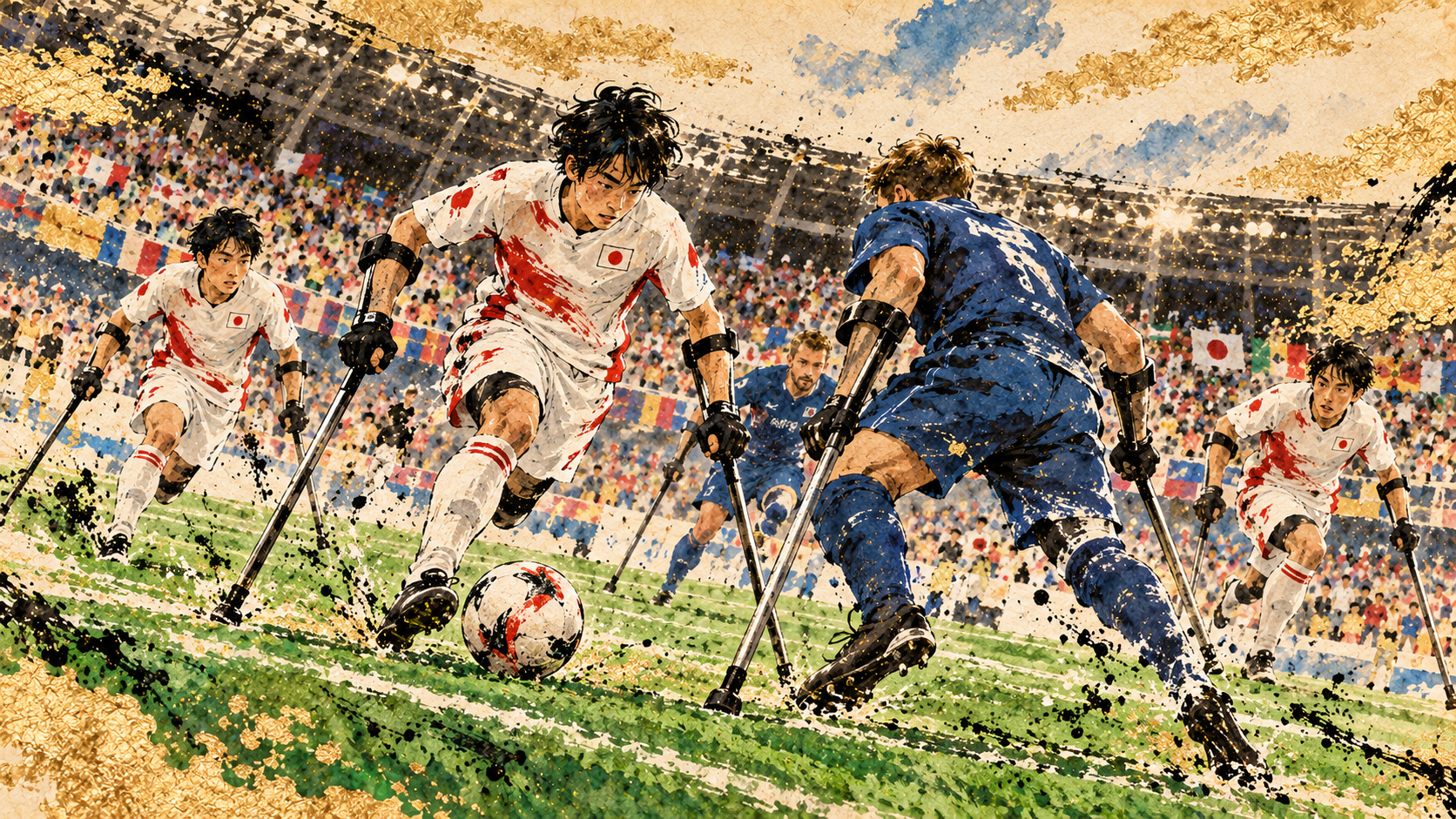
Japan has sent both men’s and women’s teams to the International Federation of CP Football’s World Cups in Atlanta, which began on October 14 and run through October 24. The competition includes 12 men’s sides and seven women’s sides, according to the Japan Football Association. It is an opportunity to judge not only results but what a national sporting system can offer footballers whose motor impairments would otherwise limit access to conventional competition.
A difficult start, and a competitive second match
Official IFCPF results show Japan’s men losing 5–0 to England on October 15, with the score 1–0 at halftime. Against Ireland on October 16, Japan led 1–0 at the interval before losing 3–2. Both are defeats; the second nevertheless shows a closer contest and Japanese scoring. The published summary does not establish the identity of scorers or explain why the lead was overturned. Those details require full match sheets or direct reporting.
Women’s football deserves equal attention
Japan’s women were scheduled to begin against the United States on October 17, then face Finland on October 19. Japan Inclusive Football Federation lists seven women on its national roster: Saki Kuroki, Mirai Toyoda, Miyabi Hamada, Mai Ota, Mayuko Kaiga, Kiona Kitajima and Aika Sasaki. The English spellings are reproduced from its official listing; the team’s matchday starters are not established by that roster. An October 17 outcome had not been independently verified at this article’s research cutoff, so no result is claimed.
What happens on a CP football field
This is a running form of football, not wheelchair football. Under IFCPF rules, teams field up to seven players, play two 30-minute halves, use a smaller field of approximately 70 by 50 metres and do not apply the offside rule. A throw-in may instead be rolled into play. Those modifications do not remove football’s essential demands: first touch, passing, spacing, defending, finishing, physical conditioning and collective judgment.
Classification is part of the competition, not a verdict on the person
The sport uses FT1, FT2 and FT3 classes to account for the impact of eligible neurological impairments on football activity. IFCPF rules require a team to have at least one FT1 footballer on the field and allow no more than one FT3 footballer at once under the standard seven-a-side framework. Classification makes competition more equitable; it should never be confused with a general ranking of personal ability, nor inferred from an athlete’s appearance.
From Paralympic history to an independent world stage
Seven-a-side football became a Paralympic sport at the 1984 Games and was last included at Rio 2016. Its absence from later Paralympic programmes did not end competition. The international federation has continued to organize events and revise its rules; a major classification overhaul took effect in 2018. Today’s Atlanta tournament belongs to that longer history and to an effort to build broader and more sustainable opportunities, particularly for women.
The system behind the national shirt
Japan’s men’s development list published by the Japan Inclusive Football Federation includes goalkeeper Hideyuki Yanagi and goalkeeper Riku Nanjo, among other squad members. A development roster should not be confused with confirmed match starters. Behind any international appearance are local teams, volunteer and professional coaching, training camps, travel logistics and the practical cost of access. Those systems deserve reporting as serious sport infrastructure—not merely as a heartwarming backdrop.
Why the women’s field matters
The difference between 12 men’s teams and seven women’s teams is an important reminder that international opportunity is still uneven. A small field can create elite competition while also revealing the work left to do in recruiting participants, providing domestic fixtures and retaining coaches. Japan’s representation on both sides is significant, but participation should be followed by questions about continuity and investment rather than congratulation alone.
What to watch after October 17
Japan’s men were scheduled to play Indonesia on October 18, with placement and knockout fixtures later in the tournament. The women were due to meet Finland on October 19. Because this report was researched on October 17 for an October 19 edition, it does not claim any unverified intervening results. Updated scores should be checked against IFCPF records before publication. The deeper measure of success will be how many players can continue to train, compete and lead the sport when the World Cup ends.