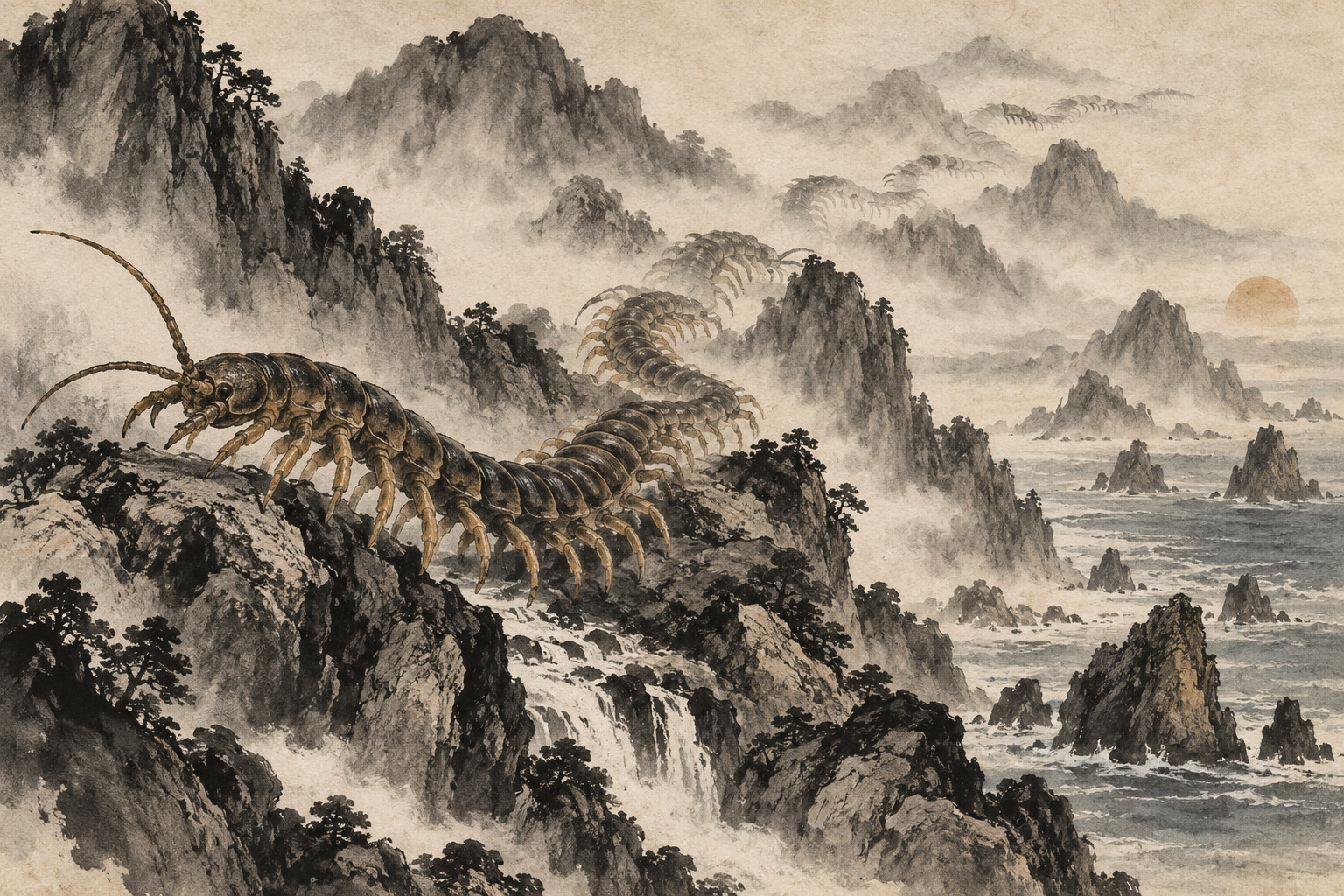
A flightless predator one or two centimeters long appears poorly equipped for an ocean voyage. Yet beneath leaf litter and inside soil pores, Japan’s blind centipedes preserve evidence of journeys operating on radically different clocks. Some lineages may have occupied the edge of Asia before the Japanese landmass broke away. Others appear to have crossed water recently enough that populations on separate islands remain genetically almost indistinguishable.
Taro Jonishi, now a Japan Society for the Promotion of Science research fellow, and Kyoto University associate professor Takafumi Nakano examined Japanese members of Cryptops, one of the world’s most diverse and widespread centipede genera. Their combination of morphology and mitochondrial and nuclear DNA found six species in Japan, including three previously undescribed forms. One has now been formally named Cryptops dupliporus, or yasoana-menashi-mukade in Japanese.
The paper, published online in Invertebrate Systematics on August 28, draws on approximately 80 specimens from about 30 locations between Honshu and the Nansei Islands. The researchers compared their sequences with overseas records and estimated when common ancestors diverged. Kyoto University announced the results on September 8.
Some of the deepest lineages were estimated to originate around the Cretaceous. That is the age of separation from an ancestral lineage, not necessarily the date on which a centipede arrived in Japan. The study therefore treats lineage origin and colonization of the archipelago as different clocks.
Why blind centipedes are historical instruments
More than 3,000 centipede species are known worldwide. Cryptops alone contains more than 150. Most members of the genus are small, eyeless predators associated with soil, litter, rotting wood and other humid cover. They do not fly, and desiccation limits their exposed travel. Those constraints make a sea channel a substantial barrier—and make the rare successful crossing evolutionarily consequential.
Until this study, Japan had records for only four named Cryptops species, all described in the 1930s and seldom encountered afterward. Jonishi and Nakano confirmed three of those species and reassessed the anatomical features used to identify them. They also found three putative undescribed species, of which one received the complete comparative description and scientific name required for formal recognition.
The Japanese name yasoana-menashi-mukade refers to a striking feature near the rear of the animal: roughly 80 glandular pores along the sides of the final trunk segment. The other two candidate species remain “undescribed.” That term is deliberately provisional. A specimen that looks unfamiliar does not become a new species until its distinguishing characters, comparisons, type material and name are published.
A ninety-year taxonomic gap
The work reconnects molecular biology with an older Japanese scientific tradition. Myriapodologist Yosioki Takakuwa undertook foundational studies of Japanese centipedes and millipedes during the early twentieth century. Cryptops japonicus was established in 1934, and C. striatus in 1936. Another species central to the new analysis, C. navis, was named by the American zoologist Ralph Vary Chamberlin in 1930 but was not recorded from Japan until Jonishi and Nakano reported specimens from Tokashiki and Minamidaito islands in 2020.
Classical taxonomy read history from grooves, pores, plates and legs. The new study does not discard those characters; it tests them against a family tree built from mitochondrial and nuclear markers. A name can then be evaluated in two ways: whether specimens share the diagnostic anatomy and whether their DNA supports a distinct evolutionary lineage.
The residents older than the islands
Cryptops japonicus, the Japanese blind centipede, occurs from Honshu to Taiwan. Its closest relatives in the analysis came from elsewhere in Asia and Oceania. More important than that geographic affinity was the deep genetic separation among Japanese localities. Molecular dating suggested that the lineage has been present in the region for more than 20 million years—before the Japanese archipelago achieved its present separation from the continent.
Geological Survey of Japan summaries place the main expansion of the Sea of Japan roughly 20 million to 15 million years ago. Northeastern and southwestern Japan rotated and moved as the back-arc basin opened. If a soil lineage already occupied the continental margin, populations could have been carried apart with fragments of land. The sea did not have to be crossed; it formed between descendants of a once broader population.
Cryptops striatus, found in part of eastern Japan, produced another ancient-looking pattern. It was related to blind centipedes in Europe and North America. Comparable disjunctions occur in other Northern Hemisphere soil organisms: a formerly broader distribution may be broken into distant remnants by climate change, tectonics and extinction between surviving pockets. The phylogeny supports such a relict interpretation, but present sampling cannot reconstruct every vanished population or exact land route.
The island populations that look too similar
The contrast with Cryptops navis—futamata-menashi-mukade in Japanese—is sharp. Specimens from the Nansei Islands and Taiwan showed almost no within-species genetic variation. Long-isolated populations normally accumulate different mutations. Near identity across islands instead suggests recent expansion or continuing movement.
One mechanism is oceanic dispersal. A centipede could travel inside a clump of soil, root mass, log or vegetation raft pushed by currents and storms. Some centipedes are known to survive saltwater drift, making the idea biologically possible. But a second mechanism fits the data too: people routinely move soil, potted plants, agricultural materials and freight among islands. A small subterranean animal could travel unnoticed.
DNA can show that separation is shallow; it cannot by itself label the carrier “current” or “cargo.” Demonstrating natural rafting would require ecological evidence such as salt-tolerance experiments, current-compatible source populations, colonization timing older than relevant trade, or direct evidence of transport. Demonstrating human introduction would likewise require source matching and a plausible pathway.
A close but still unnamed relative found in the Yaeyama Islands and Taiwan complicates the picture productively. Unlike C. navis, it is deeply differentiated from island to island, indicating that gene flow has been cut off for a long time. Two close relatives therefore appear to occupy opposite dispersal regimes. One may still travel; the other may have lost that ability or simply lost opportunities to use it.
| Lineage | Genetic signal | Leading historical interpretation | Still unresolved |
|---|---|---|---|
| C. japonicus | Deep differences among localities | Persistence for more than 20 million years | Precision of route and arrival date |
| C. striatus | Related to European and North American lineages | Fragments of an old Northern Hemisphere range | Locations of extinct connecting populations |
| C. navis | Minimal variation across southern islands and Taiwan | Recent oceanic or human-assisted dispersal | Current versus cargo |
| C. dupliporus | A distinct newly named species | Found in a central Tokyo park | Native range and introduction status |
A new species in central Tokyo
The discovery site of Cryptops dupliporus adds a modern layer to the story. It was collected not in an undisturbed mountain forest but in an urban park. City green spaces can preserve native pockets after surrounding habitat disappears. They can also be receiving terminals for organisms imported with landscaping soil and plants.
New to science therefore does not mean native to Japan, endemic to Tokyo or recently evolved. The animal may have lived unnoticed in the region for a long time, or it may be an introduced species whose source population has not yet been sampled. The way to discriminate is larger-scale collecting. A genetically diverse population elsewhere and a uniform Tokyo offshoot would support introduction; deep, old diversity around Kanto could favor persistence.
What a molecular clock can—and cannot—tell time
Phylogeography uses DNA variation as a historical record. Researchers arrange sequences into a tree, then estimate divergence times using assumptions about mutation rates and calibrated evolutionary events. Deep branches and strong geographic structure can indicate prolonged isolation; shared or nearly identical sequences across distance can indicate recent movement.
Those dates are estimates, not timestamps embedded in a gene. Results depend on which markers and specimens are sampled, the evolutionary model, calibration and whether populations went extinct before anyone could collect them. Morphology, geology and distribution provide independent checks. The strongest inference is the one that explains all of them with the fewest unsupported steps.
That is why the headline’s sea crossing is plural. Some ancestors reached what would become Japan without crossing the present sea because the land was still attached to Asia. Some may have moved along former land connections at other times. A few may have rafted between islands. Others may have crossed only after humans began carrying entire miniature soil ecosystems.
1930–1936 — The named species at the center of the study enter taxonomic literature.
About 20–15 million years ago — The Sea of Japan expands and Japanese landmasses separate from continental Asia.
2020 — Cryptops navis is reported from Japan for the first time.
August 28, 2026 — The six-species, multiple-origin analysis is published online.
September 8, 2026 — Kyoto University announces the findings.
Small animals, large conservation consequences
Soil invertebrates are easy to overlook in biodiversity surveys. They are also easy to misclassify when distant lineages retain similar external forms. If a widespread “species” contains deeply isolated genetic units, destroying one forest or island population can erase an irreplaceable piece of evolutionary history even when the name survives elsewhere.
The reverse problem matters too. If a newly detected lineage arrived through horticulture or freight, managers need to know whether it competes with native predators or alters the soil food web. Neither rarity nor novelty automatically establishes conservation priority. Accurate taxonomy and origin are the information layer beneath those decisions.
Jonishi described the samples as difficult to assemble and said their analysis revealed an unexpectedly complex history. That complexity is the result, not noise to be simplified away. Japan’s soil fauna was assembled repeatedly: by continental inheritance, geological fragmentation, rare dispersal and possibly modern commerce. A creature without eyes or wings has become a witness to an archipelago that never stopped moving.
- Cryptops: A globally distributed genus of mostly small, eyeless centipedes in the family Cryptopidae.
- Relict lineage: A surviving fragment of a group that once occupied a broader range.
- Oceanic dispersal: Movement across a sea barrier, often on vegetation, wood or other floating material.
- Undescribed species: A potentially distinct species that has not yet received a complete published diagnosis and scientific name.
- Kyoto University, “The long journey of centipedes across the sea,” September 8, 2026 — authors, sampling, species, interpretations and stated uncertainties.
- Jonishi and Nakano, Invertebrate Systematics, 2026, DOI: 10.1071/IS26025 — original taxonomy and phylogeographic analysis.
- Jonishi and Nakano, “First records of a blind centipede, Cryptops navis, from Japan,” 2020 — the species’ first Japanese records.
- Geological Survey of Japan, “Opening of the Japan Sea,” 2017 — timing and tectonic context of Japan’s separation.
- Ehime Prefecture Red Data Book, overview of arachnids and myriapods — historical context for Japanese myriapod taxonomy.
Editorial note: Japanese names, titles, affiliations, vernacular species names and technical terminology were checked against Kyoto University’s Japanese materials and the original paper record. Ocean rafting, human introduction and alien status are presented as hypotheses or open questions, not observed facts.