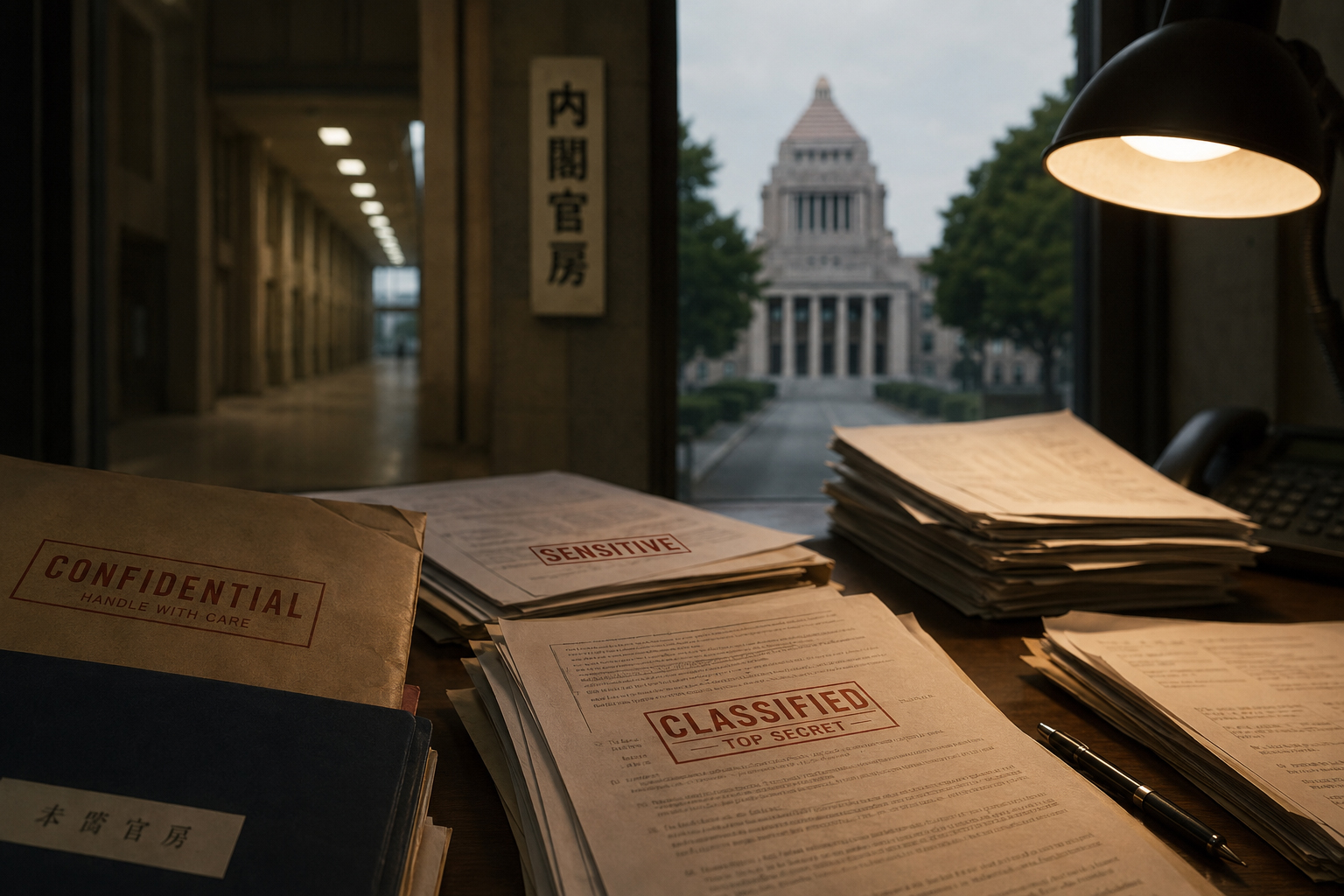
The Cabinet Secretariat mishandled 9,424 sets of administrative documents containing specially designated secrets, according to a Japan Times report. On its face, that is a document-management failure. But in Japan, where the state secrets law has been controversial since its birth, the number carries a deeper question: if the government asks society to accept powerful secrecy rules, how carefully does the government itself handle the secrets?
The problem is not simply that a folder went to the wrong shelf. The Cabinet Secretariat sits near the center of Japanese government coordination, crisis response, security policy and intelligence handling. If specially designated secrets were mishandled there in large numbers, the issue touches not only bureaucracy but public trust.
What are specially designated secrets?
Japan’s Act on the Protection of Specially Designated Secrets was enacted in 2013 and came into force in 2014. It allows the heads of administrative organs to designate certain undisclosed information as specially protected if its unauthorized disclosure could seriously damage Japan’s national security. The covered areas include defense, diplomacy, counterintelligence and counterterrorism.
The logic behind the law is understandable. Modern states cannot operate without protecting sensitive information. A country that cannot safeguard secrets will struggle to receive sensitive intelligence from allies, protect military planning, defend cyber networks or manage diplomatic crises. In that sense, secrecy is not the opposite of democracy. It is one of the uncomfortable tools democratic states sometimes need.
But secrecy can also become a democratic danger. If too much information is hidden, voters cannot judge government performance. If the government alone decides what is secret, for how long, and with what oversight, secrecy can become a shield for mistakes, not just a shield for national security.
The law was controversial from the beginning
When the state secrets law moved through the Diet, Japan was not only debating information security. It was debating the memory of wartime state control, the strength of postwar transparency, the role of journalism, and the old habit of trusting bureaucracies to police themselves.
The government argued that the law was necessary for international intelligence sharing and national security. Critics warned that its categories were broad, its oversight insufficient, and its penalties severe enough to chill reporting and whistleblowing. International press-freedom and human-rights groups also raised concerns. The law became a test of how Japan would balance a tougher security environment with civil liberties and democratic accountability.
Why 9,424 matters
A single misfiled document can be a mistake. Thousands of mishandled document sets suggest something more systemic: a procedure that became routine, a handoff that failed, a registry that did not match reality, a training culture that did not keep pace with the seriousness of the information.
At this stage, mishandling does not necessarily mean disclosure to an outsider. It does not automatically mean espionage, leakage or public harm. But with specially designated secrets, the system is supposed to be strict by design. Who created the document? Who copied it? Who saw it? Was it logged? Was it stored correctly? Was it transferred properly during personnel changes? Was it digitized, printed, destroyed or archived according to rules?
These are not glamorous questions. They are the foundation of state capacity. Japan’s bureaucracy has long governed through documents: deliberation records, approval sheets, cabinet materials, policy drafts, question-and-answer notes for Diet sessions. If the documents are disorderly, governance itself becomes disorderly.
The Defense Ministry shadow
The Cabinet Secretariat case also arrives after several years of information-management problems in Japan’s security establishment. In 2024, Defense Ministry and Self-Defense Forces scandals involving specially designated secrets, harassment and allowance issues led to major disciplinary action and senior-level consequences.
Japan’s security environment is becoming more demanding. China, North Korea, Russia, Taiwan, cyber operations, drones, space, undersea cables and AI all require more sensitive information, not less. But more secrets require a more mature management culture. A country cannot simply classify more information and assume that the old administrative habits will carry the load.
The trust account of government
Every secrecy system operates on a trust account. Citizens cannot see everything, so they deposit a certain amount of trust in the state. In return, the state is expected to classify information narrowly, protect it rigorously, submit to oversight, preserve records and explain as much as it can when something goes wrong.
Improper document handling withdraws from that account. Even if no secret leaked, citizens may ask: why are penalties severe for leakers, while administrative failures are described in softer language? Why does the state demand public trust if its own systems are careless? Why should journalism and whistleblowing face anxiety if internal accountability is weak?
International comparison
Most democracies have classified-information systems. The United States, Britain, Australia, South Korea and others all protect national-security information. But the stronger the classification system, the more important the counterweights become: parliamentary or congressional oversight, inspectors general, archives rules, declassification procedures, independent review, internal reporting channels and protection for legitimate whistleblowing.
Japan’s challenge has often been less the existence of secrecy than the culture around post-fact explanation. Administrative document alteration, deletion and incomplete preservation have damaged public trust in recent years. When the subject is specially designated secrets, the public cannot easily check the underlying facts. That makes credible oversight even more important.
The questions that should follow
| Question | Why it matters |
|---|---|
| Scope | Were the 9,424 sets concentrated in certain departments, years or policy areas? |
| Nature | Did mishandling involve storage, registries, copying, viewing logs, disposal, transfer or digital access? |
| Damage | Was there external leakage, unauthorized access, loss, mistaken destruction or improper duplication? |
| Responsibility | Was this individual error, organizational procedure failure, or a system-design problem? |
| Reform | Will training, auditing, staffing, digital controls and Diet reporting be strengthened? |
From paper cabinets to digital trails
Secret information is no longer only paper in a locked cabinet. It moves through email, shared drives, encrypted files, printers, access logs, backup systems and identity permissions. Digitization can improve control, but it can also multiply mistakes. One wrong permission setting can expose more material than a misplaced folder ever could.
Japan’s administrative culture still carries habits from the paper era. The challenge now is to combine that documentary discipline with modern access control and genuine auditability. Security is not a stamp on a folder. It is a living system of people, logs, rules and consequences.
Japan.co.jp view
This story should not be consumed as a simple anti-government headline. States have real secrets to protect. Soldiers, diplomats, informants, infrastructure operators, intelligence partners and citizens all depend on responsible information security.
But the more Japan becomes a national-security state, the more it needs democratic discipline. “It is secret” cannot be the end of the explanation. When failures occur, the government must say what happened, why it happened, how far it reached, and how it will be fixed — while protecting only the details that genuinely require protection.
The number 9,424 is a quiet warning. Japan is trying to become more capable in a harsher strategic environment. That requires not only stronger secrecy powers, but better recordkeeping, stronger oversight and a culture that treats documents as part of democracy itself.
Documents are the memory of government. Secret documents are among the state’s most serious memories. A country that handles those memories carelessly cannot build durable national security.
Sources and references
- The Japan Times: Cabinet Secretariat improperly handled 9,424 sets of administrative documents containing specially designated secrets.
- Japanese Law Translation: Act on the Protection of Specially Designated Secrets.
- The Japan Times Editorial: Protecting information as a national-security issue.
- Committee to Protect Journalists: Criticism of Japan’s state secrets law and chilling-effect concerns.
- Japan Forward / Sankei: 2024 Defense Ministry-related specially designated secrets and misconduct cases.