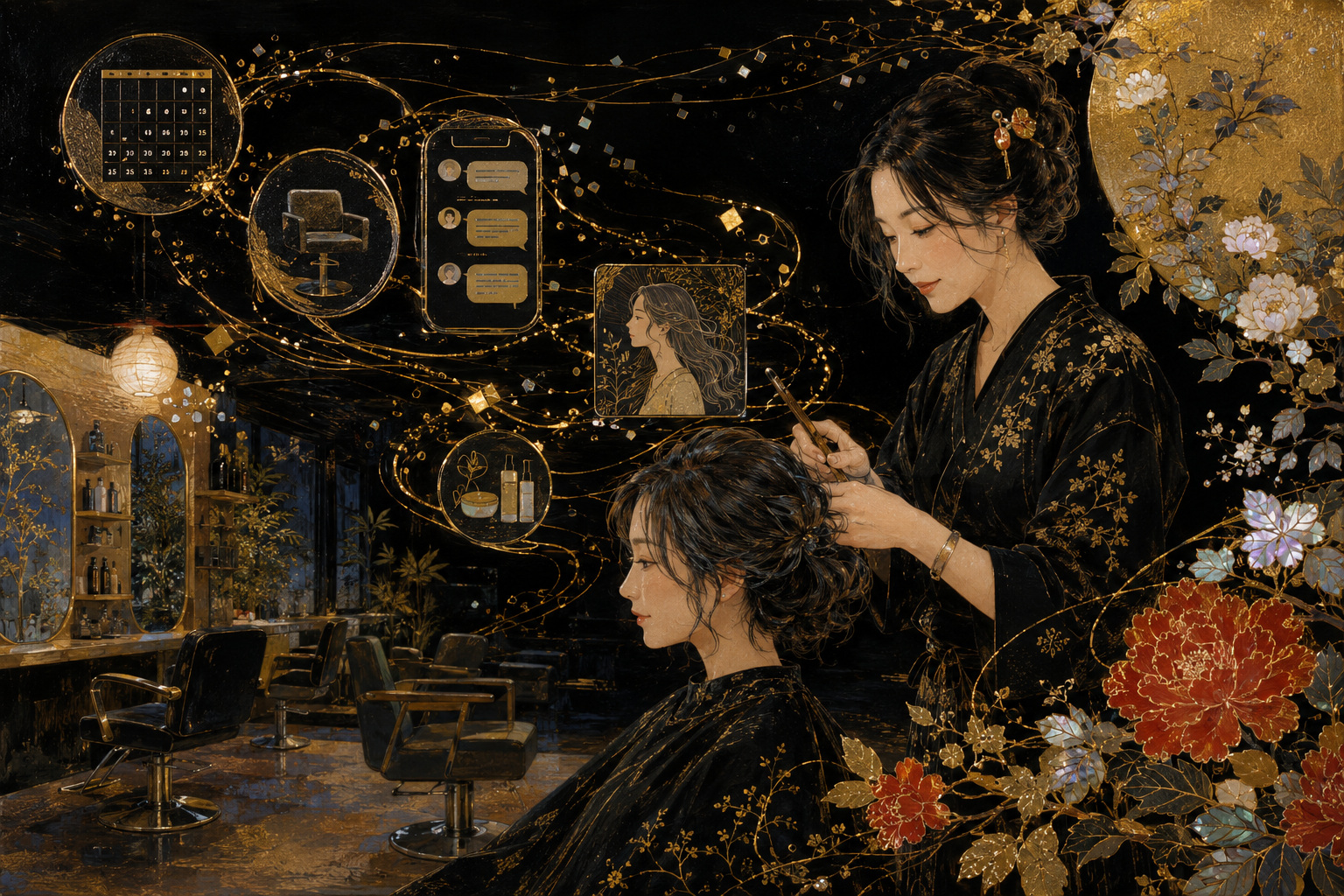
It is 8:30 in the evening at a small salon near a railway station. The final client rises from the mirror. Her stylist sweeps the hair, collects the towels and closes the till. Then comes the other job: open a phone, think up a midsummer scalp-care offer, find a photograph, and choose whether to send it to clients absent for three months or those who usually come on weekday afternoons. Work that a chain might give to a marketing department falls to the same hands that held the scissors.
SCAT Inc., headquartered in Oyama, Tochigi Prefecture, wants software to take on some of that after-hours shift. Its new “AI Automatic Customer Acquisition” feature, released for sale on Aug. 5, generates customer-facing text and images. Linked to the company’s Halca -connect- cloud POS and customer-relationship system, it can use client information and visit records to automate outreach to selected audiences.
This is not a spectacular AI announcement from a giant platform. SCAT was established in 1969. Its website lists 138 employees as of October 2023 and consolidated sales of ¥2.595 billion for the year ended October 2024. It is listed in Tokyo and Nagoya, yet remains a small specialist by public-company standards. SCAT says its systems have been installed at about 5,600 salon companies and account for roughly 30% of customers using salon POS systems. Those are company figures, not government market measurements, but they make the story unusually intimate: a small technology supplier building tools for very small local businesses.
A salon has always been a business of memory
A hairdresser sells more than a single cut. How short was the fringe last time? Which color formula was used? Is the scalp sensitive? Does the client enjoy conversation or prefer quiet? A person sits before a mirror and entrusts the salon with her body, appearance and fragments of her life. The feeling that somebody remembered can be as powerful as technical skill in bringing her back.
For decades, that memory lived in a paper appointment book and a client card. Name, phone number, visit date, service, chemical formula, price, stylist and the likely time of return. A color pencil might record the shade; a photograph might be attached; warnings went in the margin. Long before “customer relationship management” became standard business language, a local salon already possessed a handmade CRM database.
Paper has limits. Only one person can comfortably use an appointment book at a time. The files occupy more room as the clientele grows. One card is richly informative, but patterns across a thousand cards are hard to see. Counting the normal return interval or sales by stylist means manual work. In its March launch note for Halca, SCAT itself argued that technical cards become harder to store and retrieve as visits accumulate and must be managed carefully because they contain personal information.
Licensing and hygiene built the modern shop
Japan’s contemporary beauty trade rests on the Beauticians Act of 1957. The law defines beauty work as improving appearance through permanent waving, hairdressing, cosmetics and related methods; it restricts professional practice to licensed beauticians. A beauty establishment must be notified to local authorities and inspected before use.
That legal structure treats a salon as more than a fashion space. It is a hygiene-regulated business that handles blades, chemicals and close bodily contact. Salons multiplied with postwar prosperity, the adoption of perms and coloring, and changes in women’s work and consumption. The health ministry counted 277,752 registered beauty establishments at the end of fiscal 2024—3,682 more than a year earlier, an increase of 1.3%.
Abundance also means a contest for chairs. A health-ministry paper citing a Japan Finance Corporation survey for January–March 2024 found that 52.3% of beauty businesses named declining customer numbers as a management problem. Another 27.4% cited difficulty passing higher purchasing and labor costs into prices; 24.6% cited lower spending per customer. When demand weakens, a shop discounts. When it discounts, the margin shrinks. That loop is especially dangerous for the owner with two chairs and no finance department.
How the till became a map of the relationship
SCAT’s corporate history doubles as a compact history of salon computing in Japan. A predecessor entered beauty-specific computers in the 1980s. In 1990 it launched the touch-screen NAVI-YOU customer-management system. A Windows version followed in 1996; web reservations using an application-service-provider model in 2001; email and reservation promotion services in 2007; iPad input in 2013; cloud support in 2014; and a salon smartphone app in 2016.
1957 Japan enacts the Beauticians Act
1980s A SCAT predecessor enters salon-specific computing
1990 Touch-screen NAVI-YOU customer management
2001 SCAT markets ASP-based web reservations
2007 Hot Pepper Beauty launches online booking; SCAT expands web promotion
2014 SCAT launches its cloud-based Sacla system
March 2026 Halca -connect- goes on sale for use with one iPad
Aug. 5, 2026 AI Automatic Customer Acquisition goes on sale
A POS records a sale. In a salon, it can also record who came, when, for which treatment, with which stylist and at what price. Add reservations and technical records, and the system can reveal return cycles, nominations, cancellations and retail-product purchases. The till ceases to be the endpoint of a transaction and becomes the starting point for thinking about the next visit.
The important fact is that the useful structure predates AI. Generative software does not invent a relationship from nothing. Targeting has value only if a shop has spent years accurately recording appointments, services, return intervals, permissions and contact details.
Coupon media turned the stylist into an advertiser
New customers once came through the sign outside, neighborhood reputation, referrals, the telephone directory and paper leaflets. Local trust grows slowly, but can be durable. In the 2000s, free magazines and search portals reorganized salon discovery. Consumers could compare price, location, style photographs and available time slots on one screen. Recruit’s corporate history records the launch of Hot Pepper Beauty’s online-reservation service in 2007.
The convenience altered the salon’s labor. Somebody had to name every menu, photograph styles, refresh coupons and answer reviews. The smartphone era added Instagram, LINE, Google Maps and short video. The independent stylist became not only a craftsperson, listener and trainer, but also a photographer, copywriter and ad operator.
Platforms can open the door to first-time customers. They can also intensify price comparison and create dependence on listing or referral costs. A salon-owned CRM is a counterweight: it lets the business invite people with whom it already has a relationship to return in its own voice. But that produces an essential distinction. Outreach to an existing list is principally retention or reactivation. Finding a genuinely new customer who has never heard of the shop still requires reach through search, maps, referrals, advertising, social media or another external channel.
What, precisely, is being automated?
The Aug. 5 announcement describes three layers. First, a salon supplies the purpose and content of a campaign, and AI generates customer-facing copy. Second, it produces a campaign image. Third, the feature links with Halca -connect-’s CRM and uses customer information and visit histories to automate approaches to an audience suited to the campaign’s purpose.
| Campaign | Possible data-based audience | Human check |
|---|---|---|
| Time to return | Clients beyond a normal interval after a service | Is the visit truly overdue, and does the wording pressure them? |
| Empty slot | Clients with a history of that weekday or time | Does the discount leave a margin? Is contact too frequent? |
| Dormant client | People absent for a defined period | Exclude opt-outs, complaints, errors and inappropriate records |
| Related service | Interest inferred from prior treatments or purchases | Avoid sensitive inference about health, age, gender or appearance |
| Birthday or season | Consented attributes plus visit history | Purpose, accuracy, deadline, conditions and generated claims |
The practical value may be less about producing brilliant advertising than removing the terror of the blank screen. If usable draft text, a headline and an image appear in seconds, a stylist can edit rather than create from zero. For a one-person salon, that difference can determine whether regular communication happens at all.
Yet the release omits specifications a buyer should need. It does not identify the model or provider, how much client data enters a prompt, whether inputs are used for model training, whether they are processed overseas, whether campaigns can send without human approval, how an erroneous send is stopped, what audit logs exist, what the feature costs or how records can be exported to another system.
Measure incremental profit—not bookings alone
If ten reservations arrive after a campaign, the AI did not necessarily cause ten. Six clients might have booked anyway. Two may merely have switched to a cheaper coupon. One may fail to appear, while the discount and campaign cost on the remainder exceed the gross profit from the visit.
The cleanest practical test is to divide similar eligible clients at random into a send group and a no-send holdout group. After a fixed period, compare not only reservations but attended visits, revenue, gross margin, subsequent return, opt-outs and complaints. The difference is the incremental effect. The same discipline applies when comparing AI copy with words written by a person.
- Delivery, open, click and booking rates.
- Attendance, cancellation and no-show rates.
- Gross margin after discount, materials and staff time.
- Incremental bookings and profit versus a holdout group.
- Repeat visits after 30, 90 and 180 days.
- Opt-outs, complaints, incorrect personalization and corrections.
“The empty chair was filled” is an appealing success story. But moving an existing client from a busy full-price slot to a discounted quiet slot may not increase total profit. Conversely, even a modest booking effect can have value if a weekly two-hour copy-and-image chore falls to 20 minutes. Marketing lift and labor savings should be measured separately.
What does an AI infer when it chooses a client?
Visit histories look like ordinary commercial records. Treatment names can nevertheless expose or suggest hair texture, graying, hair loss, age, gender expression, religious dress, a wedding, pregnancy or changes associated with medical treatment. Using those details to classify a person beyond the purpose she expected can damage the intimacy on which the business relies.
Under Japan’s Act on the Protection of Personal Information, the salon remains responsible for specifying purposes, limiting use, securing information and supervising contractors. If an outside cloud or generative-AI provider processes the data, “the vendor handles it” is not an answer. Contracts and product screens should say who controls the data, what SCAT and any model provider process, how long they retain it, and who reports an incident.
Targeting should favor the minimum direct signals needed—an actual past service, an expressed preference, a visit interval—over crude assumptions based on age or sex. Campaigns should not infer pregnancy, illness, hair-loss treatment or economic difficulty. Mistaken intimacy is more disturbing than an obviously generic mass email.
Automation must remember how to stop
A contact list is an asset to the salon, but the address belongs to the client. People need to choose how they are contacted and stop it easily. Appointment confirmations should not be bundled invisibly with promotional consent. Preferences should be manageable by channel: email, LINE, app notification and any other route.
Automation excels at remembering to send. It must be equally good at remembering not to send. Opt-outs, complaints, deceased customers, incorrect records and sustained nonresponse need to feed suppression lists. Frequency caps should apply across campaigns, not just within one message series. A salon touches the body and hears personal conversations. If its follow-up feels like mechanical surveillance, unease will outrun convenience.
Humans keep responsibility for generated advertising
AI images can remove a photo-production chore, but beauty advertising makes illustration look like a promised outcome. A system can invent impossible gloss, an unattainable color, somebody’s face or trademark, an unlicensed character, or equipment the salon does not own. Adding “image for illustrative purposes” in tiny type does not automatically correct the overall impression.
Japan’s Consumer Affairs Agency explains that a misleading representation can violate the Act against Unjustifiable Premiums and Misleading Representations even when it was made by mistake. AI authorship is no defense. A person must verify treatment results, price, period, conditions, responsible stylist and products used, then retain the published version and evidence supporting its claims.
Text creates the same risk. If a model proposes “guaranteed,” “complete,” “No. 1 in the area” or a medical-sounding promise without support, the salon—not the machine—publishes it. A safe product should flag prohibited wording, require price and deadline fields, restrict imagery to approved brand assets, preview the final message and permit two-step approval. SCAT’s release does not say whether these controls exist.
Escaping one platform can create another lock-in
Bringing repeat marketing into a salon-owned CRM may reduce dependence on a dominant booking portal. But as POS, appointments, technical notes, consent and promotion concentrate in one provider’s cloud, switching becomes harder. Can the shop export complete records? How long are they retained after cancellation? Can staff see tomorrow’s appointments during an outage?
An independent salon does not need an enterprise IT department. It needs understandable pricing, portable data, reachable support and a paper fallback when systems fail. If the reservation ledger, till and client cards stop, the salon stops. A buyer should ask about uptime, backup, recovery, permissions and export before being dazzled by the generation screen.
Old, specialized and still small: the company behind it
SCAT is not a new AI startup. Its lineage began in 1969 with support for small and medium businesses; its beauty-technology operations date to the 1980s. It listed in 2016, adopted the SCAT name in 2023 and added a Nagoya listing in 2025. Capital of ¥200 million and 138 staff make it small beside the national chains and global technology companies, although the responsibility of hosting operational systems is not small.
The company’s advantage may lie less in novelty than in having watched salon accounts, appointments, technical cards and return cycles for decades. Its product line moved from the dedicated salon computer to touch screens, web reservations, promotional email, cloud services and mobile apps as each layer of work went digital. AI Automatic Customer Acquisition is not a sudden break. It is a generative layer added to customer-promotion software SCAT has sold in some form since before 2011.
That history should raise the standard of explanation. Which data are used? Where do they go? Where must a person approve? How is failure measured? If the claimed base of 5,600 salon businesses is real, a small design choice can reach many independent shops—and the daily lives of their customers.
Trust, finally, fills the chair
A salon chair resembles perishable inventory. If two o’clock this afternoon goes empty, it cannot be stored and sold tomorrow. That makes accurate timing and relevant outreach valuable. AI can speed the production of copy and imagery, find candidates in a long customer list, and turn forgotten follow-up into a repeatable routine.
But a notification is not why the client ultimately returns. The salon remembers the last color, explains the price, keeps her waiting time short, corrects a mistake, remembers what she does not want discussed and refuses to oversell. A salon’s CRM is a database only after it is a record of those promises.
SCAT may have placed a useful tool in the hands of the little guy. We do not yet know whether that tool gives time back, produces incremental profit or protects trust. The evidence should be holdout-adjusted profit, opt-outs, corrections, complaints and minutes a stylist can return to the person in the chair—not the number of pieces of copy generated.
Late at night, after sweeping the last hair, a stylist may read the AI draft once, change its words and press send. That final human step is not a failure of automation. It is a sign that in a neighborhood business, responsibility for deciding who speaks to whom still belongs to a person.
Reporting notes and principal sources
This article is based on public information checked through Aug. 5, 2026 at 9:41 a.m. JST. Because the feature had just gone on sale, we do not treat effects on booking, revenue or profit as proven. SCAT’s installation and share figures are clearly attributed as company claims.
- SCAT: AI Automatic Customer Acquisition launch, Aug. 5, 2026
- SCAT: Halca -connect- launch, March 2026
- SCAT: company outline and chronology
- SCAT: history of its salon systems
- SCAT: sales, installations and market-share claims
- Ministry of Health, Labour and Welfare: FY2024 Report on Public Health Administration
- Health ministry: current state of barber and beautician systems
- Health ministry: overview of the beauty business
- e-Gov: Beauticians Act
- Recruit: corporate history and Hot Pepper Beauty online booking
- Personal Information Protection Commission: APPI general guidelines
- PPC: limits on contractor matching of customer data
- Consumer Affairs Agency: misleading representations
- Health ministry: beauty-industry conditions and management improvement