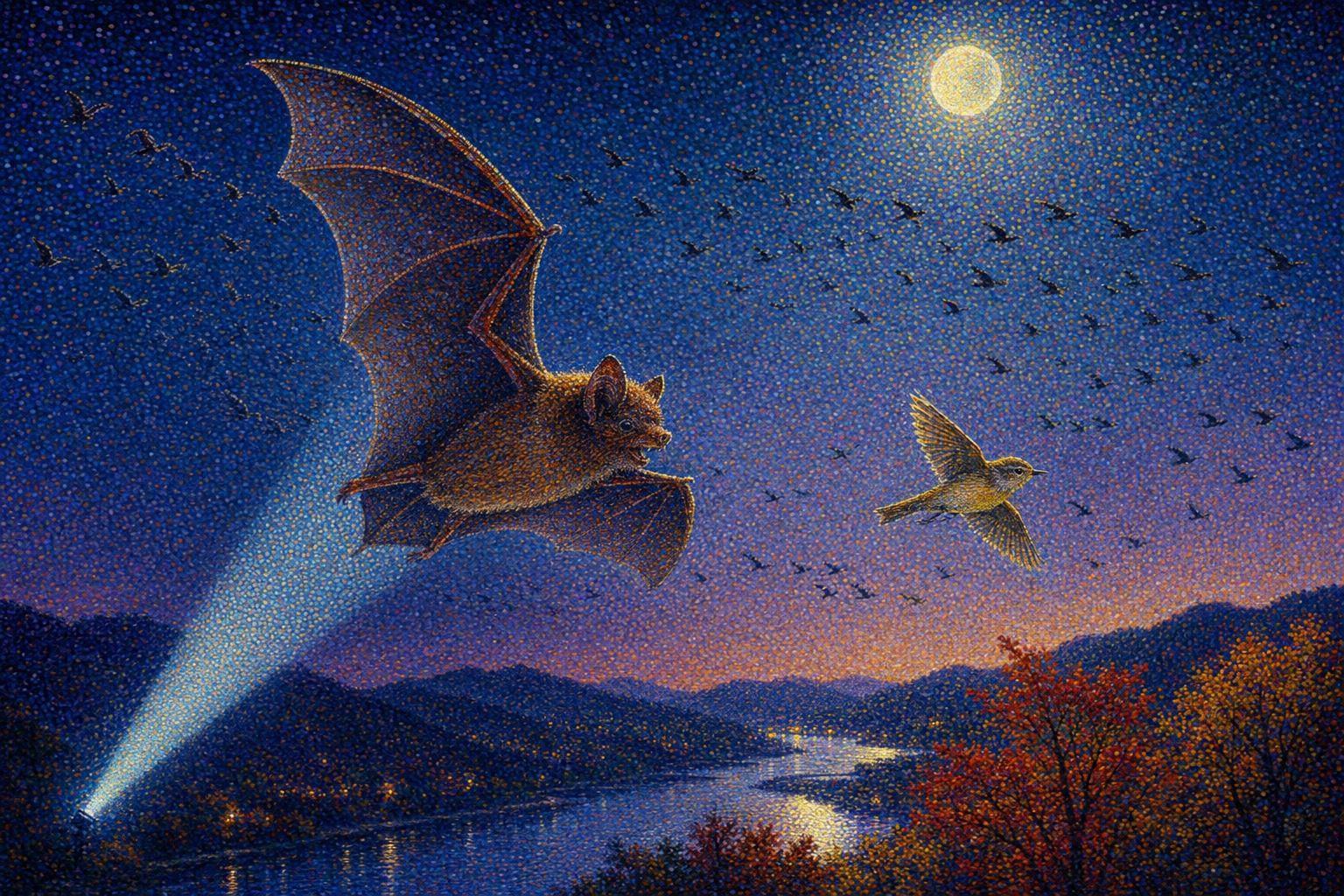
Two flying bodies appear in a dark sky. One is a small bird moving through the autumn night. The other is a mammal flying not on feathers, but on skin stretched between elongated fingers. Their paths overlap. Direction changes, distance collapses, and the larger shadow closes around the smaller one. In October 2023, researchers watched a birdlike noctule chase and seize a migrating bird in the air—turning a long-standing hypothesis into a visible event.
The team included Associate Professor Dai Fukui of the University of Tokyo’s Graduate School of Agricultural and Life Sciences; Emyo Fujioka, an agricultural specialist at the same school and research fellow at Doshisha University’s Research Center for Acoustic Navigation; Doshisha Professor Shizuko Hiryu; and community specialists in bats and migratory birds. Their paper, “Bats attack birds in the air,” appeared in the Ecological Society of America journal Ecology on July 19, 2026.
The researchers spent eight nights at an undisclosed site where large numbers of small birds pass during autumn migration. A searchlight, digital cameras, infrared cameras and thermal imaging were combined to scan airspace up to roughly 150 meters. They recorded 56 cases in which birdlike noctules pursued flying birds. Twenty-two became capture attempts; six ended with the bat taking the bird. In 33 pursuits, observers could identify the bird species.
Japanese bush warblers were most frequent, with 15 records, followed by nine black-faced buntings and four grey buntings—mostly birds under about 30 grams. Bats also followed larger eyebrowed thrushes and white-bellied green pigeons, but attacks were seen only against smaller species such as bush warblers and buntings. When one bat dropped a captured bush warbler, the team recovered the carcass. DNA on the wound identified the attacker as a birdlike noctule, joining the visual record to molecular evidence from the same event.
A large bat and a small migrant
The birdlike noctule, Nyctalus aviator, is one of Japan’s largest insect-eating bats. Its wingspan is about 40 centimeters and its mass roughly 40 grams, although regional records give a broader adult range of 26 to 60 grams. It normally roosts in cavities of mature trees and sometimes uses nest boxes, buildings or slots beneath railway viaducts. British zoologist Oldfield Thomas described the species scientifically in 1911.
Its Japanese name, yama-kōmori, may suggest an animal confined to remote mountains. The important ecological clue is its ability to fly fast through open air. Long, relatively narrow wings and powerful, low-frequency echolocation calls suit wide searches more than delicate maneuvering through dense leaves. For most of the year, it hunts flying beetles, moths, flies and other insects.
Bats eating birds is not unknown. Large tropical carnivorous bats sometimes take resting birds from nests, branches or the ground. But only three temperate or subtropical species are known to exploit nocturnally migrating songbirds regularly: Europe’s greater noctule, Nyctalus lasiopterus; the East Asian birdlike noctule; and the great evening bat, Ia io, of South and East Asia.
These are not monsters built to eat birds every night. They are primarily insectivores that cross a dietary boundary seasonally. For brief periods in spring and autumn, rivers of small birds enter the night sky. The bats redirect sensory and flight machinery developed for aerial insects toward prey that is larger, more dangerous—and far more rewarding.
Bird migration is a river invisible from the ground
Many small passerines migrate at night. The schedule lets them feed during daylight, travel in cooler air that reduces water loss, take advantage of stable winds and avoid many diurnal raptors. To a person on the ground, a great movement may exist only as faint flight calls. Yet on favorable nights, millions of birds can flow overhead.
Scientists learned to measure this invisible river indirectly. In 1941, unwanted echoes on British air-defense radar were visually confirmed as birds. David Lack and G. C. Varley were permitted to publish the fact in 1945. What military operators treated as clutter became the beginning of radar ornithology.
In 1951, American ornithologist George Lowery pointed telescopes at the Moon and counted tiny silhouettes crossing its face. The sampling circle was narrow, but coordinated observations converted the unseen migration into density and direction. Weather radar, microphones for flight calls, infrared and thermal cameras, and GPS later expanded that window.
A 2006 study aligned a vertical radar beam with a thermal camera, using heat images to count individual birds and radar to establish altitude. One instrument excelled at distance, another at shape. The 2026 Japanese study follows the same larger principle: darkness is not defeated by one perfect sensor. Visible light, near-infrared, heat, movement and expert species identification fill one another’s blind spots.
The “unknown sense” that began in 1793
Bats have their own two-century history of invisible evidence. In 1793, Italian naturalist Lazzaro Spallanzani was astonished that bats with covered eyes avoided obstacles in a dark room. Geneva naturalist Louis Jurine found that blocking their ears caused collisions and concluded that hearing substituted for sight. But without a way to measure sounds beyond human hearing, the mechanism remained unresolved.
In 1938, George Pierce and Donald Griffin detected bats’ ultrasonic emissions. Griffin and Robert Galambos linked cries, hearing and obstacle avoidance experimentally in 1941. Griffin used the word “echolocation” in 1944: an animal sends sound outward and reads distance, direction, strength and motion from the returning echo.
When an echolocating bat closes on an insect, pulse intervals shorten until the sequence becomes a rapid “feeding buzz.” A bird presents a larger acoustic target but a much harder capture problem. It is fast, maneuverable and winged; after contact it remains heavy and capable of resistance. The bat must detect, overtake, seize, disable and handle prey that may approach its own mass.
Ultrasound may also be a private sensory channel. If the bird cannot hear the hunting calls, it receives little warning that it has been detected. Yet the 2026 visual data do not establish whether wild birdlike noctules use echolocation alone, or combine it with wing sounds, bird flight calls or moonlight. Seeing a chase is not the same as recording the sensory decisions that began it.
In 2000, feathers in droppings broke the old story
The modern case for bird-eating bats began not with spectacular video but with feathers in feces. In 2000, Italian researchers examined 59 greater-noctule droppings and repeatedly found feathers from European robins and blue tits. The belief that these bats ate only arthropods was no longer tenable. But alternatives remained: perhaps feathers had been swallowed accidentally with insects, or perhaps the bats raided resting birds.
In 2001, Carlos Ibáñez and colleagues analyzed 14,000 droppings in Spain. Feathers peaked during spring and autumn migration and largely disappeared in summer. The seasonal match, together with the bat’s wings and echolocation design, supported aerial capture.
A 2007 stable-isotope study opened a different time window. A feather in feces records a recent meal; carbon and nitrogen signatures incorporated into blood and tissue integrate diet over longer periods. The isotopes supported a substantial shift from insects in summer to birds during migration, suggesting that songbirds could become a major seasonal resource rather than an incidental snack.
Still, every clue came from after the meal. It revealed what had been consumed without showing where or how the prey was caught. The feather was powerful evidence, but it resembled the final frame recovered from a missing film.
Japan’s chain of evidence: feathers, seasons and DNA
In 2013, Fukui and colleagues examined the birdlike noctule’s diet across seasons in Japan. Bird remains appeared in spring, autumn and early winter, but not summer. The European pattern had reappeared across the Palearctic, strengthening the idea that seasonal bird predation was not a local accident.
In 2019, DNA barcoding of feces collected in Hokkaido identified Middendorff’s grasshopper warbler in a pregnant birdlike noctule’s diet. The result came from a single positive sample and could not establish frequency, but the evidence had moved from “something resembling a feather” to a named prey species.
A 2021 analysis amplified DNA from feather remains and identified 14 bird species eaten by Japanese birdlike noctules. Most were nocturnally migrating passerines weighing about 5 to 25 grams. The diversity and migratory behavior were increasingly difficult to explain as accidental ingestion or opportunistic attacks inside cavities. High-altitude aerial hawking became the stronger hypothesis.
The 2026 study used DNA again, but reversed the logic. Earlier studies began with DNA in droppings and inferred behavior. This one first saw the capture, then used DNA from a dropped bush warbler’s wound to verify the hunter. Visual and molecular evidence met in one encounter.
Four kinds of eyes for seeing darkness
A searchlight reveals a slice of air and lets digital cameras record shape, plumage and relative position. Infrared cameras trace movement with light outside ordinary human vision. Thermal cameras separate warm animals from the colder sky. No single view reliably distinguishes a distant dot, insect, bird or bat. Combined imagery, trajectories, flight style and expert identification make the pursuit readable.
| Method | Best information | Main limitation |
|---|---|---|
| Searchlight and visible camera | Form, plumage, relative position and the capture moment | Narrow illuminated volume; light may influence behavior |
| Infrared camera | Continuous paths in darkness | Fine detail and species identification fall with distance |
| Thermal camera | Warm animals against the night-sky background | Cloud, humidity, altitude and target size alter detection |
| DNA | Identity of predator or prey from wounds and remains | Alone, it cannot reveal route or capture method |
The design’s strength lies in avoiding an impressionistic claim that a black shape “looked like a bat.” The team separated pursuit, attack and capture, identified birds in 33 events, and matched one recovered carcass to the predator molecularly. Cooperation between bat specialists and bird observers mattered as much as combining hardware.
Searchlight illumination is also an unnatural stimulus. Other research shows that intense artificial light can change the density and direction of nocturnal migrants. The public material does not quantify illumination effects in these individual chases. Future comparisons with passive acoustics and unilluminated thermal imaging could separate animal behavior from observer influence more completely.
Fifty-six pursuits reveal a choice
Following a bird was not equivalent to attacking it. Birdlike noctules approached larger eyebrowed thrushes and white-bellied green pigeons, but proceeded to attacks only against smaller birds such as bush warblers and buntings. The bat may evaluate size, speed, evasiveness and handling cost during pursuit.
For a bat weighing around 40 grams, a bird approaching 30 grams is enormous prey. The energetic calculation differs from chasing a moth. Success produces a rich meal; failure wastes fuel and risks collision, injury or losing the catch. Records in which a bat followed but did not attack suggest a decision stage rather than indiscriminate impact.
Six captures among 22 observed attacks yield a simple ratio of about 27 percent. That is not a species-wide hunting-success estimate. Only encounters entering the viewing volume could be counted. Pursuits above 150 meters, outside the camera direction or lost from view remain absent. The window covered one migration period, one location and eight nights.
Night-to-night variation was striking. Some nights produced no observations, while another produced nearly 50 predation-related behaviors. That could reflect bird density, weather, visibility or a shift in hunting altitude. A zero can mean nothing happened—or that the event occurred beyond the instruments.
The 2025 “direct evidence” and the 2026 “first visual evidence”
Two “firsts” must be distinguished carefully. In 2025, European researchers attached miniature biologgers to greater noctules. The devices recorded altitude, three-dimensional acceleration, echolocation and surrounding sound, producing direct evidence that bats pursued, caught and ate migratory birds in flight.
Among tags deployed on 14 bats, two detailed bird pursuits were recorded. One failed. In the successful event, the bat entered a long descending chase and captured a European robin. The bird’s distress calls were followed by 23 minutes of chewing sounds while the bat remained airborne. The sensors gave a remarkable bat’s-back view without producing an external image of the two animals.
The Japanese achievement in 2026 was different: researchers and external cameras visually followed predator and prey from pursuit through aerial capture. The European study offered the first direct multisensor biologging evidence; the Japanese study supplied the first visual documentation. The claims are complementary, not contradictory.
| Study | Animal and method | What it recorded directly | What remained hidden |
|---|---|---|---|
| Europe, 2025 | Sound, altitude and acceleration logger carried by a greater noctule | High-altitude pursuit, bird distress calls and 23 minutes of in-flight chewing | No external image of predator and prey together |
| Japan, 2026 | Searchlight, visible, infrared and thermal cameras, plus DNA | 56 pursuits, 22 attacks and six captures viewed from outside | Post-capture feeding and detailed echolocation were not recorded |
Aerial combat: find, overtake and carry
Aerial bird predation poses three barriers. The first is detection. In uncluttered air, a bird may provide a strong echo without leaves or ground reflections masking it, and a powerful low-frequency call can travel relatively far. The second is pursuit. A migrating bird may cruise on a steady heading but can turn sharply under attack, forcing the bat to accelerate and outmaneuver another accomplished flier.
The third is handling. Once seized, a bird close to the bat’s own mass adds drag and continues to struggle. Does the bat hold it in the feet, receive it in the tail membrane, or use its mouth to control the neck or torso? The new recordings demonstrate capture but do not establish where, how or in what posture the prey is eaten. The recovered bush warbler also proves that a successful grab can be followed by a failed hold.
The European study found bite marks and predator DNA on discarded wings, supporting the idea that greater noctules remove wings to reduce weight and drag. Whether Japanese birdlike noctules use the same technique is unknown. Close thermal or near-infrared images, bat-borne microphones and examination of remains will be needed rather than assuming that close relatives behave identically.
From insects to birds: evolution repurposed existing tools
Bird hunting probably did not appear as an entirely new design. Insects also migrate seasonally through temperate night skies. A bat already able to search open air at speed, detect large insects with low-frequency sonar and scoop prey with mouth or tail membrane possesses much of the necessary platform. A songbird is the difficult, nutritious target at the next scale.
Research on China’s great evening bat supports that transition. DNA metabarcoding identified 22 prey-bird species weighing 6 to 19 grams. A 2022 GPS, behavioral and genomic study found exceptional high-altitude and high-speed flight in autumn. In a dark flight room, bats emitted feeding buzzes and attacked suspended bird specimens; experiments favored active echolocation over vision or passive listening to bird calls.
The same work reported adaptive evolution in genes related to hypoxia, DNA damage repair, biting and mastication, digestion and metabolism. Those are results from Ia io, not proof of identical genetic changes in Japan’s N. aviator. A 1.77-gigabase chromosome-level reference genome for the birdlike noctule was published in 2024, anchoring 99.8 percent of the assembly to 21 pseudochromosomes and opening the way for controlled comparisons.
The evolutionary question is not whether there is one “bird-eating gene.” It is how wings, sonar, jaws, metabolism, immunity and learning came together—and in what order. A seasonal hunter must also predict migration, travel between roost and hunting airspace, and switch attack programs between insects and birds.
The night sky from the prey’s side
Night migration offers birds real advantages: refuge from many daytime raptors, cooler air and daylight hours preserved for feeding. The sky is not predator-free, however. It has a different predator. To a small bird unable to hear much of the ultrasonic search signal, the bat may approach through a sensory channel available mainly to the hunter.
Birds are not helpless. They can detect wing noise or air disturbance, turn rapidly, climb or dive, and perhaps use flight calls socially. Six captures among 22 attacks also means that most observed attempts did not end in capture. Evasion deserves the same scrutiny as predation.
Altitude, moonlight, wind, cloud and flock density will alter encounter and outcome. A headwind may push migrants lower; terrain may compress a broad front into a narrow stream. A strong tailwind may carry birds higher and faster beyond the bat’s practical reach. Eight nights were enough to expose the behavior, not to isolate every environmental cause.
Over evolutionary time, prey behavior could change too. Even without hearing ultrasound, birds may alter altitude, timing, flock structure or escape maneuvers at dangerous bottlenecks. Nocturnal migration can now be examined not only as an energy-and-weather problem, but as a coevolutionary contest with an unseen predator.
The conservation paradox: knowing a rare predator
Japan’s 2020 national Red List places the birdlike noctule in the Vulnerable category. Loss of mature cavity trees, disturbance of roosts and renovation of structures can remove essential shelter. Regional assessments report local uncertainty over remaining roosts and threats from forest clearing and land development. The dramatic hunter in the video is not an abundant menace.
Part of the work was funded through a project developing knowledge and technology to reduce bat-collision risk at wind-energy facilities. Knowing when and how high open-air bats fly can inform turbine siting, monitoring and targeted curtailment. The present study did not measure turbine collisions, however, and predation observations at one site cannot be converted directly into wind-farm risk.
It would be equally mistaken to frame the bat as an enemy of bird conservation. This rare predator participates in a natural food web. Six captures provide no estimate of population-level impact on migratory birds. Understanding predation is a reason for more accurate ecosystem management, not a justification for removing the hunter.
The larger lesson connects old trees to open sky. Forest management, bridge renovation, nighttime lighting and wind-turbine operations may belong to different policy offices. For one birdlike noctule, they form a continuous landscape from roost to hunting airspace.
What the study shows—and what it does not
The study directly shows birdlike noctules pursuing, attacking and capturing migratory birds already in flight. It counted each stage, identified multiple prey species and used DNA from a wounded carcass to verify the predator. It gives the aerial-capture hypothesis its first outside visual evidence.
Many questions remain. Does the bat eat while flying or land? Which body part makes first contact, and how is the bird killed? How do sonar frequency and pulse timing change from detection to pursuit and attack? Are some individuals bird specialists, or does most of the population exploit the opportunity?
The public release describes the location only as a particular site used heavily by night migrants. Withholding a sensitive location is reasonable for a threatened species, but limits immediate conclusions about landscape shape. An eight-night window in one autumn and below roughly 150 meters cannot establish annual diet, national prevalence or a general success rate.
- Synchronize thermal imaging, passive acoustics and radar, comparing illuminated and unilluminated periods.
- Record three-dimensional paths with ultrasound to measure detection distance, chase speed and feeding buzzes.
- Monitor above 150 meters to separate a night without hunting from a night beyond camera reach.
- Resolve post-capture transport, feeding, wing removal and prey escape maneuvers at higher resolution.
- Repeat across years, spring and autumn, and multiple sites while matching weather, moon phase, bird density and individual bats.
A relay of evidence turned darkness into behavior
This discovery is not a story in which one modern camera suddenly solved everything. The relay began with an unknown sense in 1793, ultrasound experiments in 1941, birds on wartime radar, Moon watching in 1951, feathers in bat feces in 2000, stable isotopes in 2007, Japanese seasonal diets from 2013, DNA in 2019 and 2021, and sensors on a bat’s back in 2025. Each handed one part of the problem to the 2026 visual record.
Every method answered a different question. Feathers said “a bird was eaten.” Seasonality said “during migration.” DNA said which bird. Wings and sonar said aerial capture was plausible. Biologgers said a bat chased, captured and chewed while flying. External cameras finally showed how two animals converged in the night sky.
Science is strong neither because it believes the first clue immediately nor because a new image makes old evidence obsolete. Strength comes when independent methods cover one another’s blind spots. Feces and DNA integrate many meals but contain no movement. Video shows movement in a narrow time and place. Sound and acceleration carry an individual viewpoint without showing the animal from outside.
The night sky was never empty. A river of migrating birds passed through it, and a mammalian predator waited in that stream. Humanity simply had not seen the encounter. The 2026 cameras did not change what the bat does. They brought a long-hidden ecosystem into human vision.
Primary sources and further reading
This report centers on the 2026 paper and university releases, then checks the result against European and Japanese work using feces, feathers, stable isotopes, DNA and biologgers; the history of nocturnal-migration observation and echolocation; comparative genomics; and conservation material. “First direct evidence” and “first visual record” are treated as distinct claims.
- Fukui et al., “Bats Attack Birds in the Air,” Ecology (2026)
- University of Tokyo Graduate School of Agricultural and Life Sciences research release (2026)
- Doshisha University, first visual observation and record of aerial bird capture (2026)
- Ecology Volume 107, Issue 7, Scientific Naturalist listing (2026)
- Fukui et al., “Bird Predation by the Birdlike Noctule in Japan,” Journal of Mammalogy (2013)
- Heim et al., “Molecular Evidence of Bird-Eating Behavior in Nyctalus aviator” (2019)
- Ibáñez et al., “Molecular Identification of Bird Species in the Diet of the Bird-Like Noctule” (2021)
- Stidsholt et al., “Greater Noctule Bats Prey on and Consume Passerines in Flight,” Science (2025)
- Ibáñez et al., “Bat Predation on Nocturnally Migrating Birds,” PNAS (2001)
- Dondini & Vergari, “Carnivory in the Greater Noctule Bat” (2000)
- Popa-Lisseanu et al., “Bats’ Conquest of a Formidable Foraging Niche” (2007)
- Ibáñez et al., “Concealed by Darkness: Bat–Bird Interactions Illuminated by DNA Sequencing” (2016)
- Gong et al., bird-prey diversity and choice in the great evening bat (2021)
- Gong et al., behavioral innovation and genomic novelty in an avivorous bat (2022)
- A chromosome-level genome assembly of Nyctalus aviator (2024)
- Griffin & Galambos, “The Sensory Basis of Obstacle Avoidance by Flying Bats” (1941)
- Griffin, “Supersonic Cries of Bats” (1946)
- Lack & Varley, “Detection of Birds by Radar” (1945)
- Lowery, A Quantitative Study of the Nocturnal Migration of Birds (1951)
- Gauthreaux & Livingston, monitoring bird migration with radar and thermal imaging (2006)
- Fukuoka Prefecture Red Data Book, birdlike noctule species account (2024)