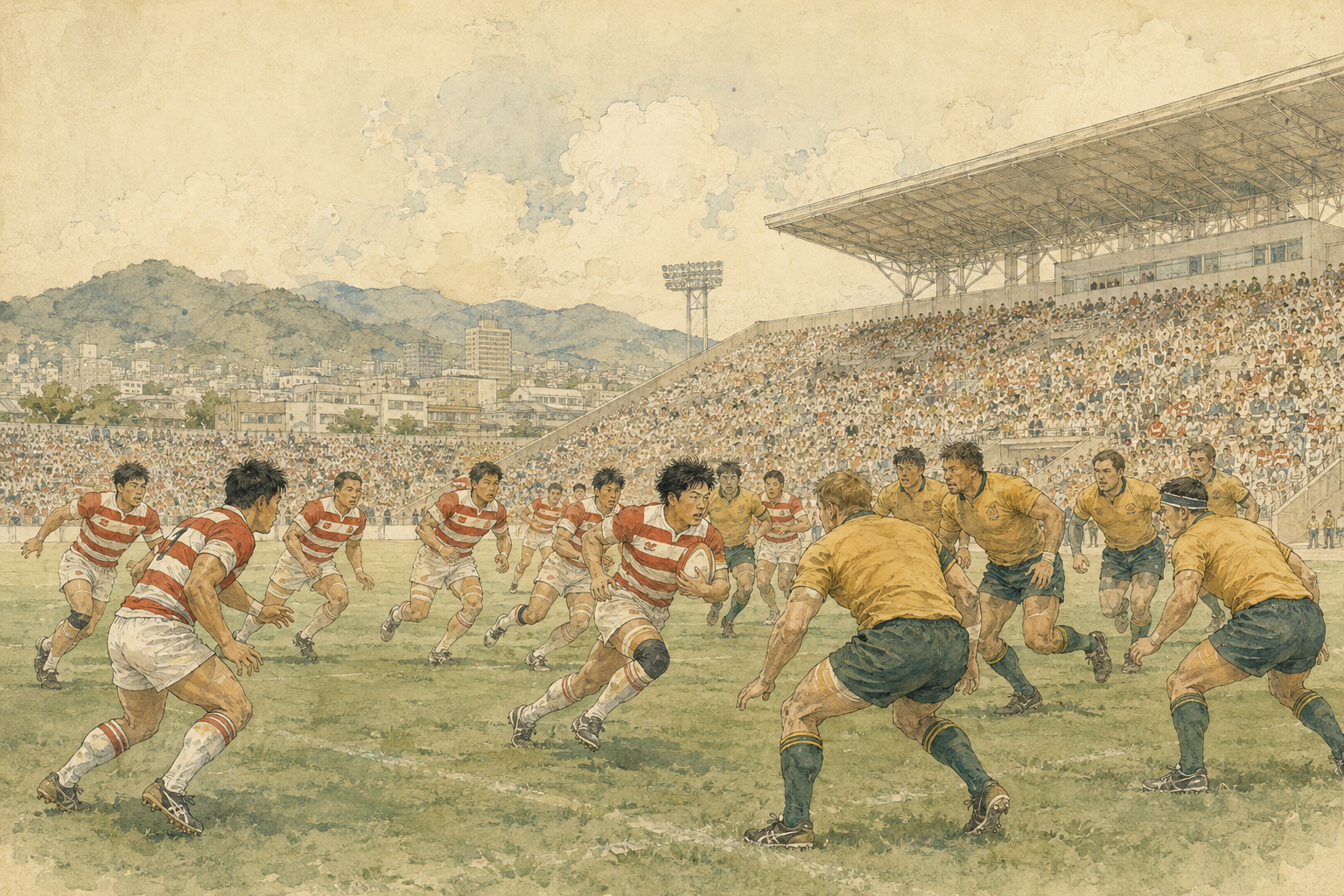
By evening, the hard white light over Higashi-Osaka is expected to have softened, but the heat will not have gone. It will linger in the concrete of Hanazono, in the wet grip of a ball, in the first scrum after a long defensive set and in every decision about whether to run once more or send the play toward touch.
The Japan Rugby Football Union expected the temperature around kickoff to hover near 30 degrees Celsius with the heavy humidity of a Japanese summer; a daytime forecast reached 36. World Rugby’s guidance stresses that heat risk cannot be reduced to a single temperature. Body size, acclimatization, illness, hydration, wind, radiant heat and work rate all matter. In an 80-minute football match in hot, humid conditions, its guidance says, a player may need to dissipate the heat represented by roughly two to 3.5 liters of sweat. This is not atmosphere laid over the rugby. It will shape the rugby.
It also sharpens a match already heavy with transition. Eddie Jones, back in charge of Japan after leading the Brave Blossoms to the 2015 “Brighton Miracle,” faces the nation he coached to the 2003 World Cup final and then through its disastrous first pool-stage exit in 2023. Across from him, Les Kiss begins his first Test as Wallabies head coach. Australia are hosts of the next World Cup, only fourteen months away. Japan are trying to prove that the unforgettable peaks of 2015 and 2019 can become repeatable performance rather than cherished exception.
The essential match facts
| Item | Verified detail at the cutoff |
|---|---|
| Fixture | Japan v Australia, Lipovitan D Challenge Cup 2026; first of two Tests, with the return match in Townsville on August 15. |
| Time and place | Saturday, August 8, 7:05 p.m. JST; Higashi-Osaka Hanazono Rugby Stadium, Osaka Prefecture. |
| Weather context | Hot and humid; the JRFU expected an evening temperature around 30°C. Forecasts put the daytime high as high as 36°C. |
| Tickets | The JRFU said the planned allocation had ended and there would be no general same-day sale. Restricted-view tickets closed at 11:59 p.m. on August 7 if not already exhausted. |
| Japan broadcast | BS Nippon TV from 7:00 p.m.; J Sports 1 from 6:30 p.m.; Hulu and J Sports On Demand streaming. |
| Australian broadcast | Stan Sport; kickoff 8:05 p.m. AEST. |
Two 1–2 teams, two very different pressures
The new Nations Championship gives the August Test a useful baseline. Japan opened by beating Italy 27–10 in a sold-out Prince Chichibu ground, then stayed within six points of Ireland with ten minutes left before losing 36–20 in Newcastle. France exposed the remaining distance in Tokyo, winning 42–15. One win, two losses: evidence of both advance and instability.
Australia arrived by the same route in the table and a more turbulent route emotionally. The Wallabies lost 33–31 to Ireland, then 42–26 to France, extending a losing sequence to six Tests. In Joe Schmidt’s final match, they broke it emphatically by beating Italy 57–10 in Perth. The result restored force to the pack and confidence to the attack; it did not answer whether one large win had become consistency.
That is the pressure Kiss inherits. Australia were eighth and Japan tenth in the World Rugby rankings entering the weekend, close enough for respect and far enough that an Australian defeat would still be treated as a shock. The Wallabies are two-time world champions, winners in 1991 and 1999, and finalists in 2003 and 2015. Their 2023 pool exit made the 2027 home tournament a national restoration project. Every Test now asks whether the project has a fly-half, a set-piece, a defensive identity and the nerve to carry favorite status.
Japan’s pressure is different. The question is not whether it can frighten a leading nation. It has done so often. The question is whether it can win the close finish after doing the frightening. In 2022 Japan trailed New Zealand by four in the final minutes before losing 38–31. In October 2025 it dominated the second half against Australia and reached the last four minutes only four points behind, but could not complete the final attack. Nearness has become evidence. It has not yet become a trophy.
The eighth Test: a rivalry written in shrinking margins
The countries’ full national teams first met at the Sydney Cricket Ground on August 2, 1975. Australia won 37–7, then 50–25 at Ballymore two weeks later. In the amateur era, those scores described different rugby worlds: Australia possessed a mature Test tradition; Japan’s game remained rooted in universities, companies and Asian competition.
The first Rugby World Cup meeting in 1987 was more competitive, 42–23. Twenty years later came the series’ abyss. At Lyon in 2007, Australia scored thirteen tries and won 91–3. Japan had not won a World Cup match since 1991. The result belonged to an era when a Tier One opponent could turn a pool fixture into a demonstration of structural inequality.
The curve changed after that. Australia won 63–30 in Yokohama in 2017, but Japan scored three tries and thirty points. The 2021 Test in Oita ended 32–23. Last October, in rain at the National Stadium, an Australian side with thirteen starting changes led 14–3 at halftime. Japan answered with two second-half tries and territory pressure before Australia escaped 19–15. The perfect Australian record survived; its certainty did not.
| Date | Result | Venue | Margin |
|---|---|---|---|
| Aug. 2, 1975 | Australia 37–7 Japan | Sydney Cricket Ground | 30 |
| Aug. 17, 1975 | Australia 50–25 Japan | Ballymore, Brisbane | 25 |
| June 3, 1987 | Australia 42–23 Japan | Concord Oval, Sydney · RWC | 19 |
| Sept. 8, 2007 | Australia 91–3 Japan | Lyon · RWC | 88 |
| Nov. 4, 2017 | Japan 30–63 Australia | Yokohama | 33 |
| Oct. 23, 2021 | Japan 23–32 Australia | Oita | 9 |
| Oct. 25, 2025 | Japan 15–19 Australia | Tokyo | 4 |
Raw scores across 51 years are not a perfect statistical series. Scoring values, substitutions, professionalism and competitive calendars changed. Yet the direction of the last three meetings is unmistakable: 33, nine, four. Jones selected eleven members of the 2025 matchday squad again. The memory inside the team is not folklore. It is recent video, recent contact and a match that still feels unfinished.
Hanazono: a shrine, not a neutral stage
Hanazono opened in 1929 on a former racecourse as Asia’s first dedicated rugby stadium. To generations of Japanese school players, its name means more than a building. The national high-school championship makes “reaching Hanazono” a life marker; the ground is a storehouse of muddy winter mornings, brass bands, company rugby and the idea that discipline can make a smaller body difficult to move.
Its international history began early. Japan beat Canada 9–8 there in 1932. A Japanese side defeated Australian Universities 14–9 in 1934. In 1972 Japan beat the Emerging Wallabies 24–22 at Hanazono. Those latter matches matter to the ground’s memory but not to the official Wallabies Test record: Australian Universities and the Emerging Wallabies were representative teams, not the full national side. Saturday is the first full Japan–Australia Test at Hanazono.
The distinction captures how rugby history is actually built. Before regular Tests and global tournaments, touring universities and development selections carried the outside game into Japanese grounds. The old connections became professional ones. Australia A, Super Rugby, the Sunwolves and today’s League One have made the rugby corridor between the countries continuous.
Quade Cooper embodies it. The 80-Test Wallaby joined the Kintetsu Liners in 2019, helped the Osaka club return to the top division and made the city home. Now in a coaching role after ending his Liners playing stint, he visited the Australian camp and explained the conditions and the ground. The visitors’ local guide is one of their own legends, shaped in part by Japan.
The team Japan chose for heat and contact
Jones changed the forward pack that started against France while leaving the backline largely intact. Takato Okabe, Hayate Era and Shuhei Takeuchi form the front row. Jack Cornelsen shifts from number eight to lock beside 201-centimeter captain Warner Dearns. Ben Gunter, Kanji Shimokawa and Faulua Makisi make a back row designed for repeated work and hard carries.
The selection says Japan does not intend to survive the Australian pack merely by moving away from it. Dearns is now a 35-cap captain, mobile enough to cover ground and central to a lineout that must function under pressure. Cornelsen supplies experience and connection; Gunter gives the first collision weight. On the bench, 208-centimeter Harry Hockings offers another lineout body, while 95-cap Michael Leitch brings late authority and an ability to read the emotional temperature of a Test.
The gamble is at fly-half. Ryunosuke Ito, still a Meiji University student, begins his fourth Test in succession with only three caps earned before kickoff. He plays outside Naoto Saito, the tactical anchor at scrum-half. Saito’s job is not simply to pass quickly. He must decide when speed will stretch Australia and when speed will only return an exhausted Japanese pack to another collision.
Behind them, Samisoni Tua and 41-cap Dylan Riley provide size in midfield. Taira Main, Kazuma Ueda and Takuro Matsunaga form a back three with counterattacking intent. Australia captain Harry Wilson identified Japan’s kick returns as a danger. That creates a contest before the chase even begins: if Australia kick loosely, Japan can turn broken field into its fastest attack; if Japan waits too eagerly for counterattack, the Wallabies can pin it deep and make the heat accumulate through exits.
- Starting XV: Takuro Matsunaga; Kazuma Ueda, Dylan Riley, Samisoni Tua, Taira Main; Ryunosuke Ito, Naoto Saito; Faulua Makisi, Kanji Shimokawa, Ben Gunter; Warner Dearns (captain), Jack Cornelsen; Shuhei Takeuchi, Hayate Era, Takato Okabe.
- Replacements: Mamoru Harada, Sojiro Otsuka, Keijiro Tamefusa, Harry Hockings, Michael Leitch, Tiennan Costley, Shunsuke Uenobo, Yoshitaka Yazaki.
The Wallabies: experience around an unfinished spine
Kiss’s first XV is neither an experiment nor a finished product. Allan Alaalatoa starts his 92nd Test at tighthead, with Rob Valetini, Fraser McReight and captain Harry Wilson in a formidable back row. Tom Wright, Max Jorgensen, Joseph-Aukuso Suaalii, Hunter Paisami and Harry Potter supply speed, height and carrying power outside. That is the experienced frame.
The new material runs through the middle. Aidan Ross makes his first Test start at loosehead and one-cap Miles Amatosero his first in the second row beside Josh Canham. Ryan Lonergan and two-cap Declan Meredith continue as the halfback combination. Their task is unusually delicate: play fast enough to exploit Australian power, but not so fast that possession becomes exposure in a humid final quarter.
The official team sheets yield a useful measure. Australia’s starting XV carries 406 caps; Japan’s carries 276. Across the full matchday 23, Australia lead 654 to 440. But the playmaking axis is young on both sides: Meredith has two caps and Ito three, while Lonergan has eight and Saito 31. Experience therefore surrounds the game without entirely controlling its most consequential decisions.
Australia’s bench is built to become heavier, not merely fresher. Angus Bell and Taniela Tupou replace starting props; Jeremy Williams covers lock; Tate McDermott and Ben Donaldson can change tempo and field position. Uncapped center Isaac Henry may make his debut. In cool conditions, that is depth. In Osaka, it is a second tactical team.
- Starting XV: Tom Wright; Max Jorgensen, Joseph-Aukuso Suaalii, Hunter Paisami, Harry Potter; Declan Meredith, Ryan Lonergan; Harry Wilson (captain), Fraser McReight, Rob Valetini; Miles Amatosero, Josh Canham; Allan Alaalatoa, Josh Nasser, Aidan Ross.
- Replacements: Billy Pollard, Angus Bell, Taniela Tupou, Jeremy Williams, Charlie Cale, Tate McDermott, Ben Donaldson, Isaac Henry.
Five contests that can decide the night
1. Japan’s lineout against Australian pressure. Japan’s preferred tempo begins with clean possession. Dearns and Cornelsen must disguise targets and deliver usable ball; Canham, Amatosero, Valetini and Wilson will try to make every throw slow or uncertain. A stolen lineout is not just a turnover—it denies Japan the launch from which its width becomes dangerous.
2. McReight against Japanese support speed. Fraser McReight returns at openside after 42 Tests. If Japan’s carriers become isolated, he can convert one slow arrival into a penalty and a long stoppage. Shimokawa’s work rate and Saito’s organization are therefore attack weapons even when neither touches the ball: they determine whether the breakdown remains playable.
3. The two young fly-halves. Ito and Meredith will be judged by more than line breaks. In humidity, a flat pass has less margin, a spiral kick is harder to catch cleanly and a missed touch can become a 60-meter counterattack. The better fly-half may be the one who refuses the spectacular option twice and chooses it once.
4. Riley and Tua against Paisami and Suaalii. Australia’s centers can win collisions and aerial contests; Japan’s pairing has enough size to prevent the channel from becoming a direct road. Defensive spacing matters because Wright and Jorgensen thrive when a center attracts the second tackler. If Japan narrows too far, Australia reaches the edge; if it spreads early, Paisami attacks the seam.
5. Minutes 55 to 75. Heat turns bench timing into strategy. Japan can introduce Hockings and Leitch for lineout control and emotional steadiness, plus Yazaki’s acceleration. Australia can send Bell, Tupou, McDermott and Donaldson into tiring structures. The match may be won not by the first plan but by which coaching box recognizes first that the first plan has expired.
What “sweltering” means in rugby terms
Humidity limits evaporation, the body’s main cooling mechanism during exercise. Sweat that stays on skin or soaks a jersey has not done all of its cooling work. Larger forwards generate and retain more heat; repeated scrums, mauls and close contact reduce airflow. Cognitive precision also matters: a tired defender rises a fraction too slowly, a scrum-half sees the space a fraction too late, a prop’s feet separate before the hit.
World Rugby’s published guidance recommends gradual exposure and says acclimatization is generally reported after seven to ten days. The Australian touring squad arrived on August 2, six days before the Test; that does not determine readiness, but it explains why conditioning, cooling and advice from Cooper attracted attention. Japan know the climate, yet familiarity is not immunity. The same medical signs and the same need for hydration apply to both teams.
The guidance does not declare that a match above 30°C or 60 percent humidity must automatically stop. It calls those figures a scheduling guide and emphasizes site assessment and individual variation. Where the heat-stress index is high, interventions can include shade, ice towels, medical monitoring, cooling and two-minute breaks around the twentieth minute of each half. The important principle is practical: heat is a player-welfare condition to manage, not a test of toughness to deny.
Tactically, the conditions produce opposing temptations. Holding the ball can make Australia defend and tire; holding it through one phase too many can produce a breakdown penalty and deny Japan a cooling stoppage on its own terms. Kicking can reduce collisions; a poor kick activates Japan’s counterattack. Scrums consume energy; a dominant scrum also consumes the opponent’s hope. The best heat strategy is therefore not “slow” or “fast.” It is control over when the match changes speed.
How Japan moved from survival to expectation
Rugby’s Japanese roots reach to Keio University in 1899, when English teacher Edward Bramwell Clarke and Ginnosuke Tanaka introduced the game. The JRFU was formed in 1926. For decades the sport grew through schools, universities and corporate teams, producing technical discipline and devoted local cultures without regular access to the strongest international competition.
The old ceiling was brutally visible at World Cups. Japan’s single victory in its first five tournaments came against Zimbabwe in 1991. Four years later New Zealand won 145–17, still one of the competition’s defining mismatches. In 2007, Australia’s 91–3 victory repeated the lesson.
Then preparation altered possibility. Under Jones, Japan built a scrum stable enough to resist South Africa and a fitness level capable of sustaining tempo. In Brighton on September 19, 2015, Japan rejected the safety of a late draw, kept attacking and won 34–32 through Karne Hesketh’s try after eighty minutes. The shock mattered not because it made Japan magically equal to every major nation, but because it proved a detailed program could make eighty minutes stronger than reputation.
Four years later, as World Cup host, Japan removed the possibility that Brighton was a solitary miracle. It beat Ireland 19–12 and Scotland 28–21, went unbeaten in its pool and became the first Asian team to reach a quarter-final. The Sunwolves’ 2016–20 Super Rugby years exposed Japanese players to southern-hemisphere travel and weekly intensity. League One, launched in 2022 from the Top League, brought Japanese players into daily work with international stars and coaches.
The exchange now moves in both directions. Dearns spent the 2026 Super Rugby Pacific season with the title-winning Hurricanes after winning domestic titles with Brave Lupus. Australian-raised Cornelsen, Gunter, Riley and Hockings developed their Test careers inside Japanese rugby. Wallabies and former Wallabies populate League One. The old question—can Japan learn the Australian game?—has become more interesting: what happens when both teams know one another’s game from the inside?
Jones and Kiss, with 2027 already in the room
Jones’s career joins almost every strand of this match. He took Australia to the 2003 World Cup final, advised South Africa during its 2007 title, rebuilt Japan for 2015 and led England to the 2019 final. His second Australian tenure collapsed in 2023. He returned to Japan on January 1, 2024, promising a new, fast national style while increasing the physical capacity required to sustain it.
Kiss arrives by a quieter route. An Australian rugby-league international in 1986, he became a defense coach, worked with South Africa and the Waratahs, helped Ireland under Joe Schmidt and led the Queensland Reds. His appointment was designed as continuity: Schmidt completed the first three Nations Championship Tests, then Kiss took the team through the long approach to a home World Cup. His public phrase has been evolution rather than revolution. Hanazono asks whether evolution can begin under immediate pressure.
The teams do not meet in the same 2027 pool. Japan will play Samoa, France and the United States. Australia’s burden is larger and more diffuse: to make the home tournament feel like a return to its 1991 and 1999 heritage rather than an audit of decline. Yet this two-Test series links their preparations. Japan needs repeated games at the speed and force of top-ten opposition. Australia needs to win away, adapt, and make young combinations reliable.
That is why the return match in Townsville matters. Osaka is not a one-night upset opportunity detached from consequence. It begins an eight-day argument across climates and countries. Selection, recovery and learning will be visible in what changes between the first and second Tests.
What a first win would mean—and what it would not
If Japan win, the headline will be historical and deserved: a first victory over the Wallabies in the eighth full Test. It would validate the narrowing margins, give a young fly-half an extraordinary reference point and place Hanazono beside Brighton and Shizuoka in the emotional map of modern Japanese rugby.
It would not by itself mean that Japan had solved France, Ireland or the set-piece demands of a World Cup. Nor would an Australian win prove that Kiss’s transition was complete. A favorite can survive through bench strength or one scrum without answering larger questions. The score will settle the night; the manner will tell both teams more about 2027.
For Japan, the most persuasive performance would combine three qualities that have too often arrived separately: a set-piece stable enough to begin, an attack brave enough to stretch the field, and decisions calm enough to finish. For Australia, success means refusing the emotional script of an ambush—controlling territory, protecting the ball from Japan’s counterattack and using superior depth before panic enters the match.
At six in the morning, thirteen hours before kickoff, none of that had happened. The scoreboard was legitimately blank. The crowd had not entered. Hanazono’s history was still only pressure stored in a place.
Reporting note and sources
This preview uses information available through August 8, 2026, 6:00 a.m. Japan Standard Time. The scheduled kickoff was 7:05 p.m. that day, so no match result is included or implied. Rankings are those reported entering the fixture. Cap totals were calculated from the two unions’ official matchday sheets; they describe caps before kickoff and may differ from later databases. Historical representative matches at Hanazono are identified separately from full Tests. Weather forecasts can change, and player-welfare decisions belong to match officials and medical teams using conditions at the venue.
- Japan Rugby Football Union: official match page, kickoff, venue, broadcast, schedule and ticket status
- JRFU: Japan matchday 23, caps, recent form, series context and expected conditions
- JRFU: August 7 ticket update and no general same-day sale
- Rugby Australia: Wallabies matchday 23 and player caps
- Rugby Australia: official Osaka preview and both lineups
- Reuters: rankings, coaching transition, heat and two-Test series context
- Reuters: Australian concern about Japan’s counterattack and humid conditions
- Rugby Australia: Quade Cooper’s Hanazono experience and visit to the Wallabies camp
- JRFU: 50th-anniversary context and the 2021 series margin
- Rugby Australia: 2025 Japan–Australia match record
- JRFU archive: 2017 result and historical results against Australian representative sides
- Rugby Database Australia: full national-team head-to-head match list
- Hanazono Rugby Museum: stadium opening in 1929 and status as Asia’s first dedicated rugby ground
- Hanazono Rugby Museum: stadium chronology and early international matches
- World Rugby: heat guideline, acclimatization, assessment and game-day interventions
- JRFU: Japan’s 2026 Nations Championship results
- World Rugby: Japan’s 34–32 victory over South Africa in 2015
- World Rugby: Japan’s 2019 quarter-final and Australia’s World Cup titles
- Rugby World Cup 2027: Japan profile, players, style and pool schedule
- Rugby World Cup 2027: Australia’s history, player core and Les Kiss profile
- JRFU Digital Museum: origins of Japanese rugby at Keio in 1899
- JRFU: the Sunwolves’ development role and 2016–20 Super Rugby contribution
- Japan Rugby League One: 2025–26 media guide
- JRFU: Eddie Jones appointment effective January 1, 2024
- Rugby Australia: Les Kiss career and appointment timeline