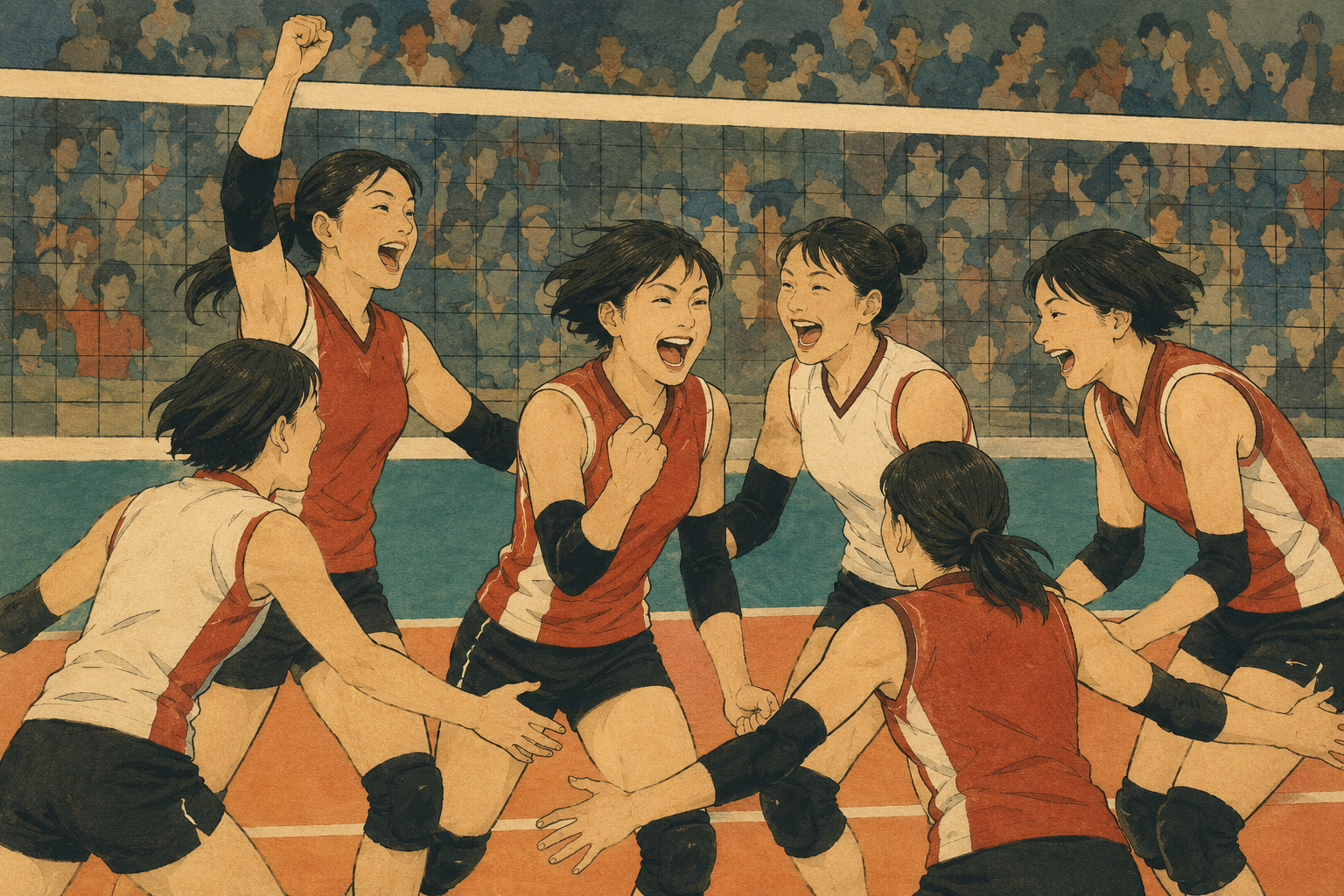
The result looks uncomplicated: Japan won its August 27 quarterfinal in straight sets and reached the semifinals with four victories, 12 sets won and none lost. The match itself included a more useful test. Chinese Taipei moved ahead early in the second set and later closed to within a point. Japan restored its passing and attacking rhythm before the set escaped, winning it 25–21. That correction, rather than the unblemished record alone, best explains the value of the afternoon.
The tournament’s official report credited Wada with 19 points—17 kills and two aces. Captain Mayu Ishikawa added 14 from nine kills, three blocks and two aces. A match report by the Japanese magazine Monthly Volleyball listed Haruyo Shimamura with 11. Japan did not rely on one terminal attacker for every difficult ball; it altered the front-row combinations, served for pressure and drew points from the middle and the bench.
Japan takes the first set from the service line
Monthly Volleyball’s set account says Nanami Seki distributed to Wada and Ishikawa at speed and brought Shimamura’s slide attack into the offense. Wada’s service run helped create separation, and Japan closed the first set 25–14. The margin reflected more than hitting: Japan’s serving restricted Chinese Taipei’s first contact and made the transition defense easier to organize.
According to Monthly Volleyball’s match report, Japan changed part of the starting formation used against Vietnam in the final pool match. Wada was deployed on the right side in the opposite role, with Shimamura and Maki Yamaguchi starting in the middle. The tournament’s official report also identifies Wada as the opposite in this match. Her right-side scoring became an important option for the semifinal.
The slow start in set two was the better test
The magazine’s set account says Chinese Taipei increased its service pressure and moved ahead early. Japan recovered through Yoshino Sato’s attacks, Yamaguchi’s blocking and Wada on the right. Chinese Taipei later pulled back to within one point, but Ishikawa’s late service pressure helped break the pursuit and Japan took the set 25–21.
An 0 in the sets-lost column should not be mistaken for the absence of stress. When reception slips, Japan must decide who takes the high ball, align the block with the floor defense and keep serving aggressively without giving away the closing points. The second set tested each of those decisions before a semifinal opponent could do so.
The bench helps close the third
The same account says Japan finished 25–13 in the third set as Ishikawa and Wada remained productive, Nichika Yamada scored with a quick attack and substitute Miku Akimoto contributed at the net. Productive short appearances matter in a compressed tournament: they manage the starters’ workload and give the next opponent more combinations to prepare for.
Ishikawa’s 14-point line included three blocks and two aces. Monthly Volleyball’s tally gave Shimamura nine kills and two blocks for 11. Wada was the leading scorer, but Japan’s points came from the left and right pins, the middle, service and blocking.
| Date | Stage · opponent | Result | Set scores | Pressure point |
|---|---|---|---|---|
| Aug. 21 | Pool · Hong Kong China | 3–0 | 25–9, 25–15, 25–12 | Japan won every set by at least 10 points |
| Aug. 23 | Pool · Korea | 3–0 | 33–31, 25–19, 25–20 | Extended deuce in the first set |
| Aug. 25 | Pool · Vietnam | 3–0 | 25–23, 25–17, 25–21 | First and third sets decided by four or fewer |
| Aug. 27 | Quarterfinal · Chinese Taipei | 3–0 | 25–14, 25–21, 25–13 | Japan fell behind early in the second |
What the 12–0 record conceals
After a comfortable opening win over Hong Kong China, Japan had to take the first set against Korea 33–31. Vietnam pushed the team to 25–23 and 25–21. Chinese Taipei produced the early second-set deficit in the quarterfinal. Inside a record of 12 straight set wins are three different kinds of pressure: extended deuce, late one-ball decisions and an early hole.
Against a stronger semifinal opponent, recovery time shrinks. Japan needs stable first contact so Seki can use the middle, a credible right-side option through Wada, and coordination between the block and backcourt. If one part breaks, the others become easier to read.
Thailand next, with separate World Cup and Olympic stakes
At the quarterfinal cutoff for this report, Japan was due to face defending champion Thailand in the semifinal. Thailand had swept Korea 25–20, 25–18, 25–21. The match was scheduled for August 29 at 5:15 p.m. in Tianjin, or 6:15 p.m. in Japan.
Volleyball World reported that the semifinal winner would reach the final and secure one of the championship’s three places at the 2027 FIVB Volleyball World Cup. Seki told the official outlet, “I think we’ve been playing well. So all we have to do is keep doing it.” Her point was continuity: prepare as before, rather than treating the perfect set record as a finished achievement.
The Los Angeles 2028 condition was different. Competition information published by Fuji Television and the official tournament report said the Asian champion would receive the Olympic berth. Even a semifinal win would leave the final to be won.
- Can Japan pass well enough for Seki to use the middle and both pins?
- Can Wada’s right-side scoring remain effective without becoming predictable?
- Will the block and backcourt defense move as one system?
- Can Japan serve aggressively after 20 without chaining errors?
- Can Yamada, Akimoto and other substitutes change a difficult rotation?
The achievement—and the reporting cutoff
At the end of the quarterfinal, Japan’s verified position was four wins, 12 straight sets and no sets conceded. Those numbers do not prove a finished championship team. They show that Japan had corrected each problem before it cost a set.
Reporting cutoff: This article is based on official records available through the morning of August 29, after the August 27 quarterfinal. It does not include the Japan–Thailand semifinal scheduled for the evening of August 29 JST. Before publication as an August 30 morning-edition page, the semifinal result and competition schedule must be updated against the official record.
- Volleyball World — Official quarterfinal report on Japan–Chinese Taipei and Thailand–Korea
- Volleyball World — Official Japan–Chinese Taipei match record
- Volleyball World — Official Japan–Hong Kong China match record
- Volleyball World — Official Japan–Korea match report
- Volleyball World — Official Japan–Vietnam match report
- Japan Volleyball Association — Quarterfinal result and official Japanese competition name
- Japan Volleyball Association — Japan women’s national-team profiles
- Fuji Television — 2026 Asian Championship dates, venue and Olympic qualification information
- Monthly Volleyball — Starting formation, set progression and Japan’s leading scorers