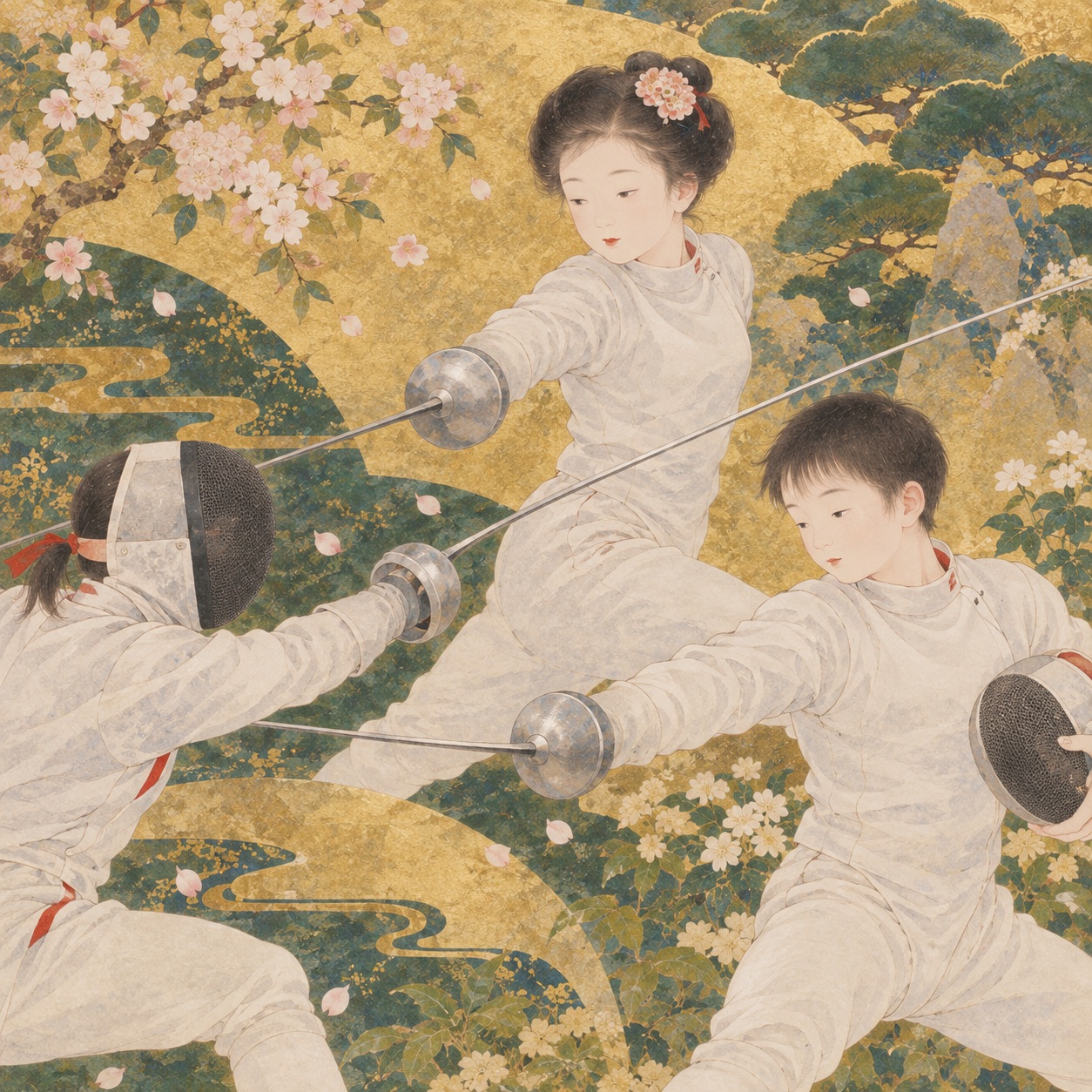
Team fencing is not simply individual fencing with more people. Four athletes are registered. Three fence a nine-bout relay. One may substitute. A star can dominate an individual bracket, but a team must carry every score forward. A bad leg does not disappear; it becomes the next teammate’s problem.
That distinction defined Japan’s final day of fencing at the Aichi-Nagoya Asian Games. On September 27, Japan won silver in women’s team sabre and bronze in men’s team épée. The women lost the final to South Korea 31–45. The men were eliminated by South Korea 37–38 in a semifinal decided by a single touch.[7][8]
Misaki Emura’s team is stopped by Korea again
Japan’s women’s sabre squad was built around Misaki Emura, Yuina Kaneko, Seri Ozaki and Yui Sano. South Korea seized the initiative early in the final and won 45–31, claiming its first Asian Games women’s team sabre title since 2018.[8]
The result has recent history. At the Asian Championships in Delhi in June, Japan beat Singapore and China before losing the final to South Korea 35–45. The Japan Fencing Federation still regarded the silver as evidence of a world-class team, but the same opponent remains the barrier at continental level.[5]
Men’s épée lost three straight Asian Games titles by one touch
Japan’s men’s épée roster was Koki Kano, Masaru Yamada, Ryu Matsumoto and Seiya Asami. Against South Korea in the semifinal, the contest came down to the final sequence.
The score reached 34–34 after the eighth bout. The ninth also finished regulation level, sending the match to a one-touch overtime. South Korea had priority, forcing Kano to attack; Jang Hyo-min scored the decisive touch, 38–37.[7]
Japan’s run of Asian Games men’s team épée titles therefore ended in the semifinal. The margin was one point, but in a relay format that single point contains the history of the eight bouts that came before it.
Individual gold does not guarantee team gold
Japan had already been exceptional in the individual events. Kano won men’s épée gold, with Yamada taking bronze. Emura won women’s sabre gold.
Yet neither squad won the team title. That is exactly why the team event matters. Individual ranking and individual medals provide only part of the picture. Coaches must manage nine bouts, matchups, score margins and substitution timing.
In épée, the tactics change depending on whether a team is protecting a one-touch lead or chasing. In sabre, five or six touches can swing in seconds. The question is not simply whether the best athlete can win—it is whether the entire relay can remain stable.
Tokyo 2020 changed Japan’s fencing identity
The most important turning point in Japan’s modern team history came at Tokyo 2020. Kano, Yamada, Kazuyasu Minobe and Satoru Uyama defeated the ROC 45–36 in the men’s team épée final, winning the first Olympic gold medal in Japanese fencing history.[10]
Before that, Japan’s Olympic fencing medals had been centered on foil: Yuki Ota’s individual silver at Beijing 2008 and men’s team foil silver at London 2012. The Tokyo épée gold expanded the national program’s belief that multiple weapons could contend at the top level.[4]
Paris 2024 turned a breakthrough into broad strength
Paris 2024 made the transformation unmistakable. Kano won individual épée gold. Japan took men’s team épée silver and men’s team foil gold. The women’s foil and women’s sabre teams also won bronze.[9]
That medal spread mattered as much as the total. Japan was no longer succeeding through one weapon or one generation. Men and women, foil, épée and sabre were all represented.
Three months ago, Japan finished No. 1 in Asia
At the 2026 Asian Championships in Delhi, Japan won six gold, five silver and four bronze medals—15 in total, a national record for the event. The Japan Fencing Federation said that haul placed Japan first in the country medal ranking.[6]
Women’s team foil won a sixth consecutive Asian title. Men’s team foil won a second straight title. Men’s team épée and women’s team sabre each took silver.
That changed the standard for Aichi-Nagoya. The question was no longer whether Japan could win medals. It was how many of its teams could convert medal contention into gold.
The fourth athlete is where team depth becomes visible
Three athletes fence the nine bouts, but a fourth is registered as a substitute. That fourth athlete is not ceremonial. A coach can use the substitute to change a matchup, inject a different tactical style or manage fatigue and form.
That is why names such as Matsumoto and Asami in men’s épée, or Ozaki and Sano in women’s sabre, matter even when public attention centers on Kano or Emura.
One of Japan’s biggest post-Tokyo advances has been developing that depth across several weapons.
What comes after Kano and Yamada?
Kano and Yamada are already part of Japanese fencing history. Both won team gold at Tokyo 2020 and team silver at Paris 2024. Kano added the Paris individual title; Yamada finished seventh individually in Paris.[2][3]
Los Angeles 2028, however, cannot be built only around the same pair. Matsumoto and Asami represent the next layer. A sustainable team needs athletes capable of winning the middle bouts when the Olympic champions are not on the strip.
Women’s sabre must become more than an Emura-centered team
Emura’s achievements are extraordinary: world titles, Olympic visibility, and individual Asian Games gold. Her success has transformed the profile of women’s sabre in Japan.
But a team gold cannot be won by one athlete. Kaneko, Ozaki and Sano must be able to hold or recover margins against the best fencers from Korea and China.
The recent scoreline makes that clear. Japan lost the Asian Championships final to Korea 35–45, then the Asian Games final 31–45. Closing that gap is a squad problem, not an Emura problem.
The next challenge is repeatability
Winning many medals at one Olympics is one achievement. Remaining competitive in all six weapons across multiple cycles is another.
Japan surprised the world in Paris and then topped the 2026 Asian Championships medal table. The next task is turning those results into a repeatable system: youth development, university and corporate programs, international competition exposure, analytics, coaching and smooth transitions from junior to senior teams.
Silver and bronze now feel different because expectations changed
There was a time when Asian Games silver or bronze would have been celebrated without qualification in Japanese fencing. The emotional response is different now because the benchmark has changed.
Tokyo 2020 produced Olympic gold. Paris 2024 produced medals across five fencing events. The 2026 Asian Championships put Japan at the top of Asia.
Japan is no longer asking whether it belongs on the podium. It is asking whether it can win.
That is why September 27’s silver and bronze are revealing. They are not evidence that Japanese fencing has suddenly weakened. They show how high the internal standard has risen—and how much the program now depends on converting individual brilliance into four-person team reliability.
Sources
- Japanese Olympic Committee: Sept. 27 fencing schedule
- JOC: Koki Kano athlete profile
- JOC: Masaru Yamada athlete profile
- JOC: Fencing rules and Japan’s Olympic history
- Japan Fencing Federation: 2026 Asian Championships women’s sabre and men’s épée team silver
- Japan Fencing Federation: record 15 medals at 2026 Asian Championships
- SBS: Korea 38–37 Japan in men’s team épée semifinal
- ChosunBiz: Korea 45–31 Japan in women’s team sabre final
- JOC: Paris 2024 medalists
- JOC: Tokyo 2020 men’s team épée gold
