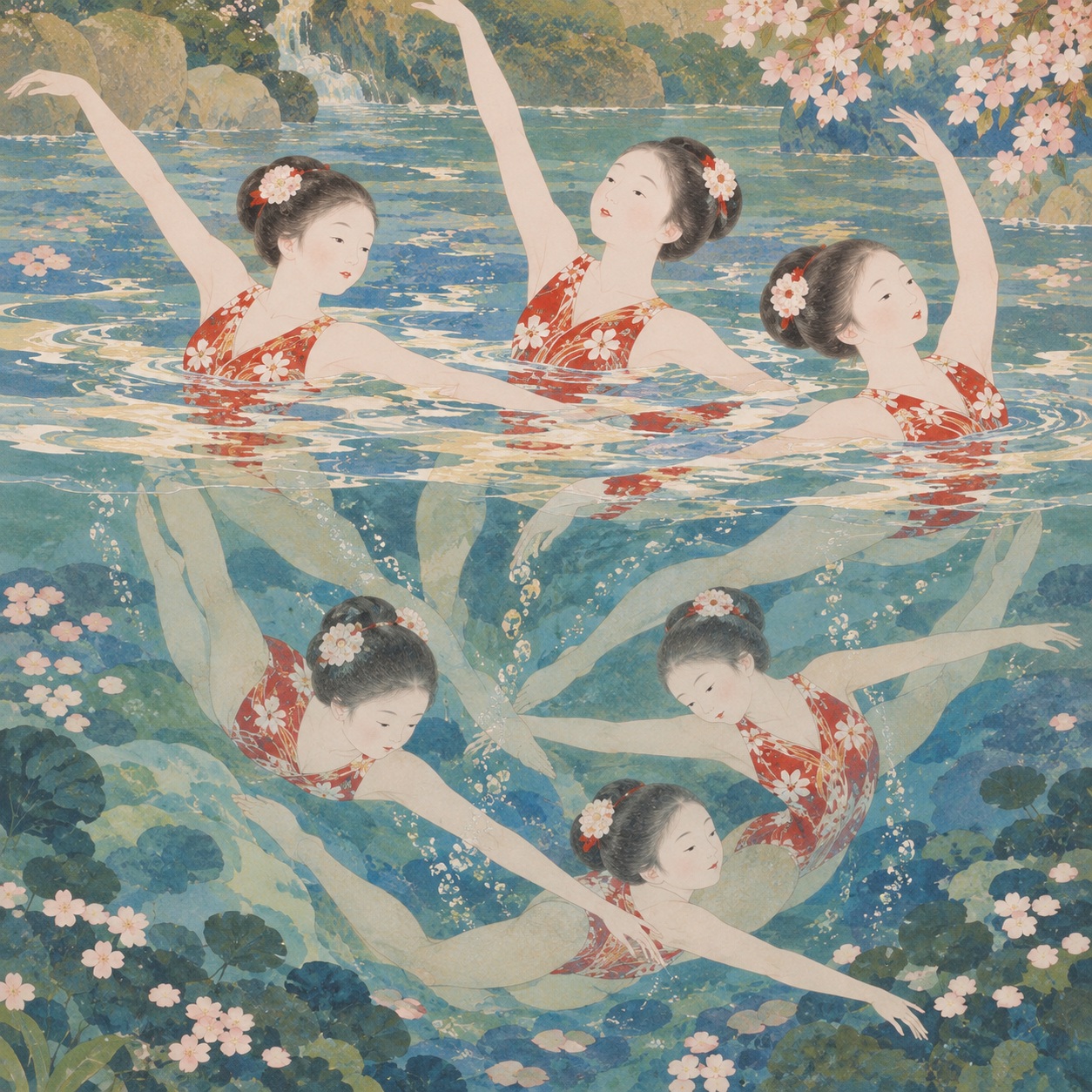
Artistic swimming looks effortless only because the strain is hidden below the surface. Athletes invert underwater, drive their legs above the pool, hold breath through long sequences and match teammates within centimeters. Under the sport’s newer scoring system, a routine can also lose heavily if a declared element is not executed exactly as submitted.
At the Aichi-Nagoya Asian Games, Japan’s Moe Higa and Yuka Sato won silver in the women’s duet. They scored 309.8432 in the technical routine on September 26 and 291.7134 in the free routine on September 27, for a total of 601.5566. China won with 640.3576. For Higa, it was a second consecutive Asian Games duet silver after Hangzhou.[6][7]
A routine called “Coexistence”
Higa and Sato’s free routine was built around the theme of coexistence: two people with different qualities influencing each other and becoming one. The routine also demonstrated how unforgiving the current rules can be. A late leg element received a base mark, producing a substantial scoring penalty.[6]
That term is central to understanding modern artistic swimming. Teams declare the difficulty of technical elements in advance. If what is performed does not satisfy the declared requirement, the element can be reduced to a minimum-value base mark.
Difficulty therefore works like leverage. Raising it can lift a score, but it also increases the cost of execution errors. Modern artistic swimming is simultaneously an aesthetic performance and a risk-management exercise.
Moe Higa is already beyond the “promising teenager” stage
JOC lists Higa as born September 15, 2007, and affiliated with Kindai University and the Imura Artistic Swimming Club. She finished eighth in the duet and fifth in the team at Paris 2024. At the Hangzhou Asian Games she won silver in both the duet and mixed team.[2]
That résumé means Higa is no longer merely a young athlete for the future. She has already been through world championships, an Olympics and two Asian Games cycles, and now carries expectations as one of Japan’s core duet swimmers.
Sato partnered Higa at Paris 2024 as well. Before the home Asian Games, she told JOC that her goal was to perform “one centimeter higher” and with precise technique.[5]
That one-centimeter language is revealing. The sport’s spectacular lifts and acrobatics are visible to everyone; the difference between medal colors often lies in height, angle, synchronization and whether a technical requirement is met exactly.
China’s margin defines Japan’s current position
China finished the duet at 640.3576, Japan at 601.5566—a gap of about 38.8 points. Treating the result simply as “Japan wins silver” would miss the competitive message.
Japan was one of the sport’s dominant powers for decades. China is now not merely an Asian rival but one of the global benchmarks. For Japan, catching China increasingly means catching the world standard.
Higa said afterward that Japan needs more sharpness and strength to close that gap, according to Japanese reporting.[6]
Japan has won 14 Olympic medals in the sport
Artistic swimming became an Olympic medal sport at Los Angeles 1984. JOC records show that Japan has competed at every Olympics since and accumulated four silver and ten bronze medals.[3]
Japan won bronze in both duet and team at Rio 2016. But Tokyo 2020 ended with fourth place in both events, and Paris 2024 with fifth in team and eighth in duet. Japan has now gone two Olympics without an artistic-swimming medal.[3][8]
For a country accustomed to treating this as a signature Olympic sport, Asian Games silver therefore carries two meanings: a medal at home, and another measure of the distance back to the global podium.
The name changed in 2018; the sport changed even more
The discipline was long known as synchronized swimming. The international name changed to artistic swimming, and Japan adopted the new terminology in 2018. JOC describes a sport that judges technical completion, synchronization, composition, artistry and expression.[3]
But the deeper transformation has been in the rules. Declared difficulty now plays a central role. Men can take part in Olympic team events, and acrobatic routines have been added to major competitions.
The sport has moved away from an image of judges simply assigning an overall impression of beauty. Its scoring architecture now tries to quantify technical risk in much greater detail.
Japan’s team program is fighting on two fronts
Japan is also competing in the team event. On September 27 it stood second after the mixed team technical routine. The final team free routine is scheduled for 11 a.m. on September 28.[1][6]
Japan’s current team programs deliberately lean into identity. The technical routine uses a rose motif—beauty and thorns—while the free routine is built around bushido, including Japanese-language spoken elements and a theme of athletes confronting themselves through training.
As the sport becomes more mathematically structured, that kind of performance identity may matter more, not less. Two teams can declare comparable difficulty; they still have to make the routine mean something to judges and spectators.
A young team built around Paris experience
Japan’s Asian Games squad includes Higa, Sato, Uta Kobayashi, Ayano Shimada, Moeka Fujii, Yuka Kawase, Kaho Aitaka, Nao Shirahase, Risako Mitsuhashi and Konatsu Ishii.
Higa, Sato, Kobayashi and Shimada bring Paris 2024 experience. Others are entering a major home multi-sport Games at an earlier point in their senior careers.
That mix matters because Japan is already looking toward Los Angeles 2028. A home Asian Games offers a rare bridge between Olympic cycles: experienced athletes can carry competitive habits while younger swimmers learn to perform under a crowd that expects medals.
Artistry has not disappeared—but it must survive inside the difficulty system
The scoring reforms have generated debate. Some longtime followers feel the sport has become more technical and acrobatic, with less room for the long, fluid choreography once associated with synchronized swimming.
There is another side to the reform. Declared difficulty is intended to make judging more transparent by attaching clearer value to what athletes attempt and whether they actually complete it.
Japan’s challenge is unusually specific: preserve the synchronization, leg lines and expressive control that historically defined its teams while matching the world’s highest difficulty. Higa and Sato’s silver shows that balance is still being rebuilt.
It has to translate traditional strengths—precision, synchronization and expression—into a sport now shaped by declared difficulty, base marks, acrobatics and mixed-team rules.
A home Games in Hamamatsu
The artistic swimming competition is being held at the Hiroyuki Furuhashi Memorial Hamamatsu Swimming Center (ToBiO) in Shizuoka Prefecture. Although the Games are branded Aichi-Nagoya, some aquatic events extend beyond the core host area.[4]
Before competition, several Japanese athletes emphasized the significance of performing in front of home supporters. Moeka Fujii, an Aichi native, told JOC that she wanted to show more people the appeal of artistic swimming.[5]
That matters for a sport whose technical rules have become harder for casual viewers to follow. A home Games can turn complexity into familiarity if spectators leave understanding not only that a routine was beautiful, but why it was difficult.
Silver is a result—and a measurement on the road to Los Angeles
Higa and Sato have an Asian Games silver. Japan’s team entered its final routine in second place. But the program’s larger objective is not to preserve second place in Asia.
JOC’s own sport overview points toward Los Angeles 2028 and the goal of returning to the Olympic podium after two medal-less Games.[3]
An artistic-swimming routine appears seamless from the stands, but it is built from hundreds of measurable details: height, angles, breath, timing, difficulty and expression. Japan’s route back to the Olympic podium will be the same. The silver medal is both an achievement and a precise reading of where that work stands.
Sources
- Japanese Olympic Committee: Artistic swimming schedule, Sept. 27
- JOC: Moe Higa athlete profile
- JOC: Artistic swimming history, rules and Japan’s Olympic record
- Japan Aquatics: Aichi-Nagoya Asian Games artistic swimming
- JOC: Team Japan athlete comments
- Yomiuri Online report: Higa/Sato silver, Japan second in team technical
- Sports Hochi report: duet totals and medal result
- JOC: Paris 2024 artistic swimming Team Japan
- JOC: Hangzhou Asian Games artistic swimming Team Japan
