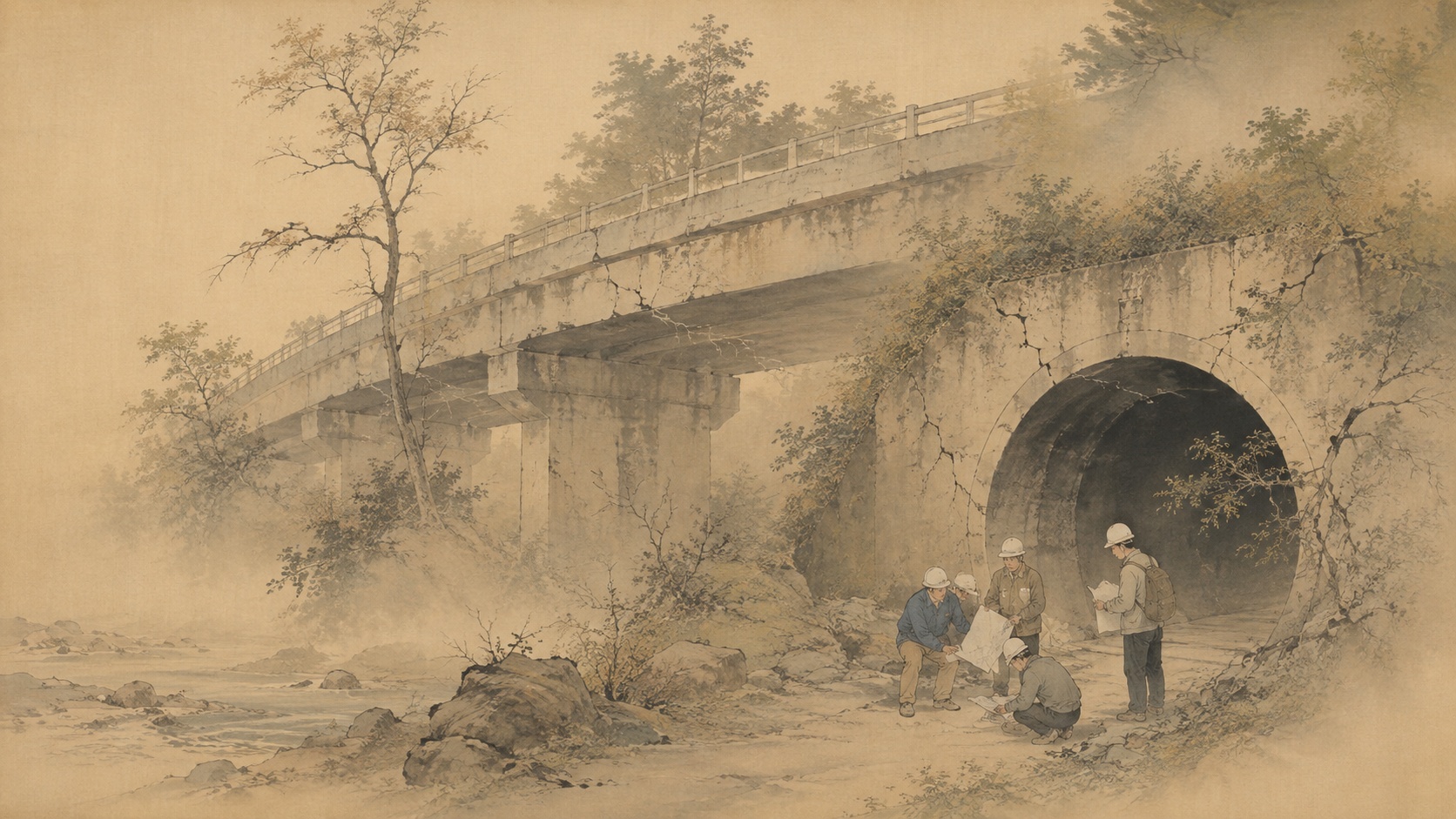
Japan’s infrastructure problem is no longer simply that bridges, tunnels and pipes are getting old. The harder problem is that a huge generation of assets built during and after the high-growth era is aging at the same time that the municipalities responsible for much of it have fewer engineers, constrained budgets and shrinking populations. On September 3, the Ministry of Land, Infrastructure, Transport and Tourism opened public comment on an interim report that proposes a change in the governing idea itself: from infrastructure maintenance to infrastructure management.
The distinction is deliberate. Maintenance asks whether an asset has been inspected, diagnosed and repaired. Management asks a wider set of questions: Which assets matter most? What happens if one fails? How much demand will remain in 20 years? Which facilities can be consolidated? Can several municipalities share engineers or contracts? Should a new bridge or sewer be designed from the beginning so that future inspection and replacement are easier? The report’s thesis is that Japan can no longer treat those questions as separate.
Fifty years is not a failure date—but the age wave is real
Japan often describes aging infrastructure by the share of facilities more than 50 years old. That benchmark needs care. MLIT explicitly says deterioration varies with environment, loading and maintenance history, and that 50 years is used as a convenient age marker. A 51-year-old bridge is not automatically unsafe, and a younger structure is not automatically sound.
Yet the demographic shape of the asset base is unmistakable. MLIT’s published series puts road bridges over 50 years old at 37% in March 2023, rising to 54% in 2030 and 75% in 2040. Tunnels move from 25% to 35% and 52%; river-management facilities from 22% to 42% and 65%; sewer conduits from 7% to 16% and 34%; port facilities from 27% to 44% and 68%. Water pipelines rise from 9% to 21% and 41%.
This is not a collection of isolated old structures. It is a portfolio problem: assets constructed in the same broad decades are entering heavier repair and renewal cycles together. That is why the shift from “maintenance” to “management” is more than a change in vocabulary.
Share of selected infrastructure more than 50 years old
| Asset class | Mar. 2023 | Mar. 2030 | Mar. 2040 |
|---|---|---|---|
| Road bridges | 37% | 54% | 75% |
| Tunnels | 25% | 35% | 52% |
| River-management facilities | 22% | 42% | 65% |
| Water pipelines | 9% | 21% | 41% |
| Sewer conduits | 7% | 16% | 34% |
| Port facilities | 27% | 44% | 68% |
Source: MLIT. The 50-year threshold is an age convention for aggregate analysis, not a condition rating for an individual asset.
Sasago created Japan’s inspection era
The modern policy story begins with tragedy. On December 2, 2012, ceiling panels collapsed inside the Sasago Tunnel on the Chuo Expressway. Three vehicles were trapped; nine people were killed and two injured. The accident became a national symbol of infrastructure risk and helped accelerate a broad overhaul of inspection policy.
Japan designated 2013 as the first year of a new “social infrastructure maintenance” push. Following amendments to the Road Act and related rules, road administrators began five-year periodic inspections of bridges, tunnels and major road accessories from fiscal 2014, with condition rated in four categories. The first national inspection cycle finished in fiscal 2018 and the second in fiscal 2023. A third cycle began in fiscal 2024.
The newest Road Maintenance Annual Report shows that, by the end of fiscal 2025—the second year of the third cycle—39% of bridges, 34% of tunnels and 38% of road accessories had been inspected. The ministry says scheduling is becoming more even. That is real institutional progress. Japan now has a far stronger system for repeatedly looking at its road assets than it did before Sasago.
But the new report asks what comes after inspection becomes routine. When the number of aging assets rises while staff and money do not, simply repeating the same inspection density and asset-by-asset workflow may not produce the safest system.
Yashio turned an asset failure into a network problem
The second turning point was the January 28, 2025 road collapse in Yashio, Saitama Prefecture, linked to a damaged sewer conduit. The ministry established an expert panel and, in December, received its third recommendation under the title Strategic Transformation of Management for Trusted Infrastructure.
The deeper lesson was that infrastructure failure does not respect administrative boxes. A sewer lies under a road. Around it may be water, gas, power and communications. A failure underground can close traffic above it, disrupt businesses, divert emergency services and create effects far beyond the damaged asset. The committee therefore treats aging-related network disruption as a threat with social consequences comparable in breadth to a natural disaster.
That reasoning is central to the current proposal: optimizing each agency’s piece is not necessarily the same thing as optimizing the system.
The local-government equation is getting harsher
The interim report’s most consequential numbers may be about people and budgets, not concrete and steel. Municipal civil-engineering expenditure peaked at roughly ¥11.5 trillion in fiscal 1993 and has recently been around ¥6.5 trillion—about 60% of that peak. Meanwhile, the number of technical staff has fallen. The report says roughly one quarter of municipalities have no technical employees at all, including civil-engineering staff, and about half have five or fewer.
That leaves small governments trying to inspect bridges, manage roads and parks, operate sewer systems, prepare contracts, evaluate technologies, answer residents and respond to disasters with extremely thin teams. The ministry’s wording is unusually stark: under these financial and organizational constraints, local staff are becoming exhausted even by basic inspection work.
The contractor side is thin as well. About 70% of surveyed offices outsource some or all routine tasks such as patrols, cleaning, mowing and pruning. Among those, about half had used a negotiated or discretionary contract in at least one of the previous three years. Local governments cited fewer bidders, labor shortages and aging workforces. Maintenance capacity is therefore not only a government staffing issue; it is a regional industry issue.
Five ideas: prioritize, visualize, personalize, strengthen the workforce, integrate
The committee organizes the proposed transformation around five concepts. The first is merihari—literally giving work sharper emphasis. In practice it means both prioritizing what deserves more attention and “lightening” work where lower intensity is justified. Risk, social consequences, asset importance and the region’s future shape should influence inspection and intervention. Consolidation or removal may be appropriate in some cases.
The second is visualization. That means technical visibility for managers—better condition data, AI, robotics and digital systems—but also public visibility. As of April 2026, the MLIT Data Platform was linked to 35 systems and 3.36 million data records. Yet the survey found that about 80% of local offices had not effectively adopted new technologies for inspection, commonly citing cost, lack of people able to judge usefulness and lack of staff able to operate the tools. Roughly half did not publish infrastructure-condition information to residents.
The third idea is to make infrastructure a matter of personal relevance and create momentum: public attention leads to media attention, political leadership, budgets and recruitment. The fourth is to put “more light” on the workforce—improving pay, contracting, working conditions and the economic strength of the infrastructure-management sector.
The fifth is integrated management. Planning, investigation, design, construction, inspection, diagnosis, repair and renewal should be treated as one life cycle. Maintainability and redundancy should be considered at the design stage. Different asset sectors and different public bodies should collaborate rather than optimize in isolation.
“Group management” is an attempt to stop making small towns fight alone
One of the most concrete tools is Regional Infrastructure Group Regeneration Strategy Management, usually shortened in Japanese to gun-mane. The idea is to treat infrastructure across multiple municipalities or sectors as a group, sharing expertise, contracting capacity, data and sometimes delivery structures.
The government has been testing 11 model cases covering 40 local governments and published the first version of a practical handbook in October 2025. But the committee survey says only about 10% of offices were implementing or considering group management. Comprehensive private outsourcing was also used by only about 10%. Reasons included unclear responsibility, no obvious adviser, lack of money and lack of staff even to study a new arrangement.
That exposes the hard part of regional collaboration. Sharing engineers may save scarce capacity, but responsibility after a failure cannot be vague. Procurement authority, liability, data ownership and cost allocation have to be explicit. Japan has created newer mechanisms for one road or sewer administrator to perform work on behalf of another, but making collaboration routine will require administrative law and contracting to catch up with the engineering logic.
From “keep everything” to choosing with the region’s future in view
The politically most difficult proposal is consolidation. In a shrinking region, should every bridge, local road, park and public facility built for a larger population remain at the same scale indefinitely? The interim report argues that infrastructure-aging plans should be integrated with broader community planning, including the possibility of consolidation or removal where appropriate.
The survey shows why this is hard. About 70% of offices had not introduced the report’s form of prioritization or lightening. Cities often said it was difficult to establish priorities; towns and villages frequently expected opposition from residents or local assemblies. Closing or downgrading infrastructure creates visible losers even when the long-term network becomes more sustainable.
That is why the report links prioritization to transparency. It proposes making condition, population distribution, disaster risk, land use and even the cost of aging countermeasures visible—potentially through mapping—so choices can be argued from shared evidence rather than made as opaque technical decisions.
Preventive maintenance is also a fiscal strategy
Japan’s long-standing cost estimates show why preventive maintenance matters. An MLIT projection using 2018 as a base estimated maintenance and renewal costs of about ¥5.2 trillion that year. Under a reactive-maintenance scenario, annual cost in fiscal 2048 could reach about ¥12.3 trillion. Under a preventive-maintenance approach, the estimate was about ¥6.5 trillion.
Across the 30 years from fiscal 2019 through 2048, the same model put reactive maintenance at about ¥280 trillion and preventive maintenance at about ¥190 trillion. Those are scenario estimates, not appropriated budgets or guaranteed savings. But they illustrate the economic logic: the purpose of preventive maintenance is not to repair everything early; it is to intervene before deterioration becomes far more expensive, while directing resources according to condition and consequence.
Dec. 2012: Sasago Tunnel ceiling collapse kills nine and injures two.
2013: Japan declares a new “social infrastructure maintenance” era and adopts the Basic Plan for Infrastructure Life Extension.
FY2014: Five-year periodic inspections of road bridges, tunnels and related facilities begin in earnest.
Dec. 2022: Government policy advances the regional “group management” model.
Jan. 2025: Major road collapse in Yashio linked to sewer-pipe damage.
Dec. 2025: Third expert recommendation calls for strategic management transformation; the Infrastructure Management Strategy Subcommittee is established.
Sept. 2026: MLIT opens public comment on the interim report through September 16.
Technology is only part of the answer
Drones, robotic crawlers, AI image diagnosis, sensors, BIM/CIM and digital twins are natural responses to a labor shortage. The committee supports them. But its survey also shows that technology availability is not the same as technology adoption. Local governments need money to buy tools, expertise to judge whether they work, procurement rules that can accommodate them, staff training, standardized data and systems that persist after a pilot project ends.
The proposed measures therefore include expert hands-on support, performance catalogues, data standardization, BIM/CIM linkage, mapping of deterioration and advisory structures to raise municipal technical capability. The policy direction is moving away from “introduce a device” toward “build an organization that can use technology in recurring management decisions.”
The real test comes in years when nothing collapses
Infrastructure becomes politically visible after failure. Sasago accelerated inspection reform. Yashio accelerated a broader management rethink. The difficult work, however, is maintaining budgets, staff, data and consolidation programs during years when no major accident forces attention.
That helps explain the report’s unusually social language—“personal relevance,” “momentum,” and putting “more light” on workers. A pipe that has not burst and a bridge that has not closed are easy to ignore. Preventive investment has to be justified before the crisis.
Postwar Japan became exceptionally capable at building infrastructure quickly. The next national capability is different: deciding how to preserve, combine, redesign and sometimes reduce a vast inherited asset base in a shrinking society. The interim report gives that challenge a new name—management. Whether it becomes a real change will depend on what happens after the consultation: municipal budgets, staffing, contracts, data systems, design standards and, ultimately, the willingness to make choices before an accident makes them unavoidable.
Sources
- MLIT, “Public Comment on the Interim Report on the Future of Infrastructure Management” — September 3, 2026.
- Infrastructure Management Strategy Subcommittee, Interim Report Draft — Summary — August 24, 2026.
- Infrastructure Management Strategy Subcommittee, Interim Report Draft — Full Text — primary source for municipal survey results and the five-part framework.
- MLIT, Current and Future Aging of Social Infrastructure — age profiles for bridges, tunnels, river facilities, water, sewer and ports.
- MLIT, FY2025 Road Maintenance Annual Report announcement — August 26, 2026.
- MLIT, Third Recommendation following the Yashio road-collapse investigation — December 1, 2025.
- MLIT, official Sasago Tunnel collapse information.
- MLIT, estimated future maintenance and renewal costs — reactive versus preventive-maintenance scenarios.
This report was checked primarily against Japanese-language MLIT primary sources available by 2:27 AM JST on September 4, 2026. Japanese policy terms such as merihari, “visualization,” gun-mane, maintainability and redundancy are translated here for clarity but retain the distinctions used in the official material. The age-over-50 figures are aggregate age markers and are not presented as safety ratings for individual facilities. The interim report remains in the public-comment stage and is not described as a final legal or budgetary decision.
Image rights: © 2026 Japan.co.jp. AI-assisted editorial illustration. Unauthorized republication or reuse is prohibited. For licensing, please use the contact page.