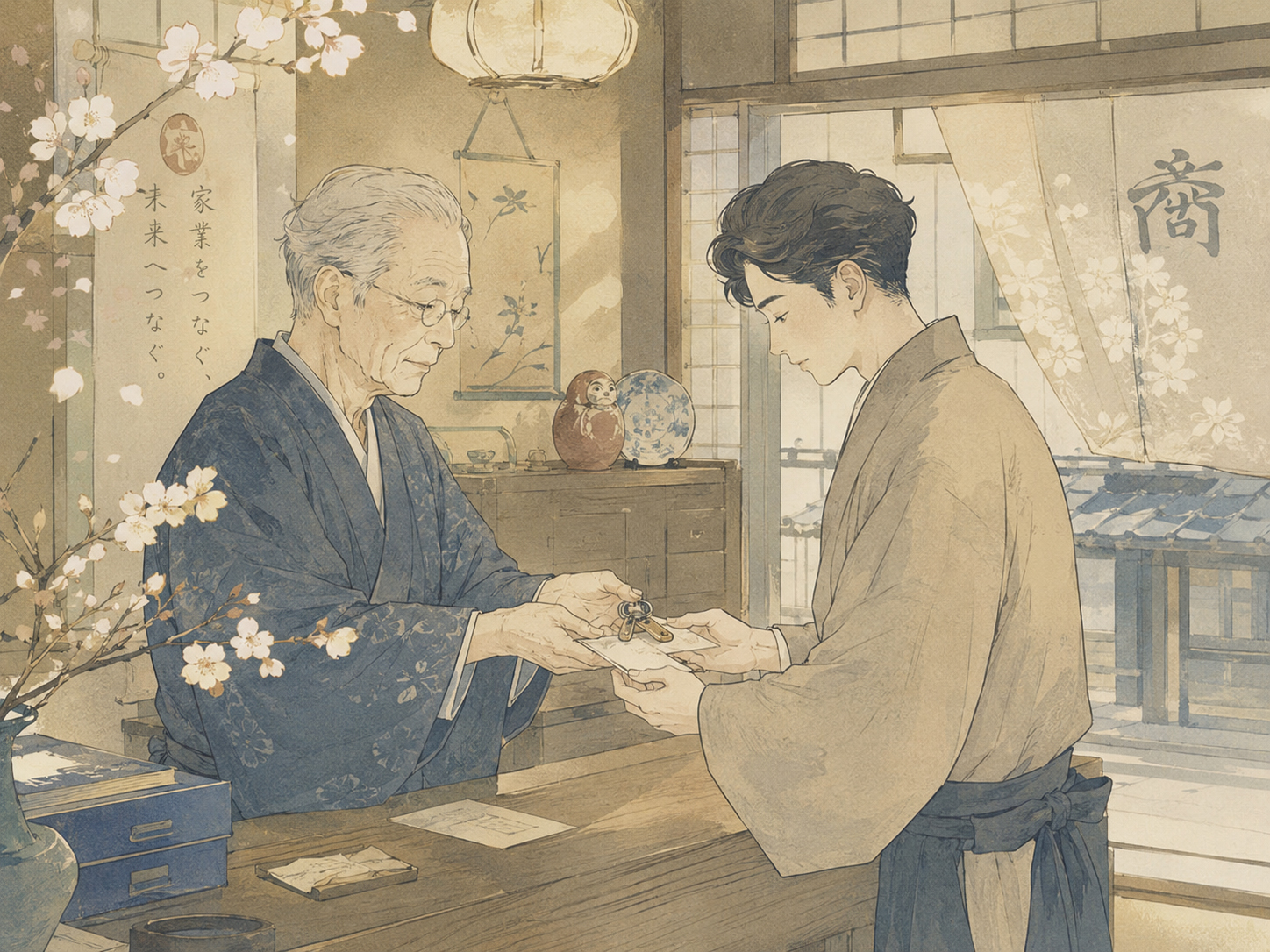
The quietest drama in Japan may be happening behind the noren curtain of a family shop, in the back room of a factory, or at a desk where an owner in his seventies still signs every invoice by hand. The company may be profitable. The customers may be loyal. The employees may know exactly how to make the product, fix the machine, greet the customer, or keep the books. Yet the owner looks across the room and sees the same question everywhere: who will inherit this?
Japan’s business-succession problem has entered a new phase. It is no longer only a family matter, a tax-planning issue, or a sentimental story about a child refusing to take over the store. It has become an economic market. Search funds, regional banks, public succession centers, M&A brokers, private equity firms, local governments, accountants, and young would-be owners are all moving into the gap left by aging founders and children who have chosen another life.
As of 2025, Teikoku Databank estimated that 50.1% of Japanese companies had no successor, an improvement of 2.0 percentage points from the previous year and the seventh consecutive annual improvement, according to a Kyodo feature carried by Japan Today. That sounds like progress. It is. But the same story points to the deeper danger: more than half of SME managers are still over 60, and the owner-age structure remains heavily tilted toward retirement.
The new meaning of inheritance
In old Japan, the question of succession was often answered by blood, adoption, marriage, or apprenticeship. The family name and the shop name were intertwined. A son might inherit. A son-in-law might be adopted. A trusted employee might be prepared quietly over many years. The founder’s work was not simply sold; it was handed down.
That system depended on assumptions that no longer hold. Families are smaller. Children move to Tokyo, Osaka, Nagoya, Singapore, New York, or the internet. A daughter or son may love the family business but not want the hours, debt, neighborhood obligations, supplier relationships, and emotional burden. Many founders also waited too long, believing that succession could be settled after “one more good year.” By the time the conversation begins, the successor may already be gone.
The result is a strange national inventory of valuable but vulnerable firms: metal shops with irreplaceable know-how, ryokan with loyal customers, dentists’ offices, local wholesalers, food processors, barbers, construction subcontractors, pharmacies, mold makers, noodle shops, printing houses, machine-maintenance firms, and tiny manufacturers embedded inside larger supply chains.
The numbers behind the worry
Why profitable businesses disappear
The tragedy of succession is that closure does not always mean failure. The World Economic Forum, citing Japanese data, has warned that even profitable SMEs can be forced to close because they cannot find successors. The OECD’s 2026 Japan survey made the same point from another angle: around 68,000 firms completed non-judiciary exits through suspension, closure, or dissolution in 2025, and only about 51% of those exits involved loss-making firms. In many cases, the business was not dead. The owner was simply done.
That is why succession has become an industrial-policy question. If an unprofitable firm exits, capital and labor may move to stronger uses. But if a profitable supplier disappears because the president has no successor, a local ecosystem loses capability. A buyer loses a trusted vendor. Employees lose jobs. A craft lineage ends. A village shopping street loses one more light.
The family handover weakens
Family succession still matters. It remains emotionally powerful and operationally elegant when it works. But the social contract has changed. Younger generations increasingly see inheritance as a choice, not a duty. A business may have good cash flow but weak weekends, no digital systems, inherited debt, aging equipment, and a workforce older than the successor. The child may ask a rational question: why trade a career for that burden?
There is also a gender story. Many Japanese family firms historically assumed a male successor. When daughters were excluded, or when sons left, the company narrowed its options. Modern succession is slowly broadening the idea of who can inherit: daughters, outside managers, employees, competitors, search-fund entrepreneurs, foreign buyers, regional consolidators, and private equity-backed operators.
Third-party succession becomes normal
The most important cultural shift is that selling the company no longer automatically means betraying the founder’s life work. Increasingly, owners describe sale as preservation. A buyer can keep the name, maintain employees, invest in systems, professionalize finance, and connect the firm to wider customers. The company survives precisely because it leaves the bloodline.
ORIX has described the rise of M&A among mid-sized and small businesses as part of the response to the successor shortage, noting that such deals jumped 16-fold between 2014 and 2022. The Japanese government introduced SME M&A Guidelines in 2020 to support third-party succession, while also confronting concerns about misconduct by some intermediaries. This is the messy middle stage of market formation: urgent need, fast growth, and uneven quality.
Regional banks have a special role. They know local borrowers, family dynamics, collateral, cash flow, and the reputational risk of a bad handover. Accountants and tax advisers often know even more. Many succession deals begin not with a glossy pitch book, but with a hesitant conversation: “Sensei, what should I do with the company?”
Search funds and the new buyers
The Kyodo feature highlights a new generation of buyers, including entrepreneurs using search-fund models to acquire and operate smaller companies. This matters because Japan’s successor shortage is partly a matching problem. There are owners with companies but no heirs, and there are younger people who want to run companies but do not want to start from zero.
Search funds, small-buyout platforms, and entrepreneur-led acquisitions can bridge that gap. They bring management ambition to companies that already have customers, employees, and assets. But the match is delicate. An outside buyer must earn trust. A company built over forty years cannot be treated as a spreadsheet. Employees will ask whether the buyer understands the craft. Customers will ask whether service will change. The old owner will ask whether the name will survive.
Private equity discovers local Japan
At the larger end, Japan’s M&A market has become one of the world’s great deal stories. Reuters reported that Japanese M&A activity reached a record $232 billion in the first half of 2025, driven by management reform, take-private transactions, outbound deals and private equity interest. That market is not the same as a neighborhood bakery succession deal, but the two stories are connected by a shared structural force: Japan is rethinking ownership.
Corporate governance reform is pushing listed companies to sell non-core units. Aging founders are pushing SMEs toward third-party succession. Investors are pushing for capital efficiency. Shrinking domestic demand is pushing firms to consolidate, specialize, or go overseas. Together, these forces make ownership more liquid than it once was in Japan.
The labor shortage makes succession harder
Succession is not only about the president. It is also about workers. Reuters reported in January 2025 that two-thirds of surveyed Japanese companies said labor shortages were seriously or fairly seriously affecting their businesses. A manager at a railway operator warned that shortages could pose a business-continuity risk. Teikoku Databank data cited by Reuters showed labor-shortage bankruptcies rising 32% in 2024 to a record 342 cases.
That puts new pressure on buyers. In the past, a successor could inherit a company and assume the workforce would remain. Today a buyer may inherit vacancies, wage pressure, older employees, manual systems, and customers who expect continuity. The best succession deals therefore require more than ownership transfer. They require hiring, automation, pricing power, digitalization, and management renewal.
Local heritage as economic infrastructure
It is tempting to romanticize succession as a story about craft. Sometimes it is. Japan’s traditional industries do contain techniques that cannot be rebuilt quickly once lost. But the larger issue is infrastructure. A small machine shop may be invisible to consumers but essential to a supply chain. A local food processor may support farmers. A rural pharmacy may be part of healthcare access. A tiny construction subcontractor may hold neighborhood repair capacity.
When those firms close, the loss is not always counted properly. GDP may see a small exit. A town may see a hole. The owner may see the end of a life.
Risks in the succession boom
A market this emotional attracts both good builders and bad actors. Succession M&A can preserve firms, but it can also produce rushed sales, unrealistic valuations, predatory intermediaries, poor disclosure, employee anxiety, tax mistakes, or buyers who promise continuity and then strip assets. That is why the government’s guidelines, intermediary registration, local-bank involvement, and professional standards matter.
There is also a policy tension. Japan needs economic metabolism: weak firms should not be preserved forever by cheap credit and sentiment alone. But the OECD’s data on voluntary exits suggests the opposite risk also exists: viable firms are disappearing because succession fails. The hard policy question is how to let unproductive firms close while rescuing productive firms that only lack an heir.
Japan.co.jp view
Japan’s succession market may become one of the most important entrepreneurship stories of the next decade. It is quieter than AI, less glamorous than semiconductors, and far less visible than the stock market. But it reaches deeper into daily life. It decides whether the old shop survives, whether the factory keeps running, whether a rural employer remains, whether skills are transferred, and whether local Japan has owners for the next generation.
The best outcome is not nostalgia. It is renewal. A good successor should respect the founder, but not become trapped by the founder’s limits. The next owner may install software, raise prices, hire differently, sell online, export, merge with a neighbor, or hand the craft to a daughter who was overlooked. The point is not to freeze Japan’s small firms in amber. The point is to keep the living ones alive.
Reader takeaways
| Question | Answer |
|---|---|
| What is happening? | Aging owners and shrinking families are turning business succession into a major market for M&A, search funds, regional banks and public support centers. |
| Why does it matter? | Many firms without successors are viable; closure can destroy jobs, skills, suppliers and local services. |
| What changed culturally? | Selling outside the family is increasingly seen as preservation rather than failure. |
| What is the risk? | Fast-growing succession M&A can attract weak intermediaries, rushed deals and buyers who do not protect employees or capability. |
| What is the opportunity? | Japan can match aging owners with younger operators and turn inheritance from a family accident into an organized entrepreneurial market. |
Sources and references
This article draws on Kyodo/Japan Today reporting on the 2026 succession market, Teikoku Databank successor-absence data cited in that report, the Small and Medium Enterprise Agency white paper summary released by METI, World Economic Forum reporting on Japan’s SME succession problem, ORIX’s overview of third-party succession and SME M&A, Reuters reporting on Japan’s labor shortage and M&A record, and the OECD Economic Survey of Japan 2026.
- Japan Today / Kyodo: Who will inherit Japan? Aging owners fuel new era of business succession
- World Economic Forum: Japan’s succession problem
- METI / Small and Medium Enterprise Agency: 2025 SME White Papers
- ORIX: From Family Succession to M&A
- Reuters: Japan firms face serious labour crunch
- Reuters: Japan hits M&A record
- OECD Economic Surveys: Japan 2026