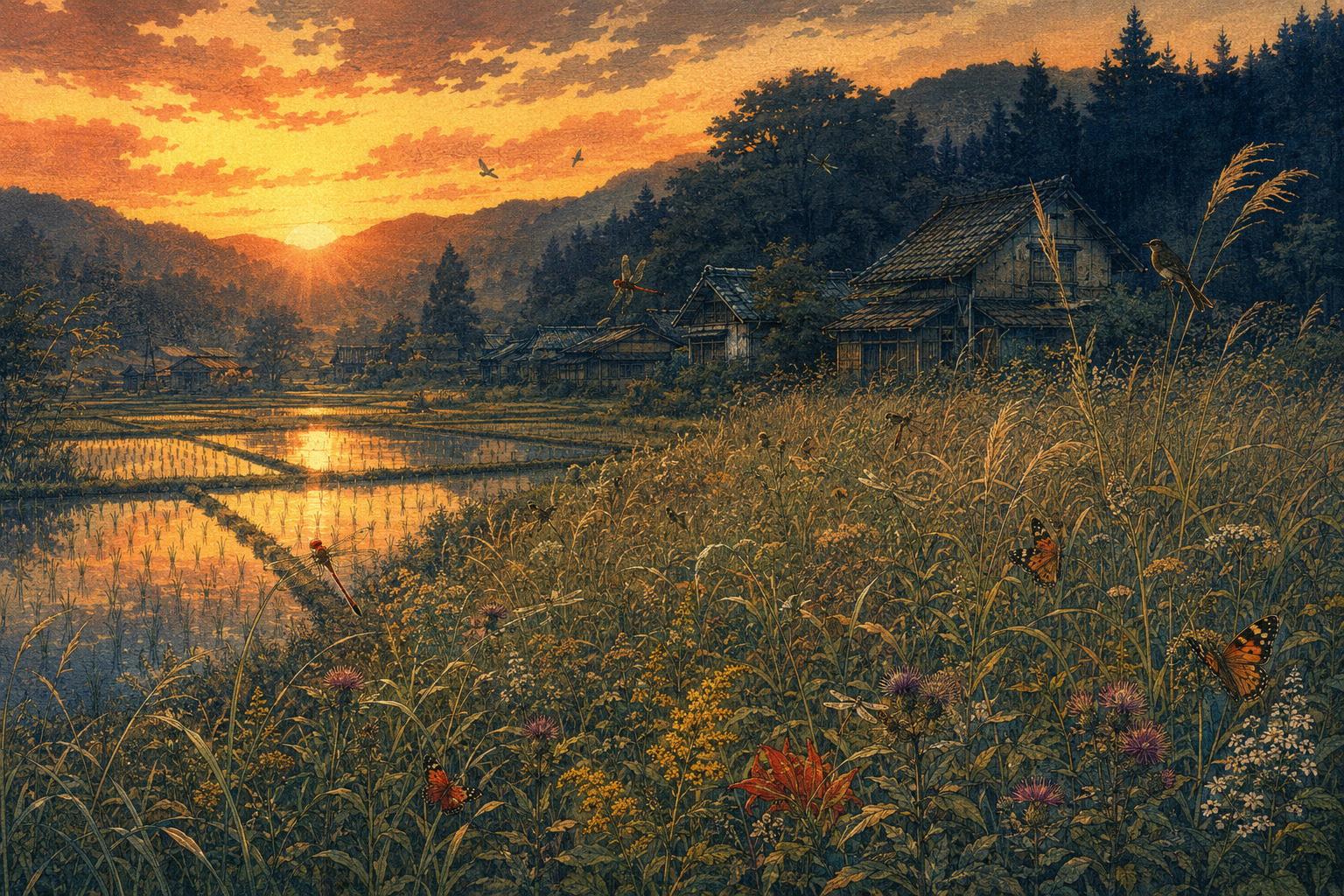
The first mistake is to see an abandoned field as empty. Stop mowing, planting, flooding and draining it, and the land begins making decisions of its own. Reeds may rise from a wet Hokkaido lowland. Shrubs may close over a dry hillside. A Kyushu paddy may lose the shallow water and exposed mud that herons used as a feeding ground. The absence of farming is not the absence of ecological change.
Japan now has an unusually practical way to anticipate which of those changes will help birds and which will hurt them. A team from the National Institute for Environmental Studies, the Forestry and Forest Products Research Institute and Hokkaido University surveyed birds in breeding and wintering seasons at 199 sites from Hokkaido to Kyushu. It then tested the Japanese pattern against published evidence from four continents.
The paper was led by NIES special researcher Munehiro Kitazawa with Yuichi Yamaura of FFPRI, Kazuhiro Kawamura and Masayuki Senzaki of Hokkaido University, and Hokkaido University professor emeritus Futoshi Nakamura. Published online by the Proceedings of the National Academy of Sciences on July 27, 2026, it does not award a universal ecological verdict to farmland abandonment. It identifies a switch. Where the regional bird community is dominated by species associated with marshes, grasslands and forests, the succession that follows abandonment can create scarce habitat and raise species richness. Where birds of bare or waterside habitats dominate, the disappearance of cultivated open ground, shallow water and field edges can reduce richness instead.
That distinction changes the policy question. The issue is no longer simply whether a parcel should be farmed or “returned to nature.” It is which nature agriculture displaced, which nature agriculture subsequently created, and which community of species will inherit the land when management stops.
The missing variable was who already lived there
Ecologists have long reported opposing outcomes after farms are left unused. In one landscape, tall vegetation and returning woody cover shelter more species. In another, a once-diverse farm becomes a uniform thicket. Climate, time since abandonment and management history can all matter, but they did not provide a simple bridge between results scattered across regions.
Kitazawa and colleagues grouped birds by the habitat structures they primarily use: wetland birds, grassland birds, forest birds, bare-ground birds and waterside birds. This “functional group” approach asks how a community is likely to respond to the physical transition of the field, rather than treating every species name as an unrelated data point.
The Japanese comparison included abandoned farmland, natural wetlands, forest, cropland, traditional rice paddies that retained features such as banks and earthen channels, and consolidated paddies reshaped for more intensive production. The PNAS paper describes two-hectare plots, including fields abandoned for no more than 50 years, and models designed to account for land cover in the surrounding landscape.
Once cultivation ends, the human disturbances that held a field in a particular state weaken. A poorly drained lowland can become reedbed. A well-drained upland can move toward scrub and forest. Those are gains for birds that require later-successional vegetation. But flooding schedules, exposed mud, short swards, ridges and small channels can vanish. Those are losses for species that depended on the farm precisely because farmers kept resetting it.
The dominant group therefore acts as a forecast of direction. If the regional species pool contains many birds equipped to use the habitat that succession is creating, richness tends to rise. If it contains many birds tied to the disturbance-created features being removed, richness tends to fall. The insight is elementary once stated, but powerful because it makes contradictory case studies part of the same ecological mechanism.
Japan is a switchboard, not a single case
Hokkaido illustrates the first path. During the breeding season, estimated bird richness in abandoned lowland farmland was about 2.4 times that of traditional, unconsolidated rice paddies. Wetland and forest birds make up a relatively large part of the northern community, and vegetation developing on unused land can supply the structures they need. Studies from Russia and Australia in the global analysis pointed in the same direction.
The pattern reversed farther south during the breeding season. In Kyushu, a traditional paddy was estimated to hold about 1.4 times as many species as abandoned farmland and about 1.8 times as many as a consolidated paddy. Agriculture’s presence was not the only difference: the older field structure, with banks, channels and heterogeneous wet places, mattered too. The finding places abandonment and intensification on the same warning map. A field can lose habitat when farming stops, and lose it again when farming becomes structurally simpler.
Season adds another switch. Southern abandoned land that may look less valuable in the breeding season can become winter habitat for migrants that breed in northern marshes. At one Okayama site, the team recorded 73 reed buntings per two hectares. A survey conducted only in spring and summer would have missed that concentration entirely.
Across the domestic abandoned sites, researchers found 87 bird species. The joint Japanese press release says particular sites supported, through the breeding season, the brown shrike subspecies Lanius cristatus superciliosus, whose national population the team describes as about 300, and the great bittern, which it describes as numbering fewer than 50 in Japan. Seven threatened or near-threatened species, including Latham’s snipe and the Japanese marsh warbler, were recorded breeding or wintering.
Those observations establish conservation potential, not automatic population security. Presence does not prove successful nesting, adequate food through every season or persistence as vegetation continues to change. A rare bird can use a parcel temporarily. Long-term decisions need repeated evidence about abundance, breeding, hydrology, predators, invasive species and the surrounding network of habitat.
A threshold from a model, not a line in the law
The global meta-analysis found that the dominant functional group could also explain the direction and magnitude of bird-diversity responses outside Japan. The PNAS abstract reports that when species associated with mature wetland, grassland and forest habitats made up more than 50% of the community, predicted richness after abandonment increased by more than 240% and reached a level comparable with natural wetlands. Where species associated with disturbed, open habitats exceeded 48%, both abandonment and agricultural intensification reduced richness.
Those percentages are model-derived transition points, not instructions to count a local checklist and declare a field protected at 50.1%. The estimates combine places, seasons and survey designs; uncertainty also follows from how species are assigned to groups and from the composition of the surrounding landscape. A municipality can use the relationship to formulate a field hypothesis. It still needs local observation before choosing a land use.
The “more than 240%” global prediction must also be kept separate from the Japanese Hokkaido comparison of about 2.4 times traditional paddies. One is a modeled percentage increase under a specified global community composition; the other is a ratio between land-use categories in a particular Japanese region and season. They are not interchangeable expressions of one result.
The most consequential part of the model may be what happens at the disturbed-habitat end: abandonment and intensification can both be harmful. The policy option between them is not merely “continue farming.” It is to continue or reintroduce management while retaining the small structures—earthen ditches, shallow water, open edges, banks and varied mowing times—that support the birds of traditional farmland.
How a rice field inherited the work of a wetland
Japan’s land-use history explains why there can be ecological costs on both sides. The Environment Ministry defines satoyama and related rural landscapes as mosaics of settlement, secondary forest, farmland, ponds and grassland formed and maintained by agriculture, forestry and everyday life. These places are not untouched wilderness. Their biodiversity often depends on repeated cutting, flooding, harvesting and gathering.
At the same time, expanding agriculture removed natural ecosystems. A 2018 Hokkaido study by researchers from the Forestry and Forest Products Research Institute and Hokkaido University cited earlier estimates that Japan had lost about 60% of its wetlands and 90% of its grasslands over the preceding century. At 48 sites in central Hokkaido, wet and dry abandoned fields tended to support more wetland and grassland birds than active farmland, though fewer than natural wetlands or grasslands. Abandonment could partly replace the nature that cultivation had displaced.
In a long-cultivated lowland, however, the paddy itself may have inherited some of the wetland’s work. Seasonal inundation, ridges, earthen channels and vegetation management create a shifting habitat for fish, amphibians, insects and waterbirds. Remove water management or allow the field to dry, and those organisms do not necessarily benefit from taller vegetation.
A separate 2018 meta-analysis by Chieko Koshida and Naoki Katayama examined biological responses to rice-field abandonment in Japan. It found that species richness and abundance after abandonment fell to 56–72% of levels in managed paddies. Dry abandoned fields were especially unfavorable for amphibians and fish; birds and mammals showed the smallest declines among the groups studied. Plants did not recover even 10 to 15 years after abandonment in the analyzed evidence.
The Hokkaido bird result and the nationwide rice-field synthesis are not contradictions. One can be true where wet former farmland is becoming a substitute marsh, while the other is true where abandonment removes managed aquatic habitat. They ask about different taxa across different physical conditions. The contribution of the 2026 study is to turn that dependence on context from a nuisance into the central explanatory variable.
Over the past century Large losses of natural wetland and grassland increased the habitat role of some managed rural landscapes.
1961 Japan’s cultivated area reached its postwar maximum of 6.086 million hectares.
From 1985 The old agricultural census showed a marked increase in self-reported abandoned cultivated land.
2018 Hokkaido bird research and a nationwide paddy meta-analysis documented positive and negative outcomes under different conditions.
2023 Japan adopted its Biodiversity Strategy 2023–2030, treating the retreat of rural management as part of a national conservation challenge.
March 2025 The government counted 257,000 hectares in its narrower, field-inspected category of severely degraded farmland.
July 2026 The PNAS study connected Japanese surveys with evidence from four continents through the dominant-group framework.
The 257,000-hectare number does not mean what it seems
Japanese debate is vulnerable to a statistical trap because several official and research terms can sound like versions of the same thing in English. They are not. The former Census of Agriculture and Forestry category kosaku hōkichi—usually translated as abandoned cultivated land—was land previously farmed but not planted for at least a year, where the respondent did not intend to resume cultivation for several years. It was self-reported; the 2015 figure was 423,000 hectares.
The current Ministry of Agriculture, Forestry and Fisheries category kōhai nōchi, or severely degraded farmland, is field-inspected land no longer under cultivation and objectively judged impossible to crop through ordinary farm work. As of March 31, 2025, it totaled 257,000 hectares. Of that, 98,000 hectares were considered capable of being restored through measures such as clearing, leveling, replotting or adding soil; 159,000 hectares were judged difficult to restore. In fiscal 2024, 24,000 hectares entered the category and 8,000 were restored to use.
The PNAS study’s ecological category includes surveyed farmland abandoned for up to 50 years. It is not a measurement of either administrative total. The 423,000- and 257,000-hectare figures should never be added together, and neither should be presented as the area whose biodiversity the paper evaluated. Owner intention, legal status, physical degradation, vegetation and biological value require different observations.
| Category | What it means | Who determines it | How this article uses it |
|---|---|---|---|
| Ecological “abandoned farmland” | Land where cultivation management has ended; Japanese PNAS plots include up to 50 years since abandonment. | Researchers classify land use and survey habitat. | Used for comparisons of bird richness. |
| Kosaku hōkichi (耕作放棄地) | Previously cultivated, unplanted for at least one year, with no intention to resume for several years. | Self-reported in the former agricultural census. | The 2015 total of 423,000 ha is historical context only. |
| Kōhai nōchi (荒廃農地) | Uncultivated farmland objectively impossible to crop through ordinary farm work. | Municipalities and agricultural committees inspect the land. | 257,000 ha at March 31, 2025; separate from the study area. |
| Yūkyū nōchi (遊休農地) | Unused farmland, or land used substantially less than neighboring farmland, under the Agricultural Land Act. | Agricultural committees conduct statutory use surveys. | A legal category tied to measures promoting use. |
Depopulation does not rewild on command
The pressure behind this debate is demographic as much as ecological. Japan’s cultivated area fell from 6.086 million hectares in 1961 to 4.239 million in 2025, a decline of about 1.85 million hectares. The core agricultural workforce shrank from 2.4 million people in 2000 to 1.02 million in 2025. Its average age reached 67.6. More communities will have to decide where scarce labor should continue managing land.
A simple “people leave, nature returns” story is especially dangerous in a landscape built by recurrent human use. A 2025 Nature Sustainability paper followed birds, butterflies, fireflies, frog egg masses and plants at 158 Japanese sites over periods of five to 17 years beginning in 2004. It found declines across most species even in areas losing population. Agricultural land-use change—including urbanization, disuse and abandonment, and intensification—was among the principal associations.
Depopulation can lower some development pressures while simultaneously removing the people who cut grass, maintain channels and keep secondary habitats open. The Environment Ministry describes this contraction of human activity as Japan’s “second crisis” of biodiversity. But classifying every unmanaged parcel as a conservation failure would be equally crude: it could destroy emerging reedbeds or grasslands precisely where those habitats have become scarce.
The practical task is triage. A region needs to place agricultural value and ecological value on the same map: where food production can remain viable, where traditional management supports threatened species, where wet succession is recreating a lost marsh, and where a field will close into lower-value vegetation unless someone intervenes.
Management choices between plowing and walking away
Where bare-ground and waterside birds dominate, the conservation response may be to sustain traditional paddies, protect earthen banks and channels, maintain shallow water, or alter mowing and flooding dates. Where wetland birds concentrate in an abandoned lowland, restoring drainage and cultivation could be destructive. The intervention might instead be to protect hydrology, monitor reed succession and invasive plants, and periodically cut or flood areas so the habitat does not become uniformly closed.
Upland fields moving toward forest create another set of tradeoffs. New woody habitat may favor forest birds while eliminating grassland species, increasing wildlife conflicts or removing a buffer around working farms. “Let it become forest” is a management choice with costs and beneficiaries, even when no machinery enters the parcel.
- Bird community: Which functional groups dominate, and does the answer change between breeding and wintering seasons?
- Hydrology: How will flooding duration, drainage, groundwater and earthen channels change?
- Succession: Is the parcel moving toward reedbed, grassland, scrub or forest?
- Threatened species: Are they passing through, feeding, breeding or wintering consistently?
- Agricultural value: What are the production potential, labor, restoration cost and effects on neighboring farms?
- Long-term steward: Who will mow, manage water, control invasive species and continue monitoring?
Japan’s policy architecture has begun to make room for this kind of design. The country is pursuing the global 30by30 goal of conserving at least 30% of land and sea by 2030. It began certifying “Nationally Certified Sustainably Managed Natural Sites,” known in Japanese as shizen kyōsei saito, in fiscal 2023. A regional biodiversity law that took effect in April 2025 covers not only the maintenance of places already rich in nature but also the recovery of biodiversity on land degraded through neglected management. By the end of June 2026, 610 Nature Coexistence Sites had been certified.
The research team’s suggestion that high-value abandoned farmland could contribute to protected-area and OECM networks can therefore meet an existing institution. But certification is not a label for doing nothing. It requires an objective, an implementing body, a management plan and monitoring. The observation of a rare bird cannot on its own resolve ownership, a farmer’s intention, flooding risk or responsibility for future work.
Start with birds; do not end with them
The authors propose that the dominant-group idea may prove useful for other taxa. Butterflies of open habitats could respond in ways analogous to bare-ground birds; fish dependent on managed water might resemble the waterside group. But the paper explicitly presents broader transfer as a hypothesis that requires empirical testing.
Birds are mobile indicators. That makes wide-area surveys feasible, but it also lets them leave a deteriorating parcel and use resources spread across a landscape. Plants, amphibians, benthic invertebrates and soil organisms may respond quite differently to drying, nutrient accumulation and woody succession. Equal species counts can also conceal replacement: a community of common or nonnative species is not equivalent to one sustaining a threatened specialist. Abundance, nesting success, genetic diversity and ecosystem function all extend beyond a richness total.
The Japanese comparisons are observational rather than a randomized experiment in which otherwise identical farms were assigned to cultivation or abandonment. Statistical models can adjust for surrounding land cover and other measured differences, but cannot erase every unmeasured history of soil, water, ownership or management. Local application should treat the study as a predictive framework to test, not as a parcel-level verdict delivered from a national model.
That is still a major advance. Public agencies rarely have the time or money to inventory every organism before acting. Determining which bird habitat groups dominate the regional species pool can provide an initial warning about the direction of change, allowing expensive fieldwork to be concentrated where the decision is hardest or the conservation stakes are highest.
A grass-covered paddy can look like nature returning and like a village disappearing at the same time. Neither visual story reveals what happened to the heron that lost shallow water, the reed bunting that gained a winter refuge, the farmer who wants to resume cultivation or the community that would have to maintain the land. Those facts belong on one decision sheet.
Abandoned farmland is not a blank between agriculture and wilderness. It is a transition zone where the ecological legacy of farming meets the next landscape. Doing nothing is one form of land-use decision, and its consequences can point in opposite directions. The birds have not supplied a slogan for rewilding. They have supplied a map of questions.
- National Institute for Environmental Studies, FFPRI and Hokkaido University — Joint research release, August 27, 2026
- PNAS — “Dominant functional group explains global bird diversity responses to farmland abandonment”
- National Institute for Environmental Studies — Official profile of Munehiro Kitazawa
- KAKEN — Research record for the nationwide farmland-abandonment and bird-diversity project
- Forestry and Forest Products Research Institute and Hokkaido University — Abandoned farmland as bird habitat in Hokkaido, 2018
- Conservation Biology — Meta-analysis of rice-field abandonment and biodiversity in Japan, 2018
- Nature Sustainability — “Biodiversity change under human depopulation in Japan,” 2025
- Ministry of Agriculture, Forestry and Fisheries — Severely degraded farmland at March 31, 2025
- Ministry of Agriculture, Forestry and Fisheries — Current conditions and countermeasures for degraded farmland, February 2026
- Ministry of Agriculture, Forestry and Fisheries — Definitions and policies for degraded and idle farmland
- Ministry of the Environment — Satoyama conservation and use
- Ministry of the Environment — 30by30 and Nature Coexistence Site policy
- Ministry of the Environment — Nature Coexistence Site certification under the regional biodiversity law, June 2026