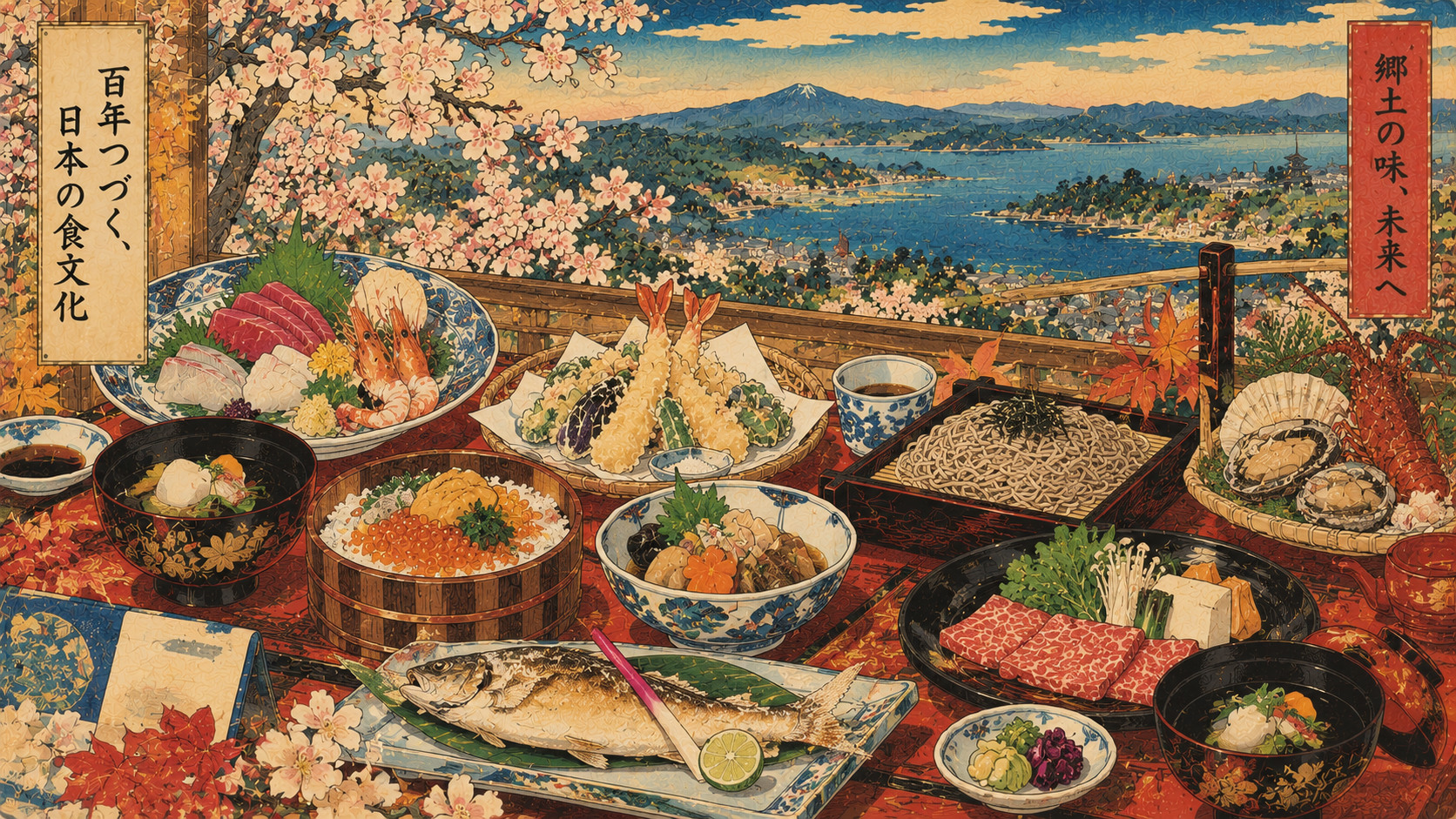
Saving a dish is not the same thing as saving the people, ingredients and knowledge that keep it alive.
The taste that holds a town together
In Japan, a dish can be a map of a place. The ingredients tell you what grows nearby or what the sea once supplied. The seasoning may carry memories of migration and trade. The name can preserve a factory town, a fishing season or a family ritual long after the circumstances that created it have changed. Yet a regional specialty is not preserved simply because it remains on a restaurant menu. Someone must know how to make it, someone must be able to obtain its ingredients, and someone must want to teach the next generation.
A new invitation, 329 existing traditions
On October 20, 2026, Japan’s Agency for Cultural Affairs opened applications for another round of its 100-Year Food program, with a deadline of November 20. The agency says it has recognized 329 food traditions so far. That number is the cumulative total of earlier recognitions, not the number of dishes chosen in the new round. Alongside it, the agency opened applications for its Food Culture Museum initiative, which identifies publicly accessible places where people can learn about food traditions.
A century in the name, the future in the rules
The most surprising feature of the program is that a dish need not already be a hundred years old. The categories deliberately span different periods: traditional foods associated with the Edo era, culinary traditions developed in the Meiji and Taisho eras, and a future category for newer local foods intended to survive another century. Each applicant must demonstrate a distinctive regional food culture passed between generations, shaped by local history and custom, and supported by an organization that pledges to carry it forward. The future category recognizes an uncomfortable truth about heritage: everything old was once new.
Who applies, and what recognition means
Applications come from local governments, civic associations, tourism organizations and other qualifying bodies, not individuals. Private organizations face additional documentation and local-government support requirements. An expert committee established by the agency reviews submissions. Recognition is meant to encourage transmission and public attention; it is not an international heritage inscription, a legal monopoly over a recipe or government certification that every restaurant selling a named dish is authentic.
In Muroran, yakitori does not mean chicken
Consider Muroran yakitori. A visitor hearing the word yakitori might reasonably imagine chicken skewers. The recognized Hokkaido tradition instead centers on pork and onion, grilled with a rich sauce and accompanied by mustard. According to the Agency for Cultural Affairs’ regional register, the dish traces its local roots to food stalls around 1933 and became closely entwined with a steelmaking city’s working life. This is industrial history you can eat: the rhythms of a factory town expressed not through a monument but through an everyday meal.
Sapporo soup curry: modern food becoming heritage
Sapporo soup curry makes the program’s wider philosophy clearer. The agency’s account points to a medicinal-style curry established in 1971 and the emergence of the name soup curry in the 1990s. The dish was recognized in the future-oriented category for fiscal 2025. A food culture that took its modern form within living memory can still be considered worthy of deliberate preservation. Recognition does not prove that all accounts of its origins are settled, but it makes the story of how a city adopts a dish part of the national conversation.
Salmon, miso and the reinvention of Ishikari
Ishikari nabe offers yet another pattern. The Hokkaido salmon hotpot has fishing-community roots, while the agency’s history describes the spread of its familiar name in the postwar years as visitors were introduced to the dish. Ingredients and public presentation changed with farming, transport and tourism. Food heritage is therefore not an exercise in freezing a recipe at an imagined historical moment. It is partly a history of adaptation—and partly a decision about which changes communities consider faithful to their identity.
What a food tradition actually needs
The risks are practical. A cook retires and does not train a successor. A fishing community loses access to a species it once depended upon. A local festival draws fewer young volunteers. A dish survives as a packaged souvenir but disappears from ordinary kitchens. The 100-Year Food designation can help people discover these traditions, and the agency points to coverage and products carrying the program’s logo. But the published cumulative count of 329 recognitions does not establish how many apprenticeships have been created, how many recipes remain widely cooked at home, or whether participating businesses have become economically secure.
Japan’s broader effort to safeguard washoku
The modern heritage movement has an important international milestone. In 2013 UNESCO inscribed washoku—traditional dietary cultures of the Japanese, notably those associated with the New Year—on its Representative List of the Intangible Cultural Heritage of Humanity. The designation concerned knowledge, preparation, respect for natural resources and the social practices of sharing and transmitting meals. It did not declare that one standardized restaurant menu represented all of Japanese cuisine. The country’s diverse regional dishes help explain why that distinction matters.
Preservation can also distort
Recognition brings trade-offs. A dish made for visitors may become more photogenic and less affordable to residents. Commercially convenient ingredients may replace local ones. A single officially promoted origin story may flatten differences between families or neighboring towns. Such risks are not evidence that the 100-Year Food program has failed; they are questions for anyone assessing its results. Academic work on Japan’s washoku heritage framing has also examined how national heritage narratives can simplify a complex culinary culture.
Museums, roadside stations and living classrooms
The companion Food Culture Museum program casts a wider net than formal museums. Eligible facilities include roadside stations and public-facing food education or experience centers. The agency says 149 facilities have already been recognized. Such venues can help explain why particular techniques evolved—how sea routes brought ingredients, why a storage method mattered before refrigeration, or how a local harvest became a celebration. They may also connect younger people with skilled producers in ways a label alone cannot.
The economics behind a bowl of noodles
Japan’s regional food culture is both cultural inheritance and local economic infrastructure. Shops buy from farmers, fishermen and wholesalers; visitors spend on transport and lodging; schools and associations can introduce children to local dishes. But a newly announced application period says little on its own about these outcomes. Evidence of durable success would require tracking producers, successor training, affordability, ingredient availability and whether regional residents themselves still eat the food. The questions matter as much to an investor examining a food enterprise as to a historian studying a recipe.
Which taste should exist in 2126?
The invitation closes November 20. Its most consequential question is not which dish will acquire a new emblem, but who will still be able to prepare and share that dish decades from now. Can a child learn it? Can its ingredients survive changing climates and markets? Will residents recognize the version sold to tourists as their own? Japan’s most distinctive culinary heritage is not only preserved in archives and beautiful photographs. It endures in hands, conversations, kitchens and communities—and in the decision to cook something again tomorrow.
Sources and further reading
Based on the Agency for Cultural Affairs’ October 20 notice, its published register and UNESCO documentation. Some dish-origin accounts are drawn from applicant-provided descriptions; they have not all been independently corroborated.