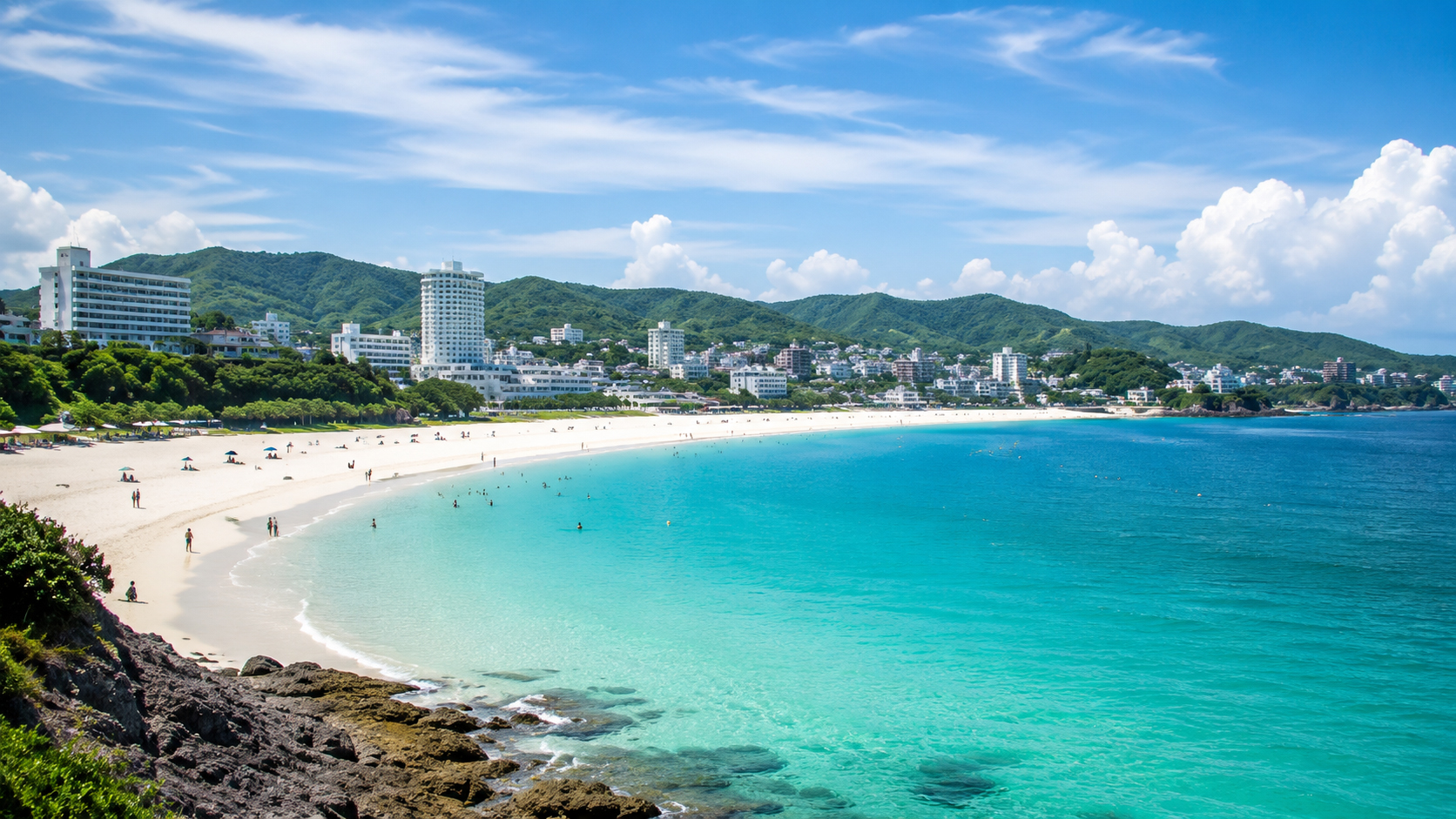
Tokyo exhales here
At the end of a Tokyo week, the human soul begins making unreasonable demands. It wants wind. It wants salt. It wants to wear sandals without looking like it has resigned from civilization. That is when Izu Shirahama becomes dangerous. White sand, clear water, surfers, mountains falling toward the Pacific, and a train route from Tokyo that makes the whole thing feel just close enough to be a responsible idea.
Shirahama Ohama Beach, on the northeastern side of Shimoda in southern Izu, is one of the peninsula’s signature beaches. JNTO describes the sand as extending for more than 800 meters, notes that the name literally means “white beach,” and highlights the clear water and regular surf. In summer it becomes a swimming destination. In other seasons it remains a surf and coastal-walk escape. Either way, it has the rare gift of making city shoes look ridiculous.
The important thing to understand is that Shirahama is not a giant convenience-resort machine. It is a real beach area. There are shops, rentals, food options and nearby hotels, but the supply is not infinite. Hours change by season. Buses matter. Cash still helps. Water and snacks are not optional philosophical concepts. Shirahama rewards people who plan just enough, then surrender to the weather.
Why the water looks different
The Izu Peninsula is volcanic, mountainous and pushed dramatically into the Pacific. The coast is shaped by cliffs, coves, hot springs and the warm influence of the Kuroshio Current. North Izu has the classic hot-spring resort towns of Atami and Ito; south Izu, around Shimoda, feels more open to the ocean. At Shirahama, the white sand, blue water, mountain backdrop and wide horizon appear in the same frame, as if the scenery committee had a productive meeting.
Shimoda also carries real historical weight. In the mid-19th century, after Commodore Perry’s arrival, Shimoda became one of the ports connected to Japan’s opening to the outside world. That means a Shirahama weekend can include swimming, surfing, seafood, hot springs and a walk through the geography of modern Japanese history. This is a lot for one beach town to accomplish, but Shimoda has never been shy.
Getting there from Tokyo: train people and car people
By rail, the classic route is to take the Odoriko or Saphir Odoriko limited express toward Izukyu-Shimoda, or to use the Tokaido Shinkansen to Atami and continue south. JNTO gives the Tokyo-to-Shimoda trip at roughly two hours and 45 minutes, then notes that Shirahama is about four kilometers from central Shimoda. From Izukyu-Shimoda Station, take a bus toward Itadoichiki and get off at Shirahama Kaigan, or take a taxi. The final four kilometers are the beach-town reminder that “almost there” is still a travel category.
By car, you gain flexibility, beach gear space and the ability to wander to nearby coves. You also join everyone else who had the same brilliant idea. Summer Izu traffic can be heroic in the wrong direction. Leave early, return strategically, and accept that at some point a parking lot will test your character.
- Sunscreen, hat, sandals, extra towels.
- Water and snacks. “We’ll buy something later” is how beach novels become tragedies.
- Cash for small shops, parking and beach-season surprises.
- Check flags, lifeguard instructions and surf conditions before swimming.
- Look at the return bus schedule before your brain becomes sea foam.
Surf culture: half sport, half waiting for the ocean to agree
Shirahama is enjoyable even if you never touch a surfboard. Watching surfers is its own beach activity: people sitting on boards, reading waves, suddenly paddling, occasionally standing with grace, occasionally discovering gravity in public. Surfing looks relaxed from shore, but it is actually a negotiation with a moving wall of water. The ocean does not care about your brand of sunglasses.
Surfing and swimming share the same broader coastline, so pay attention to zones, flags and local guidance. In peak summer, families, swimmers, surfers, photographers, couples and convenience-store philosophers all converge on the sand. Shirahama is beautiful, but it is still a natural beach. Waves, wind, rip currents and sudden weather matter. Instagram is not a flotation device.
Where to stay: beach-first or town-first
Choose your base by deciding what kind of traveler you are. Beach-first travelers should stay near Shirahama, where morning light and early swims are the luxury. Town-first travelers may prefer central Shimoda or the bay area, where restaurants, port walks and station access are easier. Neither choice is wrong. One says “I came for the sea.” The other says “I came for the sea and dinner.” The second is also a noble philosophy.
Address: 1547-1 Shirahama, Shimoda-shi, Shizuoka 415-8525 Japan
Phone: +81-(0)558-22-2111
Website: https://www.princehotels.com/shimoda/
A beach-facing Shirahama classic. Good for travelers who want to wake up with the Pacific in the window and then spend checkout morning pretending they have no train to catch.
Address: 5-12-1, Shimoda City, Shizuoka 415-8510
Phone: +81-558-22-2411
Website: https://www.tokyuhotels.co.jp/en/shimoda-h/
A strong base for balancing beaches, town walks, dining and hot springs, with access from Izukyu-Shimoda Station.
Address: 4-1 Kakisaki, Shimoda-shi, Shizuoka 415-0013 Japan
Phone: +81-558-27-2111
Website: https://www.baykuro.co.jp/en/
A bay-side stay with hot springs and local seafood. Best for people who want Shimoda’s port-town mood along with beach access.
Where to eat: fish has the home-field advantage
After the beach, seafood becomes less of a choice and more of a gravitational event. Shimoda is known for local fish, especially kinmedai, and the area around Shirahama and central Shimoda offers several practical options. Plan meals before you are starving. A hungry beach group can turn into a small, salty parliament.
Address: 2648-5 Shirahama, Shimoda, Shizuoka
Phone: 0558-22-2837
Website: https://izulunch.com/shimoda-isoichi/
A seafood set-meal spot close to Shirahama, useful for sashimi, tempura and local fish after the beach.
Address: 1-1-23 Higashihongo, Shimoda-shi, Shizuoka 415-0035
Phone: 0558-23-7200
Website: https://1930.bz/en/osyokuji_en.html
Convenient near Izukyu-Shimoda Station, especially before or after the train. Excellent for converting travel logistics into a seafood meal.
Address: 3-2-12, Shimoda, Shizuoka
Phone: 0558-22-1672
Website: http://shimoda100.com/restaurant/shinden/
A seafood restaurant near Perry Road and Ryosenji Temple, easy to combine with a town walk.
Address: 1901 Kisami, Shimoda, Shizuoka 415-0028
Phone: 0558-23-0192
Website: https://www.sunnyside-shimoda.com/
A relaxed cafe in the Kisami direction, useful when your group needs something more casual than another fish negotiation.
Do not skip Shimoda town
It is possible to spend all day on Shirahama’s sand and be perfectly happy. Still, Shimoda town deserves time. Perry Road, Ryosenji Temple, the port and the old treaty-port atmosphere give the weekend depth. Swim in the morning, eat fish at lunch, wander historic streets in the evening, soak in a hot spring at night. This is not a beach trip. This is a small cultural ambush wearing flip-flops.
Nearby beaches also broaden the trip: Sotoura, Kujuppama, Nabetahama and Kisami-area beaches each have a different mood. Shirahama is the famous one, and famous means other people know it too. If you reach the beach in August and wonder why everyone came, remember: you also came. Crowds are a mirror with beach umbrellas.
The charm of limited shops
Part of Shirahama’s appeal is that it does not erase the edges of travel. There are fewer choices than Tokyo. That means you look at bus times. You think about lunch. You notice the sky. You learn that convenience is wonderful, but inconvenience gives stories better endings. In Tokyo, picking dinner can require a group chat, three apps and a minor constitutional crisis. In Shirahama, the options become seafood, cafe, convenience store, or sleep. Democracy becomes efficient.
Sand will return home with you. It will appear in the bottom of your bag days later like a tiny postcard from Izu. Do not be angry. That is not mess. That is memory with excellent persistence.
- Izu Shirahama is a real white-sand surf beach within weekend reach of Tokyo.
- Shimoda adds history, hot springs, seafood and port-town character to the beach trip.
- Shops and transport are limited compared with the city, so plan meals, cash, water and return buses.
- Stay near Shirahama for beach-first travel; stay closer to Shimoda town for food and walks.
- Summer Izu gets busy. Book early, leave early and treat traffic as part of the folklore.
Sources and references
This feature is based on official tourism information, hotel and restaurant websites, and public travel references. Hours, prices, reservations and access details may change; confirm directly before visiting.