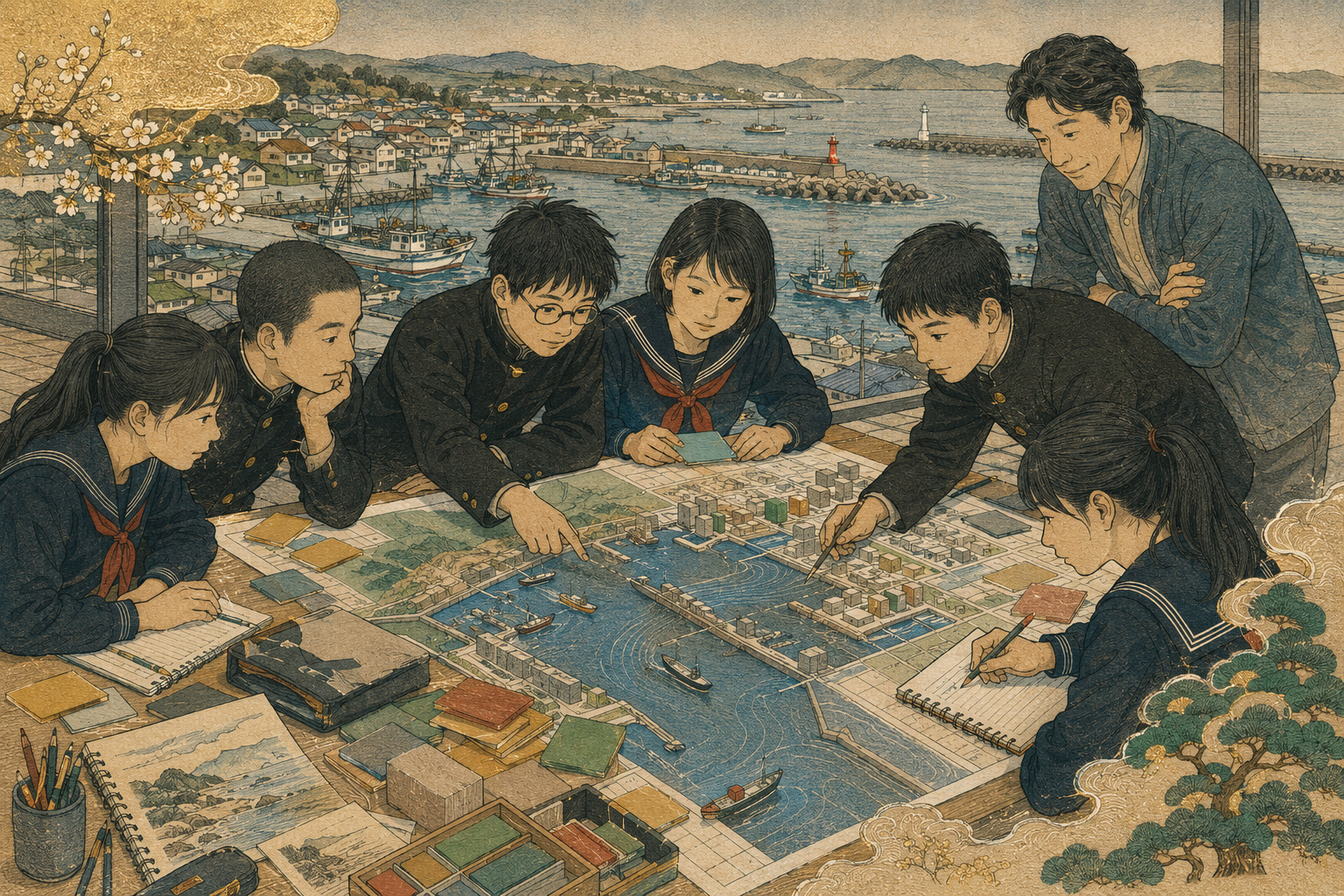
The instruction at the beginning was almost anti-instruction: walk without deciding what you are looking for. In Ishinomaki’s center, a student might photograph a faded sign, a narrow passage toward the river, a piece of litter near a drain, a shop that seems open only when school is in session, or the way a seawall interrupts a familiar view. The object need not be important. It needs only to produce the small mental resistance of “Why is that like this?”
That is how the first cohort of “Takuramu, Idomu, Tanoshimu ‘Mumumu!’”—roughly, “scheme, challenge, enjoy”—entered a six-month inquiry program in October 2025. The students met about twice a month in “Takura meetings,” then used afternoons and other free time to develop their own ideas in the city. Adults and university students helped them find people, shape plans and reflect. The venue moved among Ishinomaki’s Mutual Support Center, the organizer’s office in the Ishinomaki Gas Building, local businesses and the central streets.
The organizer, the Ishinomaki foundation Machi to Hito to, described Mumumu as a non-permanent youth-center program: a third place that is neither school nor home. Its premise was not that adults would bring a list of municipal problems for adolescents to solve. It began with the student’s own “I want to try this,” then asked whether curiosity could become a project and whether a project could create a relationship with the town.
By the closing presentation on March 8, 2026, 14 high-school students had worked on disaster education, a teenager’s collection of Ishinomaki’s familiar and mildly irritating details, conversations with local workers, overseas poverty relief, marine litter, and traditional play across generations. One team produced a video to give other teenagers a first opening into the history of the 2011 disaster. They interviewed residents and people engaged in disaster transmission because the members themselves had little or no memory of the event.
Calling these efforts “community problem-solving” is convenient, but incomplete. Some were public interventions. Some were acts of learning. Some helped a student discover what kind of work or human connection mattered to them. Their civic value may lie less in the scale of the product than in the sentence a young person learns to say: “I noticed this, I asked someone, and together we changed something small.”
A program built as a third place
The first public call appeared on September 17, 2025. A trial session was scheduled for October 1, followed by a formal kickoff in mid-October. The intended group was about ten students from junior high and high schools across the Ishinomaki area. The opening curriculum included a “Feel-degree Walk” through the city, a hand-drawn “knowledge map,” searching for the seeds of a possible project, turning ideas into form and preparing to enjoy the inevitable difficulty of trying.
The language is deliberately lighter than a municipal planning document. “Mumumu” sounds like someone pausing over a puzzle. The three verbs—plot, attempt, enjoy—make room for play and uncertainty. That tone is not decoration. A teenager who has been told for years to produce the correct answer may not immediately know how to name a self-directed question. If the first demand is “solve population decline,” the safest response is a classroom slogan. If the first invitation is “show me what you keep noticing,” a real inquiry can begin.
Twice-monthly meetings created rhythm without turning the project into another daily institution. Participants prepared with peers, consulted local adults or university students, acted at their own pace and returned to reflect. In youth work, this sequence matters. An event by itself can be exciting and disappear. A long project gives time for the awkward middle: a venue says no, a collaborator does not reply, an idea proves too large, or the student’s interest changes.
| Element | Confirmed first-cohort design | Educational purpose | Question for evaluation |
|---|---|---|---|
| Time | October 2025 through March 2026 | Allows interests, plans, setbacks and revision to develop | Did students continue after the first excitement? |
| Meetings | About twice monthly, plus activity after school | Combines peer rhythm with flexible individual work | Who attended, and who quietly dropped away? |
| Place | Mutual Support Center, central streets, organizer office and local workplaces | Treats the city as both subject and classroom | Did students reach communities beyond the familiar center? |
| Adults | Organizer staff, university students and consulted residents | Opens networks and provides planning support | Did adults enable the student’s idea or rewrite it? |
| Output | Events, exhibitions, interviews, a video and public presentations | Makes learning consequential and shareable | What remained after presentation day? |
The phrase “non-permanent youth center” describes the program’s ambition and vulnerability. It can bring the functions of a youth center—belonging, trusted adults, peer community, freedom to experiment—to existing rooms rather than waiting for a dedicated building. It also means continuity depends on staff time, borrowed space, partnerships and money that may be less visible than a capital project.
That financial question is already present in the surrounding ecosystem. Machi to Hito to said in July 2026 that its shorter Maki Bora volunteer program had relied on reconstruction-related funds and faced an annual operating need of about ¥2 million as those funds ended. It began seeking monthly supporters. Mumumu is a different program, but the warning is shared: relationship-rich education looks inexpensive because its principal material is human attention. Attention still has to be funded.
A city living through two reconstructions
Ishinomaki cannot discuss young people and the future without the date March 11, 2011. The city’s newly updated disaster record counts 3,188 deaths, 414 people still missing and 276 disaster-related deaths—a total of 3,878. The tsunami inundated 73 square kilometres, 13.2 percent of the municipality and about 30 percent of its flat land. At the peak, 50,758 people were in 259 evacuation sites. More than 20,000 buildings were destroyed.
Numbers set the scale but cannot explain what it means for a teenager in 2026. A 15-year-old may have been born after the disaster; an 18-year-old was a toddler. They inherit reconstructed roads, raised ground, memorial parks, seawalls, empty lots, family silences and an annual public language of remembrance without possessing an adult’s direct memory of the wave.
The first reconstruction was physical and urgent: shelter, debris, utilities, schools, businesses, housing, roads and coastal protection. A second reconstruction is social and has no completion date. Who belongs to the city? Who knows how decisions were made? How is disaster memory transmitted without making young people perform someone else’s grief? How do coastal settlements remain viable as the population ages and contracts?
Ishinomaki’s municipal population was 160,826 in the October 2010 census. At the end of June 2026, the resident register counted 128,859. The measures are not perfectly identical, but the difference is nearly 32,000 people, close to one-fifth of the earlier total. The decline includes disaster effects, deaths, low births and migration. In the more remote Hebei, Ogatsu, Monou, Kitakami and Oshika districts, the city’s 2026–2030 depopulated-area plan now treats sustainable services and local vitality as formal policy problems.
Adults often move quickly from those figures to a request: make young people love the hometown so they will stay. That is understandable and ethically dangerous. A 17-year-old does not owe a shrinking city permanent residence. Leaving for university, work or exploration is not a civic failure. A strong youth program expands choices and relationships; it does not turn affection into a residency obligation.
That distinction changes the meaning of a project. A student who interviews a local worker may decide to pursue that field in Ishinomaki. Another may discover a profession unavailable locally and leave with a more complex love for the city. A third may return years later with skills or remain connected from elsewhere. Civic education should make each path more deliberate, not predetermine it.
From emergency networks to a school in the city
Mumumu did not appear from an empty map. In the weeks after the disaster, local shopkeepers, nonprofit workers, architects, designers, researchers, students and volunteers gathered in damaged buildings to talk about Ishinomaki’s future. ISHINOMAKI 2.0 took its name in May 2011 and adopted an audacious idea: not merely restore the pre-disaster city, but make “the most interesting town in the world.”
The group’s chronology reads like civic improvisation. Stand Up Week, the Recovery Bar, a walking map, local media and the IRORI shared space emerged in 2011. The method connected insiders and outsiders across professions and generations, using temporary places and small prototypes to make a future visible before a formal plan could deliver it.
That spirit entered education. From 2013 to 2022, the predecessor project “Ishinomaki School” helped high-school students meet adults, explore the city and attempt projects. Machi to Hito to’s representative director, Seitaro Saito, moved to Ishinomaki in 2013 and developed work at the intersection of community and education. The independent foundation was established in March 2022, carrying forward school support, dialogue with working adults and place-based youth programs.
Its 2025 launch material for Mumumu quoted former Ishinomaki School participants. They recalled meeting adults inaccessible in ordinary high-school life, becoming able to step beyond shyness, enjoying walking the city and learning to say plainly what they liked. These are retrospective testimonials selected by the organizer, not neutral outcome data. Yet they clarify what the lineage values: social confidence, access to networks and permission to be interested.
The city itself has also created routes for youth voice. In fiscal 2025, Ishinomaki appointed 19 child and youth commissioners: 12 from elementary through high-school age and seven aged 19 to 39. Across ten sessions, they discussed places for young people, followed the mayor, made social-media material, organized a child and youth festival and developed a proposal on using empty houses or shops as places to belong.
A municipal policy contest added another route. High-school and university teams proposed realistic policies for an Ishinomaki in which they would still want to live ten years later. These programs differ in authority, selection and purpose, but together they mark a shift: young residents are not merely recipients of reconstruction or education. They are potential authors, critics and organizers.
2011 — The earthquake and tsunami devastate Ishinomaki; ISHINOMAKI 2.0 forms amid emergency civic networks.
2013 — The “Ishinomaki School” era begins, connecting high-school students with the city and its adults.
2019 — Ishinomaki Nishi High School begins a sustained regional inquiry program.
2022 — Japan’s revised high-school curriculum introduces the Period for Inquiry-Based Cross-Disciplinary Study; Machi to Hito to is established.
2023 — Japan’s Basic Act on Children takes effect, strengthening expectations for youth voice in policy.
2025 — Ishinomaki launches child and youth commissioners; Mumumu recruits its first cohort.
March 2026 — Fourteen students present six months of projects.
July 2026 — Feel-degree Walk and Knowledge Map expand across four local schools, with more than 500 participations reported.
Japan’s long turn from answers to inquiry
For much of modern mass education, the authority of a lesson was visible in its structure: the teacher knew the answer, the textbook organized it, and the student demonstrated mastery. Japan introduced the Period for Integrated Studies around the turn of the century to create space across subject boundaries. Schools could use local issues, international understanding, information, environment, welfare or health as fields for self-directed learning.
The current high-school curriculum sharpened the term. Beginning with students entering in fiscal 2022, the Period for Inquiry-Based Cross-Disciplinary Study replaced the older integrated-study label. The Ministry of Education describes inquiry as students finding questions, collecting and analyzing information, and developing their own thinking through a repeated process rather than merely applying a supplied answer.
The change responded to a real need and created a practical paradox. Inquiry cannot be standardized as easily as a chapter test, yet every school must timetable, support and assess it. Teachers may lack local contacts, project-management time or expertise across every student’s interest. Students who have been rewarded for correctness may answer “I don’t know what I want to investigate.”
Outside organizations can become bridges. They know local employers and nonprofits, can invite mentors and may accompany a project after the school bell. Ishinomaki Nishi High School, for example, has worked with regional partners on inquiry since fiscal 2019. A 2026 Nippon Foundation account reported changes in students’ communication, confidence and local orientation, while also describing the demographic fear that helped motivate the school.
But outsourcing inquiry has risks. A school can purchase an attractive workshop that yields identical posters. A nonprofit can prefer photogenic events over slow learning. A sponsor can define a “challenge” that advances its own public relations. An assessment rubric can reward fluent speakers and punish the quiet student who did the deepest observing.
Mumumu’s strongest design choice is therefore the sequence from noticing to acting. It does not begin with a corporate mission or a civic slogan. The students walk, map, talk, form an interest and then encounter the difficulty of making something real. The city becomes a source of questions, not a worksheet.
Learn to see before being told to solve
The Feel-degree Walk method used at Mumumu’s opening was developed by inquiry educator Chikara Ichikawa. Participants wander without a fixed destination and photograph things that produce a faint attraction or discomfort. They then observe selected photographs closely and sketch a “Chizu.” The Japanese pun combines the ordinary word for map with the character for knowledge: not a cartographic claim of where everything is, but a record of how one person noticed.
Students share their maps and discover that the same corridor, street or drain contains different worlds. This protects the first stage of inquiry from premature importance. An adult may think fisheries, disaster prevention and population decline are the “real” Ishinomaki issues. A teenager may begin with a heart-shaped tree cross-section, a strange object beside a water pipe or the absence of somewhere to sit. Attention can lead outward from any of them.
By July 2026, Machi to Hito to said it had brought the approach to Ishinomaki Nishi High School, Ishinomaki High School, Ishinomaki Junior High School and Yamashita Junior High School, reaching more than 500 student participations. Further sessions were scheduled at Sakurazaka High School, Minato Junior High School and Kojin-juku. That expansion turns one cohort’s opening exercise into a regional foundation for inquiry.
The method also offers a subtle answer to post-disaster education. If a student is told that every walk in Ishinomaki must be about March 11, the city can become a memorial assignment. If disaster is never discussed, the visible and invisible landscape becomes unintelligible. Open observation lets memory arise where it is materially present: elevation, routes, ruins, names, gaps and adult testimony. The student can approach the history through a question rather than inherit a script.
Observation, however, is not neutral. Photographing people, private property, temporary housing or signs of hardship can intrude. A responsible program teaches consent, context and restraint. Students should know when not to take a picture, how to ask before publishing, how to anonymize a vulnerable person and why a striking image is not automatically theirs to use.
What the first cohort actually made
The public completion materials list six kinds of project. One made disaster learning enjoyable through an event. Another collected Ishinomaki’s “aruaru”—recognizable local experiences—and “slightly unpleasant things” from a teenager’s view and turned them into an exhibition. A career-focused project organized exchanges with working adults and conducted interviews. Another aimed at overseas poverty relief through research and a charity event. A marine project considered what one person could do about litter. An intergenerational project organized traditional play.
The disaster-memory video went furthest into public history. Its student creators wanted peers with little memory of 2011 to have a reason to begin learning. Over about six months, they discussed transmission, consulted people already doing that work and interviewed people who had experienced the disaster. The result was designed for the social-media spaces of their generation rather than a ceremonial lecture.
Each project can be read on two levels. The surface level is the output: event, exhibition, meeting, interview, cleanup action or video. Underneath is a chain of capabilities: turn discomfort into a question, ask for help, make an appointment, listen to someone older, revise a plan, divide work, handle disappointment, welcome a participant, publish responsibly and explain the result.
The second level may be more valuable and harder to report. A one-day disaster event may reach a modest audience, but the student who learned how to convene it has changed their relationship to public life. Conversely, a well-attended event can conceal an adult-designed project in which teenagers performed assigned roles. Output cannot tell us who held agency.
The March sharing meeting gave each participant seven minutes to explain their attempt and learning. Organizer accounts record realizations such as discovering that a high-school student could plan an event from zero, or recognizing an interest in making people smile. These are meaningful statements, but a serious evaluation would also ask who found the program difficult, whose idea failed, whether transportation or family schedules excluded students, and whether participants still acted six months later.
Youth voice is more than youth labor
Japan’s Basic Act on Children, effective in 2023, established opportunities for children to express views and required national and local governments to take measures to reflect their opinions when formulating, implementing and evaluating child-related policy. The legal language does not mean every proposal must be adopted. It means listening needs a process, an explanation and feedback.
That feedback loop is the difference between participation and decoration. If teenagers are invited to brainstorm an empty-shop youth space, they need to learn what happened to the idea: which department considered it, what legal or budget constraints applied, what changed, and why. A photograph of smiling students beside the mayor is not evidence that their views entered a decision.
Mumumu is not a municipal policy council. Its participants can pursue personal or community projects without representing all Ishinomaki youth. That freedom is valuable. It also means the organizer should avoid presenting 14 volunteers as “the voice of young people.” Those who join a six-month after-school program may already have transport, time, confidence or supportive adults that others lack.
Inclusion requires design. The program needs accessible venues and travel support across a geographically large city. Meetings must account for club activities, jobs, caregiving, disability and school pressure. Participation should not depend on a student’s ability to speak in public or use social media. A young person should be able to leave without shame and to contribute without putting their face online.
Adults must also resist extracting free labor. Marine litter, empty shops, weak transit and disaster transmission are adult public responsibilities. A student project can illuminate or test something; it should not replace professional services, municipal accountability or paid work. The educational bargain is legitimate when the young person’s growth and choice are primary, risks are managed and the community gives knowledge and support in return.
- Choice: Could the student change the topic, method or goal—or say no?
- Power: Which decisions were actually theirs, and which belonged to adults for safety or law?
- Access: Who could not join because of travel, cost, schedule, disability or social anxiety?
- Reciprocity: Did adults contribute time, expertise, space and a response, rather than only receive student labor?
- Feedback: After a proposal or event, did someone explain what changed and what did not?
The safest adult is neither absent nor controlling. Staff should set boundaries on money, transport, safeguarding, publication and contact with strangers. Within those boundaries, they can ask questions, open a door and let the student make consequential choices. “Accompaniment” is a useful word because it locates the adult beside the young person, not in front pulling or behind pushing.
Accompaniment, memory and the ethics of care
Long-term accompaniment is especially important when a project enters disaster memory. Interviewing a survivor is not simply collecting content. The student needs preparation on informed consent, the possibility of distress, respectful stopping, ownership of recordings, factual checking and the interviewee’s right to withdraw material before publication. The adult facilitator has responsibility for both generations in the room.
Students themselves may have family histories they do not know or do not want to discuss. A program should never assume that living in Ishinomaki creates a duty to disclose loss. Disaster education can be participatory without becoming confessional. Young people can study evacuation, media, urban form, testimony or commemoration while keeping personal boundaries.
Care also applies to ordinary projects. A charity event must be transparent about recipients and money. A litter intervention needs safe handling and coordination. An exhibition of “slightly unpleasant” local details should avoid humiliating a person or small business. Career interviews require permission and accurate quotation. The freedom to attempt something becomes educational when consequences are real and supported.
Failure must be protected too. If every project must end in a triumphant presentation, students learn to conceal uncertainty and facilitators rescue weak plans. A useful final report can say: nobody came, the schedule was unrealistic, the interview question was poor, the team disagreed, or the student discovered they did not care about the topic. Reflection converts an unsuccessful output into learning; forced celebration does the opposite.
The program’s small scale makes this kind of care possible. Fourteen participants can know one another and receive individualized attention. It also limits reach. The regional spread of Feel-degree Walk offers one answer: provide a light inquiry experience to hundreds in school, then a deeper voluntary pathway for those who want to act. Maki Bora offers short encounters with workplaces; DIVE! puts students inside company missions; Mumumu accompanies self-chosen projects. Together they form a ladder rather than one program expected to serve everyone.
Measure what survives presentation day
A six-month program naturally ends with a stage. Presentations make work visible, thank collaborators and let students put experience into language. They are also dangerously easy to mistake for the outcome. The polished speaker, attractive slide and crowded room can dominate judgment while quieter, longer changes remain unseen.
A better evaluation starts before the first walk. Ask students about belonging, confidence in contacting an adult, knowledge of local places, belief that their actions can matter and ability to turn an interest into a plan. Record attendance without using it as the only measure. Track whether the participant initiated a contact, revised a project after evidence, handled consent and could identify what they learned.
Then return later. At three, six and 12 months, did participants keep a relationship with a mentor or peer? Did they join, begin or help another activity? Did they use the same skills at school, work or elsewhere? Do they understand Ishinomaki differently? An honest program should publish negative and mixed findings, not merely the best quotations.
| Outcome | Evidence during the program | Evidence after it | Misleading shortcut |
|---|---|---|---|
| Agency | Student changes the goal or makes a consequential decision | Initiates another action without staff prompting | Number of tasks completed |
| Belonging | Names peers and adults they can ask for help | Maintains at least one reciprocal local relationship | Positive satisfaction score on the final day |
| Inquiry | Uses observation and interviews to revise an assumption | Applies the process to a new question | Quality of the final slide design |
| Civic effect | Community partner responds or changes a practice | Project, policy discussion or partnership continues | Social-media views alone |
| Equity | Participation barriers and withdrawals are recorded | Next cohort design changes to remove barriers | Reporting only successful completers |
| Memory ethics | Consent, verification and withdrawal procedures are used | Interviewees remain satisfied with the published use | Emotional intensity of the story |
Community outcomes should be modest and concrete. Did the disaster video reach classes or peer groups that used it? Did an adult participant change how they speak with teenagers? Did the traditional-play event create another meeting? Did a waste organization gain a committed volunteer? Did the city reply to a youth proposal? Attribution will be difficult, but a documented chain is better than claiming the program reversed population decline.
Sustainability requires institutional learning as well as funding. Staff need manageable caseloads, safeguarding rules, partner agreements and time to reflect. Former participants can become paid assistants or trained volunteers, but “giving back” should not become an expectation of unpaid permanent service. Municipalities, schools, businesses, foundations and individual donors all benefit from the youth infrastructure and should share its cost.
In Ishinomaki, the deepest outcome may take years to see. The teenagers who walked the center in 2025 will become workers, students, parents, artists, officials, customers and residents—some local, some far away. What matters is not whether each remains inside the city boundary. It is whether they learned that a city is something people can read, question and make together.
The first Mumumu cohort began with a map that did not claim to be objective. It recorded attention. That is a fitting instrument for Ishinomaki’s second reconstruction. The physical city has maps of inundation, elevation, roads and planned land use. A living community also needs maps of curiosity: where a young person feels discomfort, delight, responsibility or possibility.
Adults cannot hand over unsolved history and call that empowerment. They can provide rooms, time, safety, money, introductions and an honest response. Then they can step aside enough for a teenager to say “Mumumu”—to pause, look again and decide that the next small move might be theirs.
Reporting notes and principal sources
This article reviewed public information available through August 11, 2026 at 8:06 AM JST. “Community problem-solving” is an editorial description; Mumumu’s own language emphasizes self-chosen interests and attempts. Program participation, outputs and reflections are primarily self-reported by the organizer. Japan.co.jp found no public independent impact evaluation or confirmed second six-month cohort in the principal sources reviewed.
- Machi to Hito to: September 2025 launch, purpose, venues, schedule, target group and meeting design
- Machi to Hito to: first meetings, Feel-degree Walk and initial participation
- Machi to Hito to: first-cohort completion, 14 participants, project examples and disaster-memory video
- Machi to Hito to: March sharing meeting and graduation report
- Machi to Hito to: 2026 regional expansion of Feel-degree Walk and Knowledge Map
- Machi to Hito to: Maki Bora participation, reconstruction-funding transition and monthly-support campaign
- Ishinomaki City disaster remains: population at the disaster, inundation, evacuation, victims and building damage
- Ishinomaki City: population at the end of June 2026
- Ishinomaki City: 2026–2030 sustainable development plan for depopulated districts
- ISHINOMAKI 2.0: post-disaster founding history and early civic projects
- ETIC DRIVE: history of Ishinomaki School and the formation of Machi to Hito to
- Ishinomaki City: child and youth commissioners, activities, festival and youth-place proposal
- Ishinomaki City: fiscal 2025 youth policy contest
- Ministry of Education: inquiry learning and the revised high-school curriculum from fiscal 2022
- Ministry of Education: aims of the Period for Integrated Studies in junior high school
- Children and Families Agency: youth opinion and Article 11 of the Basic Act on Children
- Nippon Foundation Journal: Ishinomaki Nishi High School’s post-disaster regional inquiry program