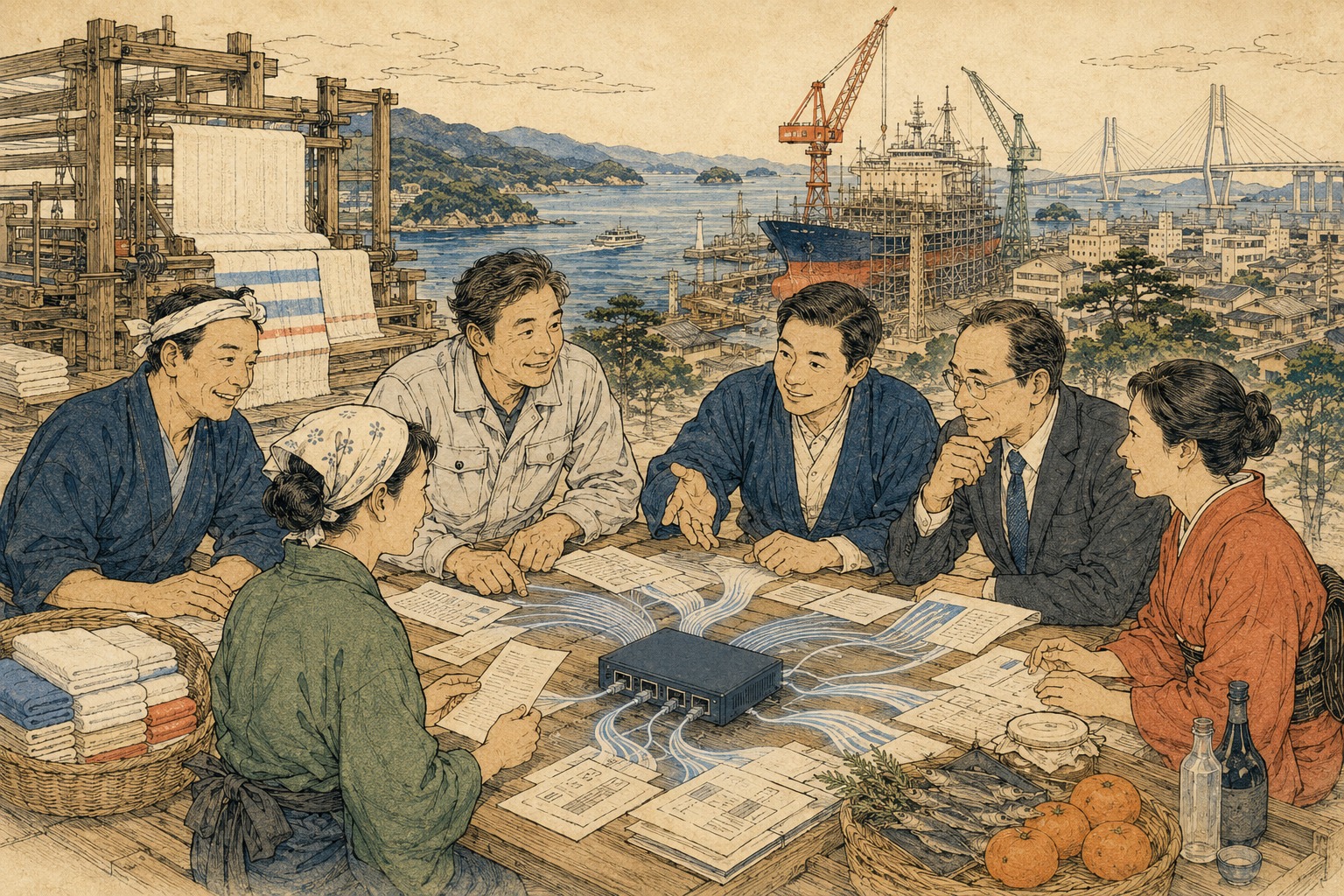
Imagine a small Imabari marine-equipment company considering a welding robot. To its owner, the purchase is one project: relieve a labor shortage, raise output, preserve skilled knowledge and perhaps cut energy use. To government, those purposes may sit in separate drawers labeled digital transformation, manufacturing, decarbonization, workforce development and succession.
The owner must search ministries, Ehime Prefecture, Imabari City and support organizations; compare programs with similar names; and read rules on eligible cost, subsidy rate, ceiling, start date and deadline. Finding one leaves further questions: Can the equipment be ordered before approval? May two programs be combined? When will cash arrive? Abundance offers choice, but it also imposes search cost.
On August 12, 2026, subsidy-technology startup Stayway announced a business partnership with Imabari City. Its Government product, launched in May, will let the city work across national, prefectural and municipal support information. Stayway described Imabari as the seventh municipal adoption, following Aomori City, Akita Prefecture, Kumamoto City and others. This is neither a new factory nor a large grant. It is an attempt to redraw the chart that determines which factory finds which grant.
Four Functions—and the Operating Details Still Missing
The release identifies four layers. First is a database collecting and updating more than 9,000 national and municipal programs. Second is a cloud register for programs administered by Imabari itself. Third is automatic organization of registered entries into list pages that can be published on the city’s website or a special portal. Fourth is distribution through financial institutions and companies in the wider Subsidy Cloud network.
“Centralization” operates in two directions. A business searches fewer sites. A city employee can answer a question with awareness of programs outside that employee’s own division. Subsidy administration is fragmented not only because some forms remain inconvenient, but because the office designing a program and the office hearing a company’s problem may not share the same view.
The announcement does not reveal who will participate locally, whether city or bank staff will proactively recommend programs, who corrects a bad entry, how quickly a closed call is updated, what the contract costs, or when the public-facing portal goes live. The operating model matters more than the headline count.
| Stage | What the platform can assist | Work that remains human and institutional |
|---|---|---|
| Discovery | Search across place, sector, purpose and deadline | Describe the business problem that an investment must solve |
| Fit | Compare applicant, cost, rate and application-period fields | Read the current rules; confirm exceptions, combinations and start restrictions |
| Finance | Give banks and city staff a shared information base | Plan the company share, bridge loan, payment timing and non-award case |
| Application | Make candidate programs and related information easier to reach | Prepare the plan, quotations, certificates, digital identity and calendar |
| Delivery | Remain a reference point for program requirements | Order, inspect, preserve payment evidence, report results and face audit |
Why Imabari? An Industrial Network Made by the Sea
Imabari’s industrial history demonstrates the power of information and capital moving through relationships. Salt making flourished on Seto Inland Sea islands by the early twelfth century, encouraging shipping to move the product. In the Edo period, high-quality salt from Hashihama and Namikata drew large trading vessels. Hashihama became a prosperous port nicknamed “Little Nagasaki of Iyo.” Ships brought a need for repair; repair trained shipwrights and justified port infrastructure.
Vessels waiting for the fierce Kurushima Strait tide sheltered in calm Hashihama Bay. The city traces modern shipbuilding to repair during those waits. Shipping companies, crews, shipyards, engine, pump and electrical suppliers, port operators, brokers, classification, insurance, lawyers and ship finance accumulated at close range. The maritime cluster’s productive asset is not one giant company but the relationship among specialists.
Imabari’s 2026–30 regional plan counts roughly 70 ocean-going operators owning about 1,100 of approximately 3,600 Japanese ocean-going vessels—more than 30%. About 150 domestic operators own 230 vessels. Fourteen area shipyards account for roughly 20% of vessels built nationally; groups headquartered or based in the area account for about 59%, the city says. Definitions and reference dates matter, but the depth of concentration is unmistakable.
The cluster now faces alternative fuels, international emissions rules, autonomous navigation, digital design and production, cybersecurity and shortages of seafarers and skilled labor at once. A large yard cannot transform alone. Small companies providing parts, inspection, logistics and maintenance must move with it. Better discovery of public support can be one instrument for raising the speed of the supplier base.
There Are Many Companies Behind One Towel
Imabari’s other industrial face is the towel. Machine weaving began in 1894, and the district developed a division of labor across yarn, dyeing and bleaching with abundant soft water, weaving, sewing, finishing, inspection, packaging and distribution. An Imabari environmental report places the city’s output at about half of Japanese towel production. One white cloth embodies many businesses.
Specialization improves quality but complicates digital investment. A shared ordering system, visual inspection, energy-efficient dyeing, e-commerce, multilingual sales or traceability may matter, yet the project is not huge for any one supplier. Few can employ a dedicated subsidy manager. Where the owner also handles sales, hiring and cash flow, an hour spent searching carries a high opportunity cost.
Imabari also includes nationally competitive food, electrical, petroleum and gas companies; Oshima stone, Kikuma tile and Sakurai lacquerware; agriculture, fisheries and tourism. A system driven only by simple nouns may miss this variety. The better route runs from a concrete problem—“let two people perform a three-person job safely,” “reduce fuel cost and emissions,” “record a skill in video and data”—to a relevant program.
Seventy-Five Years of SME Policy: From Closing Gaps to Enabling Change
Japan institutionalized small-business policy during postwar reconstruction. The Small and Medium Enterprise Agency was established in 1948; the SME Basic Act followed in 1963. Policy then emphasized a “dual structure”: gaps between large and small companies in productivity, wages, technology and access to finance.
After the Basic Act’s 1999 revision, SMEs were reframed not as uniformly weak but as varied economic actors capable of agility and innovation. Policy expanded toward startups, new business, technology, overseas markets, succession and productivity. Disasters, financial crises, the pandemic and inflation layered emergency programs on top. Each program became more targeted; the overall landscape became harder to navigate.
Application also moved online. The national jGrants platform and GBizID business identity sought to replace counters, post and program-specific accounts. The Digital Agency reported about 160,000 businesses using jGrants by 2022 as the number of available subsidies and users rose sharply. Yet moving the submit button online does not automatically solve the earlier problem: discovering which program fits.
1948 Small and Medium Enterprise Agency established
1963 SME Basic Act emphasizes the dual structure and closing size-based gaps
1999 Revised act shifts toward diverse, dynamic SMEs and entrepreneurship
2003 Financial Services Agency launches its relationship-banking program
Late 2010s jGrants and GBizID digitize national applications and authentication
2017 Stayway founded
May 2026 Subsidy Cloud for Government launched
August 2026 Imabari partnership announced as the seventh adoption
The “Finance” in Public–Private–Finance Is More Than a Distribution Channel
The partnership uses a Japanese phrase meaning collaboration among government, business and finance. Regional banks and credit associations hear the continuing context of company accounts, equipment replacement, succession, customers and labor. A city cannot visit every company monthly. A banker often speaks with one near the moment a financing need forms.
In 2003, Japan’s Financial Services Agency formalized a push for relationship banking. Regional institutions were asked to look beyond collateral and ratios, understand business value, advise on management and new activity, assist recovery, and contribute to sustainable regional economies. Placing subsidy information inside the same conversation is a digital extension of that idea.
Many subsidies do not hand over the full cost in advance. A company may order, receive and pay, submit a completion report, and receive reimbursement later. A one-half subsidy still requires the other half; bridge finance may be needed until payment. Management must decide whether the project survives rejection. A bank adds value not by counting referrals but by designing realistic cash flow around the grant.
A financial institution is not a neutral search box, however. It has interests in lending, relationships and paid advisory work. The network will need clarity on which companies receive which recommendation, how customer information is shared, where free introduction ends and paid application support begins, and how conflicts are handled. Trust can strengthen the model; opacity can undo it.
Imabari’s Own DX Subsidy Shows What Comes After Search
For fiscal 2026, Imabari offers a DX Promotion Project Subsidy for local companies using generative AI and other digital technologies. A research-and-development category funds two-thirds of eligible cost up to ¥500,000. An innovation category for implementation funds one-half up to ¥3 million. Systems, cloud services, consulting, product development, dedicated equipment and high-speed network work may qualify.
After a search result says “possibly eligible,” the road remains long. The city requests an application, project plan, pledge, proof of paid city tax, corporate registry or tax return, and quotations or product material. After award and completion come a project report, invoices, bank-transfer evidence, delivery and inspection records. The same project cannot receive another national, prefectural or city subsidy.
This is not simply a tale of pointless paperwork. Controls establish that public money served its purpose, was not claimed twice and corresponds to a real transaction. The objective of DX should not be to erase review and evidence. It should stop asking for the same corporate facts repeatedly, make conditions intelligible earlier and help evidence be preserved as it arises.
- Applicant conditions: location, sector, company size, taxes and exclusions
- Whether contract, order or payment may occur before the award decision
- Eligible and ineligible costs, consumption tax, rate and ceiling
- Combination rules and prohibition of double funding for the same cost
- Company cash, bridge finance, payment timing and the plan if rejected
- Completion reporting, record retention and restrictions on subsidized property
Nine Thousand Is Both Strength and Noise
Database quality cannot be measured by count alone. Closed programs, exhausted budgets and schemes limited to another place or sector can produce a rich but useless result page. Rules change by fiscal year even when names remain similar. The practical meaning of “updated continuously”—hours or days—determines whether a short call can be used.
A good service structures source URL, administrator, last verification, open status, geography, size, eligible cost, rate, deadline and pre-approval restrictions, while always linking back to the authoritative text. If automation or generative AI enters the process, summaries need traceable evidence and a clear correction owner. The Imabari announcement says information is collected and updated and pages can be generated; it does not disclose technical methods, AI use, freshness guarantees or liability for error.
Access must include owners with limited digital confidence, foreign entrepreneurs, island businesses and people needing visual or cognitive accommodations. A portal should be paired with telephone, counter, bank, chamber, trade association and professional channels that consult the same current record and explain it plainly or in other languages. DX should improve the answer at a counter, not serve as a reason to close it.
When a Subsidy Distorts the Investment
Easier search carries side effects. A company may choose what is subsidized instead of what it needs, rush an immature project toward a deadline, overlook reporting obligations or pay a large success fee to an adviser. If habitual applicants continue to move from program to program, the information gap merely becomes a professional-advice gap.
Government can mistake portal views and searches for outcomes. The object is not traffic. It is higher productivity, retained jobs and skills, new markets, stronger supply chains and a durable local tax base. More awards produce little additional value if public money merely reimburses investments that would have occurred unchanged.
A platform should therefore ask about the problem before recommending money: Would the investment be necessary without a subsidy? How will it change revenue, time, energy, accidents or skill transfer? Will it still be used in three years? A subsidy should not become the subject of strategy. It is one source that may make a sound strategy executable.
Seven Numbers That Can Define Success
Whether the partnership becomes infrastructure can be judged through published operating measures. How many companies move from search to consultation? What share of recommended programs prove genuinely eligible? How quickly does a new announcement reach a company? How many users are first-time applicants, very small firms, island businesses or members of each local industry?
Beyond application, award and amount, Imabari could track total investment including bank and company funds, project-completion rate, administrative hours saved, and later productivity, energy, employment and sales. Recording rejected recommendations, bad matches, stale entries and corrections triggered by questions would turn the system into a learning regional asset.
| Measure | What it reveals |
|---|---|
| Update lag | Whether data are fresh enough for short application windows |
| Match-to-eligibility rate | Whether search results are usable rather than noise |
| First-time user share | Whether the system closes information gaps instead of serving regulars |
| Reach by place, sector and size | Whether island and very small firms are being left behind |
| Preparation time | Whether administrative effort falls for businesses and city staff |
| Private capital mobilized | Whether public support activates wider investment |
| Post-investment result | Whether productivity, energy, jobs, sales or skill transfer improve |
Drawing a Usable Route Across a Sea of Information
Imabari industry began with reading the sea: where to wait for the tide, how to carry cargo and who could repair a vessel. Knowledge accumulated in the port and turned salt commerce into shipping and shipbuilding. The towel district likewise connects specialized people and companies to create the quality of one finished cloth.
The subsidy sea has tides and shoals of its own: deadlines, applicant rules, start restrictions, rates, reimbursement and combination bans. Putting 9,000 points on a map does not move a vessel. A company needs the right route, while city staff, a bank and an adviser look at the same chart and arrange documents and cash before departure.
Stayway’s software can change the first field of vision. Imabari must change what organizations do afterward: departments updating records, bankers hearing investment intent, counters assisting those who do not search easily, and all parties publishing successes and failures. Only then does a database become regional infrastructure.
Success is not an owner who knows 9,000 programs. It is an owner who learns about the right one before the deadline, invests for the company’s future rather than for the subsidy, and retains a sound decision even if the application fails. Imabari’s new chart will be tested on whether it can turn the quantity of information into the capacity to act.
- Never rely on a search result or summary alone; read the latest official guidelines and Q&A.
- A contract or order placed before award can make some projects ineligible.
- Many subsidies reimburse later, requiring company funds, tax, bridge finance and a rejection plan.
- When hiring application support, check fee, scope, professional qualifications, any award guarantee and conflicts.
- Stayway: partnership with Imabari City (August 12, 2026; company announcement in Japanese)
- Imabari City: FY2026 DX Promotion Project Subsidy (application and completion requirements; Japanese)
- Imabari City: Fifth Settlement and Independence Area Vision (2026–30 industrial figures and policy; Japanese PDF)
- Imabari City: Maritime History of Imabari (salt, shipping and ship repair; Japanese)
- Imabari City: FY2024 Environmental Report (industry and towel output; Japanese PDF)
- Digital Agency: public services friendly to businesses and officials (jGrants and GBizID; Japanese)
- Small and Medium Enterprise Agency: SMEs and support organizations (policy history; Japanese)
- Financial Services Agency: Action Program to Strengthen Relationship Banking (2003; Japanese)
Editor’s note: This report began with the company announcement and checked it against primary city and national policy documents. Japan.co.jp did not independently interview Imabari City, Stayway or financial institutions. Cost, operating date, participating institutions, AI use and performance targets were treated as undisclosed rather than inferred.