- The oilman who built an art museum—and the works now on view in Oita
- A young collector’s first encounter with a Zen monk
- From the port of Moji to the top of the Imperial Theatre Building
- The Chinese ceramics that offered refuge from business
- Screens that change the room—and the exhibition calendar
- An American collector’s vision returns to Japan
- How bold black lines carried Sengai to Rouault
- Artists and artisans who were his contemporaries
- Why the collection is traveling while Tokyo’s museum is closed
- What visitors can see—and when
- What a corporate collection owes the future
The oilman who built an art museum—and the works now on view in Oita
A Zen monk’s playful drawing, a Ming-dynasty ceramic plate, a painted screen and a twentieth-century French artist might seem to belong to different histories. They meet in a new exhibition at Oita Prefectural Art Museum because they once met in the collecting imagination of a Japanese petroleum entrepreneur. “Masterpieces from the Idemitsu Collection: The Spirit of Idemitsu Sazo—Preserving Beauty, Connecting It to the Future” opened on November 13, 2026, and runs through January 11, 2027.
The presentation follows Sazo Idemitsu (1885–1981), founder of Idemitsu Kosan and of the Idemitsu Museum of Arts. Approximately 100 carefully selected objects trace the long evolution of a collection he began as a student. The broader holdings comprise around 10,000 objects, including two National Treasures and 57 Important Cultural Properties. Those figures describe the collection as a whole—not the number of designated works on display in Oita.
A young collector’s first encounter with a Zen monk
The museum’s own historical account traces the beginning to 1905. Idemitsu, a 19-year-old student, encountered Sengai’s “Hotei Pointing at the Moon,” a witty Zen painting shown at an antique sale in Hakata, and asked his father to help acquire it. The encounter shaped a lifetime of collecting. The object’s appeal was not simply that it was old: Sengai’s abbreviated brushwork and disarming humor challenged the assumption that serious art had to be solemn.
The first chapter of the Oita exhibition is devoted to that affection for Sengai. It offers a way into the entire display: these are not merely trophies bought after commercial success. The story begins with an aesthetic judgment that preceded the company’s founding. A different Sengai work, “Hotei Painting with Inscription,” is scheduled to be shown from November 13 through December 13, an early reminder that the show has rotating displays.
From the port of Moji to the top of the Imperial Theatre Building
Idemitsu was born in Akama, in what is now Munakata, Fukuoka Prefecture, in 1885. In 1911, he founded a petroleum-sales concern in the port of Moji, now part of Kitakyushu. That business became Idemitsu Kosan, incorporated in 1940. Its history intersects with postwar economic reconstruction, overseas oil supplies and the controversial 1953 importation of Iranian oil in the Nissho Maru affair.
Art collecting developed beside this commercial history. The museum says Idemitsu organized his holdings more systematically from around 1951, opened a gallery in Fukuoka in 1964, and established the Idemitsu Museum of Arts on the ninth floor of the Imperial Theatre Building in Tokyo’s Marunouchi district in 1966. He became its first director. The transition from possession to preservation, research and public display is central to understanding why the collection matters beyond the private life of its founder.
The Chinese ceramics that offered refuge from business
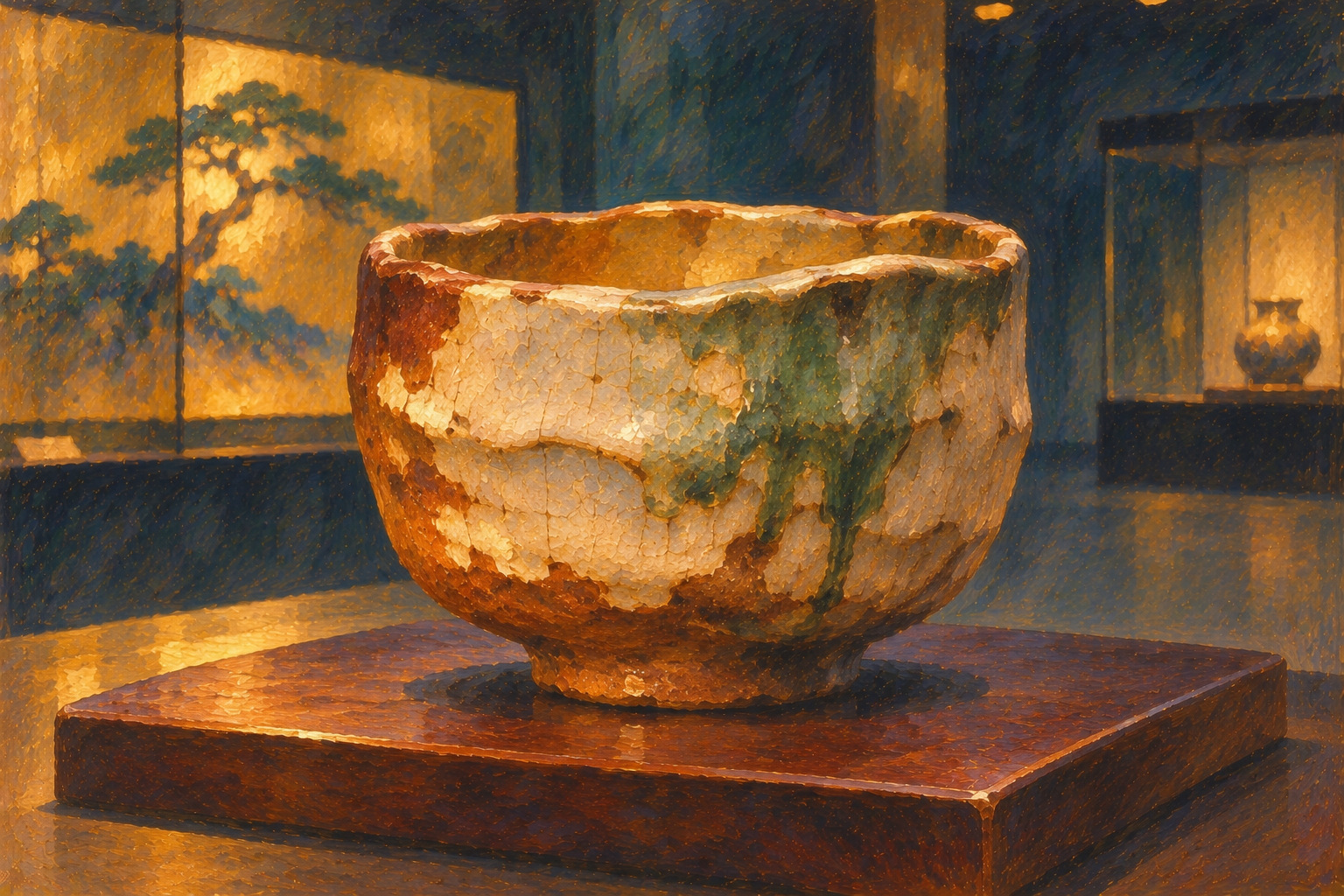
The exhibition’s second chapter turns to Chinese ceramics. The Oita museum recounts a story from Idemitsu’s visits to northeastern China: after difficult business trips, he found comfort in ceramics displayed at his regular lodging in Dalian. A Ming-dynasty plate decorated with peonies illustrates the cross-border sensibility that expanded his collecting. The objects connect surface beauty to trade, kiln technology, craftsmanship and changing tastes.
The museum’s collection also encompasses Japanese Karatsu ware, Chinese bronzes and arts from farther west. Ceramics are vessels of history as well as vessels for use. Each piece has a particular production and ownership story, however, and the public exhibition overview is not a complete provenance dossier for every object. For works where ownership histories are contested or complex, they must be examined individually rather than assumed from a broad collection narrative.
Screens that change the room—and the exhibition calendar
Monumental Japanese folding screens represent another expansion of the collection. Screens flourished as both furnishings and paintings in the Momoyama and Edo periods, making architecture and imagery inseparable. Among the highlights is a tiger-and-bamboo screen associated with Hasegawa Tōhaku, whose large compositions exemplify the power of painting across hinged panels.
This highlight requires a practical qualification. According to Oita’s detailed exhibition page, the left-hand screen of Tōhaku’s “Bamboo and Tiger” is scheduled for display from December 15 to January 11. It should not be described as necessarily visible during opening week. Rotations protect fragile works and change what visitors can see. The value of an exhibition review depends in part on respecting these details instead of turning every advertised object into an all-dates promise.
An American collector’s vision returns to Japan
One especially consequential chapter concerns the former Price Collection. Joe Price, an American collector, developed a passion for Edo-period painting and particularly the inventive forms of Itō Jakuchū. In 2019, part of his collection was acquired for the Idemitsu holdings. Some of the works are now shown in Japan, returning objects previously held abroad to audiences with close historical connections to the tradition.
Jakuchū’s “Flock of Cranes” is identified by Oita as a highlight available through December 13. This is not a claim that the entire Price Collection transferred to Japan or that every Jakuchū work is present. The relationship between an object’s place of origin, where it has been cared for, and where it is publicly accessible is more complex than a simple narrative of homecoming. The exhibition invites that complexity rather than resolving it.
How bold black lines carried Sengai to Rouault
The fifth chapter brings the French painter Georges Rouault into an unexpected conversation with Japanese Zen painting. The Oita guide recounts how Idemitsu encountered a group of 54 works from Rouault’s “Passion” series in 1972 when they faced dispersal. He reportedly recognized in their heavy black outlines something akin to the expressive ink line that had long attracted him to Sengai. The American painter Sam Francis also entered the collection.
This encounter illustrates why a collection can become more than a sequence of historically separate schools. An individual collector may build connections on the basis of visual affinity, even when the artists worked in different cultures. That judgment is subjective; it should not be mistaken for proof of a direct artistic influence between the two. Nor does discussion of the paintings imply that unrestricted reproductions of copyrighted twentieth-century works are available.
Artists and artisans who were his contemporaries
Idemitsu also collected contemporary Japanese makers. The exhibition includes the pottery of Itaya Hazan, painting by Kosugi Hōan and bamboo work by Iizuka Rōkansai. Their inclusion complicates the familiar image of a collector concerned only with ancient masterpieces. Ceramics and bamboo baskets ask visitors to consider how the technical intelligence of material and everyday objects can be inseparable from artistic ambition.
Iizuka’s 1942 basket “Longevity” is scheduled for the first display period, through December 13. The exhibition encourages attention to craftsmanship as living knowledge: preserving an object means safeguarding the evidence of how it was made, how it has been repaired and how it entered the collection. Museums face continuing costs for conservation, interpretation and skilled staff. A famous collection is not exempt from those practical responsibilities.
Why the collection is traveling while Tokyo’s museum is closed
The Idemitsu Museum of Arts in Marunouchi is closed for an extended period while its building is redeveloped. The museum’s collection notice highlights venues beyond Tokyo, including its Moji branch, which opened in 2000 near the commercial port where Idemitsu’s career began. An Oita presentation carries particular resonance: a collection whose founder came from Kyushu is being interpreted for visitors in Kyushu, rather than remaining associated exclusively with the capital.
For regional museums, exhibitions of this kind offer opportunities extending beyond ticket sales. School groups can encounter work otherwise seen only in distant institutions; local craftspeople can study historic material techniques; visitors can learn how their region participated in the history of collecting. These potential benefits are plausible reasons for holding the show, not independently demonstrated attendance or economic results. The distinction matters when art institutions are assessed as public resources.
What visitors can see—and when
The exhibition occupies the third-floor collection galleries at Oita Prefectural Art Museum, 2-1 Kotobuki-machi, Oita City. It runs from November 13, 2026, through January 11, 2027. General admission is ¥1,500; high-school students pay ¥1,000; younger visitors through junior high school enter free. Regular hours are 10 a.m. to 7 p.m., extended to 8 p.m. on Fridays and Saturdays, with last admission 30 minutes before closing. The only exhibition closure date currently identified by the museum is December 14.
Visitors seeking Sengai’s “Hotei” or Jakuchū’s “Flock of Cranes” should go by December 13; Tōhaku’s “Bamboo and Tiger” is listed for December 15 onward. The museum also warned of parking restrictions around the November 15 Oita International Wheelchair Marathon, but that specific notice should not be misread as a parking closure for November 16. Changes to schedules or displayed works should always be checked against the museum’s official website before traveling.
What a corporate collection owes the future
The exhibition’s lasting theme is not that business wealth automatically produces cultural good. It is that one person’s tastes, resources and relationships can assemble works that would otherwise remain dispersed—and that the resulting institution acquires public responsibilities. Scholarship must examine individual objects, provenance and historical context. Conservation must sustain them. Interpretation must allow people with no specialist background to ask their own questions.
The first thing Idemitsu loved, according to his museum, was a Zen painter’s unpretentious line. The collection that grew from that encounter now places Japanese ceramics beside Chinese vessels, Tōhaku beside Jakuchū, and Sengai in conversation with Rouault. Oita’s exhibition asks visitors to consider not only what earlier generations judged beautiful, but what it takes to ensure that future generations can see the objects, question their histories and develop judgments of their own.
Sources and methodology
Methodology: Cross-checked the Oita museum’s exhibition guide and artwork rotations against the Idemitsu Museum’s institutional history and Idemitsu Kosan’s chronology. No personal gallery visit or interviews were conducted. Individual provenance, conservation histories, attendance and financial outcomes were not independently audited.
- 大分県立美術館:出光美術館名品展・公式展示解説/Oita museum, exhibition and rotating highlights
- 出光美術館:初代館長・出光佐三の歩み/Idemitsu Museum, founder biography
- 出光美術館:施設と休館について/Idemitsu Museum, institutional outline
- 出光美術館:巡回・地方での公開情報/Idemitsu Museum, collection away from Tokyo
- 出光興産:会社沿革/Idemitsu Kosan, corporate chronology
- 出光興産:創業者出光佐三の年譜/Idemitsu, founder chronology
- 大分県民芸術文化祭:展覧会の公式案内/Oita cultural festival, event listing
- 出光美術館:国宝《伴大納言絵巻》コレクション情報(本展への出品を意味しない)/Collection National Treasure background