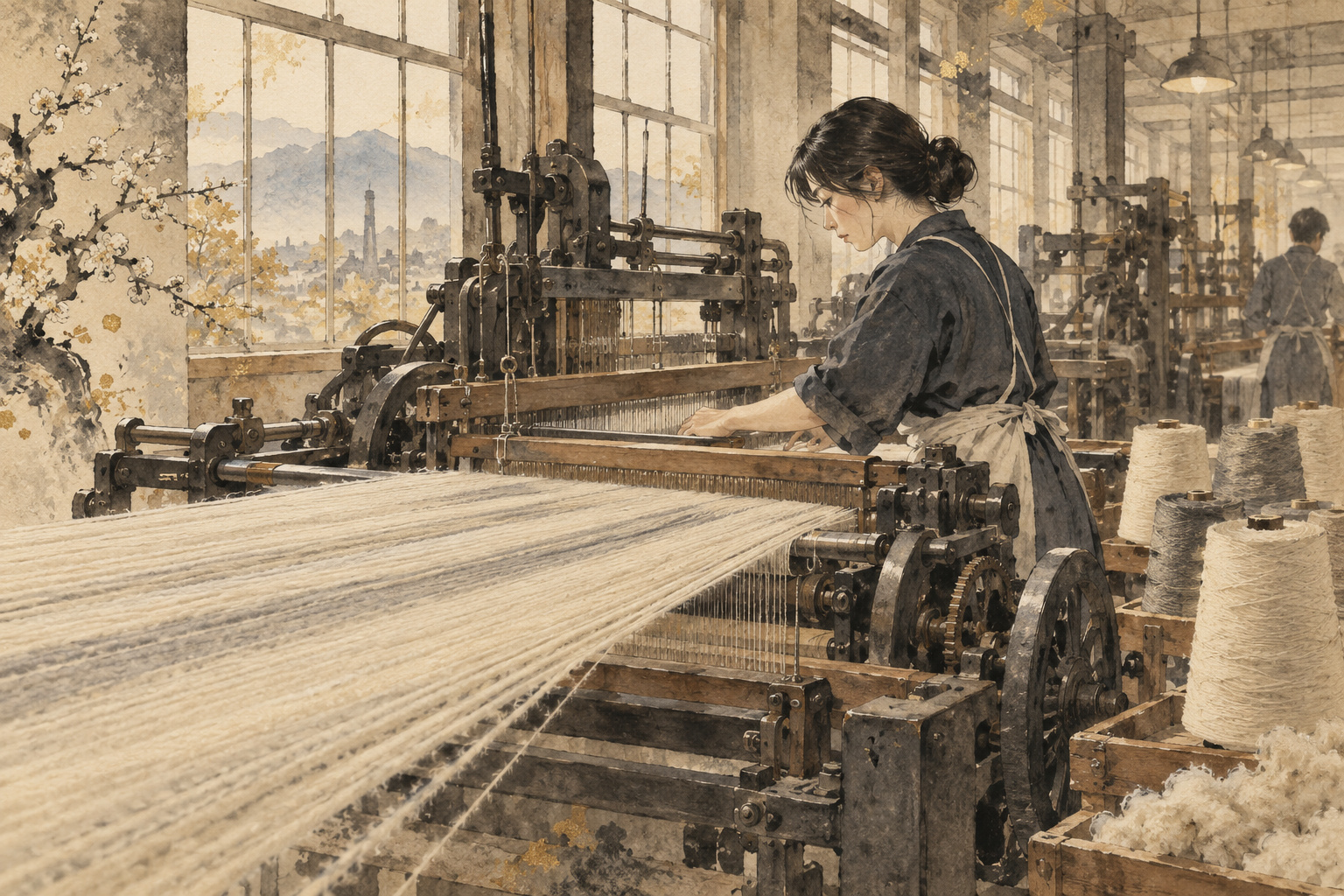
An old loom can be a museum object, or it can be a production decision. In Ichinomiya, Kuzuri Keori’s Schönherr looms belong to the second category: machines retained for the kinds of cloth the company wants to make. Their age is part of the story. Their continuing usefulness is the business question.
The Ichinomiya Tourism Association dates the company’s founding to 1912, when it made patterned textiles combining silk and cotton. In 1932 it introduced Schönherr looms and moved into wool fabrics. What now looks like a surviving tradition began, in this company’s history, as a change of direction.[1]
That tension remains relevant in September 2026. Bishū manufacturers are preparing to show fabrics for autumn/winter 2027/28 in Tokyo on September 17–18. The region’s commercial calendar reaches forward even as some of its machines reach far into the past. Understanding its luxury-fabric business requires looking at both.[10]
Why keeping a slower machine can make sense
A Schönherr is a type of powered shuttle loom. A shuttle carries the weft yarn across the warp; describing the resulting cloth as having a handwoven character does not mean the machine is operated as a handloom. Woolmark’s Japanese profile explains Kuzuri’s process in terms of this older weaving technology.[2]
In that profile, the company’s account stresses weaving slowly without placing unnecessary tension on wool yarn. It also describes equipment configurations that allow complex weave structures. These are explanations of a particular producer’s approach, not proof that every old loom makes better cloth than every modern one.[2]
The commercial logic is more demanding than the phrase “slow craftsmanship” suggests. Time spent making a fabric has to produce something a buyer values: a particular handle, body, drape or surface. In textiles, handle means how the material feels and responds when touched. It is a property to develop for a purpose, rather than a synonym for softness alone.
A designer may want a cloth that falls gently, or one that holds a shape. A tailor needs to know how it behaves in construction. The fabric has to answer those requirements. The old machine earns its place through that work, rather than through the appeal of its photograph.
The market did not always see the value
The Ichinomiya Tourism Association’s factory interview describes a turning point in 2009, when the company participated in business meetings organised by the Japan External Trade Organization, JETRO, and attracted interest from overseas brands. The account includes investment constraints among the reasons older equipment remained in use. It is more complicated than a story of an uninterrupted, perfectly planned commitment to heritage.[7]
What changed was partly the commercial context in which the cloth was judged. A process at a disadvantage in a contest over output could have a different value to buyers seeking a particular material. Finding those buyers did not alter the age of the machines; it changed the opportunity around them.
Aichi’s official tourism listing also reports inquiries from international high-end brands. That supports describing a business connected to the luxury market, while leaving open the questions that determine financial health: realised prices, repeat orders, development costs and margins. Brand recognition is not itself an audited account of profitability.[9]
Bishū is a region of interdependent skills
Ichinomiya is the focus of this Aichi story, but Bishū extends beyond it. The Fashion Design Center’s BISHU JAPAN site describes an area including Tsushima, Inazawa and Kōnan in western Owari, and places such as Hashima in Gifu. It is a textile region crossing a prefectural boundary, not one mill or a single municipal brand.[4]
The centre identifies a system of specialised production: spinning, twisting, dyeing, weaving, knitting and finishing, carried out through cooperation among businesses in the region. This concentration allows several kinds of expertise to contribute to a material.[5]
The distinction matters because a finished fabric is easy to attribute to the most photogenic stage of its production. A loom provides movement and sound. Yarn preparation and finishing may be less familiar to the wearer, yet they influence what the cloth becomes. The weaving company operates inside that larger system.
A wool industry built through change
Bishū’s long textile history should not be presented as an equally long history of an unchanged wool industry. The Fashion Design Center’s historical account traces a transition from cotton and silk textiles. It identifies the damage caused by the 1891 Nōbi earthquake and competition from large-scale cotton production among the pressures behind the search for other products.[3]
Early wool weaving exposed another limitation: cloth could be woven before the region had sufficient dyeing and finishing capability to turn it into a marketable product. The centre records work being sent to Kyoto for finishing and the opening of a specialist wool-finishing operation in 1908. The supply of looms alone could not create a complete industry.[3]
Disrupted imports and demand for domestic textiles during the First World War encouraged wool production, followed by expansion into Western-style clothing fabrics. The enduring regional capability was therefore adaptation: adopting equipment, changing materials and building complementary processes.[3]
Before the shuttle moves
The visible weaving action follows substantial preparation. Warp yarns must be arranged for the fabric design, then threaded through the heddles and reed. Those components help control the separation of warp yarns and the formation of the cloth. The tourism association’s factory account describes this preparation as well as the interventions required when yarn breaks during weaving.[7]
Both that account and Woolmark’s profile give an example of three to four days to weave 50 metres. It is a figure from those published accounts, not a verified 2026 capacity statement or a delivery quotation for every fabric. Preparation, material and construction all matter.[2][7]
This is why metres per day tell only part of the economic story. A short order may still require careful setup. A sample that changes a customer’s design can be useful even before it leads to a production run. Those activities consume time that needs to be recognised somewhere in the relationship between producer and buyer.
The cloth is not finished at the loom
For a concrete example of the next stage, Ichinomiya finishing company Tsuyasei Kogyo describes washing out oils and dirt left on unfinished fabric. Its technical explanation also describes wool fulling: moisture, heat and pressure encourage fibres to interlock, making the fabric denser and thicker.[6]
Weaving establishes a structure; finishing changes how that structure presents itself. Attributing all the fullness or softness of a finished fabric to the age of the loom would erase this work. Tsuyasei is cited here as an example of regional finishing expertise, not as a verified processor of a particular Kuzuri product.
Specialisation can help manufacturers solve difficult material problems together. It also creates dependencies. If a critical process loses capacity or expertise, retaining the weaving machinery may not be enough to reproduce the same fabric. The region’s productive heritage includes relationships between businesses as well as equipment within them.
A registered building and a working factory
Kuzuri’s building complex became nationally registered tangible cultural property in 2020, according to Ichinomiya City Museum, which featured it in a 2022 exhibition. The tourism association describes workshops, offices, storage and living accommodation on one site, with high north-facing windows providing light to the sawtooth-roof factory.[8][1]
That architecture records a relationship between work and domestic life. Its cultural significance is distinct from the operational task of keeping production running. A preserved building does not, by itself, maintain a loom, identify a yarn problem or judge a sample.
Woolmark’s account describes maintenance and repair knowledge, including help within the region, and the different characteristics that machines acquire in use. Keeping them productive requires people who can recognise those differences and respond to them.[2]
Training therefore belongs in the commercial calculation. A workshop needs time to explain decisions, practise adjustments and correct mistakes while meeting orders. Admiration for the machinery becomes more useful when accompanied by transactions that support the people operating it.
The next season is already on the table
The Fashion Design Center’s August 21 announcement for the 2027/28 Autumn & Winter Bishu Material Exhibition gives the region a timely business context. It plans to bring 14 textile manufacturers and approximately 1,250 new fabric samples to WITH HARAJUKU HALL in Tokyo on September 17–18, 2026. The selling season is 2027/28; the exhibition year is 2026.[10]
The same announcement describes differing sales plans among exhibitors: slightly fewer than half anticipate growth for that season, while others plan for flat or lower sales. These are exhibitors’ plans, not achieved results or a forecast for the whole industry. They resist a simple narrative of universal recovery.[10]
The event matters as evidence of the wider region’s forward-looking material development. Its old machines exist within an industry preparing new propositions for designers and buyers.
For readers hoping to see production, Aichi’s listing asks visitors to consult the company at least two weeks in advance and says Saturday and Sunday visits are generally unavailable. This is a working factory, not a drop-in Sunday attraction.[9]
The most useful question raised by Ichinomiya’s old looms is not whether manufacturing should become slower. It is which capabilities are worth retaining for the work customers will need next. Bishū’s future depends on being able to answer that question in cloth.
- Ichinomiya Tourism Association: Kuzuri history and sawtooth-roof buildings (Japanese)
- The Woolmark Company: Kuzuri and Schönherr weaving, manufacturer interview (Japanese; publication date not stated)
- Bishū Fashion Design Center: regional textile history before the Shōwa period (Japanese)
- BISHU JAPAN: definition and geography of the region (Japanese)
- Bishū Fashion Design Center, BISHU JAPAN: regional cooperation and production processes (Japanese)
- Tsuyasei Kogyo: washing and fulling, company technical account on BISHU JAPAN (Japanese)
- Ichinomiya Tourism Association: factory interview, preparation and 2009 business turning point (Japanese; publication date not stated)
- Ichinomiya City Museum: 2022 exhibition and the buildings’ 2020 cultural-property registration (Japanese)
- Aichi Now, official prefectural tourism site: Kuzuri company name, profile and visit arrangements (Japanese)
- Bishū Fashion Design Center: 2027/28 Autumn & Winter Bishu Material Exhibition, August 21, 2026 announcement (Japanese)