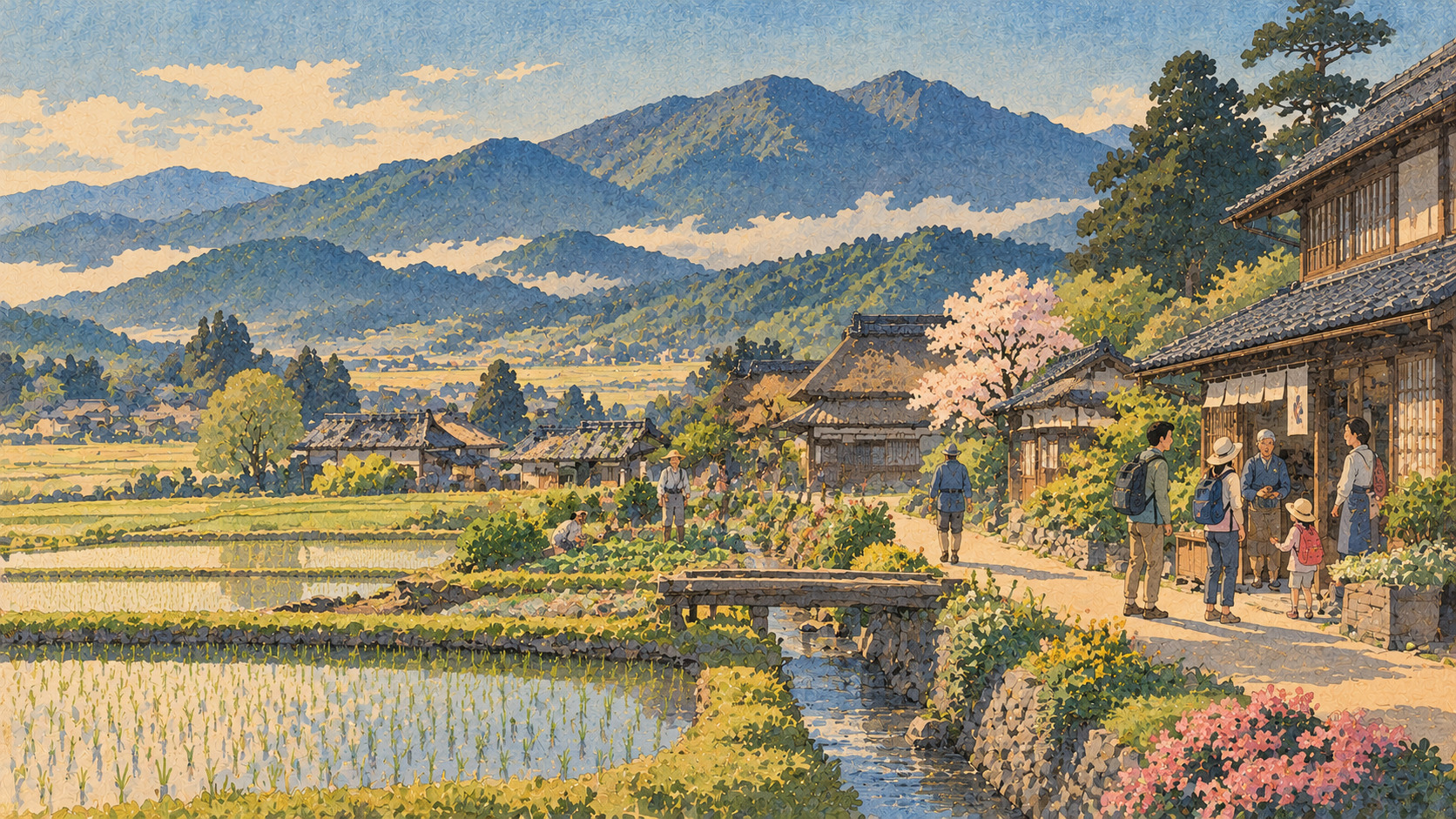
A net inflow of people does not guarantee population growth. The harder test is whether newcomers can build lasting lives.
A place can gain newcomers and still lose people
Ibaraki is wrestling with a demographic paradox. In September 2026, the prefecture recorded 9,165 arrivals and 8,369 departures, a positive migration balance of 796. Yet births numbered only 1,172 and deaths 2,786. The resulting natural decrease of 1,614 left the overall population down 818 in a single month, at 2,772,431 on October 1. The latest official relocation and regional-revitalization pages, updated on October 30, make more sense against that contrast. An encouraging migration statistic is not the same as reversing population decline.
Two Ibarakis: research-city growth and more fragile communities
For a prospective Tokyo commuter, Tsukuba and the southern belt of Ibaraki can offer a different proposition from a mountain village in the north. The prefecture includes research institutions, established manufacturing, farms, ports and old regional communities. Its September figures show population growth in eight cities and one town but decline in 24 cities, nine towns and two villages. A prefecture-wide balance can mask the different fate of particular municipalities. That matters when politicians discuss attracting people as though all newcomers are settling in the places losing residents fastest.
Relocation is not the same as a second home
Japan’s policy vocabulary draws a distinction between permanent relocation, dual-region living (ni-chiiki kyoju) and the more elastic idea of kankei jinko, people who maintain a meaningful relationship with a community without necessarily living there. A person alternating between Tokyo and Ibaraki may contribute to local shops and community activities yet remain officially resident elsewhere. Counting remote workers, visitors, migration-grant recipients and actual new residents as if they were interchangeable would exaggerate the demographic benefit. Each measure answers a different question.
The cash incentive—and the fine print
Ibaraki’s official Re:BARAKI relocation portal describes a national-local program, Wakuwaku Ibaraki Seikatsu Jitsugen Jigyo, designed partly to ease labor shortages. Eligible people moving from Tokyo’s 23 wards, or qualifying Tokyo-region commuters into the wards, may receive ¥600,000 as individuals or ¥1 million per household. Families may qualify for an additional amount of up to ¥1 million per accompanying child younger than 18. These headline figures do not mean any person moving to Ibaraki automatically receives cash: prior residence, employment or entrepreneurship, local participation, application timing and municipal participation conditions all matter.
Why remote work is not a blanket exemption
Some prospective migrants might assume that keeping a Tokyo job while working from Ibaraki is enough. The prefecture imposes additional rules. For telework-based eligibility, its published guidance requires purchasing or newly building a home from April 2024, and from April 2025 requires at least 20 hours of telework weekly without routine commuting. For certain relationship-population pathways, work in agriculture, forestry, fisheries or related fields is required. Applicants must consult their destination municipality before moving, and consultation does not guarantee an award. This makes precise local advice more useful than generic relocation advertising.
A 168-person experiment in rebuilding community capacity
As of April 1, 2026, Ibaraki counted 168 active members of chiiki okoshi kyoryokutai, Japan’s Community-Reactivating Cooperator Squad. The distribution is instructive: 25 worked in a northern Ibaraki entrepreneurship-oriented program, 22 in Sakai, 12 in Shimotsuma, and 11 each in Shirosato and Miho. These workers come from outside their host communities to undertake locally designed activities, often with the hope of settling afterward. The figure of 168 is the number active on a specific date—not the number who have successfully remained in their towns after their assignment.
The longer history of Japan’s attempts to revive the regions
The dilemma did not begin with pandemic-era remote work. Postwar industrial expansion drew labor and students toward metropolitan areas, while many smaller communities lost young residents. Rural development, factory relocation, infrastructure programs and depopulation measures attempted to restore balance. The cooperator squad began in fiscal 2009, and Japan’s national regional-revitalization agenda was placed on a more explicit demographic footing in 2014. The persistence of rural depopulation shows why grants alone cannot substitute for sustainable businesses, accessible schools, healthcare and transportation.
Sakai and the practical meaning of dual-region living
A prefectural infrastructure plan adopted March 27, 2026 identifies S-Telework, a remote-work facility in Sakai town, as part of a dual-region living strategy covering fiscal 2025–2029. The plan explicitly lists the facility as having been completed in March 2022. It is not a newly opened 2026 building. Its relevance lies instead in whether an existing workspace can anchor repeat visits, business activity and relationships strong enough to turn occasional visitors into enduring contributors—or eventual residents.
A lesson in reading population data
Ibaraki’s official August 1 population estimate was 2,776,105, compared with 2,772,431 on October 1. But the prefecture cautions that its estimates were rebased using the 2025 census. Analysts should not simply subtract numbers from different statistical baselines and claim the answer measures a coherent two-month outflow. The defensible September breakdown is much clearer: positive migration, larger natural decrease, net population loss. It is an unusually useful example of why demographic reporting requires more than a single headline number.
What would count as success?
A municipal fair, an inquiry at a migration desk, a trial stay and a cash award are different milestones. The harder test is whether households remain three or five years later, find worthwhile employment, contribute to schools and businesses, and can navigate housing, healthcare and transport. Neither an updated promotional page nor a count of active cooperators establishes a region-wide long-term retention rate. A serious evaluation would separate municipalities, compare participant cohorts over time and acknowledge people who arrived independently of grants.
A note for prospective international residents
The published grant conditions specify eligible immigration statuses for certain foreign nationals, but they also contain Tokyo-area residence and commuting requirements. Arriving from overseas directly does not by itself satisfy those relocation-origin conditions. A foreign resident weighing a move must separately assess visa status, employment, Japanese-language access, housing and education. The program should not be advertised as an unrestricted cash incentive for international relocation.
The question Ibaraki should keep asking
The appeal is real: mountains and seacoast, research-city jobs, agricultural communities and proximity to Tokyo are powerful assets. But the central measure of revival is neither scenic photography nor the number of people who attend an information session. It is whether newcomers and long-established residents can continue building lives in the same communities years from now. Ibaraki’s September numbers—796 more people moving in than out, yet 818 fewer residents overall—show why that more demanding standard matters.
Primary sources and verification
Primary documents and official statistics. Consultation counts and permanent settlements are not conflated; long-term retention has not been independently established.
- 茨城県統計課・2026年10月1日現在の推計人口 / Ibaraki population estimates
- 茨城県・移住・二地域居住 / Relocation and dual-region living
- 茨城県・地域おこし協力隊168人 / Cooperator roster
- Re:BARAKI・移住支援金と要件 / Grant eligibility
- 茨城県・二地域居住広域計画 / Dual-region infrastructure plan
- 総務省統計局・2025年人口移動報告 / Statistics Bureau migration report
- 茨城県・10月30日更新一覧 / October 30 listing