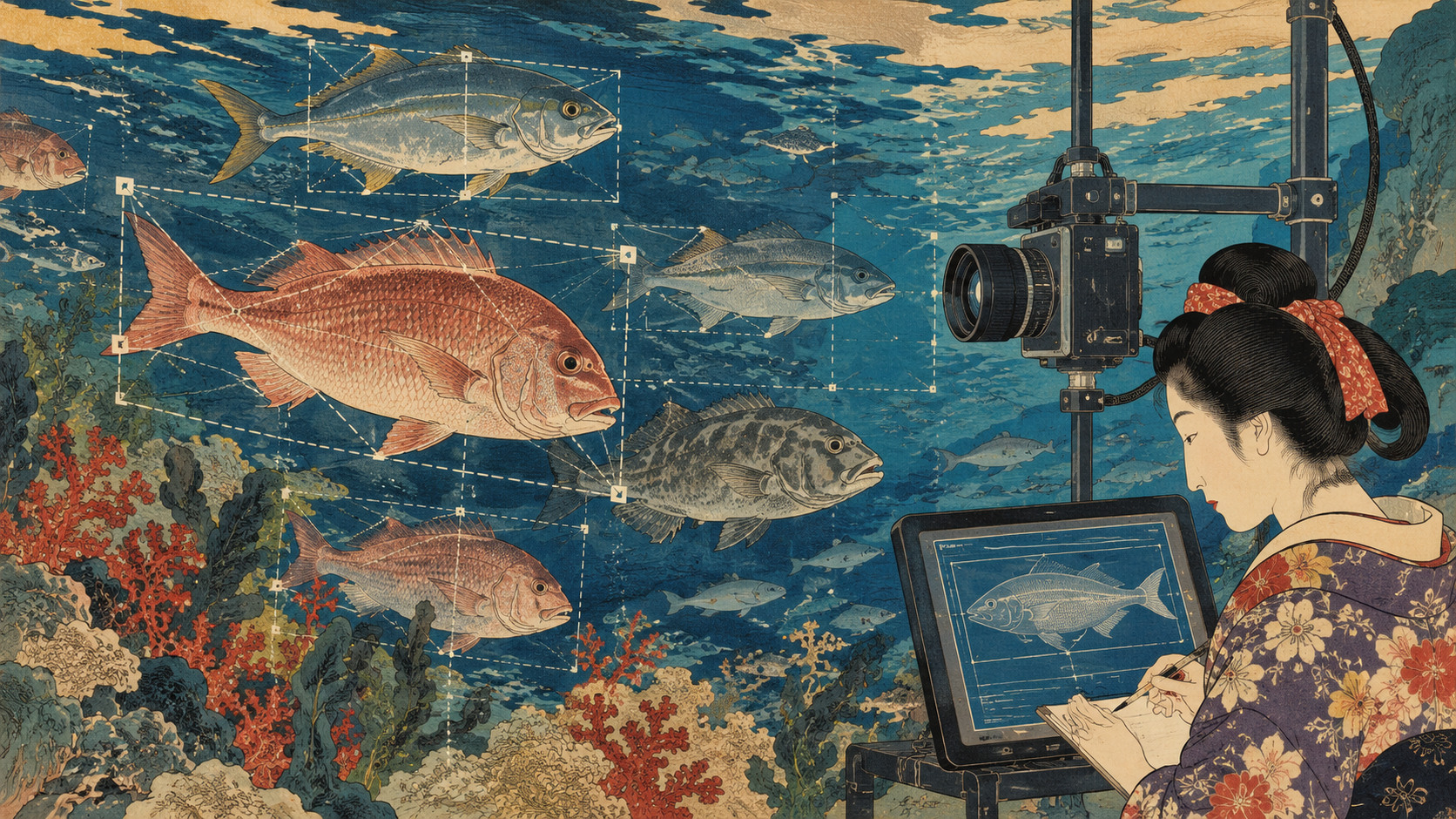
The innovation is not weighing a fish on camera. It is inferring size from the way the animal moves.
The eye, not the ruler
Fish do not hold still for measurement. In a sea cage, they turn, overlap and disappear into turbid water. Taking them out for measurements takes labour, interrupts feeding and can stress the animals. A team at Hokkaido University is proposing an unconventional alternative: watch a swimming fish with one camera, follow the movement of its eye, and use that motion to estimate how its tail is beating—and, from there, how large the animal may be.
What Hokkaido University actually announced
On October 20, 2026, associate professor Kazuyoshi Komeyama of Hokkaido University’s Faculty of Fisheries Sciences presented “Technology for estimating fish body size and swimming condition through monocular-camera imaging” at an online New Technology Presentation Meeting organized by the university and the Japan Science and Technology Agency (JST). The published description says image recognition detects the trajectory of a fish’s eyeball and derives tail-fin oscillation frequency. That frequency is then used to estimate body length, body weight and behavioural state. The researchers describe prospective applications in tanks, aquaculture cages and natural waters.
Why a fish’s eye can reveal its tail
A swimming fish does not propel itself like a rigid torpedo. In many swimming modes, the body and tail move periodically; other parts of the body sway in relation to that motion. Tracking the apparent motion of the eye in video can supply a signal from which a tail-beat rhythm may be inferred, even where the tail itself is hard to follow. The size estimate relies on a relationship between movement and body dimensions. That relationship is an inference—not a tape-measure reading—and its calibration is likely to depend on species, speed, swimming mode and observation conditions.
The promise and the catch in one camera
The JST presentation contrasts the technique with stereo cameras, which observe an object from different viewpoints and reconstruct depth. A single lens may cover a wider practical observation area and avoid attaching instruments to individual fish. But a monocular image does not automatically disclose true scale or three-dimensional position. Depth, perspective, refraction at underwater housings and the direction in which the fish swims can all complicate measurement. The published outline does not provide species-by-species validation results, confidence intervals, field trial counts or a commercial price. None should be invented.
A research history behind the announcement
Komeyama’s group has been building a larger body of camera-based fisheries measurement research, rather than suddenly discovering fish monitoring in October. A peer-reviewed 2024 study used stereo cameras to follow the growth of farmed masu salmon in sea cages in Matsumae, Hokkaido. It compared image-derived growth curves with later direct measurements. A 2025 Fisheries Engineering paper by Atsushi Ikegami and Komeyama compared AI-assisted stereo-camera measurements of farmed yellowtail with a logger attached to one fish in an experimental tank. The camera system recorded a mean swimming speed of 0.52 ± 0.14 metres per second; differences between the methods were within 0.1 metres per second under the reported conditions.
What the older measurements do—and do not—prove
Those studies establish expertise in underwater image analysis and help explain why the group is now testing a simpler imaging arrangement. They do not validate the new single-camera eye-tracking method. The 2025 yellowtail work used stereo vision and one tagged fish in a tank, not large-scale monocular body-weight measurement in a commercial sea cage. Conflating them would give readers a false sense of scientific certainty.
An engineering problem disguised as a biology problem
Before a fish can be weighed by its movements, software must reliably identify the same anatomical landmark frame after frame. Fish turn, flash reflected light, disappear behind one another and alter their tail beats when startled, fed or carried by water flow. Water clarity and camera stability matter. Small errors can propagate from an estimated rhythm to inferred length and then to inferred mass. A useful commercial system must say when it cannot make a trustworthy estimate, not merely return a number.
What fish farmers would gain
Growth monitoring helps farmers decide feeding rates, estimate harvest timing and understand whether conditions are changing. Knowing how a population is behaving may help identify unusual patterns earlier. Non-contact monitoring can be attractive where manual netting and measurements are expensive. But estimating the weight distribution of thousands of fish involves sampling bias: the fish visible to a camera may not represent the entire cage. The technology’s potential business value depends on demonstrating sufficiently accurate, repeatable estimates under ordinary operating conditions.
Fish welfare is more than an efficiency metric
Attaching loggers or repeatedly handling fish can interfere with behaviour and welfare; image-based methods can reduce some of that disturbance. The 2025 yellowtail paper explicitly discusses the risk that an attached speed logger changes drag or injures the animal. Yet being contact-free does not establish a welfare benefit by itself. Camera installation, lighting and the decisions made from its output also matter. The strongest evidence would compare handling frequency and animal outcomes in working farms.
The new method alongside alternatives
Fish-farm monitoring is already a crowded engineering field: human observation, underwater cameras, acoustic equipment, bio-logging, stereo reconstruction and software-assisted tracking each have strengths. The Komeyama laboratory itself describes low-cost stereo rigs built with commercial waterproof cameras, improvements using four-camera arrangements, and a system called SALMO++ that supports two-dimensional single-camera analysis as well as three-dimensional stereo measurements. The latest proposal addresses a specific bottleneck—extracting information about body size and swimming state without measuring fish directly from multiple camera viewpoints.
Where commercialization would begin
The JST forum is designed to present university technologies and connect them with potential users and partners. It is not a product launch, regulatory approval or proof of successful deployment. Prospective operators should ask for the fish species tested; the number and size of animals; reference measurements; error by distance, speed and angle; performance in murky or crowded cages; required camera placement; and whether the underlying model must be retrained for each species. These are research and purchasing questions, not objections to experimentation.
Why it matters beyond Hokkaido
Japan’s coastal industries face a difficult combination of labour pressure, environmental uncertainty and the need to produce food with measurable efficiency. Better monitoring cannot solve warming seas, disease or the economics of feed, but it can make decisions less dependent on occasional manual samples. The same logic could reach hatcheries, public research stations and conservation projects if a method proves sufficiently robust in different environments.
The next decisive test
The most revealing next step would be a prospective field comparison: a single-camera estimate made without handling a fish, then checked against independently measured length and mass, across species, lighting, seasons and cage conditions. Until results from such tests are available, the advance should be described as a promising research technique presented on October 20—not as a finished system that can weigh every fish it sees. In a good scientific story, the question is not only what the camera sees. It is how firmly the evidence supports what the computer claims to know.
Sources and further reading
Based on the October 20 public technology outline and prior research. No independently verified accuracy data, patent status, sales figures or original interviews are claimed for the new monocular method.