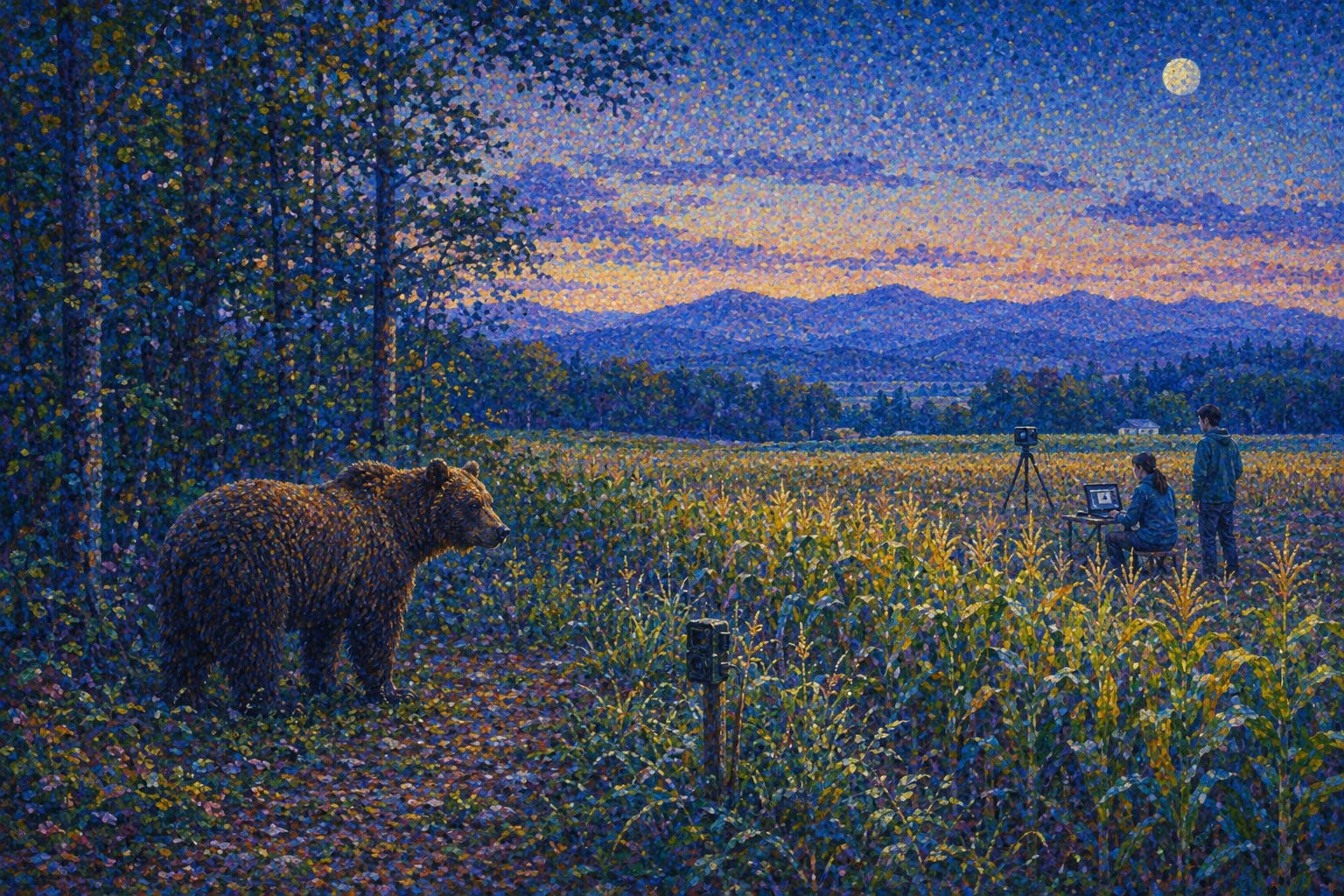
A pile of brown-bear scat on a forest road is not dramatic evidence. It does not roar. It does not cross a schoolyard or flatten a row of corn while a camera is watching. But washed through a sieve, examined seed by seed and placed beside records of acorns, berries, harvest dates and field area, it becomes something more useful than spectacle: a record of choice.
That record is the foundation of a new Hokkaido University study published online in Wildlife Biology on July 20, 2026. Naoki Kanasugi and ten co-authors analyzed field data gathered with the Brown Bear Research Group of Hokkaido University—Hokudai Kumaken, the university’s student bear-research circle. Their question sounds simple. When a Hokkaido brown bear eats dent corn, is it driven mainly out of the forest by a poor crop of wild acorns, or drawn into farmland by the abundance of corn?
The answer is both. Use of dent corn declined when the mast of the mizunara oak, Quercus crispula, was abundant. It increased when more unharvested corn acreage was available. In poor-acorn years, corn remained in the autumn diet for longer, sometimes after the crop had been harvested. The bear’s meal was governed not by one shortage but by a ratio across a human-made boundary.
A result measured on both sides of the boundary
Many crop-conflict studies examine one half of the food landscape. Some ask whether wild food failed. Others ask where crops are planted. Kanasugi’s team brought the two sides into the same analysis: annual and weekly availability of natural foods, especially mizunara acorns; seasonal change; and the weekly area of dent-corn fields still standing before harvest.
The distinction matters. If natural scarcity alone caused crop use, management would be hostage to the forest’s irregular mast cycle. Oaks cannot be ordered to produce a bumper crop. If accessible corn also matters, farmers and municipalities have levers: maintain electric fencing, reduce entry cover, remove spilled or unharvested residue, and keep protection active after harvest when poor mast makes leftovers valuable.
Six autumns, nine routes and meals reconstructed from remains
The work took place around Hokkaido University’s Teshio Experimental Forest in northern Hokkaido, a roughly 22,500-hectare landscape of mixed conifer and broadleaf forest. Sakhalin fir, Erman’s birch and mizunara oak rise above an understory rich in dwarf bamboo. Agricultural land lies outside and along the study landscape, bringing forest food and cultivated food within a bear’s foraging range.
From 2016 through 2021, observers walked nine fixed routes at intervals of one or two weeks during autumn. Fresh scat was collected and preserved. After washing, researchers identified visible remains and estimated dietary composition using a point-frame method, then corrected the apparent volume to reflect differences in digestibility. Corn fragments do not pass through a bear exactly as leaves, flesh or animal remains do; a raw visual percentage would therefore misrepresent intake.
At the same time, teams recorded mature fallen acorns and counted the fruits of hardy kiwi, crimson glory vine and Japanese rowan. For the crop side, the researchers obtained field areas and harvest dates from a local corn-growing enterprise for 2018–2021. The area of corn not yet harvested in each week served as an index of what was available. It was an observational design, not a fencing experiment, but it joined diet, forest production and farm timing at a useful weekly scale.
Seven foods reveal an autumn calendar
The seven principal food categories were dent corn; mizunara acorns; hardy kiwi, Actinidia arguta; sika deer; fish; crimson glory vine, Vitis coignetiae; and Japanese rowan, Sorbus commixta. Statistical ordination found that environmental variables explained 40.7% of the measured variation in diet, with its first constrained axis accounting for 28.42%. Oak mast, season and the availability of some berries organized much of the shift.
The broad pattern was intuitive but not trivial. In good mast years—2019 and 2021 in this series—the share of mizunara increased more sharply as autumn advanced and corn use receded. In poor mast years—2016, 2017, 2018 and 2020—corn use endured. Hardy kiwi and sika deer could serve as alternatives later in the season, but neither erased the importance of corn and acorns.
The weekly 2018–2021 model supplied the paper’s clearest management result. More acorns were associated with less corn in the diet. More available cornfield area was associated with more corn in the diet. Harvest reduced standing-crop availability and generally reduced use, yet corn could still appear afterward, especially when acorns were scarce—evidence that residue and missed ears can extend a field’s attraction after its commercial purpose has ended.
Why dent corn is more than an accidental snack
Dent corn is grown primarily as livestock feed, not as the sweet corn served at a summer table. For an omnivore preparing for winter, a field presents food in a dense, predictable block. Tall plants can also conceal an animal while it feeds. A bear that finds repeated success need not understand agriculture; it needs only to remember a route and the reward at its end.
Earlier Hokkaido research had already established corn’s importance. A 2005 analysis of 556 stomachs from bears killed between 1991 and 1998 found crops occupying 32–46% of late-summer stomach volume across three regions, with corn the leading crop. In the seasonal gap after spring herbs have declined but before berries and hard mast peak, farmland can become the most efficient cafeteria in the landscape.
A 2006 Furano study then demonstrated the other half of the pattern: in the especially poor 1995 acorn year, crop remains occurred more often in scat from September into November. The new study does not overturn that shortage hypothesis. It completes it. The bear responds to the wild food that is missing and the cultivated food that remains reachable.
Before the cornfield, Hokkaido’s bears ate a different island
The boundary between “natural” and “human” food is itself historical. Stable-isotope work on Hokkaido bear remains found major changes during roughly the last 100 to 200 years. Salmon consumption in eastern Hokkaido fell from an estimated 19% to 8%; terrestrial-animal consumption fell from 56% to 5% in western Hokkaido and from 64% to 8% in the east. Modern land use, river alteration, hunting and the disappearance of the Hokkaido wolf rewired the food web.
That history complicates the phrase “return bears to natural food.” There is no untouched dietary baseline waiting just beyond a fence. Different Hokkaido populations rely on different mosaics. On the Shiretoko Peninsula, a 2012–2018 study of 2,079 scats and 1,226 photographs found pine nuts and salmon central to the changing body condition of adult females. Elsewhere, grasses, ants, berries, deer, acorns, crops and waste occupy the calendar.
The brown bear is not a specialist displaced from a single ideal meal. It is an unusually flexible omnivore living in a food system that people have already transformed. That flexibility helped the species survive. It also makes exposed crops and discarded food powerful teachers.
Kimunkamuy: a relationship older than modern agriculture
Long before Hokkaido’s modern agricultural frontier, Ainu communities understood the bear through a relationship of respect, use and reciprocity. The animal was kimunkamuy—a kamuy of the mountains. In the iyomante ceremony, the bear’s spirit was sent back to the realm of the kamuy, part of a cyclical understanding in which humans received the mountain’s gifts and answered with ritual obligation.
This history should not be reduced to a romantic claim that conflict did not exist. Bears were powerful animals, hunted and carefully read. What differs is the frame. The bear was not merely a unit of damage or an enemy outside society. Hokkaido University archaeologists and Ainu-studies scholars describe a relationship in which humans understood themselves as embedded in an exchange with the living landscape.
Modern policy works through population models, damage reports, permits and fences, not ceremonial reciprocity. Yet the older idea contains a contemporary warning: coexistence is a managed relationship. It requires attention to what humans take, what they offer—intentionally or not—and what behavior that exchange teaches.
From spring eradication to recovery
Twentieth-century Hokkaido policy moved through nearly opposite ideas of the bear. An aggressive spring-culling system was built during the 1960s. Bears were hunted at dens or soon after emergence, before they could cause trouble. Females and cubs were especially exposed. A long-term study noted that spring kills made up more than 80% of removals in northern Hokkaido from 1983 to 1986.
Numbers and signs fell far enough to raise fears for local populations. The program ended in 1990 as conservation and biodiversity gained institutional weight. Bear populations and distribution recovered—but so did encounters and damage in an island where rural depopulation, abandoned land and declining hunter numbers were changing the human side of the boundary.
Hokkaido’s official estimate rose from about 5,200 bears in 1990 to about 12,200 at the end of 2022, subject to the uncertainty of population modeling. Agricultural damage reached ¥271 million in fiscal 2022; dent corn alone represented 48% of the total, followed by sugar beet at 18%. Recovery was a conservation achievement. It was not the end of management.
| Era | Management frame | What the student record revealed |
|---|---|---|
| 1960s–1989 | Preventive spring culling and den hunting reduced numbers before conflict occurred. | Bear field signs declined markedly during the culling era. |
| 1990s–2010s | Conservation-oriented policy, nuisance response and gradual adoption of prevention. | Signs rebounded after the spring program ended. |
| 2020s | Adaptive management, zoning, prevention and renewed population-control debate. | Diet records show when accessible human food recruits crop use. |
The student circle that became a scientific institution
Kumaken was founded by volunteer Hokkaido University students in 1970. The original desire was direct and youthful: to see wild bears. The work soon became systematic. In 1975 the group began surveys at Teshio; the long comparable series starts in 1976. Students walked rivers and forest roads, recording tracks, scats, feeding signs, claw marks and footprint size.
Across the 1976–2015 dataset, an average year involved 38 survey teams and 91 participants. The monitoring stopped from 1987 through 1989 when signs had become so scarce that student engagement faltered, then resumed after spring culling ended. The interruption itself is part of the history: absence can exhaust the people asked to document it.
The circle solved a problem that defeats many professional projects. Bears live long, reproduce slowly and respond to policy over decades; grants and academic appointments are short. A student club renews its membership every year. Methods, route knowledge, safety chants, notebooks and responsibility pass from one cohort to the next. The people change so that the observation can continue.
That continuity is citizen science in an unusually demanding form. It is not casual crowdsourcing. It is repeated field protocol performed by trained volunteers, supported by experimental-forest staff, local people, alumni and university researchers. Paper records later had to be digitized and statistically interpreted, but the data could not have been reconstructed after the fact.
One archive, two major scientific answers
The first landmark analysis of the student record, published in 2021, used state-space modeling to separate observation uncertainty from the underlying trend in tracks and scats. It detected the decline associated with spring culling and the recovery after abolition. In March 2026, a data paper preserved and documented 40 years of field signs—feeding remains, tracks and scat—from 1976 to 2015, making the monitoring architecture itself a scientific contribution.
Four months later, the corn study showed that the archive is more than a population index. Scat and feeding records contain an ecological diary. The 2026 data paper noted that corn, forage grass and sika deer appeared in its long record only from the 2010s—possibly reflecting the expansion of corn cultivation and the increase of deer around the research forest.
This is the quiet power of a long series. A footprint means presence on one morning. The same route walked for forty years can reveal the biological signature of a law, a recovering population and a changing agricultural landscape.
What “manage crop availability” means on the ground
Availability in the paper is an ecological term, not simply the number of hectares planted. A crop behind a functioning electric fence is physically present but less available to a bear. A harvested field with broken ears left on the ground is commercially finished but ecologically open. A brushy forest edge can provide a concealed approach. A cleared strip changes the perceived cost of entry.
Hokkaido’s bear-response handbook places prevention before capture. For farmland, it recommends removing attractants, cutting vegetation around fields, chasing bears away where appropriate, and correctly installing and maintaining electric fences. It also calls for camera monitoring, coordinated reporting and a prepared response system. Capture is considered when preventive measures cannot stop ongoing or likely damage.
The new study sharpens the timing of those familiar tools. Protection is especially important in early September, before acorns have matured regardless of whether the year will ultimately be rich or poor. In a low-mast autumn, a fence should not come down merely because the harvester has passed. Remaining cobs and kernels should be removed, and voltage, vegetation contact and access gaps should be checked after harvest.
| Management lever | Ecological logic | Operational question |
|---|---|---|
| Electric fencing | Turns standing corn from present food into less accessible food. | Is voltage maintained, vegetation cleared and every gap closed? |
| Harvest timing and residue | Reduces the reward after the commercial crop is removed. | Are missed ears, spills and edge rows cleaned in poor-mast years? |
| Edge clearing | Removes concealment and makes approach riskier. | Is the forest–field boundary visible enough for detection and deterrence? |
| Mast monitoring | Identifies years and weeks when substitution pressure is high. | Can acorn counts trigger earlier, longer or more intensive protection? |
| Zoning and reporting | Separates core habitat, prevention areas and human-use zones. | Do neighboring farms and municipalities share the same response map? |
Prevention and population control answer different questions
Hokkaido is no longer debating prevention in a vacuum. In April 2024, most Japanese bear populations—including Hokkaido brown bears—were added to the national category of Designated Wildlife Species for Control. Hokkaido resumed a regulated spring shooting program and moved toward adaptive management, while national bear-management guidance was revised again in April 2026.
The policy problem is genuinely difficult. Preventing access to crops can stop a bear from learning a profitable habit and reduce the creation of new nuisance animals. But fencing one field does not determine how many bears a region can sustain, nor how to respond to an individual that has lost fear of people or presents an immediate danger. Population management cannot substitute for securing attractants; attractant control cannot substitute for emergency action.
A 2026 Oshima Peninsula analysis made the same distinction from another direction. Several bears may use one small silage-corn field. Removing one identified animal may leave the unprotected resource ready to recruit another. Effective policy therefore needs at least three scales at once: secure the field, respond proportionately to individual behavior, and monitor the regional population.
What the study shows—and what it cannot yet show
The study is strong because it paired multiple food measures over time. It is not a randomized experiment. An association between field area and corn in scat does not measure the exact reduction that a particular fence design will achieve. “Available corn” was estimated primarily from unharvested area, not from direct measurement of crop energy, ripeness, waste kernels or bear-by-bear access.
The survey routes were near an agricultural boundary and may overstate corn’s importance relative to bears living deeper in the forest. Scat does not identify every feeding individual, so a week’s samples may reflect repeated use by a few bears as well as broader population behavior. Food categories were measured with different field indices; temporal dependence and corn maturity remain targets for better models.
Those limitations define the next research program. Experiments can compare protected and unprotected fields, before and after fencing, while genetic identification from scat distinguishes individuals. GPS collars and cameras can reveal routes and the timing of first entry. Drone or satellite imagery can map harvest residue. Standardized acorn monitoring could feed an early-warning system that lengthens protection automatically in poor-mast years.
- The paper shows a statistical relationship between bear diet, oak mast and accessible crop area.
- It supports preventive management of corn access; it does not calculate a universal fence effect.
- It describes food use around one northern Hokkaido landscape, not every bear population on the island.
- Crop consumption is a conflict risk, but it is not proof that every crop-eating bear is aggressive toward people.
A boundary can be managed before it becomes a crisis
The most compelling figure in this story is not a bear. It is a line walked by students: forest road, riverbank, oak plot, field edge, then the same line again one or two weeks later. Over six autumns, those repetitions showed how an animal’s diet responds to two simultaneous harvests—the irregular crop of the oak forest and the scheduled crop of the farm.
Over half a century, the larger repetition showed something else. Hokkaido first reduced bears until signs nearly vanished, then protected them until recovery produced a new era of conflict, and is now trying to build an adaptive middle ground. The student archive survived each policy swing.
The lesson is neither “feed bears in the forest” nor “remove every bear near a farm.” It is to stop treating the boundary as an accident. Count the acorns. Secure the corn. Clear the approach. Remove the residue. Share the reports. Track the animals and the population. Keep measuring after a policy changes.
A bear enters a cornfield one decision at a time. Coexistence is built the same way.
Primary sources and further reading
This report centers on the 2026 Wildlife Biology paper and Hokkaido University release, then traces the student-monitoring record, long-term diet change, crop-conflict research, official damage statistics and the evolution of bear policy. Observational associations are distinguished from experimental proof.
- Kanasugi et al. (2026), “The relative abundance of crop and natural food influences crop consumption by brown bears,” Wildlife Biology
- Hokkaido University research release, July 24, 2026
- Furumaki et al. (2026), 40-year brown-bear field-sign dataset, Ecological Research
- Takinami et al. (2021), population decline and recovery detected by student monitoring
- National Institute for Environmental Studies, 40-year monitoring explanation
- Hokkaido University and Bears: Understanding Bears and Kumaken fieldwork
- Hokkaido University, Teshio Experimental Forest profile
- Sato, Mano and Takatsuki (2005), stomach contents of 556 Hokkaido brown bears
- Sato et al. (2006), crop use and mizunara acorn production in Furano
- Matsubayashi et al. (2015), historical decline in marine and terrestrial foods
- Shirane et al. (2021), salmon, pine nuts and female body condition in Shiretoko
- Fujimaki (1994), agricultural damage in Rikubetsu
- Hokkaido Government, population, injury and agricultural-damage statistics
- Hokkaido Government, Brown Bear Countermeasure Handbook
- Tsuruga et al. (2026), estimating nuisance bears in the Oshima Peninsula
- Sato (2026), urban bear-management trends and challenges in Hokkaido
- Saitoh et al. (2025), social background of Hokkaido bear-policy transformations
- Matsuda et al. (2026), adaptive management model for Hokkaido brown bears
- Ministry of the Environment, Designated Wildlife Species for Control program
- Ministry of the Environment, 2026 revised bear-management guidelines
- Hokkaido University and Bears: Researching Bears, Ainu history and kimunkamuy
