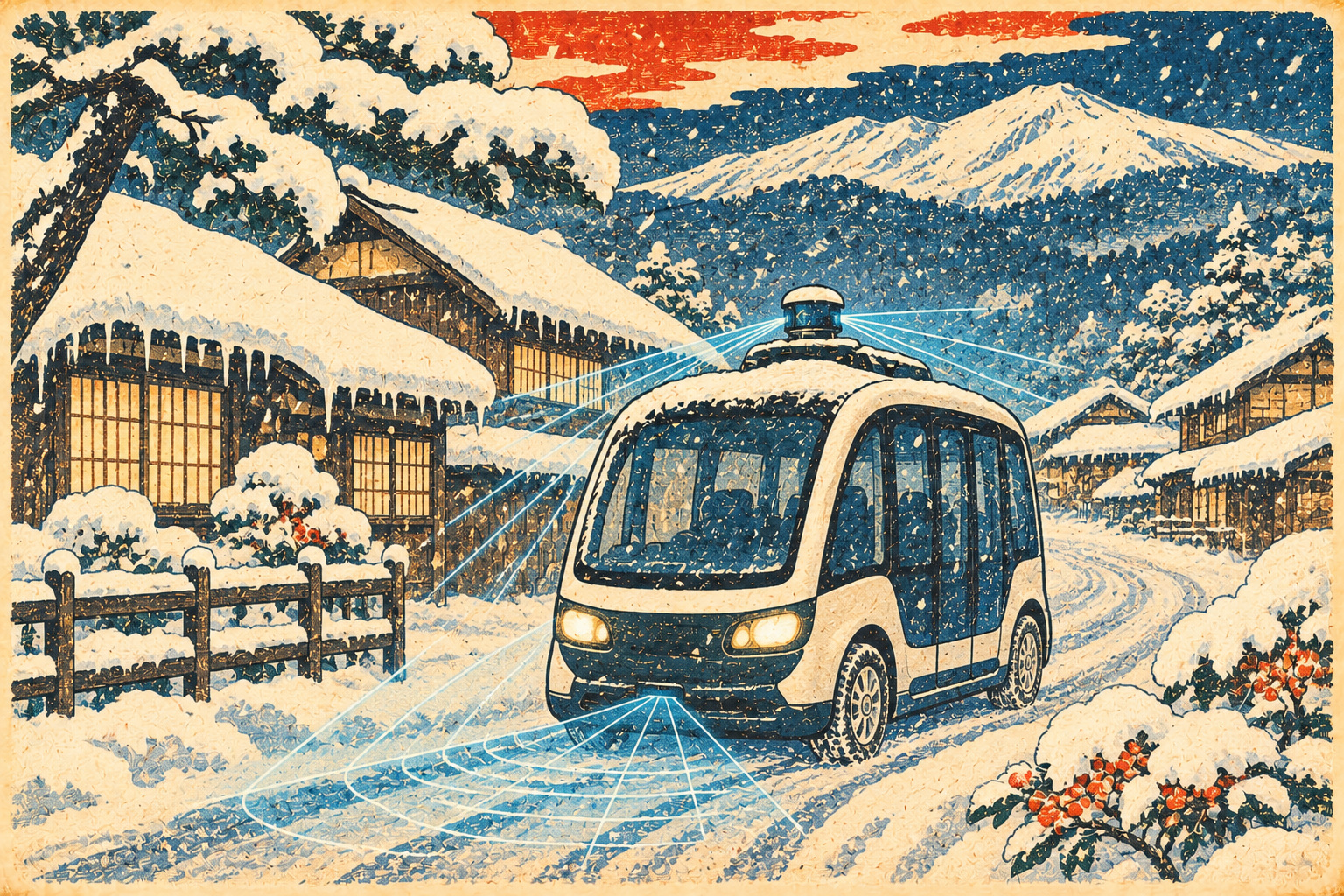
- When the road disappears beneath the snow
- The transportation problem comes before the robot
- Kamishihoro: a decade of trials, not a finished revolution
- Why snow changes the machine’s understanding of the world
- Knowing an obstacle exists is not the same as stopping
- Level 2 is not Level 4
- From American desert trials to northern Japan
- Why the Sapporo symposium broadened the conversation
- What should a town measure?
- An autonomous shuttle still needs a human system around it
- The promise measured in ordinary winter mornings
When the road disappears beneath the snow
Imagine a bus arriving on a winter morning when the lane markings have vanished. A plow has pushed a wall of snow toward the shoulder, the next bend is slippery, and blowing flakes obscure the road ahead. The question is not merely whether an autonomous shuttle can identify a pedestrian. It is whether it can know where it is, what ground is drivable, and when its safest action is to stop.
That challenge gave the 24th ITS Symposium, scheduled for November 12–13, 2026, in Sapporo, particular urgency. Its theme links data, artificial intelligence and regional resilience. A November 13 session specifically addressed automated driving in snowy and cold regions, with Hokkaido positioned not as a backdrop but as a demanding testing environment.
This feature draws on the organizers’ published program and official government and municipal documents. It does not purport to report unpublished remarks from symposium speakers or results unavailable at the research cutoff.
The transportation problem comes before the robot
For residents of a remote community, the critical journey might be a short trip to a clinic, supermarket, or public office. In widely dispersed parts of Hokkaido, the absence of a reliable transport option can constrain everyday life, particularly for older residents who no longer drive.
Japan’s government-backed RoAD to the L4 project describes how some community bus services in Kamishihoro operate only three days a week, leaving gaps on other days. An autonomous shuttle could help cover these gaps, but that value depends on actual service availability rather than a demonstration vehicle’s ability to travel a prescribed circuit.
The test of success therefore extends beyond technology. Planners must consider frequency, accessibility, affordability, vehicle maintenance, winter closures and whether residents can count on a ride throughout the year.
Kamishihoro: a decade of trials, not a finished revolution
Kamishihoro, in the Tokachi region, began testing autonomous buses in 2017. Municipal records describe winter trials in 2021, scheduled service beginning in December 2022, a Level 4 trial in October 2024, and separate robot-bus and robot-taxi experiments in 2026.
The town says its 2021 winter trial recorded autonomous operation for 90% of the test while investigating snow, frozen pavement and falling snow. That percentage is not a blanket reliability guarantee across all temperatures, storms and routes. The conditions of the trial matter.
Crucially, the town’s public service page says the regular NAVYA ARMA route has been suspended since June 20, 2026, for vehicle maintenance, with no restart date listed. Other trials have continued, including a February RoboBus test and an October robot-taxi experiment. Conflating these distinct projects would create a misleading picture of uninterrupted passenger service.
Why snow changes the machine’s understanding of the world
Autonomous systems may combine cameras, lidar, radar, satellite positioning and high-definition maps. Cameras can struggle when the contrast between road and roadside vanishes. Snowflakes can introduce returns into lidar point clouds. Radar may remain useful in degraded visibility but cannot, on its own, interpret every curb, person or road boundary.
The problem is also geometric. A map can place a vehicle exactly where a road was measured last summer, while winter snowbanks now occupy part of the usable road. The vehicle must account for uncertainty in the sensor data and the physical space it can safely occupy.
Even accurate localization does not solve everything. Slippery surfaces lengthen stopping distances, ice can alter steering response, and snow or grime can obstruct cameras and other sensors. Winter reliability requires perception, control, maintenance and operating rules to work together.
Knowing an obstacle exists is not the same as stopping
A system that correctly detects a person ahead has only completed part of its task. The vehicle must estimate available traction, braking distance and a safe maneuver. Tire condition, vehicle mass, wheel speed and road temperature are as relevant as the sophistication of the perception model.
Cold weather introduces practical problems for electric shuttles, too. Cabin heating and defogging consume energy. Snow buildup can obstruct doors, and an icy bus stop can be hazardous even when the trip itself was uneventful. Transport operators need coordination with snow removal and road managers.
The safety objective should not be “drive through every storm.” It should be to operate within clearly specified conditions—and to reach a safe stop or another controlled response when those conditions cease to hold.
Level 2 is not Level 4
The phrase “self-driving” covers systems with sharply different responsibilities. Level 2 driver assistance still requires a human driver to supervise the driving task. Level 4 automation allows the automated system to perform that task within a defined operational design domain, which may restrict speed, location, weather and other conditions.
Japan established a framework for specified Level 4 automated operations through legal changes effective in April 2023. The transport ministry’s first vehicle authorization was issued for a project in Eiheiji, Fukui Prefecture, in March of that year. Authorization is not permission to operate under every possible condition.
Official Kamishihoro project materials distinguish a Level 2 service from Level 4 demonstrations. The existence of an advanced test does not mean every shuttle in town is currently carrying passengers without a driver in heavy snow.
From American desert trials to northern Japan
Modern autonomous-driving research has multiple roots, but the DARPA Grand Challenge became a milestone. No entrant finished the 2004 desert course. In 2005, five vehicles completed the redesigned challenge; the 2007 Urban Challenge subsequently confronted complex traffic behavior and intersections.
Japan developed intelligent transport systems alongside advances in communications, mapping and automotive engineering. ITS Japan’s symposium series began in 2002, bringing transportation researchers together with policymakers and specialists from other disciplines.
Yet the transition from a controlled demonstration to a public winter bus is profound. A desert test can set a defined course. In a Hokkaido village, the edges of the course may move overnight after a snowfall. The meaningful unit of progress is not just kilometers completed, but years of dependable service.
Why the Sapporo symposium broadened the conversation
The program for the November meeting included a keynote by Kamishihoro Mayor Mitsugu Takenaka on future mobility and local development, plus sessions on energy, cold-region automated driving and transport resilience during weather disasters. Organizers planned more than 160 technical presentations across different categories.
The central insight is that a vehicle is part of a larger system. Roads have to be cleared, service disruptions communicated, electricity supplied, hazards mapped and passengers supported. A shuttle’s sensors cannot replace coordination among road authorities, transport operators, healthcare facilities and local government.
Because transcripts and post-event outcomes were not independently verified for this feature, these are documented program topics and reasoned implications—not invented claims about what particular speakers proved.
What should a town measure?
Test reports often highlight the autonomous-driving percentage or distance covered. Residents may ask a more practical question: did a medical appointment become easier to reach? A serious public assessment should make room for both types of evidence.
Useful measures include service days lost to weather or maintenance, safety-driver interventions with clear definitions, near-miss reporting, passengers carried, cost per trip, customer accessibility and confidence in the service. A safe cancellation can be the correct decision, although repeated cancellations may undermine a transport service’s usefulness.
A transport ministry summary reports 1,209 riders for Kamishihoro’s fiscal 2023 service. That historical number provides context; it must not be passed off as a 2026 ridership total or as proof of commercial profitability.
An autonomous shuttle still needs a human system around it
Advanced driving software may reduce some staffing needs, but does not remove maintenance crews, road workers, dispatchers, emergency responders or people helping passengers board. The burden shifts rather than disappearing. In winter, the reliability of the whole operation depends on the weakest connection.
That is why the question of procurement and economics matters alongside technology: who pays for vehicles, sensors, repairs, maps, communication infrastructure and snow clearance? How do authorities decide when a route is unsafe? Who informs the passenger waiting at a stop?
Kamishihoro’s mixture of trials, scheduled service and a public maintenance suspension gives a more credible picture of deployment than polished demonstrations alone. It shows progress with operational friction still visible.
The promise measured in ordinary winter mornings
Autonomous transport may help rural Japan preserve mobility amid population aging and driver shortages. But a small shuttle navigating a snowy village is not yet an all-weather transportation system, and Level 4 in a bounded domain is not universal autonomy.
For engineers, the Hokkaido test is a formidable combination of sensing, localization, traction, energy and fault management. For communities, it is a question of a ride that can be trusted—not on a perfect test day, but through an entire season.
The larger achievement will come when safety and ordinary usefulness coexist: when the shuttle knows to stop in a storm, and when the community has planned what happens next.
Sources and verification
Based on published organizer, municipality and government sources. We have not independently verified unpublished symposium remarks, service restart dates, or outcomes of individual 2026 trials.