A town of 6,704 people in eastern Hokkaido received more than ¥22 billion in Furusato Nozei donations in a single fiscal year. The scale looks almost disconnected from ordinary municipal finance. Shiranuka's program began with just ¥1.94 million in fiscal 2008. It rose to ¥159 million in fiscal 2015, ¥21.165 billion in fiscal 2024 and, according to the newest Ministry-derived data released in July 2026, ¥22.329 billion in fiscal 2025. [1][2][13]
On September 18, Immu Co. released a book titled Furusato Nozei kara Hajimaru Machizukuri—roughly, “Community Building That Begins With Furusato Nozei.” Based on interviews with Mayor Takao Tanano and local producers and businesses, the book presents Shiranuka's central argument: tax-deductible donations and return gifts should not end as a fundraising transaction but should be converted into local industry, people, education and investment in the town's future. [10]
The book's main numerical arc runs through 2024, when Shiranuka received ¥21.165 billion. The latest data have already moved further. Furusato Choice, publishing figures sourced to the Ministry of Internal Affairs and Communications, records fiscal 2025 receipts of ¥22,329,453,385 across 1,276,246 donations. The amount rose about 5.5% from fiscal 2024 even as the number of donations fell from 1,333,228. [13]
¥22.3 billion does not mean ¥22.3 billion of free municipal cash
The gross figure needs an immediate qualification. Furusato Nozei revenue is not a pure municipal profit. Return gifts must be purchased. Frozen seafood has to be packed and delivered. Portals, payment processing, certificates, one-stop tax applications, customer service and promotion all carry costs.
A secondary aggregation of MIC public data calculates Shiranuka's fiscal 2025 fundraising-related expenses at about ¥11.088 billion, or 49.7% of receipts. The figure is important because it prevents a common error: treating every yen of the ¥22.329 billion as money available for unrelated public programs. [14]
At the same time, some of those expenses feed the regional economy. Procuring seafood, meat, dairy products, processing, packaging and logistics can become revenue and employment for local businesses. But not every fundraising cost stays in Shiranuka; portal commissions and parts of distribution can flow outside the town. Neither “expense” nor “local economic benefit” should be used as a blanket description for the entire cost side.
The inflection point was October 15, 2015
Shiranuka received 11 donations totaling ¥1.94 million in the national program's first fiscal year, 2008. Through 2014, annual receipts remained only in the low millions of yen. The town began offering return gifts on October 15, 2015. That fiscal year, donations jumped to 6,953 transactions and ¥159,034,105. [1][13]
The subsequent rise was steep: ¥817.6 million in fiscal 2016, ¥1.856 billion in 2017, ¥3.214 billion in 2018, ¥6.733 billion in 2019, ¥9.737 billion in 2020, ¥12.522 billion in 2021, ¥14.834 billion in 2022, ¥16.778 billion in 2023, ¥21.165 billion in 2024 and ¥22.329 billion in 2025. [13]
FY2008 — 11 donations, ¥1.94 million; no return-gift system.
October 2015 — Shiranuka begins giving return gifts; fiscal-year receipts reach ¥159 million.
FY2018 — ¥3.21 billion.
FY2020 — ¥9.74 billion.
FY2022 — ¥14.83 billion.
FY2024 — ¥21.17 billion, No. 2 nationally.
FY2025 — ¥22.33 billion, again No. 2 nationally.
Why “food and ingredients” became the economic engine
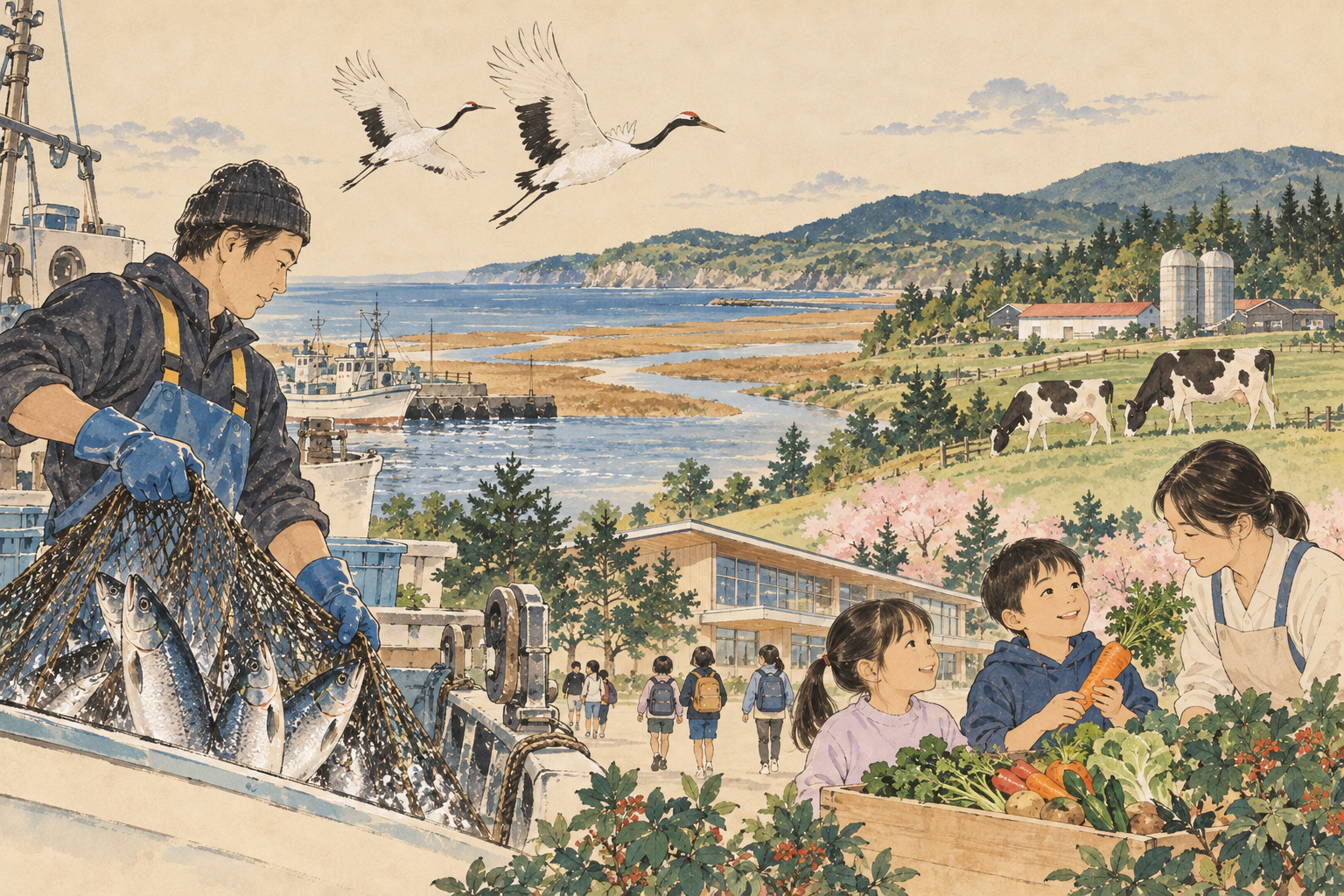
Shiranuka sits on Hokkaido's Pacific coast and has long based its economy on fishing, dairy, livestock and forestry. The town markets itself as a place of “food and ingredients,” including salmon roe, salmon, crab, octopus, shellfish, cheese, lamb, venison and the shiso used in the nationally known shiso shochu Tantakatan. Its comprehensive plan explicitly calls for adding value to marine products, building the “Shiranuka brand,” and linking primary production with local commerce and industry. [7]
Food also fits the logistics of Furusato Nozei unusually well. A town with only 6,700 residents has a tiny local consumer market. Frozen and refrigerated distribution turns the whole country into a potential market. The tax program therefore operates simultaneously as public finance and as a massive e-commerce channel for regional food.
By fiscal 2024, Shiranuka received more than 1.33 million donation transactions—an external customer base on a scale that bears little relation to its resident population. The town and its partners have increasingly emphasized events, producer stories, donor communication and product development rather than simply waiting for orders. [10][13]
Return gifts can become industrial-development tools
The local effect is not limited to putting existing products into a gift catalogue. If a product can reach national demand, businesses gain a reason to invest in processing, freezing, packaging, staffing and branding.
A current example is the Gokkan Buri project. Changes in the marine environment have brought more yellowtail to waters where the fish was once less familiar commercially. Immu says Shiranuka yellowtail landings rose from 0.5 metric tons in 2019 to more than 100 tons in 2023. Since 2022, the town, Shiranuka fisheries cooperative and business partners have worked on onboard ikejime handling, freshness control, processing, branding and product development, selling products through Furusato Nozei. [12]
The strategic point is larger than “sell more popular seafood.” The tax-donation market can act as an early customer base for adapting to a changing resource. The harder long-term test is whether such products can become competitive in ordinary retail and wholesale channels rather than depending indefinitely on the tax incentive.
What has the money actually funded?
Shiranuka's official Furusato Nozei site lists major use categories including child-rearing support under the “Taiyo no Te” program, health and welfare, industrial development, protection of the natural environment, education, community development and an unrestricted category. [3]
Historical town disclosures show what that can mean on the ground. Fiscal 2018 uses included community-bus operation, training for young workers, parenting support and family education, with ¥145 million allocated across 46 projects. Fiscal 2019 uses included support for new farmers, after-school learning and forestry-worker development, totaling ¥241.76 million across 71 projects. [5][6]
For fiscal 2020, the town reported ¥550.17 million allocated across 70 projects. Examples included 3,700 household and business disaster radios, forest access and management work, support for the town's first residential facility for people with intellectual disabilities, and the public Kuon Juku learning program supporting students at Hokkaido Shiranuka High School. [4]
| Policy area | Examples disclosed by the town |
|---|---|
| Children | Childcare and meal support, playgrounds, nursery-school resources, school-entry assistance. |
| Education | Kuon Juku public tutoring, after-school learning, school equipment, furusato education. |
| Industry | New-farmer support, forestry workforce, local-resource research and branding. |
| Resilience & welfare | Household disaster radios, disability facilities and elderly support. |
| Community development | Local transport, trial-residence initiatives and promotion of the town. |
Those historical examples should not be confused with a final allocation schedule for the fiscal 2025 ¥22.329 billion. Donation receipt years, fund accumulation and the fiscal years in which projects are financed can differ. Japan.co.jp keeps the town's stated project year attached to each example rather than treating all past projects as uses of the latest year's receipts.
Child policy is also a way to return value to residents
Shiranuka's Furusato Nozei Manifesto explicitly pairs industrial development with the ambition to be Japan's leading child-rearing-support town. Its official giving site highlights childcare and school-meal support, school-entry assistance and other measures under the “Taiyo no Te” program. [3][9]
This illustrates the program's two-sided structure. Nonresident donors receive regional products; residents receive public services financed by the remaining fiscal resources. If demand for seafood creates local processing revenue and the donation system then finances childcare and education, industrial policy and population policy become linked.
Yet Shiranuka's population is still shrinking. Its registered population was 6,704 on July 31, 2026. The town's population vision and revitalization strategy explicitly treat demographic decline as a central challenge. High Furusato Nozei receipts and population decline are occurring at the same time. [2][8]
More donations do not automatically mean more residents
Furusato Nozei can provide extraordinary fiscal room, but demographic outcomes depend on employment, wages, education, health care, transportation, housing and family formation. A town cannot infer population-policy success from a donation ranking.
Shiranuka's more interesting achievement may be economic rather than demographic: it has connected local production to nationwide demand and created a very large external base of customers and supporters even while the resident population falls.
About 15,000 donors with Shiranuka roots
On September 15, Shiranuka and Immu said analysis through the Furusato Repeat Map donor-data system estimated that about 15,000 past donors around Japan have family, geographic or other roots connected to Shiranuka. The town is using that finding in a second phase of its Furusato Nozei Manifesto, seeking more continuous communication with donor segments. [11]
For a town of about 6,700 people, a potential off-site community of 15,000 people with roots is significant. But it is an estimate generated through the FRM system, not an official nationwide census based on family registers. The complete classification method is not disclosed in the public release, so the number should remain labeled as an estimate.
“Don't let it end with the donation” is also a hedge against system dependence
The better a municipality becomes at return-gift competition, the more exposed it may become to rule changes, portal behavior and changing consumer preferences. Permanent public spending built on the assumption that a specific gift will remain popular forever carries obvious risk.
In October 2025, portal operators were barred from awarding their own points tied to Furusato Nozei contributions. The national government has continued refining local-product and solicitation rules. Shiranuka's own manifesto emphasizes lawful operation, transparency, continuous donor relationships, high-value regional food and investment in local industry rather than treating annual donation volume as an end in itself. [1][9]
The durable asset, therefore, may not be the ¥22.3 billion. It may be the producer brands, processing capacity, customer data, logistics relationships, recognition and human capital built while the money is available.
The 2024 “No. 2 nationally” ranking needs one line of context
Shiranuka's fiscal 2024 ¥21.165 billion was indeed the second-highest municipal total in Japan. The national No. 1, Takarazuka in Hyogo, received an extraordinary roughly ¥25.4 billion donation from two residents to its municipal hospital as part of its total. The two top totals therefore did not arise from the same fundraising model. [13]
Shiranuka's defining characteristic was volume: 1,333,228 donation transactions linked largely to a mass-market return-gift operation. That makes the town more useful as a case study in repeated small-to-medium donations and food distribution than as a direct comparison with Takarazuka's exceptional large gift.
Fiscal 2025: more money, fewer transactions
In fiscal 2025, receipts rose from ¥21.165 billion to ¥22.329 billion while donation transactions fell from 1.333 million to 1.276 million. The simple average per donation therefore increased from about ¥15,875 to about ¥17,496. [13][14]
The data do not by themselves explain why. Product mix, timing, donor behavior around rule changes and portal mix could all matter. It would be premature to conclude that the donor base became “higher quality” or that return gifts simply became more expensive.
Outbound resident tax credits are a different period and should not be netted casually
Shiranuka residents can also donate to other municipalities and receive resident-tax credits. A secondary processing of MIC data reports 257 Shiranuka residents receiving Furusato Nozei credits in fiscal 2026 taxation, with total resident-tax credits of roughly ¥12.4 million. [14]
That figure should not simply be subtracted from fiscal 2025's ¥22.329 billion to produce a “profit.” The periods differ, fundraising costs matter, fund accounting shifts spending across fiscal years, and other local-government finance mechanisms are involved.
Shiranuka is now also seeking corporate Furusato Nozei
In June 2026, Shiranuka opened solicitation for the separate Corporate Furusato Nozei system. Companies that donate to nationally certified regional-revitalization projects can receive corporate-tax credits, and Shiranuka says it will use the program to advance its regional revitalization strategy. [15]
This is a different tax system from the individual return-gift program and should not be mixed with the ¥22.329 billion figure. Strategically, however, it shows Shiranuka trying to broaden the relationship from individual food-driven donations toward corporate participation in local projects.
The new book is not an independent audit
The newly released book is useful as a source of interviews and the town's own theory of what it is trying to achieve. But it was self-published by Immu, a company that also works with Shiranuka on Furusato Nozei operations and product development. [10]
It should therefore not be treated as an independent fiscal audit or an external policy evaluation. Japan.co.jp uses the book and related releases to understand the participants' stated goals, while checking donation amounts, population and public-project examples separately against municipal and Ministry-derived data.
What remains unknown
Public information does not establish how much of fiscal 2025's ¥22.329 billion was directly spent with businesses physically located in Shiranuka, how much portal and logistics spending left the region, how much was placed in funds for later years, the net number of local jobs created, business-by-business revenue effects, a local economic multiplier, or a measurable demographic impact attributable to the program.
Nor does a high donation total prove that every funded public project has high cost-effectiveness. Each program—education, childcare, industry, transport, welfare or branding—still has to be judged on its own outcomes.
What it means for a town of 6,700 people to have a national market
The most interesting part of Shiranuka's story is not simply that a small town found a large source of money. It built a mechanism that moved local food into a national market, generated more than a million annual donation transactions and then redirected fiscal capacity toward childcare, education, disaster preparedness and industry.
But that mechanism depends on rules that can change. Products lose popularity. Portal economics shift. Fisheries change with the climate. A town that succeeds at Furusato Nozei therefore faces a second challenge created by its own success.
Can a person who first chose salmon roe become a long-term customer for Shiranuka products? Can a donor become someone who knows the town's producers? Can ¥22 billion become equipment, skills, brands, education and jobs that survive a future year when donations are lower?
The real Furusato Nozei ranking is not the annual table of municipalities. It is what remains in the town after the ranking changes.
Sources & documents
- Shiranuka Town: Furusato Nozei program page (updated Aug. 31, 2026; Japanese primary source)
- Shiranuka Town: Population statistics (updated Sept. 2, 2026)
- Shiranuka Furusato Nozei official site: Uses of donations
- Shiranuka Town: FY2020 examples of furusato-tax-funded projects
- Shiranuka Town: FY2018 examples of funded projects
- Shiranuka Town: FY2019 examples of funded projects
- Shiranuka Town: Seventh Comprehensive Plan—industry, education and local economic circulation
- Shiranuka Town: Population Vision and Regional Revitalization Strategy
- Shiranuka Town: Furusato Nozei Manifesto (Japanese primary release)
- Immu: Publication of Furusato Nozei kara Hajimaru Machizukuri (Sept. 18, 2026)
- Shiranuka Town: About 15,000 donors with family/geographic roots identified (Sept. 15, 2026)
- Immu: Gokkan Buri value-added fisheries project (Sept. 17, 2026)
- Furusato Choice: Shiranuka 2008–2025 donation history, sourced to MIC
- Furusato Hikaku: Shiranuka FY2025 receipts, fundraising costs and use categories, processed from MIC data
- Shiranuka Town: Corporate Furusato Nozei