- The surprising thing is not the shrimp shell
- What chitosan contributes
- Why crowding could be useful
- The numbers—and what their units mean
- Oxygen complicates the chemistry
- Japan’s half-century pursuit of solar hydrogen
- Why a Hokkaido laboratory is an apt setting
- How far is this from a hydrogen economy?
- The next question is whether the design rule travels
The surprising thing is not the shrimp shell
A material associated with crab and shrimp shells has helped Japanese researchers coax more hydrogen from a light-driven chemical reaction. That sounds like a story about turning seafood waste into clean fuel. The experiment is more interesting—and more limited—than that enticing shorthand suggests. The researchers were not feeding discarded shells into a hydrogen generator. They were using a shell-derived polymer to arrange light-absorbing molecules at just the right density.
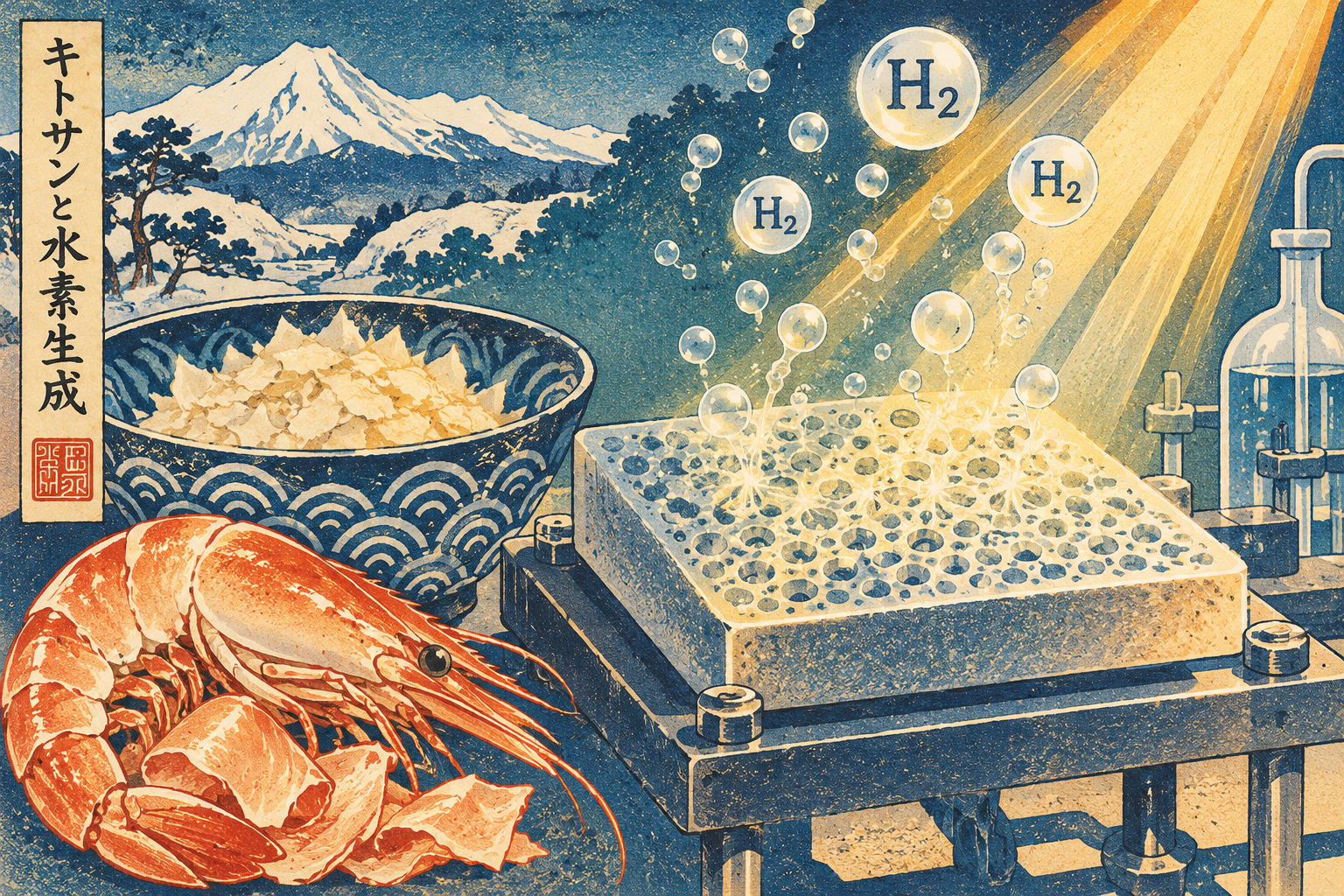
In a study announced November 16 by Hokkaido University and the Japan Science and Technology Agency (JST), a team including doctoral researcher Kushal Mohan Gowda and associate professor Yuta Takano used chitosan as a scaffold for a platinum-porphyrin dye. The work appeared online November 11 in the peer-reviewed Journal of Materials Chemistry A. Their central finding: moderate molecular crowding, often assumed to harm performance, can instead steer excited-state chemistry toward useful electron transfer.
The headline improvement of roughly tenfold was measured against the team's own lowest-dye-loading formulation, not against every existing photocatalyst or an industrial electrolyzer. That distinction is essential to understanding what the research actually changes.
What chitosan contributes
Chitosan is a biopolymer produced by processing chitin, a structural material found in crustacean shells and other biological sources. It can be chemically useful because its functional groups interact with other molecules, allowing it to serve as a support for engineered reaction sites. Its value in this experiment was architectural: it helped determine how densely molecules of the light-sensitive platinum porphyrin were positioned.
Many accounts of new catalysts focus exclusively on the active metal or light-absorbing semiconductor. But the support material can shape the distance between molecules, the microenvironment around them and the pathways through which energy is lost or converted. Hokkaido's finding treats the scaffold not as passive packaging but as an active design choice.
Why crowding could be useful
Light-absorbing dyes can suffer when packed too tightly. Neighboring molecules may interact in ways that dissipate absorbed energy before it drives chemistry—a problem commonly discussed as aggregation-related quenching. A conventional response has been to keep such molecules separated.
The Hokkaido team varied the amount of platinum porphyrin immobilized on chitosan. Under selected conditions, deliberately allowing some aggregation helped retain an excited state for longer, while reducing the pathway in which energy is transferred to oxygen. The researchers propose that electron-transfer chemistry then becomes more competitive. The result does not establish that aggregation is universally beneficial; it illustrates why there may be an optimum between isolation and overcrowding.
The numbers—and what their units mean
Under 405-nanometer illumination in water containing ascorbic acid as an electron donor, the optimized material evolved hydrogen at a reported rate of 39.2 millimoles per hour per gram of dye in an air atmosphere. That is approximately ten times the rate achieved by the lowest-dye-loading material in the same study. After reducing dissolved oxygen in the water, the rate for the optimized formulation rose to 72.7 millimoles per hour per gram of dye.
These are activity figures normalized to the mass of the dye. They are not the total output from a commercial reactor, a kilogram of shrimp shell or a solar panel. Nor do they demonstrate an autonomous process splitting ordinary water into hydrogen and oxygen under natural sunlight. A 405-nanometer light source supplied the excitation, and ascorbic acid supplied electrons. The laboratory conditions and input materials matter.
The paper describes cocatalyst-free hydrogen evolution, but that does not mean it is platinum-free: the photosensitizer itself is a platinum porphyrin. Any future commercial comparison would need to account for precious-metal use, durability and recycling.
Oxygen complicates the chemistry
Oxygen is essential to human life, but it can interfere with excited molecular states by accepting transferred energy or changing reaction pathways. According to the university and JST, adjusting the porphyrin loading reduced the relative importance of an oxygen-directed energy-transfer pathway and increased the apparent contribution of electron transfer. Yet removing some dissolved oxygen still improved performance substantially.
This observation matters beyond the chemistry laboratory. A practical reactor would need to address whether and how oxygen is controlled, how much energy that control consumes, and what happens as reaction products accumulate. Optimizing a photochemical reaction is not the same as optimizing the complete industrial process that surrounds it.
Japan’s half-century pursuit of solar hydrogen
Japan helped establish modern research into light-driven water splitting. In 1972, Akira Fujishima and Kenichi Honda published their work on titanium dioxide photoelectrodes in Nature, building on experimental discoveries made in the late 1960s. The Honda–Fujishima effect became a landmark: sunlight, in principle, could drive chemistry that stores energy in hydrogen. The oil shocks of the 1970s lent urgency to the idea.
But early titanium dioxide systems mainly absorbed ultraviolet light, only a small portion of the solar spectrum. That limitation spurred decades of research on visible-light absorbers, charge separation, more durable catalysts and reactors that safely handle hydrogen and oxygen. In 2019, NEDO and partners reported visible-light-responsive oxysulfide photocatalysts for water splitting. In 2021, a separate Japanese consortium described a 100-square-meter demonstration using photocatalyst panels and gas-separation equipment under outdoor sunlight.
Those projects addressed system architecture and scale. The new chitosan work works at a different level: the arrangement of molecules, the lifetime of their excited states and the probability that absorbed light can drive electron movement. Both layers matter, but success in one does not prove readiness in the other.
Why a Hokkaido laboratory is an apt setting
Hokkaido's fishing industry makes the shellfish origin of chitosan an appealing narrative connection. Yet the published announcement does not establish the geographical origin of the chitosan used in the experiment or show that local seafood waste was processed directly into the laboratory catalyst. Such a claim would require sourcing evidence that has not been presented.
The study also fits into a broader Hokkaido University interest in biomass and light-driven chemistry. In 2025, university researchers reported a separate approach linking cellulose-derived materials with photocatalytic hydrogen generation. That history suggests a productive line of inquiry about biological feedstocks and chemical functions—not a common commercial platform, nor proof that all biomass-derived catalysts are necessarily sustainable.
A full environmental assessment would consider how chitosan is extracted and processed, the other ingredients in the catalyst, its life span and eventual recovery. The biological origin of one component is a starting point for sustainability analysis, not its conclusion.
How far is this from a hydrogen economy?
Hydrogen can be useful for low-carbon industrial processes and certain energy applications, but its climate impact depends heavily on how it is manufactured. Electricity-driven electrolysis and direct photocatalytic pathways are different routes, with different costs and bottlenecks. Neither should be confused with this particular dye-based experiment using a sacrificial electron donor.
Before the Hokkaido chemistry could be judged as a fuel-production technology, researchers would need convincing results for operation under the full solar spectrum, solar-to-hydrogen efficiency, stable operation over extended periods, output per reactor area, the cost and replacement of electron donors, separation and purification of hydrogen, and a life-cycle assessment that accounts for the platinum-containing dye.
Japan's own public research portfolio illustrates the difficulty of moving from concept to production. NEDO's published program status records a solar-to-hydrogen efficiency target that was not reached and a related project component that was discontinued after review. Photocatalysis deserves ambitious research, but commercial inevitability is not a scientific finding.
The next question is whether the design rule travels
The most promising implication may extend beyond hydrogen. If a biopolymer scaffold can regulate the branching of excited-state pathways by controlling dye density, the same design logic could be investigated in other light-driven reactions. That possibility is an inference from the mechanism, not an application demonstrated by this study.
The immediate research agenda is demanding: determine whether the density effect persists under realistic illumination; reproduce it over larger areas; measure long-term stability and catalyst degradation; quantify precious-metal loading and recovery; and establish whether the approach can be adapted to chemistry that does not rely on a replenished electron donor.
For now, the achievement is precise and worthwhile. By treating the molecular arrangement on a familiar shell-derived polymer as a control knob, the team has shown how apparently unhelpful crowding might be turned into a productive photochemical strategy. That is a genuine materials-science advance—without needing to claim that tomorrow's hydrogen fuel will come straight from yesterday's shrimp shells.
Sources and verification notes
Based on the November 16 Hokkaido University/JST announcement, bibliographic details of the peer-reviewed study, and university/NEDO histories. No original researcher interviews or site visits were conducted; the study’s raw measurements were not independently reanalyzed.
- Hokkaido University (16 Nov 2026)
- Japan Science and Technology Agency (JST), joint announcement
- Research paper, Journal of Materials Chemistry A (11 Nov 2026)
- University of Tokyo: history of photocatalysis
- NEDO: 100-square-meter solar hydrogen demonstration (2021)
- NEDO: visible-light water-splitting catalysts (2019)
- NEDO: hydrogen / artificial photosynthesis program status
- Hokkaido University: cellulose-derived hydrogen research (2025)