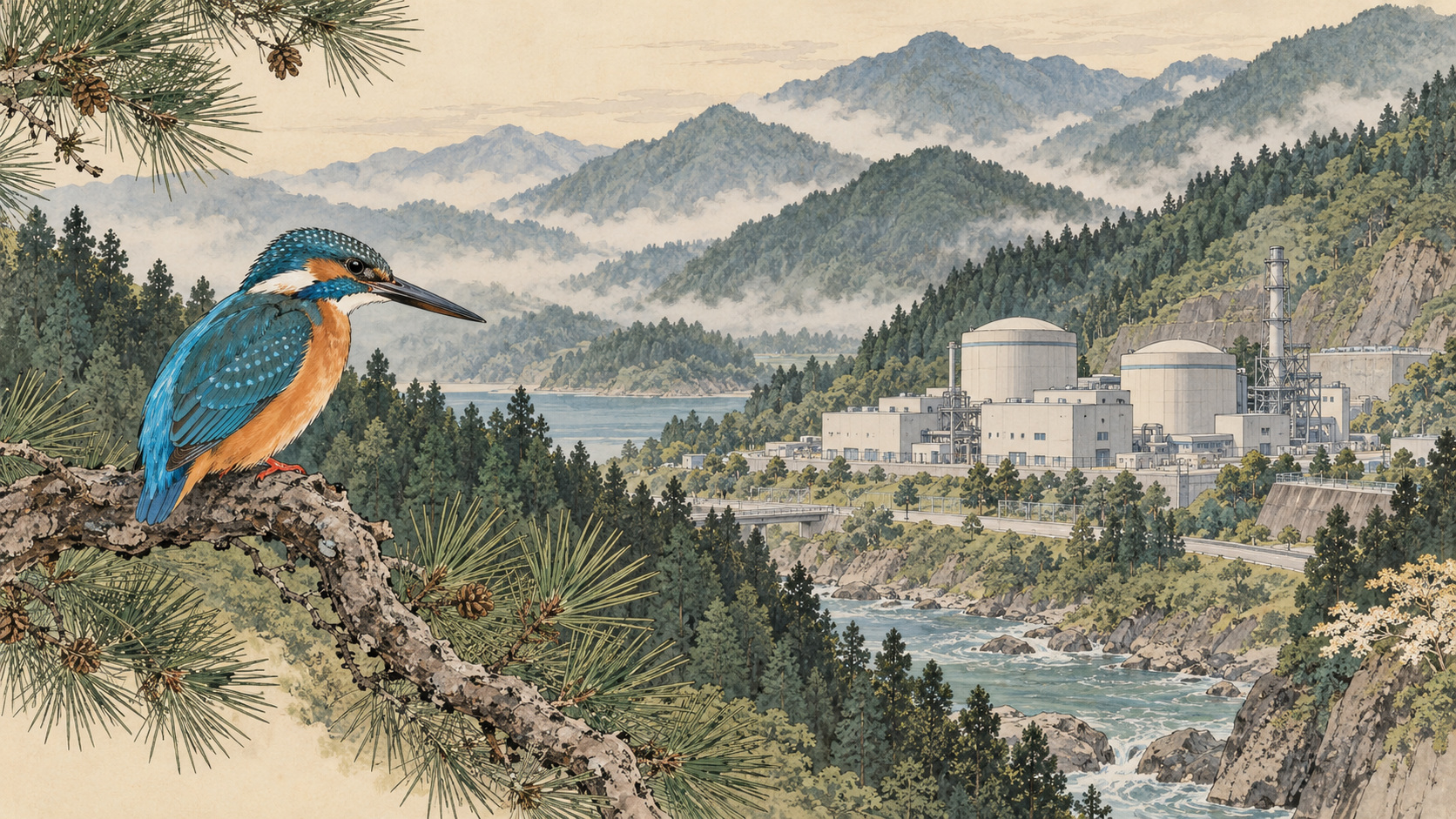
A small reactor, a very large national question
Japan's next electricity challenge is no longer just about replacing the power lost after Fukushima. Artificial intelligence, data centers, electrified industry and semiconductor factories are raising the stakes for reliable, low-carbon generation. That makes a report that Hitachi is exploring small modular reactors for its home market potentially important. It does not make a Japanese nuclear construction project a done deal.
Bloomberg reported on October 14 that Andreas Schierenbeck, chief executive of Hitachi Energy, spoke about potential SMR development in Japan at a New Delhi forum, pointing to costly electricity and an evolving public debate. The distinction is essential: no Japanese site, utility purchase agreement, construction licence, financing package or operating timetable accompanied that report. For investors and local communities alike, the first task is to separate a company executive's exploration of an opportunity from a formal investment decision.
What Hitachi can actually offer
The clearest technology in Hitachi's nuclear portfolio is the BWRX-300, developed through Hitachi's nuclear joint ventures with GE Vernova. It is a roughly 300-megawatt electric small light-water reactor descended from boiling-water reactor technology. Its promoters argue that simplifying systems, standardizing the design and relying on modular construction can make building reactors more predictable.
Hitachi GE Vernova Nuclear Energy describes a design intended to provide up to seven days of cooling without alternating-current power or operator intervention under specified conditions. That is a safety-design claim, not a universal guarantee. As with any nuclear plant, the complete safety case—including external hazards, accident management, spent fuel, emergency response and real operating performance—must be assessed by independent regulators.
SMR is a category, not a magic ingredient. It covers different designs, fuels and safety approaches. Smaller individual units can provide incremental capacity and may limit a single project's financial size, but the idea of making reactors cheaply in factories only works if the market reaches sufficient repetition. A one-off prototype can be expensive; dozens of standardized units might eventually be different. That proposition has yet to be demonstrated at a mature commercial fleet scale for this particular design.
Ontario is the reality check
At Darlington, east of Toronto, Ontario Power Generation has gone much further than a memorandum of understanding. Canada's nuclear regulator issued a licence to construct one BWRX-300 in April 2025. The Ontario government approved the start of construction in May. OPG plans a four-unit development, but permits and progress for the first unit should not be presented as evidence that four reactors are operating or independently licensed for the same milestones.
OPG has targeted grid connection for its initial unit by the end of 2030. A construction licence is not an operating licence, and OPG filed a separate operating-licence application in 2026. That chronology matters for Japan: construction timelines, first-of-a-kind engineering issues, contracting risks, and the performance of completed systems are all measurable questions, not simply promises in a presentation.
Why Japan's nuclear conversation is different
Japan developed a powerful domestic nuclear equipment and construction industry as it sought stable electricity during its postwar industrial expansion. The 2011 earthquake, tsunami and Fukushima Daiichi disaster transformed that trajectory. Loss of confidence, plant shutdowns, regulatory reform and the unresolved experience of affected communities reshaped the country's relationship with nuclear energy.
Debates that appear purely technical overseas therefore have different weight in Japan. A plant must fit the seismic and tsunami risks of its location, withstand scrutiny of emergency plans and severe accidents, and address who pays for long-lived liabilities. Communities have a stake in more than the nominal output or carbon intensity of a proposed reactor. Fukushima is not an objection to be waved away with a smaller reactor diagram; it is a continuing test of governance, engineering and public trust.
The policy opening—and its limits
Japan's Seventh Strategic Energy Plan, approved in February 2025, calls for making use of both renewable energy and nuclear power while securing sufficient low-carbon electricity. Government documents explicitly connect nuclear generation to prospective demand from data centers and semiconductor facilities. They also set conditions for moving toward advanced reactors.
The policy's concrete replacement pathway focuses on sites operated by utilities with reactors already selected for decommissioning, conditional on benefits to regional employment and industry and on local understanding. Progress on the fuel cycle, waste and other back-end issues also figures in the framework. The government has not issued blanket permission to scatter compact nuclear power stations around industrial parks. Any Japanese SMR proposal would still face site-specific licensing, funding decisions and public engagement.
Will small mean inexpensive?
The strongest financial case for SMRs is to exchange some of the scale of a giant reactor for repeatable manufactured components, more manageable project phases and potentially shorter construction schedules. But reducing a reactor's size also loses economies of scale. The cost per megawatt-hour depends on the cost of capital, licensing, construction overruns, staff, utilization, fuel, waste management and decommissioning—not just the dimensions of its reactor vessel.
The comparison with wind, solar, storage, hydropower, gas and grid reinforcement must be made on a consistent system basis. Hourly reliability, fuel-price risk, network costs and construction lead times all count. Nuclear proponents are right to emphasize firm low-carbon capacity; critics are right to demand independently demonstrated economics and clarity about liabilities. Neither proposition can be resolved by assuming that “modular” means “cheap.”
Two Hitachi businesses, different roles
The October comments were attributed to the chief executive of Hitachi Energy, a major grid and power-infrastructure business. Reactor technology sits with Hitachi's nuclear operations and GE Vernova partnerships. That organizational distinction may be easily missed in headlines using only the Hitachi name. Which company would develop, own, build or supply any Japanese SMR has not been publicly resolved by the interview.
At the same time, the grid business is hardly irrelevant. A new reactor needs transformers, transmission capacity and a reliable connection to customers. New electricity demand is concentrated in specific places, and the ability to deliver power to a semiconductor plant or computing hub matters as much as nationwide generation totals. A nuclear strategy without a grid strategy would be incomplete.
Markets abroad are moving first
In March 2026, Hitachi and GE Vernova announced a memorandum of understanding to explore BWRX-300 opportunities in Southeast Asia. In September they joined a framework for exploring wider European deployment. In the United States, the Tennessee Valley Authority has taken steps toward permission for a prospective reactor at Clinch River. These are meaningful indicators of an emerging supply chain and customer base—but an MoU is not a final investment decision and an application is not a construction licence.
For Japanese manufacturers, overseas orders may arrive before a domestic Japanese plant is authorized. Precision components, quality assurance, engineering services and nuclear-grade manufacturing could become export opportunities. Yet participating in international projects also requires long-term skills, certification, political coordination and clear rules for nuclear technology transfer.
Six questions before the first shovel
Before treating a Japanese SMR as an investable project, readers should ask six questions. Which reactor design and legal entity are proposed? Which utility and community would host it? What regulator-approved safety case is envisaged? Who pays—and absorbs construction risk? What is the credible plan for spent fuel and eventual dismantling? And how does the promised electricity price and delivery year compare with alternatives?
Hitachi's reported interest is news because Japan is searching for an answer to a real industrial and energy dilemma. It is not yet evidence that the country has chosen the site, buyer, or economics of its next small reactor. The experiment under construction in Canada, and the political and regulatory process inside Japan, will reveal whether SMRs can become more than a compelling engineering idea.
Sources and documents
- Bloomberg via The Japan Times, October 14, 2026
- Hitachi: BWRX-300 product and project information
- Hitachi and GE Vernova: Southeast Asia MoU, March 2026
- Hitachi: Europe SMR cooperation, September 2026
- METI: Seventh Strategic Energy Plan, February 2025
- METI: Policy text on advanced reactors and replacement sites
- Ontario Power Generation: Darlington new nuclear project