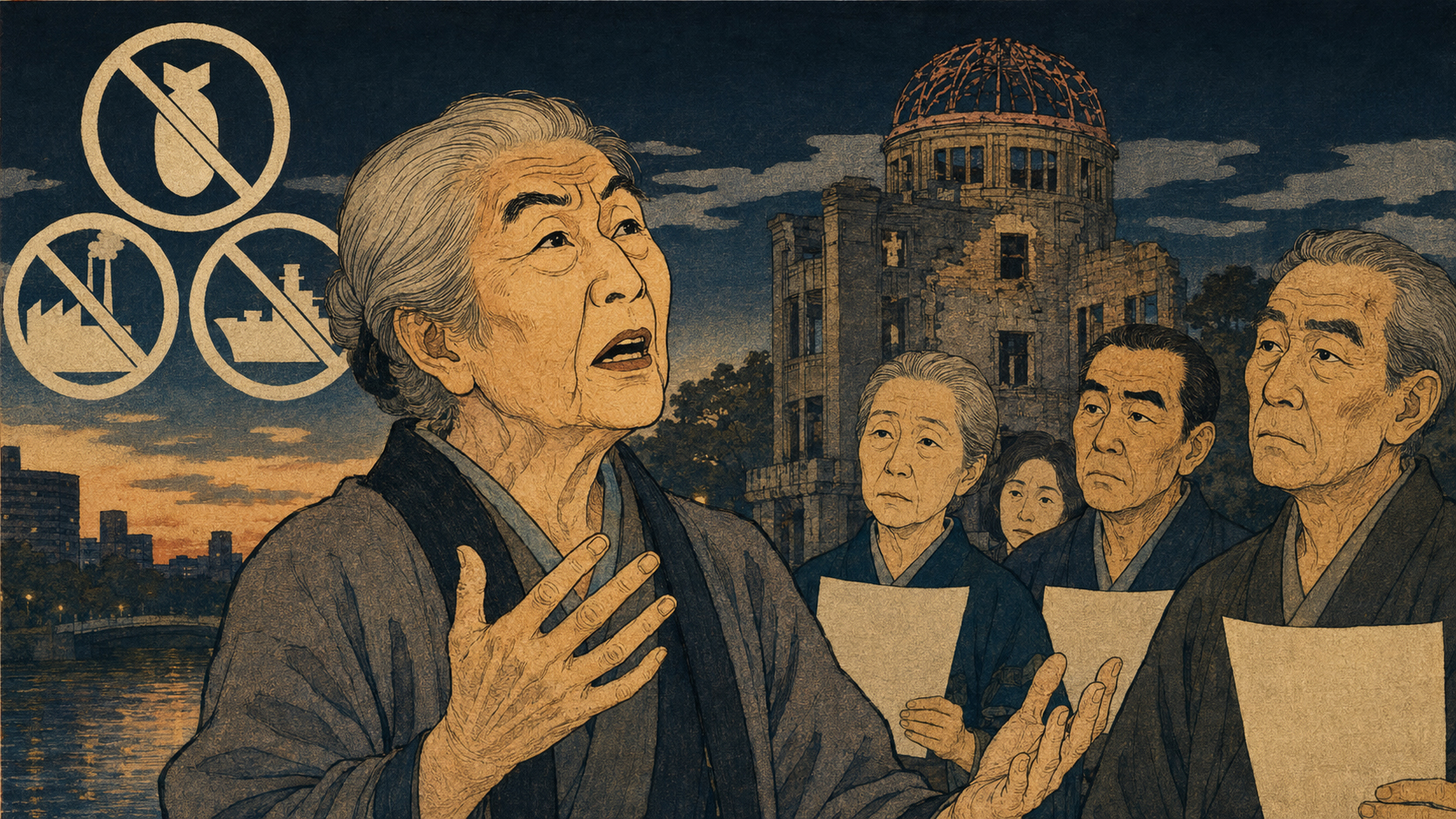
In Hiroshima on July 22, campaigners sought signatures calling on the Japanese government to join the Treaty on the Prohibition of Nuclear Weapons. There, Satoshi Tanaka, 82, secretary-general of a Hiroshima liaison council of atomic-bomb survivor groups and a representative director of Nihon Hidankyo, turned to words spoken several days earlier by Defense Minister Shinjiro Koizumi.
In an online program released July 17, Koizumi said nuclear policy was difficult for Japan to discuss but could no longer be avoided. Given the changing security environment, he argued, Japan had to debate every policy “without taboos.” At NATO headquarters in Brussels on July 22, he repeated the position, pointing to France’s changing nuclear posture and Europe’s response to Russian aggression as evidence that countries could no longer build security alone.
Tanaka called the statement unforgivable. A cabinet minister was opening discussion around principles successive governments had treated as national policy, he said, and the distance between survivors and the government had become unprecedented. On July 23, Chief Cabinet Secretary Minoru Kihara answered that the government still upheld the Three Non-Nuclear Principles as policy. Yet when asked whether the principles would be revised in the security-strategy documents due at year’s end, he declined to prejudge the outcome. Reassurance and reservation occupied the same briefing.
What the defense minister said—and did not say
Precision matters. Koizumi did not announce that Japan would acquire nuclear weapons. He did not approve nuclear sharing, and he did not expressly renounce the Three Non-Nuclear Principles. His immediate context was the planned revision of the National Security Strategy, National Defense Strategy and Defense Buildup Program. His position was that options involving nuclear policy should not be excluded before discussion begins.
But a cabinet minister’s language is not a private thought experiment. In late 2025, a senior official working on security policy at the prime minister’s office reportedly said Japan should possess nuclear weapons, prompting sharp criticism. Before becoming prime minister, Sanae Takaichi had questioned whether the third principle—not permitting introduction—could weaken the effectiveness of the American nuclear umbrella. Voices within the Japan Innovation Party, the Liberal Democratic Party’s coalition partner, have called for that third principle to be reconsidered. Koizumi’s remark belongs to a political continuum, not an empty room.
Survivor groups are therefore responding not because warheads will arrive tomorrow, but because policy change often begins by moving the boundary of acceptable language. An option is first made discussable, then described as realistic, then converted into an exception. Hiroshima’s city assembly had already warned of that sequence on January 9, sending the Diet and the government a formal request to preserve all three principles as the administration prepared to revise its security documents.
One “taboo,” two opposite meanings
The word at the center of the dispute is doing two different jobs. Koizumi is challenging a taboo on discussion: the idea that excluding a security option before analysis can become a form of strategic paralysis.
Survivors are defending the taboo on use. When the Norwegian Nobel Committee awarded Nihon Hidankyo the 2024 Peace Prize, it honored the survivors’ witness for helping establish the norm that nuclear weapons must never be used again. In the Nobel lecture, Terumi Tanaka said the organization’s movement had played a major part in creating that nuclear taboo.
Opening discussion is not the same as justifying use. Yet the two cannot be separated completely when the policy under discussion is deterrence. Deterrence works only if an adversary believes that nuclear weapons might be used under extreme conditions. A promise never to use them weakens the threat; a vivid display of willingness can erode the norm survivors spent eight decades building. This structure—not sentiment alone—explains Hiroshima’s alarm.
What remained after 8:15
At 8:15 on the morning of August 6, 1945, the uranium bomb Little Boy, dropped by the American B-29 Enola Gay, detonated above central Hiroshima. Blast crushed buildings, thermal radiation burned people and city, and ionizing radiation injured survivors from within. Hiroshima estimates that about 350,000 people were in the city and roughly 140,000 had died by the end of 1945. The exact toll remains unknowable.
Death did not end on August 6. Acute radiation illness was followed by elevated leukemia and cancer risks. Keloids, chronic disease and the memory of loss extended across lifetimes. Survivors encountered discrimination in employment and marriage, including unfounded fears about heredity. Koreans, Taiwanese and others from Japan’s former empire, mobilized workers, soldiers, students and American prisoners of war were also in the city. Confining the story to Japanese victims alone would erase part of what happened.
Occupation censorship sharply restricted reporting on atomic-bomb damage, while meaningful state support came slowly. The 1957 Atomic Bomb Survivors’ Medical Care Law established certificates, examinations and treatment for recognized illnesses. A 1968 law added allowances and other special measures. The two laws were not unified into the Atomic Bomb Survivors’ Assistance Act until December 1994. Relief expanded because survivors organized, but it did not simply become the state compensation Nihon Hidankyo had demanded for war damage.
A national movement born from Bikini’s fallout
The event that transformed anti-nuclear concern into a mass Japanese movement came nine years after Hiroshima, far out in the Pacific. On March 1, 1954, the Japanese fishing vessel Daigo Fukuryu Maru was exposed to radioactive fallout from the United States’ Castle Bravo hydrogen-bomb test near Bikini Atoll. All 23 crew members developed acute radiation illness. Radio operator Aikichi Kuboyama died that September. Anxiety about contaminated tuna brought nuclear danger to dinner tables, and a petition against atomic and hydrogen bombs gathered more than 30 million signatures.
The first World Conference Against Atomic and Hydrogen Bombs met in Hiroshima in 1955. Survivors who gathered at the second conference in Nagasaki founded Nihon Hidankyo on August 10, 1956. Its two core demands remained constant: the abolition of nuclear weapons and state compensation for atomic-bomb damage. Survivors turned wounds that had been treated as private misfortune into political testimony delivered at the United Nations, schools, churches, labor meetings and civic halls.
Their testimony returned a human body to the abstractions of military strategy—“one weapon,” “retaliatory capacity,” “acceptable damage.” No single explanation can prove why nuclear weapons have not been used in war since 1945. Deterrence, chance, restraint, diplomacy, arms control and social movements all played roles. But the survivors’ contribution to making use morally and politically unacceptable is a historical achievement recognized by the Nobel Committee.
How the Three Non-Nuclear Principles became national policy
The principles are not clauses of Japan’s Constitution. Prime Minister Eisaku Sato stated them before a House of Representatives Budget Committee on December 11, 1967: Japan would not possess nuclear weapons, would not produce them and would not permit their introduction. As Okinawa’s reversion approached, the House adopted a November 24, 1971 resolution urging the government to observe the principles and verify that Okinawa was free of nuclear weapons. A 1976 committee resolution associated with ratifying the Nuclear Non-Proliferation Treaty described the principles as established national policy.
Japan had already limited nuclear activity to peaceful purposes in the 1955 Atomic Energy Basic Act. It signed the NPT in 1970 and ratified it as a non-nuclear-weapon state in 1976. Domestic law, international obligation and political principle thus overlap in preventing an independent arsenal.
There is a legal wrinkle. As a matter of abstract constitutional interpretation, successive governments have maintained that Article 9 would not necessarily prohibit a hypothetical nuclear weapon that remained within the minimum force required for self-defense. But the same government position says that the Three Non-Nuclear Principles, the Atomic Energy Basic Act and Japan’s NPT obligations mean Japan cannot possess nuclear weapons. The principles are neither a casual slogan that can be discarded without consequence nor immutable constitutional text. They draw force from political commitment, Diet resolutions, international law and public memory.
Rejecting nuclear weapons while being protected by them
Japan’s postwar nuclear policy cannot be understood through the three principles alone. On the other side stands the 1960 U.S.-Japan Security Treaty and American extended deterrence—the nuclear umbrella. Japan forgoes an arsenal while seeking to persuade potential attackers that the United States could answer aggression with its full range of capabilities, including nuclear weapons. A country advocating abolition depends for its safety on an ally’s possible nuclear use. This was not a late exception to the system. It was central to its design.
The contradiction sharpened around “not permitting introduction.” During the Cold War, the United States generally refused to confirm or deny whether its ships carried nuclear weapons. A Foreign Ministry inquiry released in 2010 found that Washington and Tokyo had interpreted the rules around nuclear-armed vessel visits differently and had tacitly agreed not to force the issue into the open. It was not an explicit secret treaty in the narrow sense, the expert panel concluded, but it amounted to a secret understanding in a broader sense.
Okinawa’s return cast another shadow. Sato and President Richard Nixon publicly pursued reversion “without nuclear weapons” under conditions comparable to the mainland, while a private channel produced a document addressing the possible reintroduction of nuclear weapons in an emergency. The 2010 inquiry concluded that this document did not bind later cabinets and did not qualify as a secret agreement. Even so, the history shows a public non-nuclear principle coexisting with alliance ambiguity.
Why the argument is intensifying in 2026
The government’s account of a deteriorating security environment is grounded in real developments. SIPRI estimates that nine nuclear-armed states possessed 12,187 warheads in January 2026. About 9,745 were in military stockpiles and approximately 4,012 were deployed with missiles or aircraft. All nine states continued modernization during 2025. The post–Cold War decline in nuclear reliance is weakening as these weapons regain prominence as instruments of national power.
Japan faces China’s rapid and opaque nuclear expansion, North Korea’s advancing nuclear and missile programs, and a Russia that has used nuclear threats during its invasion of Ukraine. The classic extended-deterrence question is whether Washington would risk nuclear retaliation against the American homeland to defend an ally in a Taiwan Strait or Korean Peninsula crisis. European governments, responding to Russian aggression and anxiety about American commitment, are also reconsidering how nuclear forces fit their security.
Japan and the United States have held an Extended Deterrence Dialogue since 2010. They issued guidelines in late 2024 to reinforce consultation and communication. At a June 8–9, 2026 dialogue in Tokyo, the United States reaffirmed that it would defend Japan using its full range of capabilities, including nuclear. Officials discussed nuclear posture, missile defense, crisis coordination, arms control and risk reduction, and conducted a tabletop exercise.
Japan, then, is not a country that has refused to talk about nuclear weapons. Its governments have discussed them in detail with Washington for years. Koizumi’s remark raises a different issue: whether discussions that have occurred inside government and alliance channels will be presented to the public, and which choices will become open political decisions. If “no taboos” means transparency, the benefits of deterrence must be shown alongside its costs, accident risks, escalation pathways, command problems, targeting consequences and diplomatic damage.
Separating five policies too often called one “nuclear debate”
| Option | What it means in practice | Central questions |
|---|---|---|
| Status quo | Retain all three principles while combining the U.S. umbrella with Japanese conventional forces and missile defense. | The principles remain intact, but Japan has limited influence over American nuclear decisions and continued concern about credibility. |
| Deeper consultation | Strengthen crisis planning, exercises, decision-making communication and strategic messaging without basing nuclear weapons. | This extends the current dialogue. At what point does consultation become participation in use planning? |
| Exception to or revision of “not permitting introduction” | Allow some nuclear-armed ship or aircraft visits, transit, temporary deployments or emergency introduction. | A substantive change to the third principle, with questions about prior consultation, local safety, targeting and public consent. |
| NATO-style nuclear sharing | Forward-deploy U.S.-controlled bombs in allied territory while the host provides delivery capability, training and consultation. | This is not joint ownership. It raises issues under the principles, the NPT, base agreements, peacetime custody and wartime control. |
| Independent arsenal | Build Japanese warheads, delivery systems, command and control, warning, protection and testing infrastructure. | NPT withdrawal, domestic legal change, major cost, regional arms racing, pre-emption risk, diplomatic isolation and possible sanctions. |
Collapsing these choices into “nuclear sharing” or “nuclear discussion” makes greater consultation appear equivalent to domestic deployment or independent armament. They are not. After Russia invaded Ukraine in 2022, former Prime Minister Shinzo Abe urged discussion of NATO-style sharing. The Kishida government said an arrangement placing American weapons on Japanese territory for possible delivery by Japanese aircraft was incompatible with the Three Non-Nuclear Principles. Prime Minister Shigeru Ishiba later emphasized communication about American nuclear decision-making and sharing risk, not ownership or deployment. Similar vocabulary can conceal enormous policy distance.
What deterrence promises—and what it cannot prove
Deterrence seeks to alter an adversary’s calculation. It combines the ability to deny an attacker its goal with the possibility of imposing intolerable costs, making peace the rational choice. Supporters argue that a policy ignoring American extended deterrence is unrealistic for a Japan surrounded by nuclear powers. Moral authority cannot intercept a ballistic missile, and the Three Non-Nuclear Principles alone cannot stop an invasion.
The theory’s weakness is that success is measured by a war that did not occur. It is impossible to isolate whether nuclear threats, conventional forces, diplomacy, economic ties, geography or leadership judgment prevented attack. Deterrence assumes rational interpretation, reliable communication and controlled organizations. Real crises contain false alarms, cyberattacks, misperception, time pressure, accidents and domestic political incentives.
Extended deterrence adds two fears. An ally worries that the United States may abandon it, but also that American confrontation may entrap it. Bringing nuclear operations closer to Japan might demonstrate commitment. It could also increase Japan’s value as a target and create pressure for an adversary to disable those forces early in a crisis. Deterrence is described as insurance, yet some forms of the insurance can intensify the danger being insured against.
The hibakusha argument is not simply that wishing for peace will make Japan safe. It is a risk argument: if more states treat nuclear weapons as ordinary instruments of security, proliferation grows, interactions become more complex, and the probability of use somewhere rises. The world does not require all 12,187 warheads to fail at once. One detonation over a city would turn strategic abstractions back into mass burns, fire, radiation, collapsed medicine and impossible evacuation.
The missing bridge to the nuclear-ban treaty
Adopted in 2017 and in force since 2021, the TPNW prohibits developing, possessing, transferring, using and threatening to use nuclear weapons. It also addresses victim assistance and environmental remediation. It is the treaty most closely aligned with the humanitarian consequences survivors have spent their lives describing. Japan has neither signed nor ratified it, and it declined to observe the meetings of states parties in 2022, 2023 and 2025.
The government argues that a treaty without nuclear-armed states cannot directly produce disarmament, and that attending while defending a deterrence policy fundamentally opposed to the treaty could blur Japan’s diplomatic position. Instead, Tokyo calls the NPT—the framework including both nuclear and non-nuclear states—the foundation of a realistic and practical path. The Kishida government also established an International Group of Eminent Persons to bridge divisions.
Hiroshima argues that the two forums need not be mutually exclusive. On June 26, its city assembly unanimously asked Japan to attend the first TPNW Review Conference, scheduled for November 30 to December 4 in New York, as an observer. Observation is not ratification. Japan could explain its security concerns, hear the concerns of treaty members and add the evidence of Hiroshima and Nagasaki. If Tokyo claims to be a bridge, entering the rooms on both banks is a minimum test of the metaphor.
Before the witnesses are gone
At the end of March 2026, Japan had 91,105 holders of Atomic Bomb Survivor Certificates, with an average age of 86.66, according to the Health Ministry. The total, which exceeded 370,000 in the early 1980s, is falling rapidly. Nihon Hidankyo has said it will vote in June 2027 on whether to continue or dissolve the national organization. Only a few years after its Nobel Prize, the movement faces a succession cliff.
Testimony does not confer a veto over defense policy. Hibakusha do not all hold identical views on war responsibility, the alliance, nuclear energy or treaty strategy. Turning elderly survivors into sacred symbols beyond disagreement can itself deny their political agency.
Yet their testimony contains expertise that cannot be reduced to one opinion among many. It is embodied knowledge of how blast, thermal radiation, ionizing radiation, medical collapse, family annihilation and lifelong discrimination can proceed from one weapon. Defense officials know missile range; diplomats know alliance signals; survivors know the day after use. Responsible policy needs all three forms of knowledge at the same table.
Conditions for an honest “no-taboo” debate
- Threat: Which capability and scenario cannot be managed by the present posture?
- Purpose: Is the proposal for greater consultation, temporary introduction, domestic basing, nuclear sharing or an independent arsenal?
- Effect: By what mechanism would it reduce an adversary’s willingness to attack, and how might it increase Japan’s target value or crisis instability?
- Control: Who holds final use authority, and who manages accident, false warning, cyber intrusion, base protection and civilian evacuation?
- Law: How would it comply with the principles, Diet resolutions, the Atomic Energy Basic Act, the NPT and base arrangements?
- Diplomacy: What arms-race and nonproliferation effects would it have on Korea, China, Russia, Pacific states and ASEAN?
- Alternatives: Can conventional forces, air defense, civil protection, crisis communication, arms control or confidence building achieve the same goal?
- Democracy: What Diet scrutiny, disclosure, independent review and participation by Hiroshima, Nagasaki and base communities will be guaranteed?
The claim that democracy should not prohibit a conclusion at the start of debate is understandable. But “without taboos” does not remove policy gravity. Once nuclear options are built into bases, training, warning posture and alliance planning, they are difficult to reverse. Adversaries alter their own plans in response, so Japan cannot control reversibility by itself.
Nor is repeating the Three Non-Nuclear Principles an adequate security plan. Their defenders must explain how Japan will be protected amid neighboring arsenals, how dependence on the American umbrella can be reduced, and what costs should be paid for conventional defense and diplomacy. Morality cannot be a substitute for security, and security cannot be an exemption from morality. That is the minimum standard of an honest debate.
Hiroshima is defending more than silence
The preservation of the Atomic Bomb Dome, survivor testimony, relief laws, the Three Non-Nuclear Principles, the NPT and the nuclear-ban treaty do not form a straight line of victory. Relief arrived late. Ambiguity lived behind principle. Disarmament stalled. Japan still relies on the nuclear umbrella. Yet because survivors continued to speak, any leader contemplating use can no longer say the consequences were unknown.
If Koizumi’s “no-taboo” debate brings the credibility of the alliance, regional threats and Europe’s changing posture into a candid public accounting, it can have value. If the phrase instead treats the principles as outdated emotion and moves nuclear deployment toward the category of normal policy, survivor organizations are right to sound an alarm.
Hiroshima is not demanding that Japan stop talking about nuclear weapons. For 81 years, Hiroshima has talked about them more persistently than anyone. It is demanding that the conversation not stop before the explosion—that beyond launchers, alliance doctrine and deterrence theory, Japan place the city at 8:15 and the human lives that followed.
Whether the government preserves the principles or changes their operation, it must name the choice, objective, cost and danger. If Japan is to remove taboos, the first habit to remove is the habit of hiding what nuclear weapons do behind abstraction. The line Tanaka and other survivors defend is not an escape from debate. It is a boundary meant to keep the debate from escaping reality.
Sources and references
This article distinguishes discussion of nuclear policy from a decision to acquire nuclear weapons. The legal standing of the principles, NATO-style sharing, extended deterrence and global warhead totals are identified through primary records or clearly labeled estimates.
- Kyodo / Nikkan Sports: Koizumi on debating nuclear policy “without taboos”
- Jiji Press / nippon.com: Koizumi after his NATO visit
- Kyodo / Ryukyu Shimpo: Nihon Hidankyo’s Satoshi Tanaka responds
- Jiji Press / nippon.com: Cabinet response on the principles and security documents
- Reuters: Security official’s nuclear-arms remark and Japan’s non-nuclear pledge
- City of Hiroshima: Estimated deaths from the atomic bombing
- Nobel Prize: Nihon Hidankyo Nobel lecture by Terumi Tanaka
- Health Ministry: Survivor certificate holders and average age, March 2026
- Health Ministry: History of atomic-bomb survivor relief
- Foreign Ministry: Three Non-Nuclear Principles and Sato’s 1967 statement
- Foreign Ministry: Diet resolutions concerning the principles
- House of Councillors: 2016 government reply on nuclear weapons and Article 9
- Foreign Ministry: Findings of the 2010 inquiry into secret understandings
- Foreign Ministry: June 2026 Japan-U.S. Extended Deterrence Dialogue
- SIPRI Yearbook 2026: Global nuclear-force estimates
- Foreign Ministry: Japan’s reason for not observing the 2025 TPNW meeting
- Hiroshima City Assembly: Resolutions on the principles and TPNW Review Conference
- UN Office for Disarmament Affairs: 2026 TPNW Review Conference
- Prime Minister’s Office: 2025 remarks on extended deterrence, sharing and the principles