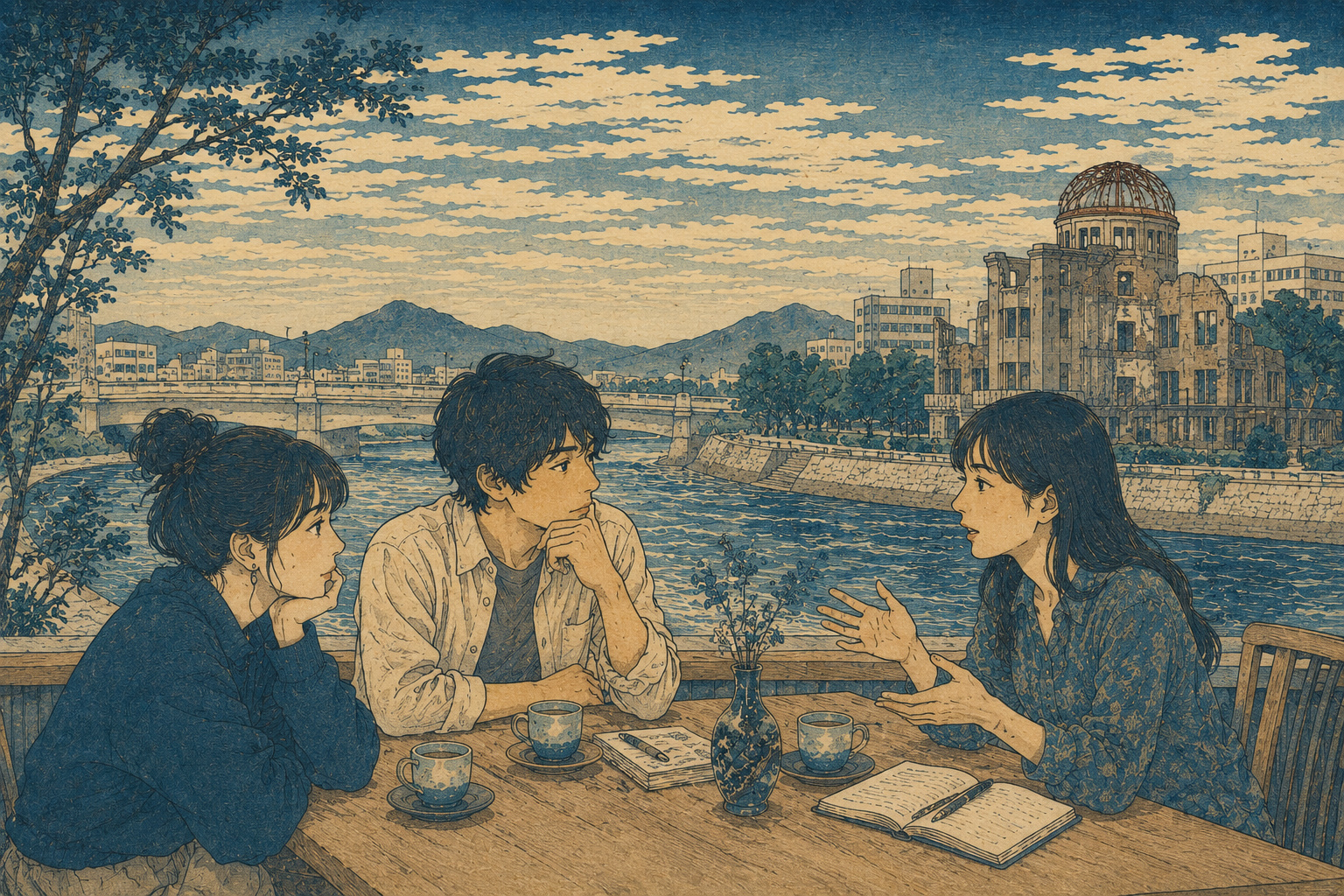
There will be no speed-dating cards, no public profiles and, if Hiroshima Prefecture’s plan works as designed, no identifiable faces. On the evening of September 5, six unmarried residents in their twenties and thirties are scheduled to complete a three-session workshop by talking about a problem that conventional matchmaking rarely captures: a person can want marriage and still not want to pursue it now.
The participants are expected to use nicknames. Recruitment materials said they would wear masks or other face coverings to protect anonymity and psychological safety. The final meeting, at Hiroshima City Central Library near Hiroshima Station, is meant to revisit what they learned from two earlier sessions—first from one another, then from a married couple—and turn that material into a personal understanding rather than a prescribed answer.
The prefecture calls the project the Hiroshima Marriage “Honne” Meeting. Honne is the private feeling that may sit behind a socially acceptable response. The policy significance is not that six people are discussing marriage. It is that a government with a decade of matchmaking history is trying, at least in this small program, to listen before it directs.
The gap between wanting and doing
Hiroshima’s starting point is a survey conducted from June to September 2025. The prefecture collected web responses from 1,000 unmarried residents aged 20 to 39 and followed with individual interviews involving ten people. The survey data were weighted to align the age and sex distribution of respondents with the prefecture’s unmarried population.
The broad result appears encouraging for a marriage-support program: 70.7% said they wanted to marry or would do so if possible, while 12.1% said they would rather not or did not want to marry. But the headline percentage hides a steep sequence of smaller groups.
| Question | Denominator | Result | What it does—and does not—show |
|---|---|---|---|
| Do you want to marry? | All 1,000 respondents | 70.7% expressed an intention | A stated preference in a 2025 survey, not a forecast of marriages. |
| Do you currently have a partner? | 707 respondents with marriage intention | 58.8%, or 416 people, did not | The absence of a current partner is a different issue from the absence of intention. |
| Are you taking action to find someone? | 416 intending respondents without a partner | 73.8%, or 307 people, were doing little or nothing | The percentage does not apply to all unmarried residents or even to everyone who wants marriage. |
| Can your hope be realized? | 307 intending, unpartnered, inactive respondents | 28.3% answered positively | A subjective expectation under present circumstances, not an objective probability. |
That narrowing is the reason a listening project can matter. A policy built only around the first number treats intention as latent demand for an event. A policy that follows the funnel asks why demand does not become participation, and whether participation is even the appropriate next step for each person.
“Inactive” is not one kind of person
Among the 307 respondents who wanted marriage, had no partner and were not actively looking, the largest single reason was that they had other priorities, at 21.6%. The rest of the distribution did not yield one dominant obstacle: 12.0% said searching was troublesome, 11.9% preferred a natural encounter, 11.4% did not know a good method, 10.6% lacked confidence in their appearance, 8.0% lacked confidence in their personality and 6.6% lacked confidence in their income.
Those answers imply different policy responses—and sometimes no intervention at all. Someone prioritizing work, study, recovery or a personal project is not necessarily suffering from an information deficit. Someone who dislikes apps or agencies may need alternatives, but also needs the freedom to reject those channels. Social anxiety may require a safe form of consultation. Lack of time, income or housing security points beyond marriage promotion to labor and economic policy.
The survey’s question about triggers reinforces the distinction. Among all respondents with marriage intention, reaching a certain age and having more free time were the leading answers. Among the inactive group without a partner, gaining self-confidence ranked first, at 25.1%. The same message—“take the first step”—can therefore feel useful to one person and accusatory to another.
The ten interviews put human language around the categories. Respondents described workplaces that produced few new contacts, uncertainty about how romantic relationships begin, fear of entering social venues alone, concern about the cost of marriage and child-rearing, and the negative marriage narratives amplified online. Those accounts are illustrative, not statistically representative. Their value is depth, not prevalence.
Hiroshima once built a matchmaking machine
The prefecture has not arrived at this question from scratch. In fiscal 2014 it opened the Hiroshima Encounter Support Center to help people who wanted marriage find opportunities and act sooner. By March 2015, the center reported 1,364 registered members. In June 2015, Hiroshima launched the deliberately interventionist Minna de Osekkai “Koinowa” Project—roughly, a community effort to give well-meaning nudges.
The model expanded beyond prefecture-run events. Restaurants hosted small Koinowa Café gatherings with volunteers. Private supporter groups and municipalities organized events. Center registrations rose from 4,716 in fiscal 2015 to 15,159 in fiscal 2019. By the end of that period, the prefecture reported 709 cumulative marriages among members.
Then Hiroshima audited itself.
A November 2020 restructuring paper said the reported member marriages represented only about 1% to 2% of all marriages in the prefecture and that the program’s target for increasing the partnered share of 25-to-39-year-olds was not expected to be met. The paper concluded that obstacles other than a lack of encounters were complex and significant. Hiroshima stopped directly organizing large events and broad promotional campaigns, shifted the support center toward outside operation, continued volunteer development and said public resources should move toward other barriers.
The 709 figure should not be read as a causal estimate. It counted reported marriages involving support-center members; it did not compare them with a similar group that received no support. The importance of the 2020 review lies elsewhere: Hiroshima acknowledged that registrations and marriage reports were not enough to establish population-level impact.
Fiscal 2014: Hiroshima Encounter Support Center opens; 1,364 registrations are reported by March 2015.
June 2015: The community-based Koinowa initiative begins.
Fiscal 2015–2019: Registrations rise from 4,716 to 15,159; 709 cumulative member marriages are reported.
November 2020: The prefecture restructures the policy and retreats from directly staging large events.
June–September 2025: Hiroshima surveys 1,000 unmarried residents and interviews ten.
August–September 2026: A three-session Honne workshop puts hesitation and reflection at the center.
A small room attached to a publicity system
The new workshop is intimate by design, but it is not private in purpose. Participants were told that their views may be used in prefectural publicity after identifying details are removed. They were also warned that media could attend the third session. Hiroshima’s September 1 press notice actively invited coverage while asking reporters not to identify participants.
That combination can work: public institutions need to explain what they learn, and anonymity can protect contributors. It also creates risk. In a small group, identity can be inferred from voice, occupation, neighborhood, family history or the unusual combination of details in a story even when a face is hidden. Public materials reviewed by Japan.co.jp do not set out the full process for recording, quotation approval, withdrawal or the handling of indirect identifiers.
There is also an editorial temptation. A communications campaign naturally favors a clean arc: hesitation, insight, action. A credible account of honne must preserve messier endings. A participant may feel less certain after the discussion. Another may conclude that marriage matters, but not now. Another may decide that the obstacle is work, money or unequal expectations rather than a lack of courage. Those outcomes are harder to advertise and more useful to policy.
What ¥4.5 million is supposed to buy
The prefecture’s request for proposals set a tax-inclusive budget of ¥4.5 million and a term running from contract execution through March 31, 2027. Four companies submitted proposals. Hiroshima announced on May 26 that Chugoku-Shikoku Hakuhodo Inc. had been selected as the prospective contractor, with the highest published score, 551 out of 750. The selection committee praised its execution plan, advertising strategy and use of a project staff member within the target age group, while recording concern about whether the proposed schedule could be maintained.
The procurement specification connects the listening room to a digital marketing funnel. Workshop material and survey findings are to feed social-media and web advertising, which sends users to a prefectural landing page and then toward Koinowa’s membership-registration page. At least ¥1.5 million was designated for ad distribution. The targets are 35,000 visits to the landing page and 350 “conversions.” But Hiroshima defines a conversion here as a click from the landing page to the registration-page URL—not a completed registration, a relationship, a marriage or a birth.
The fiscal 2026 implementation sheet separately describes four workshops a year with roughly ten participants each and lists the ¥4.5 million as contracted services. The prefecture’s grant disclosure assigns ¥3 million to this workshop-and-publicity project. The publicly announced Honne program, however, is a three-session sequence for the same small participant group, with six people expected at the final session. Public documents do not explain whether the three sessions count as three of the planned four workshops, as one workshop in three parts, or whether additional meetings are planned.
It would therefore be misleading to divide ¥4.5 million by six and call the result a participant cost. The project covers design, facilitation, participant payments, analysis, creative production and advertising. Hiroshima has disclosed the prospective contractor, but the executed contract price, proposal and detailed line-item allocation were not found in the public record reviewed by Japan.co.jp. The more useful test is whether the project produces knowledge—and policy change—that cannot be reduced to an advertising click.
Japan.co.jp analysis: a five-level test
- Safety: Could participants speak without pressure or fear of identification?
- Understanding: Did the project distinguish time, money, confidence, information, values and competing priorities?
- Choice: Were people who wanted action given options without treating non-action as failure?
- Policy: Did the findings reach employment, housing, care, household-work and economic measures—not just more events?
- Disclosure: Will Hiroshima publish the method, range of views, limits, costs and changes made afterward?
The project should not be judged in the short term by the prefecture’s marriage count or total fertility rate. Hiroshima’s plan lists 10,099 marriages and a total fertility rate of 1.29 as 2024 reference indicators. Those outcomes are shaped by population structure, wages, housing, work, care, health and private choice. There is no defensible line from one six-person discussion to a prefecture-wide fertility statistic.
Marriage itself is changing
National data help explain why an encounter-only model has weakened. Japan’s 2021 National Fertility Survey found that 81.4% of unmarried men and 84.3% of unmarried women aged 18 to 34 intended to marry eventually, both lower than in the previous survey. At the same time, roughly one-third of unmarried respondents did not want a romantic relationship.
Expectations inside marriage were moving as well. Combining employment and child-rearing became the most common ideal life course for women among both male and female respondents. The share of women who considered a prospective husband’s ability and attitude toward housework and childcare rose to 70.2%. The share of men considering a woman’s earning power rose to 48.2%. Among recent marriages, 13.6% of couples had met through internet services such as social media or matching apps.
These are national findings from a 2021 survey, not measurements of Hiroshima’s 2026 workshop participants. They still show why “more opportunities to meet” cannot carry the entire policy. A person may be evaluating whether a future partnership is compatible with work, money, care, identity and autonomy—not merely whether another single person is available.
Hiroshima’s own child-and-family plan records a never-married share at age 50 of 24.2% for men and 15.8% for women in the 2020 census, and average first-marriage ages of 30.3 for men and 29.0 for women in 2023. The plan itself describes nonmarriage as the product of intertwined economic insecurity, work-and-childcare concerns, household labor expectations, encounters and changing lifestyles.
The constitutional boundary around demographic policy
Marriage policy exists at an uncomfortable junction. Governments track marriages and births because population structure affects schools, labor markets, tax bases and care systems. Individuals do not owe government a marriage in return.
Article 24 of Japan’s postwar Constitution established marriage on the basis of the parties’ consent and required family law to rest on individual dignity and the essential equality of the sexes. More recently, the Children and Families Agency has stated that marriage, pregnancy, childbirth and child-rearing are matters of free individual decision, with diverse values respected, and that policy should support young people when they themselves want those outcomes.
Hiroshima repeats that boundary in its public materials. The project is not intended to suggest that marriage is necessary, condemn unmarried people or deny diversity; marrying or not marrying is a free personal decision.
That disclaimer becomes meaningful only through implementation. The fiscal plan speaks of spreading a positive image of marriage and changing awareness. The public workshop promises no correct answer. Those aims can coexist if “positive” means replacing distorted information with a fuller picture and widening choices. They conflict if success is defined as moving every hesitant person toward the same destination.
What Hiroshima should publish after September 5
The final 90 minutes will not determine whether the policy worked. The evidence will come afterward. Hiroshima should explain the facilitation method, how participants were selected, how privacy was protected, what range of views emerged, what changed across the three sessions and which findings will alter public programs.
It should also preserve the difference between depth and representation. Six volunteers who could attend three meetings and accepted a masked discussion format are not a miniature sample of every unmarried resident in the prefecture. Their accounts can reveal mechanisms that a 1,000-person survey misses; they cannot establish how common those mechanisms are. The quantitative survey and qualitative workshop answer different questions.
Most importantly, the prefecture should resist returning every obstacle to the individual. A lack of confidence may be personal. A lack of time can be a labor-market problem. Anxiety about income and child-rearing costs can be economic policy. Concern about unequal domestic work can be a workplace and gender-equality issue. Listening is useful only if government is prepared to hear criticism of the conditions it helps shape.
Hiroshima spent years building places where people could meet, then publicly acknowledged the limits of that strategy. The Honne Meeting could mark a more mature phase—not because a conversation is automatically transformative, but because it starts with uncertainty rather than treating uncertainty as a defect. The test is whether Hiroshima can keep that ambiguity intact when it turns six private voices into public policy.
Sources and documentation
- Hiroshima Prefecture, press notice for the Hiroshima Marriage “Honne” Meeting workshop (September 1, 2026; final-session time, venue, planned attendance, guests and media conditions)
- Hiroshima Prefecture, workshop recruitment page (three-session structure, audience, recruitment, anonymity, honorarium and publicity use)
- Hiroshima Prefecture, Hiroshima Marriage “Honne” Meeting page (survey-to-workshop design, connection to Koinowa and autonomy disclaimer)
- Hiroshima Prefecture, marriage-attitudes survey results page (October 20, 2025)
- Hiroshima Prefecture Child Future Support Division, marriage-attitudes survey report (method, 1,000 web respondents, ten interviews, intention, action, reasons and expected realization)
- Hiroshima Prefecture, fiscal 2026 Regional Revitalization Measures for Declining Birthrates implementation plan, project sheet 6 (project title, ¥4.5 million plan, four workshops, publicity and reference indicators)
- Hiroshima Prefecture, procurement-result page for the marriage-image communications project (May 26, 2026)
- Hiroshima Prefecture, public proposal result list (four bidders, scores and selection of Chugoku-Shikoku Hakuhodo Inc.)
- Hiroshima Prefecture, draft commissioned-services specification (advertising floor, 35,000-visit target, definition of 350 conversions and autonomy safeguards)
- Hiroshima Prefecture, request-for-proposals explanation (tax-inclusive ¥4.5 million budget and performance period)
- Hiroshima Prefecture, Regional Revitalization Measures for Declining Birthrates grant disclosure (fiscal 2026 awards)
- Hiroshima Prefecture, Restructuring of the Koinowa Encounter and Marriage Support Policy (November 30, 2020; registrations, participation, reported member marriages and policy review)
- Hiroshima Prefecture, fiscal 2014 review (opening of the encounter support center and March 2015 registration count)
- Hiroshima Prefecture, fiscal 2015 review (launch and development of the Koinowa project)
- Hiroshima Prefecture, Hiroshima Children’s Future Support Plan, Area II (marriage-support context, never-married shares, first-marriage ages and interlocking barriers)
- National Institute of Population and Social Security Research, 16th Japanese National Fertility Survey (2021 survey; marriage intention, relationships, household-role expectations and online encounters)
- Children and Families Agency, Working Group on Young People’s Life Design and Encounters (free choice and respect for diverse values)
- The Constitution of Japan, Article 24 (consent, individual dignity and equality)
- Official website of Naoki Nakashima and Etsuko Inoue (verification of Japanese readings and Romanized names)
The English edition was written independently from Japanese primary documents; it is not a translation of the Japanese article. Hiroshima’s web survey covered 1,000 unmarried residents aged 20–39 and used weighting for age and sex, but weighting does not eliminate limitations arising from web-panel recruitment, question design or self-report. The ten interviewees and the six planned workshop participants are not statistically representative of the prefecture. Percentages in the survey use different denominators; the article identifies each subgroup rather than applying 58.8%, 73.8% or 28.3% to the full sample. The September 5 session had not occurred by the reporting cutoff, and no outcome is inferred.
Image rights: © 2026 Japan.co.jp. This AI-assisted editorial illustration may not be reproduced or reused without permission. For licensing, use the contact page.