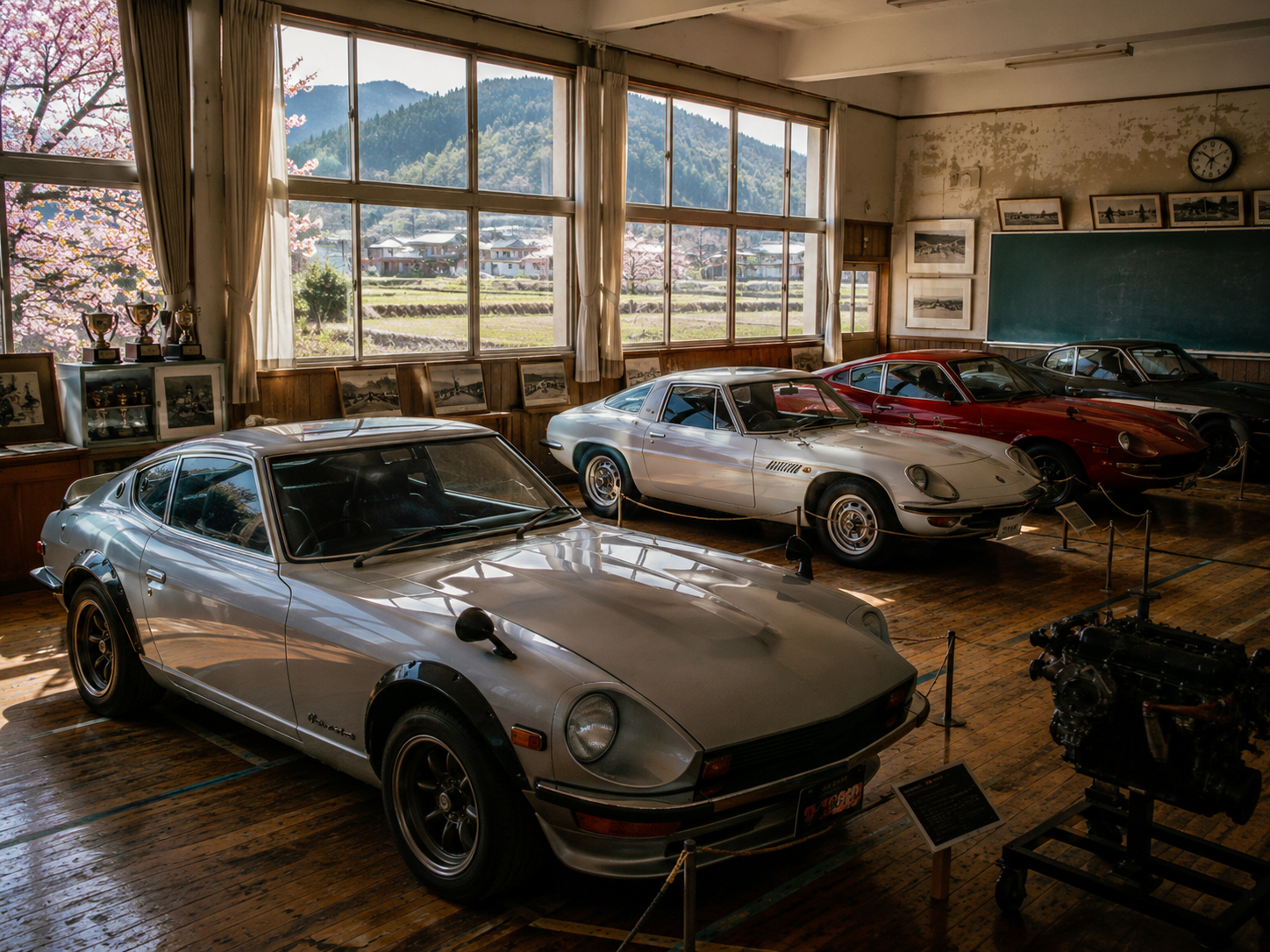
A plan is moving forward in Akitakata, Hiroshima Prefecture, to turn a closed school into a sports-car museum. According to reporting in Japan, the project is led by Yukiaki Sasaki, a former Mazda engineer. At first glance this might sound like a familiar rural-revitalization story: reuse an empty school, bring visitors, give a community a new landmark. But the subject is sports cars, and the place is Hiroshima. That changes the level of seriousness.
For serious collectors, a great car is not simply an old car. It is a documented object: chassis number, build date, trim, export or domestic specification, accident history, restoration choices, original paint, service records, tool kit, manuals, catalogues and ownership trail. A sports-car museum in Hiroshima will succeed not by looking attractive in photos, but by proving that it understands provenance and preservation.
Collectors do not only look at the display stand
Tourists look at beautiful cars. Collectors look at why the cars are there. They ask what is original, what has been replaced, who restored it, what records survive, whether the paint code is correct, whether the seats match the production year, and whether the car is preserved as a static exhibit or maintained as a running machine.
If the museum is serious, each car becomes a research object. The hood cannot stay closed forever. Suspension geometry, engine bay layout, interior materials, parts availability, catalogue differences and small trim changes are part of the story. Collector trust is built in details that casual visitors may never notice.
Hiroshima and Mazda memory
No serious sports-car story in Hiroshima can avoid Mazda. The company began in 1920 as Toyo Cork Kogyo, moved through postwar recovery and grew into one of Japan’s most distinctive automakers. Hiroshima’s factories, engineers, test departments, suppliers, body shops, paint specialists and mechanics built more than vehicles; they built an industrial culture.
Mazda’s official history identifies the 1967 Cosmo Sport as the world’s first volume-production sports car powered by a two-rotor rotary engine. Turning the German Wankel concept into usable production technology required trial, failure and enormous persistence. Mazda engineers fought apex seals, durability, heat, fuel consumption and emissions. The rotary engine became more than a powerplant. It became a Hiroshima symbol of engineering stubbornness.
Cosmo, RX-7, Roadster
A serious exhibition should be organized by lineage, not just by model name. The Cosmo Sport was Mazda’s declaration that it would not remain an ordinary small-car maker. The RX-7 burned the combination of light weight, front-engine rear-drive balance and rotary character into global enthusiast memory. The Roadster, launched in 1989 as the MX-5, restored the joy of the small open two-seater when that category had almost vanished.
These cars are not chosen only by market value. Collectors care about early versus late production, domestic versus export trim, factory colors, limited grades, motorsport links and how much of the period atmosphere remains in the individual car. A museum must teach visitors to read differences, not merely admire shapes.


The sacred status of the 787B
In 1991, Mazda’s 787B won the 24 Hours of Le Mans. Mazda’s own museum treats the 787B and the sound of the rotary engine as major elements of its motorsport zone. For collectors, the 787B is not just a race car. It is proof that Mazda’s rotary technology was validated at the highest level of endurance racing. It is close to a relic in Hiroshima’s engineering history.
An Akitakata museum does not need to own a 787B to matter. What it needs is literacy. It should connect production cars, club racing, tuning culture, Le Mans, service knowledge, parts supply and engine sound. Rotary culture belongs as much to garages as to galleries. A museum that respects that will attract serious enthusiasts from far beyond Hiroshima.
Why a closed school matters
Closed schools are a practical problem in rural Japan. Depopulation leaves buildings that still hold local memory. Placing sports cars inside a school is not merely filling empty space. It turns a place of learning into a place where mechanical culture can be studied.
For collectors, however, the building must meet the cars’ needs. Humidity, temperature, ultraviolet light, floor load, fire prevention, security, parts storage, ventilation and paint protection all matter. A car is an assembly of materials: rubber, leather, cloth, paint, resin, aluminum, steel and plating. They age differently. A museum earns credibility not with spotlights, but with preservation environment.
- Chassis numbers, production data and ownership history
- Original versus replaced components
- Temperature, humidity and UV management
- Whether cars are static or maintained as runners
- Access to documents, manuals and catalogues
- Clear donation, loan and ownership arrangements
How a regional museum reaches the world
Overseas collectors and JDM enthusiasts want more than rare cars from Japan. They want accuracy. Vehicle data, English explanations, archives, restoration notes, engineer testimony, original parts, advertising material and catalogues matter. Documents that feel ordinary in Japan may be precious abroad.
If the Akitakata museum is to become important, it should be a small research node as much as a tourism attraction. Former engineers, body craftsmen, mechanics, owners’ clubs, parts suppliers, universities and Mazda veterans all belong in the network. Cars must be displayed, but they must also be recorded. To pass a car to the future, one must preserve both the machine and the words around it.
Sports-car preservation is cultural preservation
Sports cars are not purely practical objects. That is why they concentrate dreams, engineering risk and the feel of an era. A low seat, a long hood, a thin pillar, a tactile shifter, a gauge font, an engine note — these are industrial design and body memory at the same time. In the age of electrification and automation, older sports cars become more than machines. They become records of how people once wanted to move.
If the Akitakata museum succeeds, it will show another face of Hiroshima. Not only peace, islands, oysters and Miyajima, but machinery, failure, repair, persistence and speed. For serious collectors, seeing these cars in that place matters. Cars can survive in garages. Their stories cannot survive unless someone records them.
Sources and references
This Japan.co.jp report is based on Japan Times reporting on the Akitakata project, Mazda official history, Mazda Museum materials and rotary-engine heritage sources.