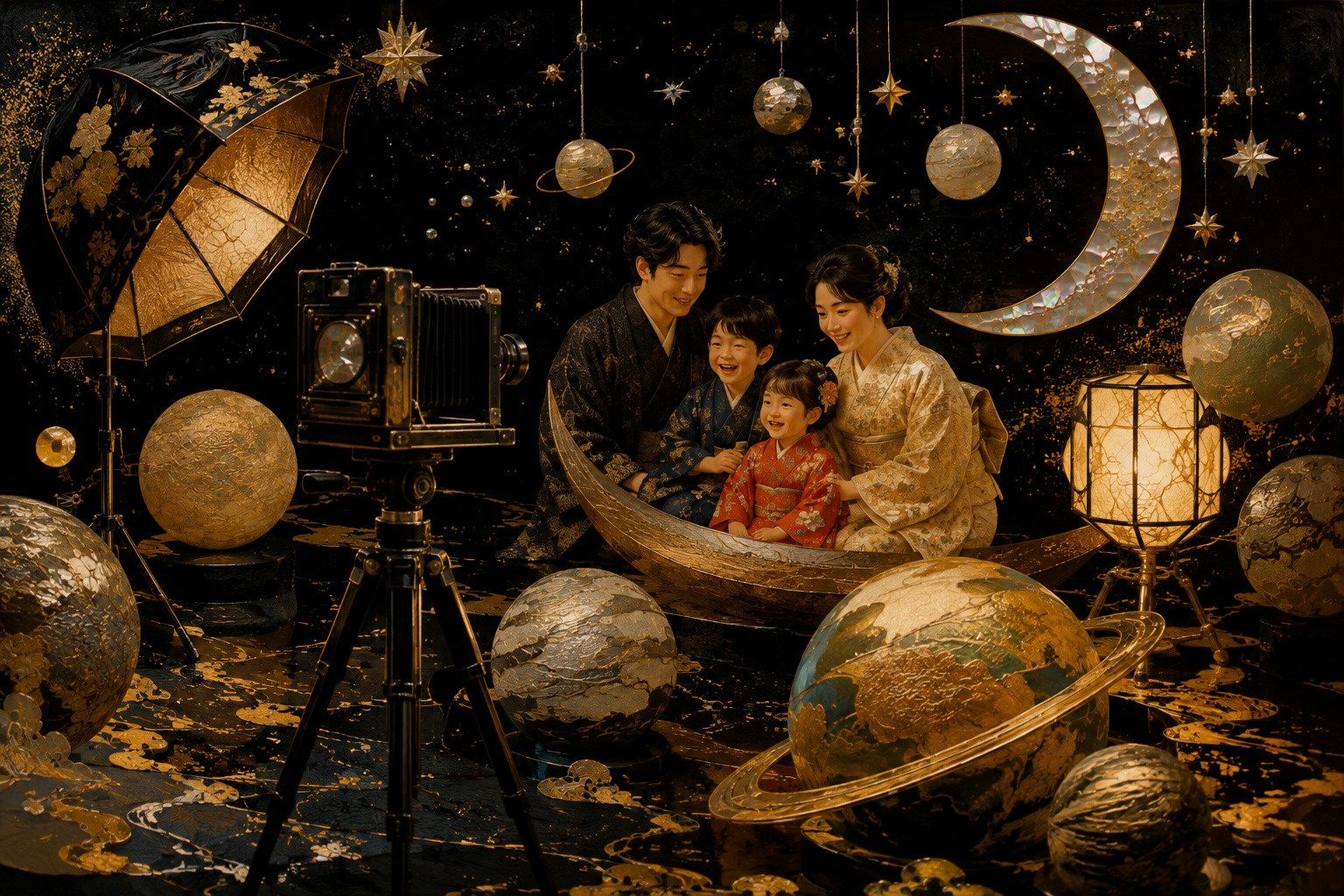
Imagine a child in ceremonial kimono standing beside a moonlike sphere, the folds of the fabric caught by soft artificial starlight. The picture may look futuristic. Its purpose is ancient: to say that in this year, with these faces and this family, we were here together.
Emu Inc., a Kobe-based regional photography company, plans to open Photo Studio ému Himeji on September 5 at 3-2-13 Tadera, Himeji. It will be the company’s seventh current studio. Its official concept is “Starlight Fantasy”—a portrait environment made from quiet cosmic imagery, glints of stars, gentle light and smooth curves. A first-floor furisode exhibition for coming-of-age customers is scheduled to begin earlier, on August 10.
This is not a national chain making a giant flagship investment. Emu is privately held and unlisted, with capital of ¥3 million. It was incorporated in September 1998 and operates a compact network across Hyogo. That is why the scale of the idea matters. A modest regional company has looked at a crowded family-photography market and decided that its next competitive territory is outer space.
A Rebellion Against “Natural Antique”
The company’s clearest design statement concerns what will not be there. Contemporary Japanese family studios frequently use timber, white plaster, dried flowers, worn chairs and desaturated cloth to create a “natural antique” mood. The formula works: it flatters skin, accommodates fashionable clothing and produces a soft image on social media. Its success has also made studios in distant cities look remarkably alike.
Emu says Himeji will deliberately exclude those elements. Its “subtractive design” will rely on abstract form and illumination rather than a crowded collection of props. This is not meant to be a scientifically accurate spacecraft or a literal theme park. It is a suggestive planetary world in which the sitter can remain visually dominant. The goal is less to add spectacle than to remove familiarity.
That choice extends a strategy already visible across the company’s six existing studios. Emu does not give nearby branches an identical interior. Each is marketed as a different world.
| Studio | Official concept | Core visual idea |
|---|---|---|
| Nishinomiya | Flower Elegance | Seasonal flowers and refinement |
| Southern Mall Rokko | White Circus | A circus rendered in white |
| Suma Patio | Modern Pop | Color and playful form |
| Nishikobe | Natural Light Atelier | Daylight; the first studio, opened in 2001 |
| Akashi Okubo | Relaxing Resort | A polished tropical retreat |
| Kakogawa | Classic Wonderland | Antiques with wit |
| Himeji | Starlight Fantasy | Cosmic calm, stars and curves |
A standardized chain promises the same result everywhere. Emu instead gives customers a reason to choose among branches, and perhaps to use another branch for the next milestone. Seven locations are enough to share costume buying, training, reservations and marketing, yet few enough for each shop to retain a visual identity. It is a middle position between the single atelier and the national factory.
The Portrait Studio Was Always a Stage
The space set is new. The underlying practice is not. When photography took root in late-Edo Japan, a studio was simultaneously a chemical laboratory, optical workshop, furniture stage and service business. Research published by the Tokyo Photographic Art Museum says portraits were the pictures Japanese customers first wanted most. By early Meiji, the idea that photography could make a likeness relatively easily had spread, bringing a growing field of photographers into fierce competition.
In 1862, Ueno Hikoma opened Ueno Studio beside the Nakashima River in Nagasaki. Around the same time, Shimooka Renjo established a commercial studio in Yokohama. Exposure was slow. Sitters had to hold still, sometimes aided by concealed supports. Photographers judged daylight entering through the roof and arranged chairs, pillars, curtains and painted scenery. Shimooka later devoted substantial work to photographic background painting. The backdrop was not incidental decoration; it was part of what a studio sold.
An early portrait was almost the opposite of a phone snapshot. The customer dressed, travelled to the studio, entered the photographer’s space and remained still. Owning the image was itself an event. Modern cameras have reduced exposure to an instant and files can be delivered quickly, but the ritual survives: choose clothing, arrange hair, coordinate several generations, submit posture and expression to another person, then select the picture that will speak for the family.
The Father of Japanese Portraiture Also Photographed Venus
The Himeji concept contains an unexpectedly elegant historical echo. Ueno Hikoma did more than photograph figures including Sakamoto Ryoma and Takasugi Shinsaku. In 1874 he recorded the transit of Venus across the face of the sun—the first astronomical photograph made in Japan, according to the JCII Camera Museum.
Portrait and planet expressed two desires through the same technology. One was the wish to arrest a face that would disappear. The other was the wish to preserve evidence of a celestial body too distant to touch. Ueno’s wet plates turned a person and an astronomical event alike into proof of having seen.
One hundred and fifty-two years later, the Himeji studio will not measure a planet through a telescope. It will bring a planetary suggestion indoors and place a family in front of it. The role has reversed—from scientific record to emotional theater—but the core act remains: resisting time long enough to hand one moment to the future.
1848 A daguerreotype apparatus reaches Japan
1862 Ueno opens his Nagasaki studio; Shimooka opens in Yokohama
1874 Ueno photographs the transit of Venus, Japan’s first astronomical photograph
1998 Emu Inc. is incorporated
2001 The first Studio ému opens in Nishikobe
2026 The seventh current studio takes a planets-and-space theme to Himeji
Japan’s Life-Cycle Rituals Built the Business
A family studio cannot beat a smartphone on the number of ordinary pictures made each day. It survives by attaching itself to the calendar of a life: maternity, newborn days, omiyamairi shrine visits, birthdays, Shichi-Go-San, school entrance, the ages of ten and thirteen, graduation hakama, coming of age and marriage. On those days, clothes, grandparents, shrines, schools and meals move together. The portrait becomes both the center of the occasion and its container.
Emu’s menu spans that entire sequence. What it sells is not one shutter release. The service bundles costume inventory, dressing, hair and makeup, color and styling advice, the emotional labor of relaxing a child, posing several generations, image selection, mounts, albums, frames, digital data and—in the furisode business—pre-shoot preparation and dressing on ceremony day.
The August 10 furisode exhibition reveals the economic depth beneath the photogenic concept. Coming-of-age kimono can create a relationship that runs from garment choice through the advance portrait to the ceremony itself. The space theme earns attention; regional skills in wardrobe, dressing and beauty support the business. For a small operator, interior design cannot be separated from inventory, bookings or staff development.
The Smartphone Paradox
Japanese households possess more photographs than any previous generation, yet a parent is often missing because that person is holding the phone. Images remain vertical, scattered and unseen in a camera roll. They disappear from daily life after a device change or become an unmanageable cloud archive. When everyone carries a camera, the act of putting the entire family in one frame, deliberately dressed and printed for a wall, becomes rarer.
A studio will always cost more than a phone. Its mistake would be to explain the difference only through resolution. Its real value is that everyone can be present; a child can enjoy transformation; a trained photographer can wait for a fleeting expression; and a finished object can travel to grandparents. The cosmic room is a background, but also a mechanism that lets the family enter the same story.
Generative AI raises the pressure again. A person photographed against a plain wall can be placed on a moon, in a palace or under impossible stars. But producing a synthetic background is not the same as sharing an occasion in which a child reacts to a physical set and the family laughs together. A real studio’s advantage is not that its “space” is authentic. It is that the time spent there actually happened.
Fewer Births, More Pressure on Every Milestone
Romance does not pay rent. Japan’s preliminary vital statistics for 2025 recorded 671,236 births, down 14,937 from the year before. The birth rate was 5.6 per thousand population. The future customer base for newborn, Shichi-Go-San and school-entry photography is shrinking every year.
Regional studios therefore need deeper relationships with fewer families and more value around each occasion. They stretch the relationship from newborn to adult and wedding, include grandparents and pets, and add rental, beauty and physical products. Emu’s emphasis on abundant costumes and “total production” is not just aesthetic enthusiasm; it is a response to demography.
That strategy has a danger. “Experience value” can become a maze of upgrades. A trustworthy operator should disclose before booking what the sitting, wardrobe, digital files, albums, extra images, cancellation and ceremony-day services will cost. From September 5 through 30, Emu says all branches will offer a cabinet-size print and a commemorative marshmallow; Himeji will add a free trial shoot, an image for LINE registrants and “space food” for customers. A charming entry offer should be judged alongside the transparency of ordinary pricing.
Himeji Has Long Looked Up
Himeji is globally identified with its white castle, but it also has a long civic history of space education. The predecessor of the Himeji City Science Museum opened in 1965, and the present institution opened in 1993. Its exhibits and planetarium have invited residents to look into a dark dome for generations; total attendance reached six million in 2022.
There is no suggestion of a partnership between the museum and Emu. The point is cultural, not contractual. Space is not an alien symbol suddenly dropped into the city. If the science museum is a public place for learning about the universe, the studio will be a private place for borrowing its imagery to tell a family story.
A Business That Holds Children’s Faces
Beauty brings responsibility. A child’s face, name, age, ceremony and family relationships form a dense package of personal information. Customers should be told where reservation data and images are stored, who may access them, whether outside retouchers or cloud services receive them, how long they are retained, and how deletion works. Consent to make a photograph should not silently become consent to use it in advertising or on social media.
The physical set poses practical questions too. Can a wheelchair or stroller pass the curves? Can a child sensitive to light or sound opt out of an effect? Can someone in kimono move safely over changes in level? Are grandparents offered seating and rest? The most convincing fantasy is one that does not purchase drama by reducing safety or inclusion. After opening, the route to the final photograph deserves as much scrutiny as the photograph itself.
- Whether the finished cosmic sets support subjects rather than overwhelm them.
- Whether sitting fees, data, products and additions are clear before booking.
- Whether children, older relatives and disabled customers can move and rest safely.
- Whether storage, sharing, deletion and marketing consent for images are explicit.
- Whether the company can continually train local hair, makeup and dressing talent.
- Whether Himeji families return for another milestone after the novelty fades.
Using Distant Stars to Photograph Nearby Time
Emu Inc.’s corporate history begins in 1998. The studio brand’s story begins with Nishikobe in 2001. The company calls 2026 its 25th anniversary because it is counting the latter. That distinction may look small, but accurate reporting on a regional business requires it. The age of a legal entity, the age of a brand and the changing size of a shop network are not interchangeable.
In that anniversary year, the company chose space. It declined to reproduce the dominant background and tried to make a reason for customers to visit this particular place. It is carrying familiar skills—wardrobe, beauty, posing and hospitality—onto a new stage. Surrounded by smartphones, demographic contraction and image-generating software, it is trying to convert photography from “data” back into “a day.”
Ueno Hikoma, a pioneer of Japan’s commercial portrait studio, photographed faces and then Venus. Himeji’s new shop reverses the order: construct something like Venus, then place the faces before it. The real subject will not be the cosmos. It will be a parent straightening a ceremonial sleeve, a child’s smile after nervousness, grandparents standing together again—the nearby time that distant stars help us see.
Reporting notes and principal sources
This article uses company releases, public statistics and museum sources available through August 5, 2026 at 9:41 a.m. JST. Pre-opening claims are treated as plans rather than results, and promotional self-assessments are not presented as independently verified performance.
- Emu Inc.: Himeji opening, concept and campaign (August 4, 2026)
- Studio ému: official branch list and concepts
- Studio ému Himeji: address, hours and Starlight Fantasy concept
- Southern Mall Rokko: the 2001 first studio and the ému name
- JCII Camera Museum: Ueno Hikoma’s 1862 studio and 1874 Venus photograph
- Tokyo Photographic Art Museum: pioneers and early demand for portraits
- Tokyo Photographic Art Museum: Shimooka Renjo and early Japanese photography
- Ministry of Health, Labour and Welfare: 2025 preliminary vital statistics
- Himeji City Science Museum: purpose and institutional history
- Himeji City Science Museum: planetarium