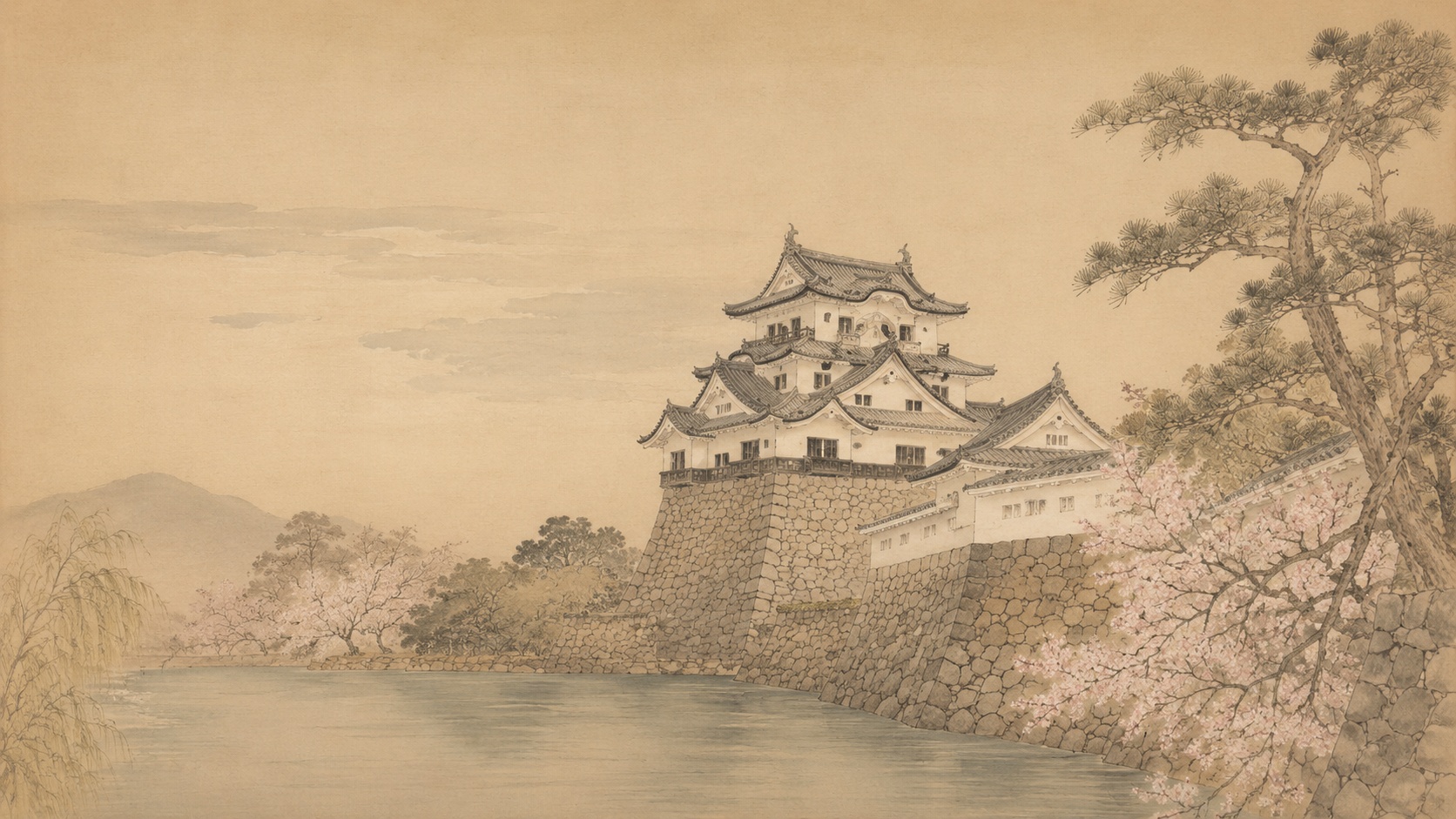
Hikone Castle has spent almost the entire life of Japan's participation in the World Heritage Convention waiting for this moment. Japan accepted the convention on June 30, 1992. Hikone was placed on UNESCO's Tentative List on October 1 that year. Himeji, placed in the same early Japanese heritage pipeline, was inscribed in 1993. Hikone remained tentative.
On September 3, 2026, Japan's Council for Cultural Affairs finally selected Hikone Castle as the cultural property it considers appropriate for nomination in the current cycle. Hikone City calls the step an informal securing of the domestic nomination slot and is aiming at a World Heritage Committee decision in 2028.
The hardest question was never whether Hikone is a good castle
Hikone's 34-year wait is easy to misunderstand. It did not sit outside the World Heritage List because the castle lacked national importance. The keep is a National Treasure. The castle site is a Special Historic Site. The core inside the middle moat preserves the early-modern castle plan, walls, moats and earthworks to an unusually high degree.
The problem was international argument. World Heritage status requires more than national prestige, age or beauty. A nomination must establish Outstanding Universal Value: why this place represents something significant to human history that cannot be adequately substituted by similar sites elsewhere.
The 1992 Tentative List entry presented Hikone in the familiar language of Japan's golden age of early-17th-century castle architecture and listed criteria (i), (ii), (iii) and (iv). But Japan already had an extraordinary castle nomination moving faster through the same system.
Himeji-jo was inscribed in 1993 under criteria (i) and (iv). UNESCO calls it a masterpiece of wooden construction and the culmination of Japanese wooden castle architecture. That left a basic comparative problem for Hikone: if another Japanese castle is already on the List as the supreme architectural expression of the type, what different chapter of world history would Hikone add?
The answer that emerged over decades is now the core of the 2026 dossier. Hikone is no longer asking primarily to be judged as another beautiful fortress. It is asking to be read as a surviving diagram of government.
A castle that explains where power lived
The Agency for Cultural Affairs' September 2026 summary gives the nomination a long but precise title: Hikone Castle as evidence of the daimyo governance system at a regional governing center in Tokugawa Japan.
The argument begins with the political reorganization of the 17th century. Under the Tokugawa order, daimyo were given recognized regional seats of authority. Senior retainers were concentrated around those seats rather than simply remaining dispersed on their own holdings, and political administration was conducted through a hierarchy centered on the daimyo's castle complex.
Hikone can make that invisible structure legible because several categories of space still fit together. Moats, stone walls and earthworks define controlled zones. The keep, turrets and gates represent authority and defence. The palace site represents administration. Sites of senior-retainer residences show the concentration of high-ranking political actors around the lord.
Hikone City's research on the castle town adds another layer. The zone between the inner and middle moats included the lord's Keyaki residence — later Genkyuen and Rakurakuen — and residences of senior retainers, including karo. Between the middle and outer moats lay the inner town; beyond the outer moat was the outer town, where merchants, artisans and lower-ranking warriors occupied more differentiated districts.
The point is not that Tokugawa society can be reduced to one castle plan. The point is that political hierarchy was built into space, and Hikone retains enough of that spatial logic to make a global heritage argument from it.
Why criterion (iii) now matters more than the old architecture pitch
In 2023, Japan took Hikone into ICOMOS's preliminary assessment process before attempting a full nomination. The process is designed to let the advisory body identify weaknesses in a proposed Outstanding Universal Value argument before a state spends an entire nomination cycle defending it.
The result arrived in October 2024. According to the Agency for Cultural Affairs' later public summary, ICOMOS supported the strategic decision to focus on the importance of the daimyo governance system and said the property might be capable of satisfying World Heritage criterion (iii).
Criterion (iii) is about testimony: a property that bears unique or exceptional witness to a cultural tradition or civilization. That is a fundamentally different proposition from Himeji's criterion (i) masterpiece and criterion (iv) architectural-type arguments.
But the preliminary assessment was not an approval. ICOMOS asked Japan to explain more clearly how the daimyo governance system actually functioned, widen and tighten the comparative analysis, and confront a difficult question: can a single property — Hikone alone — fully express the system being claimed?
In 2025, Japan's own experts said: not yet
That international advice made the domestic selection process harder, not easier. In August 2025, the Council for Cultural Affairs acknowledged progress but concluded that important problems remained.
Some were almost methodological. If Hikone was being compared with other Japanese castles using the rank of the daimyo house, domain income, closeness to the shogunal family and whether the castle was newly constructed in the early modern period, what made those filters objective rather than convenient?
Other problems involved survival. Should the comparative analysis judge standing buildings, archaeological remains, or both? If several castles survived well, how could the dossier narrow the field without subjective scoring?
Then came questions of vocabulary that Japanese readers may take for granted: what exactly counts as the “castle” in this argument? Does it include the place where administrative work was done? How does the castle town relate to the property? Which political figures are included when the dossier uses the word “daimyo”?
The council's message was not that Hikone lacked value. It was that the argument still depended too heavily on concepts that made sense inside Japanese history but had not yet been defined rigorously enough for an international comparative evaluation.
The 2026 breakthrough is real — but conditional
Shiga Prefecture and Hikone City continued rewriting. In May 2026, their joint World Heritage promotion council submitted a revised draft nomination for domestic review. Four months later, the Council for Cultural Affairs selected Hikone as the candidate.
The official selection reason is worth reading carefully. The council still says the dossier should be revised so that overseas specialists can understand it more easily before submission. But it now considers Hikone capable of demonstrating Outstanding Universal Value as evidence of a daimyo governance system described as unlike systems found abroad, and it concludes that the proposed components are sufficiently protected.
That is the threshold crossed on September 3: not “Hikone has become World Heritage,” and not “ICOMOS has accepted the claim,” but “Japan's expert body now believes this is a defensible case to take into the international nomination process.”
The road from September 2026 to a possible 2028 decision
| When | Expected step | What it means |
|---|---|---|
| Sep. 3, 2026 | Council for Cultural Affairs selects Hikone as recommendation candidate | Domestic cultural-value gate cleared |
| By Sep. 30, 2026 | Provisional nomination dossier expected at UNESCO | Preparation and technical review stage |
| 2027 | Cabinet approval and formal dossier by Feb. 1 | Japan formally nominates the property |
| 2027 | ICOMOS evaluation, including field mission | International review of OUV, integrity, authenticity and protection |
| 2028 | World Heritage Committee | Committee may inscribe, refer, defer or decline the nomination |
The political story begins immediately after Sekigahara
Hikone's value claim becomes clearer when the castle's construction is read against Japan's transition from civil war to Tokugawa rule.
After the Battle of Sekigahara in 1600, Ii Naomasa, one of Tokugawa Ieyasu's leading commanders, received Sawayama Castle, previously associated with Ishida Mitsunari. Naomasa entered Sawayama in 1601 but died the following year.
His household then considered a replacement seat. Hikone City's historical research says Sawayama, Hikoneyama and Isoyama were considered, with Hikoneyama chosen. Construction began on July 1, 1604 under Naomasa's heir Ii Naotsugu.
The early project looked like a shogunal strategic operation. Officials were dispatched by the shogunate and nearby daimyo were ordered to supply labour. Hikone was being built as a western control point at a moment when the new Tokugawa settlement still faced major political and military uncertainty.
Speed also produced one of Hikone's most interesting architectural characteristics: reuse. Stone and timber were gathered from surrounding castles and religious sites. The keep has long been said to have been transferred from Otsu Castle; later repair investigations identified reused components consistent with a transferred earlier keep, though municipal conservation material retains some caution about treating the precise origin as absolutely proven. Material from Sawayama, Nagahama and other sites is also associated with the construction.
Then the fortress became an office
The Osaka campaigns of 1614 and 1615 interrupted work. Naotsugu's younger brother Ii Naotaka, who distinguished himself in the campaigns, later carried the second phase forward. By around 1622, the castle and castle town had broadly reached their completed early-modern form.
The end of large-scale warfare changed what the castle needed to do. The domain's principal political space shifted down from the mountaintop.
Hikone's Omotegoten palace eventually occupied more than 10,000 square metres at the foot of the hill. The lord's principal hall had moved from Kanenomaru in 1604 to the Honmaru area around 1606 and then, after the Osaka campaigns, into the much larger palace below. That final location remained the center of Hikone domain government for more than 250 years.
This is precisely why the current nomination strategy can tell more than a military story. The castle's evolution records the shift from an emergency stronghold built to secure Tokugawa power to a long-lived administrative center designed for governing a peaceful domain.
Hikone survived the Meiji state when many castles did not
After the fall of the shogunate, castles across Japan lost their old administrative and military functions. Buildings were sold, dismantled or repurposed. Hikone's Omotegoten itself was put up for sale in 1878, with buildings and fittings dispersed.
The main castle survived. Hikone City's conservation plan records that during Emperor Meiji's 1878 tour of Shiga, an order was issued to preserve the castle. Later accounts associate the intervention with statesman Okuma Shigenobu, who regretted the dismantling and brought the matter to the emperor; recent municipal historical research has continued examining the documentary chain behind that well-known preservation story.
The property later passed to the Imperial Household Ministry, then back to the Ii family in 1894. It was lent to Hikone town from 1915 and donated to Hikone City by the Ii family in 1944, opening the way to municipal public stewardship.
National protection followed. The castle site became a historic site in 1951 and a Special Historic Site in 1956. The keep, attached turret and tamon turret were designated a National Treasure in 1952. The 1992 Tentative List entry came after more than a century of active decisions to prevent the core from disappearing.
1600: Battle of Sekigahara; Ii Naomasa receives Sawayama.
1604: Construction begins at Hikoneyama under Ii Naotsugu.
c. 1606–07: Keep completed.
c. 1622: Ii Naotaka era; castle and town reach broadly completed form.
1878: Castle preservation ordered during Emperor Meiji's Shiga tour; Omotegoten buildings sold.
1944: Ii family donates Hikone Castle to the city.
1952: Keep complex designated a National Treasure.
1956: Castle site designated a Special Historic Site.
1992: UNESCO Tentative List.
2023: Japan requests ICOMOS preliminary assessment.
2024: Preliminary assessment supports governance strategy, identifies major questions.
2025: Domestic experts say more work is still required.
2026: Council for Cultural Affairs selects Hikone as nomination candidate.
2028: Earliest World Heritage Committee decision.
What survives is broader than the famous keep
Visitors naturally focus on the three-storey National Treasure keep, with its varied gables and distinctive katomado windows. But the World Heritage case deliberately pulls the eye outward.
Inside the surviving core are the relationships among the hilltop military structures, defensive walls, moats, gates and lower administrative zones. Beyond them, the castle town's historical organization records the position of senior warriors, other samurai, townspeople and lower-ranking military groups.
Not every building survives. That fact is central to the nomination challenge. The Omotegoten was dismantled in the Meiji period. Today's Hikone Castle Museum, opened in 1987, reconstructs part of the palace using archaeological excavation, historic plans and documentary research. Senior-retainer residences survive unevenly, sometimes as gates, sites, archaeological evidence or urban patterns rather than intact mansion complexes.
ICOMOS's questions about standing buildings versus archaeology therefore go to the heart of the case. Hikone must show that the surviving evidence is sufficient to communicate the governance system without pretending that every Edo-period component remains physically complete.
Legal protection does not mean the castle is physically invulnerable
The 2026 domestic selection notes that the components have strong protective measures. Hikone's national designations provide a substantial legal framework. Yet long-term conservation remains an active engineering problem.
Hikone City has published seismic assessments indicating that at shaking of upper-6 intensity or greater, the keep building could be at risk of collapse even where the underlying stonework is not expected to fail. The attached turret and tamon turret have more serious vulnerabilities involving both building and stonework. Public access routes were altered, and the city has pursued strengthening design and emergency-evacuation planning.
That distinction matters for World Heritage. Inscription would not certify that the castle is finished being preserved. It would make the obligation to manage earthquakes, fire, visitor pressure, landscape change and maintenance a permanent part of the property's international stewardship.
Hikone's mayor is celebrating — carefully
Hikone Mayor Issei Tajima, who took office in 2025, welcomed the September 3 decision but chose a revealing phrase in his official statement: “This answer is not the goal.”
He is right in procedural terms. Japan still has to make the formal state nomination. ICOMOS will revisit the same core claims from an international perspective. The World Heritage Committee is not bound by Japan's domestic selection.
Even the 2026 Council for Cultural Affairs says the nomination text should continue to be rewritten so foreign experts can follow it more readily. Terms that are intuitive in Japanese history — daimyo, karo, castle, palace, domain, castle town — have to be translated not just linguistically but conceptually.
The deepest test is whether a political system can be made visible
The city often explains the daimyo system as one of the foundations of the long social order of the Edo period. That is an appealing public narrative. A World Heritage nomination, however, has to make a more disciplined case.
Why was this system historically significant? In what way was it exceptional compared with political organization elsewhere? How does a castle physically prove it? And why does Hikone demonstrate the system better than other surviving Japanese castles?
Those are the questions behind the seemingly technical criticism issued in 2025. Defining “daimyo,” defining the territorial scope of “castle,” clarifying the role of the palace and senior-retainer compounds, and designing an objective comparative analysis are all ways of converting an invisible political institution into material evidence.
World Heritage nominations usually look easiest from the outside when the monument is visually spectacular. Hikone demonstrates the opposite. Its architecture is the easy part. The difficult part is proving that the architecture, archaeology and urban layout together preserve a political idea.
The castle changed little; the explanation changed for 34 years
Hikone's keep did not suddenly become more historic in 2026. The moats did not acquire their meaning this year. What changed over three decades was the intellectual case for why the property belongs on a global list.
The 1992 language emphasized a castle from the golden age of Japanese fortification. Later work had to confront Himeji's stronger architectural precedent. Archaeology, urban research and the preliminary dialogue with ICOMOS gradually pushed the nomination toward governance: the castle as the organized seat of a daimyo, senior retainers and domain administration.
That evolution is a useful reminder of what UNESCO designation actually asks. Old is not enough. Beautiful is not enough. Nationally famous is not enough. The nominating state has to explain what the property contributes to a global understanding of human history, and then defend that claim against comparable sites.
Hikone has spent 34 years looking for a version of that answer that can survive international scrutiny.
On September 3, 2026, it cleared the most important domestic gate yet. The next audience will not be residents who already know the Ii clan or Japanese experts who understand what a daimyo castle meant. It will be international evaluators comparing Hikone with political and fortified landscapes across the world.
For the first time since 1992, the question “Will Hikone become World Heritage?” now comes with a concrete international calendar attached. The earliest answer is 2028.
Sources
- Agency for Cultural Affairs, Council for Cultural Affairs recommendation-candidate decision — September 3, 2026.
- Council for Cultural Affairs, selection reasons for Hikone Castle — current domestic reasoning, remaining drafting work and protection findings.
- Agency for Cultural Affairs, 2026 Hikone Castle nomination overview — official daimyo-governance-system concept and physical elements.
- Agency for Cultural Affairs, August 26, 2025 opinion on future World Heritage nominations — public summary of the 2024 ICOMOS preliminary assessment and unresolved comparative/definition issues.
- Hikone City, domestic recommendation announcement and Mayor Issei Tajima statement — September 3, 2026; also provides the expected 2026–28 schedule.
- Hikone City, submission of the revised draft nomination — May 25, 2026.
- UNESCO World Heritage Centre, “Hikone-Jo (castle)” — Tentative List entry dated October 1, 1992.
- UNESCO World Heritage Centre, Japan — 27 current World Heritage properties and three Tentative List entries in 2026.
- UNESCO World Heritage Centre, “Himeji-jo” — 1993 inscription under criteria (i) and (iv), providing the essential comparison with Hikone's newer governance argument.
- Hikone City, research on the Omotegoten palace — Sekigahara aftermath, Ii Naomasa/Naotsugu/Naotaka, construction and the palace's long administrative role.
- Hikone City, Hikone castle town — senior-retainer compounds, inner and outer town structure.
- Hikone City, cultural properties inside Hikone Castle — Special Historic Site, surviving moats and castle plan, National Treasure structures.
- Hikone City, features of Hikone Castle — reused materials and the tradition/assessment concerning the Otsu Castle keep.
- Hikone City, Hikone Castle Buildings Conservation and Utilization Plan — preservation order in 1878, later transfers of custody and modern designations.
- Hikone City, seismic diagnosis of the National Treasure keep complex — physical conservation risks and access changes.
- Hikone City, mayor profile — verifies Mayor 田島一成 as Issei Tajima.
This report was checked against public information available by 6:00 AM JST on September 4, 2026. The September 3 Council for Cultural Affairs action selected Hikone Castle as Japan's cultural World Heritage recommendation candidate for the current cycle; it is not a UNESCO inscription and is not yet the completed formal nomination by the Government of Japan. Hikone City's phrase “domestic recommendation effectively secured” is treated as the city's description, while Cabinet approval and formal submission are kept separate and are expected in 2027. The 2024 ICOMOS preliminary assessment is described from the Agency for Cultural Affairs' published 2025 summary: it supported the daimyo-governance strategy and indicated possible use of criterion (iii), while raising questions about operation of the system, comparative analysis and whether a single property can fully express it. The reported Otsu Castle origin of the keep is presented with appropriate caution because Hikone municipal sources describe both a long-standing transfer tradition and investigative evidence without treating every aspect of the precise origin as beyond dispute.
Image rights: © 2026 Japan.co.jp. AI-assisted editorial illustration. Unauthorized republication or reuse is prohibited. For licensing, use the contact page.