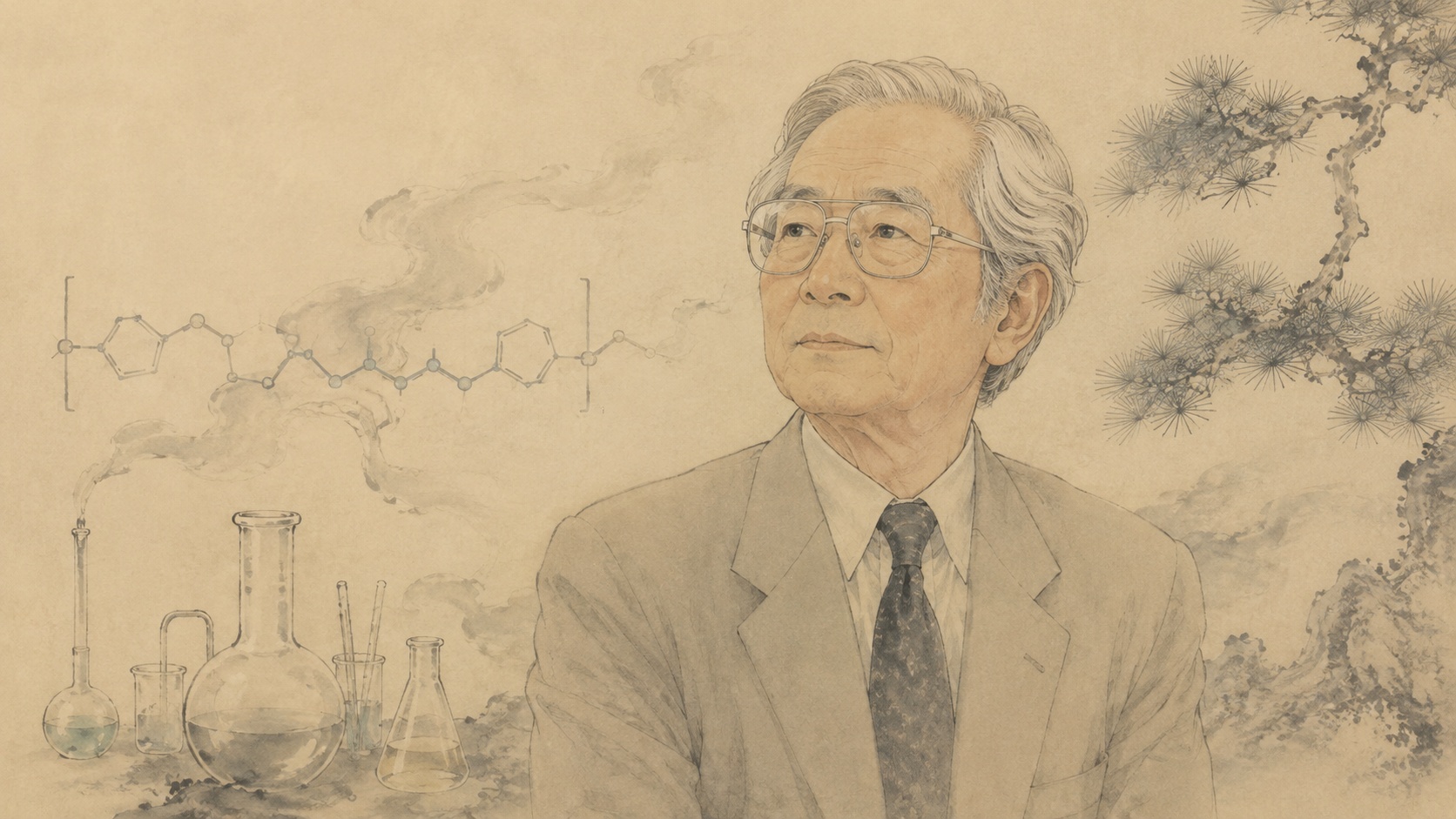
The breakthrough began with a result that looked wrong. In 1967, in a polymer laboratory at the Tokyo Institute of Technology, an acetylene experiment produced a film instead of the familiar black powder. Hideki Shirakawa did not discard it. He worked out why it had formed, learned to make it deliberately, and eventually carried the lustrous material into a collaboration that overturned one of the simplest rules people associated with plastic: that it was an electrical insulator.
Shirakawa, professor emeritus at the University of Tsukuba and a joint recipient of the 2000 Nobel Prize in Chemistry, died on August 24, 2026, the university announced on September 3. He had turned 90 four days earlier. Tsukuba's official notice did not state a cause of death. Jiji Press and other Japanese outlets, citing information surrounding the funeral announcement, reported that he died in a Yokohama hospital from a metastatic liver tumor and cancer of unknown primary origin. That medical detail is therefore treated here as attributed reporting rather than part of the university's primary notice.
The Nobel Prize was not awarded merely because Shirakawa made a shiny plastic film. It recognized a scientific field created across chemistry and physics. The Royal Swedish Academy of Sciences shared the 2000 chemistry prize among Shirakawa, physicist Alan J. Heeger and chemist Alan G. MacDiarmid “for the discovery and development of conductive polymers.” Their work showed that the electronic behavior of an organic polymer could be transformed by molecular structure and chemical doping, opening a route from ordinary plastics toward materials with metal-like or semiconductor-like electronic properties.
The obstacle was not knowing polyacetylene existed — it was making it measurable
Polyacetylene had been studied before Shirakawa. The practical problem was its physical form. Conventional polymerization typically yielded an insoluble, infusible black powder. That made spectroscopy, structural measurements and electrical measurements awkward. A material could be chemically interesting and still remain experimentally inaccessible because researchers could not turn it into a useful specimen.
Shirakawa graduated from the Department of Chemical Engineering at Tokyo Institute of Technology in 1961 and completed his doctorate there in 1966. He joined the university's Chemical Resources Laboratory as an assistant and worked in Sakuji Ikeda's group on the mechanism of acetylene polymerization using Ziegler–Natta catalysts.
In his Nobel lecture, Shirakawa dated the decisive accident to 1967. An experiment produced polyacetylene directly as a thin film. When the group reproduced the conditions, it found that the catalyst concentration had been nearly a thousand times the customary value. High catalyst concentration drove film growth at the reaction interface instead of leaving only the intractable powder.
The story is often retold as a student's unit mistake. A University of Tsukuba education program has indeed described the episode that way. Shirakawa's own Nobel lecture was more restrained: he called it a “fortuitous error,” then emphasized the experiments used to reproduce it. That distinction matters. Serendipity supplied an anomaly. Research turned the anomaly into knowledge.
The discovery came from understanding why the film existed.
A metallic shine without metallic conductivity
The new method gave Shirakawa something polymer chemists could actually handle. By controlling polymerization conditions and temperature, he prepared copper-colored, predominantly cis-polyacetylene and silvery trans-polyacetylene. The films were striking enough to invite a misleading first impression: they looked metallic.
They were not yet good metals. Nobel Committee technical material shows that undoped trans-polyacetylene remained orders of magnitude less conductive than a true metal. The great conceptual jump came later, after Shirakawa's work intersected with two researchers in Pennsylvania.
MacDiarmid had been studying the metallic-looking inorganic polymer sulfur nitride, (SN)x, with Heeger. During a visit to Tokyo, he saw Shirakawa's equally lustrous organic polymer and invited the Japanese chemist to the University of Pennsylvania. Shirakawa arrived as a postdoctoral researcher in 1976. The collaboration put synthetic polymer chemistry, inorganic chemistry and condensed-matter physics around the same bench.
MacDiarmid proposed treating the polyacetylene with iodine. Heeger's laboratory measured what happened. According to the Nobel Committee's advanced scientific account, iodine-treated trans-polyacetylene reached roughly 3,000 S/m, about seven orders of magnitude above the undoped material. The seminal paper was received on May 16, 1977: “Synthesis of electrically conducting organic polymers: Halogen derivatives of polyacetylene (CH)x.”
Doping changed the electronic structure, not simply the surface
The result was revolutionary because it could be explained chemically. A conducting polymer needs a conjugated backbone — a chain in which single and double carbon-carbon bonds alternate, allowing π electrons to extend along the molecule. But conjugation alone is not enough to make polyacetylene highly conductive.
Chemical doping changes the number and distribution of charge carriers. Oxidizing agents such as iodine remove electron density, creating mobile positive charge states; reduction can push electrons into other conjugated systems. Those charges can move along and between polymer chains. In effect, chemists acquired a way to tune the electronic character of an organic material over enormous ranges.
This collapsed an old mental boundary. Plastics had been valued partly because they were light, moldable and electrically insulating. Metals conducted electricity but were heavy and rigid by comparison. Conducting polymers showed that “organic” and “electronic” were not opposing categories. Molecular design could create materials combining properties once thought to belong to different worlds.
What the conducting-polymer breakthrough changed
| Old assumption | What the work demonstrated | Fields that followed |
|---|---|---|
| Plastics are principally insulators | Conjugated polymers can become highly conductive through doping | Conducting polymers, synthetic metals |
| Electronic materials are mainly inorganic | Organic molecules can be engineered for electronic function | Organic LEDs, solar cells, transistors and sensors |
| Chemical synthesis and solid-state physics are separate | Chemical structure can control bulk electronic behavior | Modern interdisciplinary materials science |
| An anomalous experiment is a failed experiment | Reproducible anomalies can reveal new regimes of matter | A durable lesson in scientific serendipity |
The Nobel Prize recognized a field, not a single gadget
On October 10, 2000, the Royal Swedish Academy of Sciences awarded the chemistry prize jointly to Heeger, MacDiarmid and Shirakawa. The wording — “discovery and development of conductive polymers” — is broader than any one specimen or device. It recognized the emergence of a research area at the boundary of chemistry, physics and engineering.
By then, the implications had expanded far beyond polyacetylene. The Nobel materials pointed to antistatic coatings, smart windows, polymer light-emitting diodes, solar cells, displays and molecular electronics. Japan's Ministry of Education, Culture, Sports, Science and Technology later used conducting polymers as an example of basic science flowing into practical technology.
Shirakawa also received Japan's Order of Culture and was designated a Person of Cultural Merit in 2000. The same year he retired from the University of Tsukuba and became professor emeritus.
How close is Shirakawa's discovery to today's smartphone?
The shortest obituary sentence says that conducting plastics helped make modern displays, batteries and mobile electronics possible. That is useful shorthand, but it can erase four decades of additional chemistry.
Polyacetylene itself is chemically sensitive and difficult to process. It is not the universal conductor hidden behind today's touchscreens. Later researchers created more practical conducting polymers, including polyaniline, polypyrrole and polythiophene families, as well as PEDOT-based materials. Organic light-emitting displays and organic photovoltaic cells developed through their own generations of conjugated polymers and small organic molecules.
Shirakawa therefore should not be described as the inventor of the OLED, the lithium-ion battery or the smartphone. His deeper contribution was making it scientifically credible to treat an organic polymer as an electronic material whose conductivity could be deliberately engineered. The descendants of that idea are everywhere even when the original polyacetylene is not.
A Tokyo-born chemist shaped by Takayama
Shirakawa was born in Tokyo on August 20, 1936 and spent his school years in Takayama, Gifu Prefecture, according to University of Tsukuba materials. He entered Tokyo Institute of Technology and remained there through his doctorate. His dissertation concerned block sequences in copolymers — solid polymer chemistry, not a manifesto about future electronics.
After the Pennsylvania collaboration, Shirakawa joined the University of Tsukuba as an associate professor in 1979 and became a professor in the Institute of Materials Science in 1982. He spent more than two decades teaching and researching at Tsukuba before retiring in 2000.
University President Kyosuke Nagata, in the September 3 memorial notice, emphasized not only Shirakawa's research but his cultivation of younger scientists. That educational role continued after formal retirement. Institute of Science Tokyo said Shirakawa repeatedly taught first-year undergraduates in the “Frontiers of Science and Technology” course that began at Tokyo Tech in 2016.
He kept questioning what plastics had done to society
Shirakawa did not end his public life by telling a simple triumphal story about plastics. At a 2023 lecture marking the University of Tsukuba's 50th anniversary, he spoke about the fascination of chemistry — the dramatic change in properties when one substance is transformed into another — but also raised the consequences of plastic's extraordinary usefulness.
Tsukuba's account of the lecture says he warned that the versatility of plastics had encouraged mass consumption and created harms that science still had to confront. It was a revealing coda. The chemist whose fame rested on giving plastic a new capability also insisted that materials science had to examine what happened after successful materials spread through society.
Just months before his death, on June 9, 2026, Institute of Science Tokyo conferred the title of Honorary Professor on Shirakawa. The university publicly announced the honor on June 19. In its memorial after his death, President and CEO Naoto Ohtake recalled that Shirakawa had continued speaking to entire cohorts of first-year students even after the institutional transition from Tokyo Tech to Science Tokyo.
Aug. 20, 1936: Born in Tokyo; later spends his school years in Takayama, Gifu.
1961: Graduates from Tokyo Institute of Technology.
1966: Earns doctorate in engineering and becomes an assistant at the Chemical Resources Laboratory.
1967: Fortuitous high-catalyst experiment yields polyacetylene film.
1976: Joins the University of Pennsylvania as a postdoctoral researcher.
1977: Shirakawa, MacDiarmid, Heeger and colleagues publish the landmark halogen-doped polyacetylene paper.
1979: Joins the University of Tsukuba as associate professor.
1982: Becomes professor.
2000: Retires from Tsukuba; receives the Order of Culture and the Nobel Prize in Chemistry.
2023: Addresses Tsukuba's 50th-anniversary audience on research, chemistry and the social costs of plastics.
June 2026: Named Honorary Professor at Institute of Science Tokyo.
Aug. 24, 2026: Dies at age 90.
Serendipity is a poor explanation unless the scientist is included
Shirakawa's story has become a standard example of serendipity in science: the thousand-fold catalyst error, the unexpected film, the chance international encounter. All of that is real. None of it explains the achievement by itself.
A researcher had to know that the film was unusual. The experiment had to be reproduced. The cis and trans structures had to be separated and understood. The lustrous polymer had to be shown to scientists who asked different questions. The electrical measurements had to be made. The doping mechanism had to be investigated. Then generations of chemists and physicists had to extend the idea into new polymers and devices.
Japan's 2001 science and technology white paper used Shirakawa as an example of world-class achievement emerging from persistent basic research following an initial discovery. That is a more useful lesson than “mistakes win Nobel Prizes.” Most mistakes remain mistakes. What matters is the trained eye that notices when nature has done something unexpected.
The silver film leaves a question for the next generation
Materials science in 2026 bears little resemblance to the field Shirakawa entered in the 1960s. Organic electronics now includes flexible sensors, wearable devices, printed circuits, light-emitting displays, photovoltaic materials and electrochemical systems. The idea that carbon-based molecules can carry sophisticated electronic functions is no longer surprising.
Yet the success of plastics has also produced environmental problems on a planetary scale: persistent waste, difficult recycling, fossil-resource dependence and short-lived consumer electronics. Shirakawa's late reflections point toward the unfinished part of his legacy. The next materials revolution will not be judged only by whether a material can do something unprecedented, but by whether it can be produced, used and recovered responsibly.
One experimental error in 1967 created a film. A decade of careful science turned the film into a new electronic material. Decades of work by many researchers turned that insight into a discipline.
Hideki Shirakawa's legacy is therefore larger than the phrase “plastic that conducts electricity.” He showed that properties people treat as fixed — conductor or insulator, organic or electronic — can be rewritten by understanding matter at the molecular level. The silver film was the beginning, not the conclusion.
Sources
- University of Tsukuba, memorial notice for Professor Emeritus Hideki Shirakawa — September 3, 2026; primary source for date of death, career chronology and university memorial.
- Institute of Science Tokyo, “In memory of Honorary Professor Hideki Shirakawa” — September 3, 2026; primary institutional account of his Tokyo Tech research and later teaching.
- University of Tsukuba, Hideki Shirakawa biography and achievements — education, awards, polyacetylene film, chemical doping and later polymer research.
- Hideki Shirakawa, Nobel Lecture, “The Discovery of Polyacetylene Film: The Dawning of an Era of Conducting Polymers” — first-person scientific account of the 1967 film-forming accident and catalyst concentration.
- Royal Swedish Academy of Sciences, 2000 Nobel Prize in Chemistry press release — prize citation, basic mechanism and applications.
- Nobel Committee, “Conductive polymers,” Advanced Information — conductivity values, doping experiments and the 1977 paper.
- NobelPrize.org interview with the 2000 chemistry laureates — first-person recollections of how the collaboration formed.
- University of Tsukuba, Shirakawa's 50th-anniversary lecture — 2023 comments on chemistry, research and the social consequences of mass plastic consumption.
- Institute of Science Tokyo, honorary professor announcement — June 2026. If the English page is unavailable, the Japanese institutional announcement is authoritative.
- MEXT, 2001 White Paper on Science and Technology — contemporary Japanese government framing of Shirakawa's work as basic research developed through persistent study.
- University of Tsukuba GFEST, Shirakawa profile accompanying “The Chemical History of a Candle” — background on his Tokyo birth and school years in Takayama.
- RSC Advances, “Conducting polymers: a comprehensive review on recent advances in synthesis, properties and applications” — representative later conducting-polymer families and modern application areas.
- Jiji Press, obituary report — September 3, 2026; secondary-source reporting for cause and place of death, neither of which appears in Tsukuba's official notice.
This report was checked against public sources available by 2:40 AM JST on September 4, 2026. Japanese institutional sources were prioritized for Shirakawa's name, titles, career and technical terminology. The account of the 1967 film and the roughly thousand-fold catalyst concentration is grounded in Shirakawa's own Nobel lecture. References to smartphones, OLEDs, solar cells and batteries describe the later field of conducting and semiconducting organic materials; the article does not claim that Shirakawa's original polyacetylene is itself the material used in each modern device. The cause of death is attributed to Jiji Press and other Japanese reporting because the University of Tsukuba memorial does not state it.
Image rights: © 2026 Japan.co.jp. AI-assisted editorial illustration. Unauthorized republication or reuse is prohibited. For licensing, use the contact page.