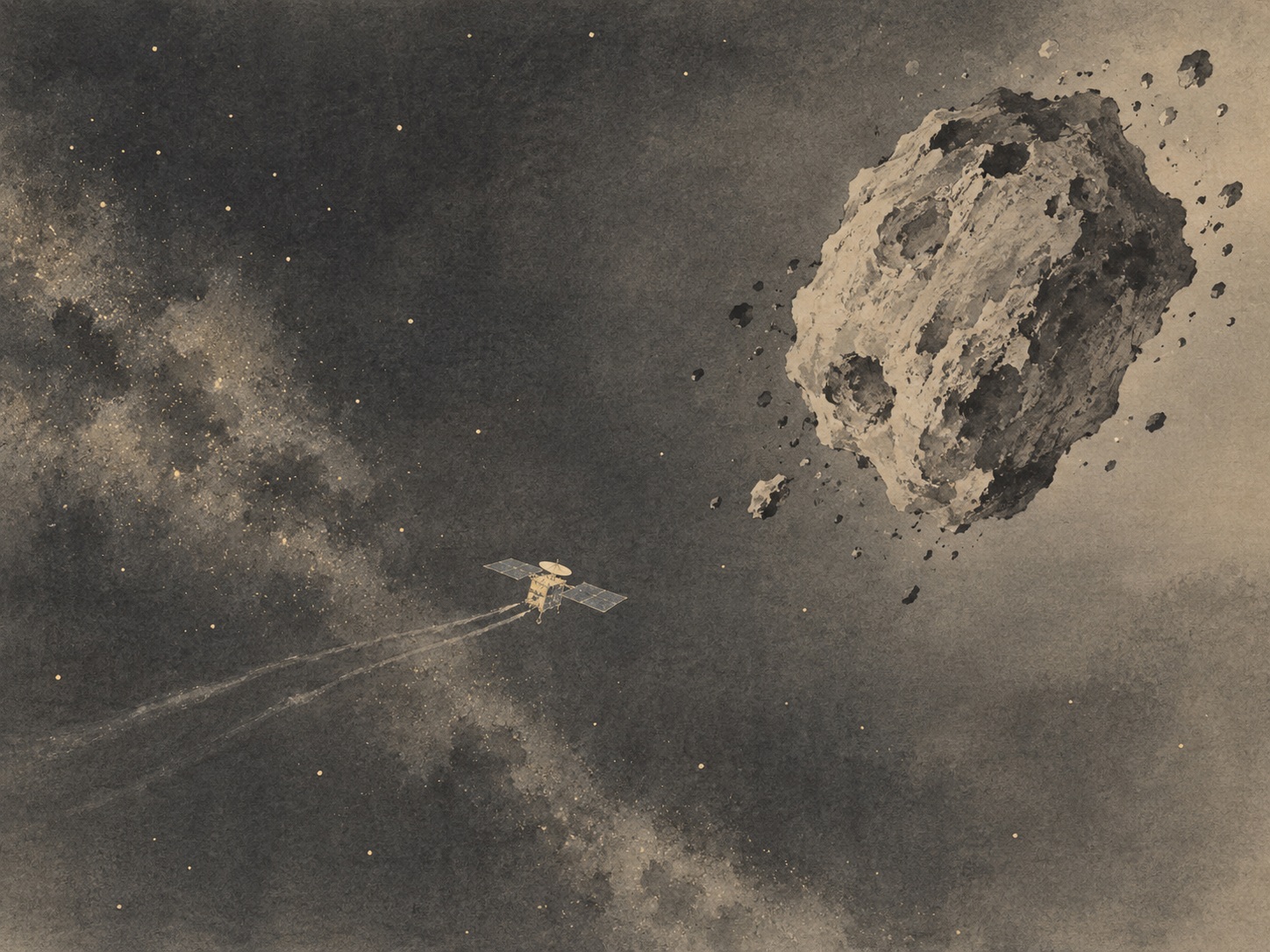
Hayabusa2 has reached the stage of its life when the question is no longer whether every subsystem works as designed. The question is whether enough pieces still work to be rearranged into something useful. In August 2026, the spacecraft’s ion engine B—the last unit carrying most of the propulsion burden—developed repeated discharges and stopped operating normally. By late August, JAXA had identified a deeper problem: the power supply had lost its ability to feed current to B’s ion source.[1]
That did not end the extended mission. Engineers tested combinations of surviving components and found one that works: the ion source from engine D paired with the neutralizer from engine B. JAXA now plans to continue trajectory control using this cross-operation configuration. It is a striking reprise of a technique used by the original Hayabusa when damaged ion engines threatened its return to Earth in 2009.[1][2]
The next propulsion crisis began four days after a triumph
On July 5, Hayabusa2 flew past asteroid Torifune, also known as 2001 CC21, in one of the most demanding operations of its extended mission. Detailed analysis later showed that the spacecraft passed about 744 meters from the asteroid’s center and roughly 400 meters above its surface at a relative speed of 5.3 kilometers per second. JAXA says this set a record for the closest flyby of a Solar System body, and the mission also achieved the first laser-ranging measurement during an asteroid flyby using its LIDAR instrument.[3][4]
Only four days later, on July 9, the spacecraft began ion-engine trajectory control again. The reason is unforgiving orbital mechanics. To reach its final target, asteroid 1998 KY26, in 2031, Hayabusa2 must first set up a planned Earth swing-by in December 2027. The spacecraft therefore had to begin reshaping its orbit almost immediately after Torifune.[1]
Four thrusters do not age in the same way
Hayabusa2 carries four ion engines, labeled A through D. They use xenon propellant, ionize it and accelerate the charged particles electrically. The thrust is tiny compared with a chemical rocket, but an ion engine can run for thousands of hours, slowly accumulating large changes in velocity.
That makes lifetime more important than peak power. During the extended mission, engines A, C and D showed earlier-than-expected increases in neutralizer voltage, a sign of degradation. Engine B remained in better condition and became the unit engineers relied on most heavily. By June 9, 2026, B had accumulated 8,143 hours of operation. JAXA said the combined ion-engine system had already exceeded the original Hayabusa’s total impulse by about 20%, added roughly 2 km/s of velocity, and reached 155% of the delta-v requirement defined for the nominal mission.[5]
But B had also begun to show the same rising neutralizer voltage seen in the other units. Engineers increased xenon flow to slow the degradation and successfully completed the final planned ion-engine run needed to secure the Torifune encounter in June. By then, however, the propulsion system was no longer a collection of healthy redundant units. It was a set of aging components whose remaining life had to be managed carefully.[5]
Repeated discharges became a real electrical failure
Engine B initially behaved normally after ion propulsion resumed on July 9. In mid-August, repeated electrical discharges appeared and the engine became unstable. Similar episodes had occurred in 2021 and 2025, and in both cases repeated discharge operation eventually cleared the problem. JAXA therefore tried the same approach for about a week.[1]
This time it did not work. Operations in late August showed that the power supply’s current-delivery function for the ion source had failed. That changed the diagnosis from a recoverable discharge condition into a hardware-level electrical fault. Continuing to discharge the engine would not restore the lost function.
Why an ion engine needs two working halves
An ion engine does not simply eject positively charged ions and stop there. It also needs a neutralizer that emits electrons. Without those electrons, charge would build up on the spacecraft and stable thrust could not continue.
Normally, the ion source and neutralizer attached to the same engine operate as a pair. But Hayabusa2’s electrical architecture allows some components to be connected in different combinations. That creates the possibility of cross operation: use the functioning ion source from one engine and the functioning neutralizer from another.
The original Hayabusa already proved the concept
The idea carries one of the most famous engineering precedents in Japanese spaceflight. On November 4, 2009, the original Hayabusa suffered an ion-engine anomaly during its difficult journey home from asteroid Itokawa. On November 19, the team secured propulsion by combining usable elements from two different ion engines. The spacecraft completed its continuous ion-engine trajectory correction in March 2010 and returned its sample capsule to Earth that June.[2][6]
Hayabusa2 was designed with lessons from that troubled first mission built into it. Reliability was improved precisely because Hayabusa had exposed so many failure modes. Yet an extended mission pushes hardware well beyond the original timeline, and new degradation appears. The old operational logic—preserve options, reconfigure systems, exploit redundancy creatively—has become relevant again.
The 2026 cross configuration
JAXA tested several combinations of the ion sources and neutralizers that remained usable. The successful arrangement uses the ion source of engine D, the neutralizer of engine B and the still-functional neutralizer-related portion of power supply 1. JAXA says the combination can function as an ion engine and will be used for further trajectory control while engineers continue monitoring its condition.[1]
The distinction matters. Engine D is not fully healthy, and engine B is not fully healthy. The mission is exploiting the fact that their surviving functions are complementary. In deep space, redundancy is not always a spare box waiting to be switched on. Sometimes it is the ability to recombine partial capabilities after the nominal architecture has broken down.
Why go on after the Ryugu mission was already complete?
Hayabusa2 has already accomplished the mission it was built for. Launched on December 3, 2014, it traveled to the carbon-rich asteroid Ryugu, conducted extensive remote observations, collected surface and subsurface material and delivered a sample capsule to Earth on December 6, 2020. Analysis has identified minerals, diverse organic compounds including amino acids, and liquid water in the returned material, though the implications for the origin of Earth’s water and life remain active research questions.[7]
After releasing the capsule, the spacecraft itself remained healthy enough to continue, with roughly half its xenon propellant expected to remain. JAXA searched for objects reachable with that residual fuel and initially found 354 candidates. Engineering feasibility, orbital uncertainty and scientific interest narrowed the possibilities to a small number, with 1998 KY26 selected as the final destination.[8]
1998 KY26 is an extraordinary target: only about 11 meters in diameter, rotating roughly once every five minutes. At that scale and spin rate, centrifugal effects can exceed the body’s weak gravity near the surface. Rendezvousing with such a tiny fast rotator would take asteroid exploration into a physical regime no previous Japanese mission has studied up close.[9]
Torifune was already a major scientific return
The July 2026 Torifune encounter shows that the extended mission is not simply a long cruise toward one last target. Four science instruments collected data during the flyby. JAXA later confirmed a record-setting closest approach and the world’s first successful laser-ranging measurement during an asteroid flyby.[3][4]
That means the extended mission is already producing new navigation, instrumentation and small-body science even before the attempted 2031 rendezvous.
The failure itself is becoming engineering data
Since launch, the Hayabusa2 team has accumulated long-duration in-space data on ion-engine degradation. Ground testing can run neutralizers for tens of thousands of hours, but JAXA has observed degradation in space that was not reproduced the same way on Earth. The difference matters because no laboratory can reproduce every aspect of years in deep space.[10]
JAXA says it has been studying possible degradation mechanisms, performing reproduction tests on the ground and feeding the results into later systems. Lessons from Hayabusa2’s aging ion engines are already being reflected in the design of ion propulsion for DESTINY+, which is scheduled for launch in fiscal 2028.[1]
A spacecraft failure is therefore not automatically the opposite of mission success. If engineers can identify where degradation occurs, how fast it advances and which operating conditions delay or accelerate it, the aging spacecraft becomes a full-scale life test that no ground facility can duplicate.
The real enemy is time
Cross operation has been demonstrated, but that does not guarantee arrival at 1998 KY26. Ion propulsion produces small thrust and must operate for long periods to accumulate useful delta-v. The rebuilt configuration must remain stable long enough to create the trajectory required for the December 2027 Earth swing-by.
Beyond that lies another Earth swing-by in 2028 and the 2031 rendezvous attempt. By then Hayabusa2 will have been in space for well over 16 years. Solar arrays, attitude-control hardware, communications equipment, thermal systems and scientific instruments are all aging alongside the propulsion system.
How to survive where nothing can be repaired
A machine on Earth can be opened, serviced and fitted with replacement parts. A deep-space probe cannot. Survival therefore depends not only on preventing failure but on preserving options after failure occurs.
The original Hayabusa became famous for surviving through exactly that kind of engineering improvisation. Hayabusa2 was built to be more reliable, but its extended mission has pushed it into the same fundamental problem: use what remains, change operating conditions, reroute functions and rewrite the plan around the hardware that still responds.
No one can yet say that Hayabusa2 will reach 1998 KY26 in 2031. What JAXA’s September 28 update establishes is narrower and, in engineering terms, remarkable enough: the spacecraft still has a way to produce ion thrust. After nearly twelve years in space, the mission remains alive not because nothing has failed, but because failure has not exhausted its options.
Sources and references
- JAXA Hayabusa2 Project, ion-engine status after the Torifune flyby, September 28, 2026.
- JAXA ISAS, history of the original Hayabusa, including November 2009 ion-engine cross operation.
- JAXA, Hayabusa2 sets record for closest Solar System-body flyby, July 30, 2026.
- JAXA, first laser-ranging measurement during an asteroid flyby, July 30, 2026.
- JAXA Hayabusa2 Project, final ion-engine operation for Torifune completed, June 10, 2026.
- JAXA ISAS, completion of continuous ion-engine trajectory control by the original Hayabusa, March 29, 2010.
- JAXA ISAS, Asteroid Explorer Hayabusa2 mission overview.
- JAXA Hayabusa2 Project, selection of the extended mission after Earth return.
- JAXA ISAS, Hayabusa2 extended mission and 1998 KY26 target characteristics.
- JAXA Hayabusa2 Project, operations-status reporting on ion-engine degradation and ground lifetime testing.
Reporting cutoff: October 4, 2026. JAXA has confirmed that the cross-engine configuration can operate, but has not established that it will remain healthy through the full trajectory-control campaign or guarantee arrival at 1998 KY26 in 2031.