- The Japan beyond Tokyo, written into the landscape
- Before Gunma: Kōzuke and the geography of eastern Japan
- Why 1876 matters—and why 1871 matters too
- Tomioka and the industrialization of silk
- From Nakajima aircraft to modern manufacturing
- A declining population—and a growing number of households
- An aging countryside and growing international communities
- People who carried Gunma onto the national stage
- The hot-spring towns: Kusatsu, Ikaho and Shima
- Mountains and marshlands: Akagi, Haruna, Oze and Minakami
- Food, crafts and a hands-on regional culture
- Planning a visit without trying to see everything
- The next 150 years of Gunma
The Japan beyond Tokyo, written into the landscape
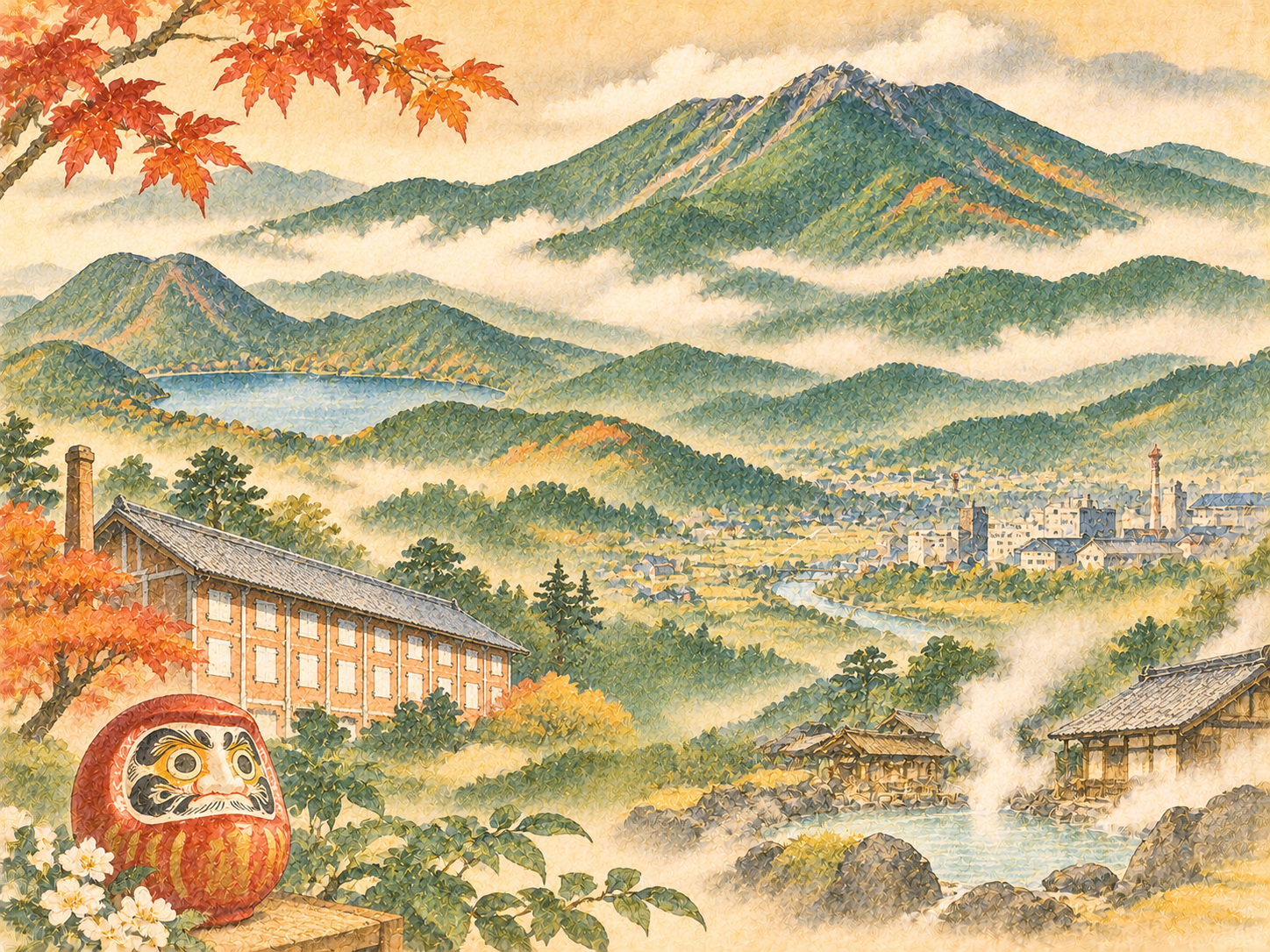
Gunma has no coastline, yet it has rarely been isolated. Steam rises from Kusatsu’s hot springs; trains converge at Takasaki; brick buildings at Tomioka record a revolution in silk production; factory districts around Ota recall the transition from aircraft to automobiles. The prefecture is connected to the rest of Japan by people, technologies and markets as much as by roads.
In 2026, Gunma can mark 150 years since the administrative reorganization of 1876 gave the prefecture approximately its modern form. That is a meaningful anniversary, but not the beginning of local history: the story reaches much further back to ancient Kōzuke Province, castle towns and rural silk-growing communities.
Before Gunma: Kōzuke and the geography of eastern Japan
Much of modern Gunma belonged to ancient Kōzuke Province, part of the historical eastern regions of Japan. Its river valleys, agricultural land and routes through the mountains made it a place of exchange. Archaeological landscapes and older place-names preserve traces of this period, although ancient administrative boundaries should not be treated as identical to today’s prefecture.
In the Tokugawa era, multiple castle towns developed, among them Maebashi, Takasaki and Numata. Markets, highways and river networks linked these places to the wider economy. Modern Gunma’s several urban centers are easier to understand when viewed as the descendants of different regional histories rather than as suburbs of a single city.
Why 1876 matters—and why 1871 matters too
Gunma’s official chronology distinguishes the first establishment of the prefecture in 1871 from the 1876 creation of a reorganized prefecture that broadly resembles today’s. Calling 2026 a 150th anniversary is accurate when the starting point is specified as the latter event, but not when it suggests continuous unchanged borders from 1871.
As the administrative map stabilized, new transport links made inland industry more competitive. The Takasaki Line reached the city from Ueno in 1884. The Ryōmō Line connected Maebashi and Oyama in 1889. The economic significance was profound: provincial products could move into larger national distribution systems.
Tomioka and the industrialization of silk
Opened by the Meiji government in 1872, Tomioka Silk Mill represented more than an impressive red-brick factory. It stood within a network of silkworm cultivation, egg production, silk reeling, technical instruction and export trade. French equipment and expertise helped turn an existing regional craft into organized industrial production.
UNESCO added Tomioka Silk Mill and Related Sites to the World Heritage List in 2014. The designation includes related sites that help explain how sericulture innovation spread. A visit is most rewarding when the buildings are read as evidence of farmers, workers, technology transfer and Japan’s efforts to compete in international markets.
From Nakajima aircraft to modern manufacturing
The prefecture dates the establishment of the Nakajima Aircraft works in Ota to 1917. Wartime aviation manufacturing later gave way through corporate and industrial changes to an important automotive production base. Ota’s factories are visible manifestations of skills and infrastructure accumulated over decades.
Gunma is not a one-industry economy. Takasaki’s rail connections and commercial functions, Maebashi’s political and cultural institutions, and the varied industries around Ota and Isesaki make for a more complex economic geography than a simple rural-versus-urban description. This diversity also helps explain the prefecture’s international workforce.
A declining population—and a growing number of households
Final results from Japan’s 2025 census put Gunma’s population at 1,865,934, down 73,176 people, or 3.8 percent, since 2020. Yet households grew by 16,604 to 821,856. A shrinking population alongside more households raises questions about smaller households, housing demand and the provision of public services.
A different prefectural series estimates 1,863,014 residents and 846,128 households as of October 1, 2026. These are not directly interchangeable with the census household figures: the methodologies and statistical bases differ. The October estimate recorded 1,201 more deaths than births for the reported month and net in-migration of 309 people.
An aging countryside and growing international communities
The 2025 census puts the share of Gunma residents aged 65 or older at 31.4 percent, while children under 15 account for 10.5 percent. Of its 35 municipalities, only Yoshioka recorded a population increase from 2020. Aging is especially pronounced in remote places such as Nanmoku, where 68.9 percent of residents were at least 65.
The same census recorded 84,040 foreign nationals, a rise of 41.8 percent over 2020, particularly concentrated in Isesaki and Ota. Separately, a prefectural resident-register count found 87,544 foreign residents at the end of December 2025. These figures have different dates and coverage; neither should be casually substituted for the other. Their significance extends far beyond factories, to language support, schooling, medicine and community life.
People who carried Gunma onto the national stage
Takeo Fukuda, born in what is now Takasaki, became prime minister in 1976. Yasuhiro Nakasone, also born in Takasaki, served as prime minister from 1982. Their records belong in political history and deserve factual treatment rather than unqualified hometown celebration. The prefecture’s biographical records establish their local links.
Gunma also shaped the arts. Maebashi-born poet Sakutarō Hagiwara made a landmark contribution to modern Japanese verse with Howling at the Moon in 1917. Tomioka-born Ichirō Fukuzawa helped introduce Surrealism to Japanese painting. Tomihiro Hoshino, from present-day Midori, brought poetry and art to a wide audience. Komuro Suiun, born in Tatebayashi when it was administratively part of Tochigi, became an influential modern Nanga painter; today his birthplace lies in Gunma.
The hot-spring towns: Kusatsu, Ikaho and Shima
Kusatsu’s Yubatake, where geothermal water flows through the town center, is among Japan’s most memorable hot-spring landscapes. Visitors can learn about yumomi, the traditional water-stirring practice. At Ikaho, the stone steps connect inns, shops and generations of visitors. Shima offers a quieter combination of riverside scenery and bathing culture.
Rather than ranking one spring above another, consider their different histories and landscapes. A hot spring is both a geological resource and a maintained human environment. Check individual bath rules, seasonal closures and opening schedules with the operators before traveling.
Mountains and marshlands: Akagi, Haruna, Oze and Minakami
Mount Akagi offers wooded walks and lakeside scenery; Mount Haruna is known for its distinctive volcanic terrain and Lake Haruna. Oze National Park protects highland wetlands visited by walkers using established boardwalks and designated routes. Minakami is a base for hiking, river adventures, skiing and winter scenery.
Altitude makes Gunma’s seasons uneven. A pleasant day in Maebashi can coincide with dangerous conditions in the mountains. Trail access, winter road closures, park rules and local transport schedules should be checked against official information. Responsible visits protect both travelers and fragile environments.
Food, crafts and a hands-on regional culture
Takasaki’s daruma tradition turns paper, shaping, painting and the symbolism of perseverance into a distinct craft. Gunma’s wheat-based foods include mizusawa udon and okkirikomi noodles; konjac has an important place in regional cooking. Takasaki’s enthusiastic pasta culture shows that local food identities can continue changing rather than remaining frozen in an imagined past.
A visitor can paint a daruma, explore the silk mill with a guide, browse local markets or walk through traditional onsen streets. None of these experiences is merely decorative: each is connected to skills, institutions and livelihoods maintained by local residents.
Planning a visit without trying to see everything
For a first trip, choosing a coherent area usually works better than attempting the whole prefecture. Takasaki and Tomioka make a culture-and-industry itinerary; Kusatsu or Ikaho suit a hot-spring stay; Minakami is a base for outdoor activities. The official Gunma tourist guide provides destination and seasonal information, but individual operators control admission and reservations.
Travel between cities and mountain resorts can be slow or require multiple connections. Public transit works well for some urban sites, while other destinations require buses, local transfers or a car. In winter especially, verify road and trail status. No journey time or open-now claim in this article should be read as a live guarantee.
The next 150 years of Gunma
Gunma contains Japan’s industrial past and some of its major contemporary pressures in unusually clear proximity. A silk mill that tells a story of international technology transfer sits within the same prefecture as modern automotive suppliers. Historic castle towns coexist with multilingual manufacturing communities. A shrinking population does not mean that every kind of local life is shrinking.
The challenge is to turn these contrasts into a future that people can inhabit: accessible services for aging villages, opportunity for younger residents, a place for newcomers, and industries able to adapt. Discovering Gunma means looking not only at its landscapes, but at the choices connecting its history to tomorrow.
Reading Gunma’s population figures correctly
| Series | Date | Value | Note |
|---|---|---|---|
| Final census, population | Oct 1, 2025 | 1,865,934 | Five-year census |
| Final census, households | Oct 1, 2025 | 821,856 | Census household definition |
| Monthly population estimate | Oct 1, 2026 | 1,863,014 | Prefectural estimate |
| Census, foreign nationals | Oct 1, 2025 | 84,040 | Nationality in census |
| Resident register, foreign residents | Dec 31, 2025 | 87,544 | Separate register-based series |
Primary sources and reporting limitations
Statistics reflect their stated reference dates. Visitor-site hours, transportation, seasonal closures and reservations must be checked with operators.
- Gunma Prefecture: modern historical chronology
- Gunma Prefecture: 2025 census final results
- Gunma Prefecture: October 2026 population estimate
- Gunma Prefecture: foreign resident registration, December 2025
- UNESCO: Tomioka Silk Mill and Related Sites
- Gunma Prefecture: honorary citizens and biographies
- Gunma Prefecture: Takeo Fukuda biography
- Maebashi City: Sakutaro Hagiwara Memorial Museum
- Gunma Museum of Modern Art: Komuro Suiun
- Gunma Official Tourist Guide: destinations
- Gunma Official Tourist Guide: seasons and travel
- Gunma Prefecture: 2025 census methodology