A poem was never just words on a page
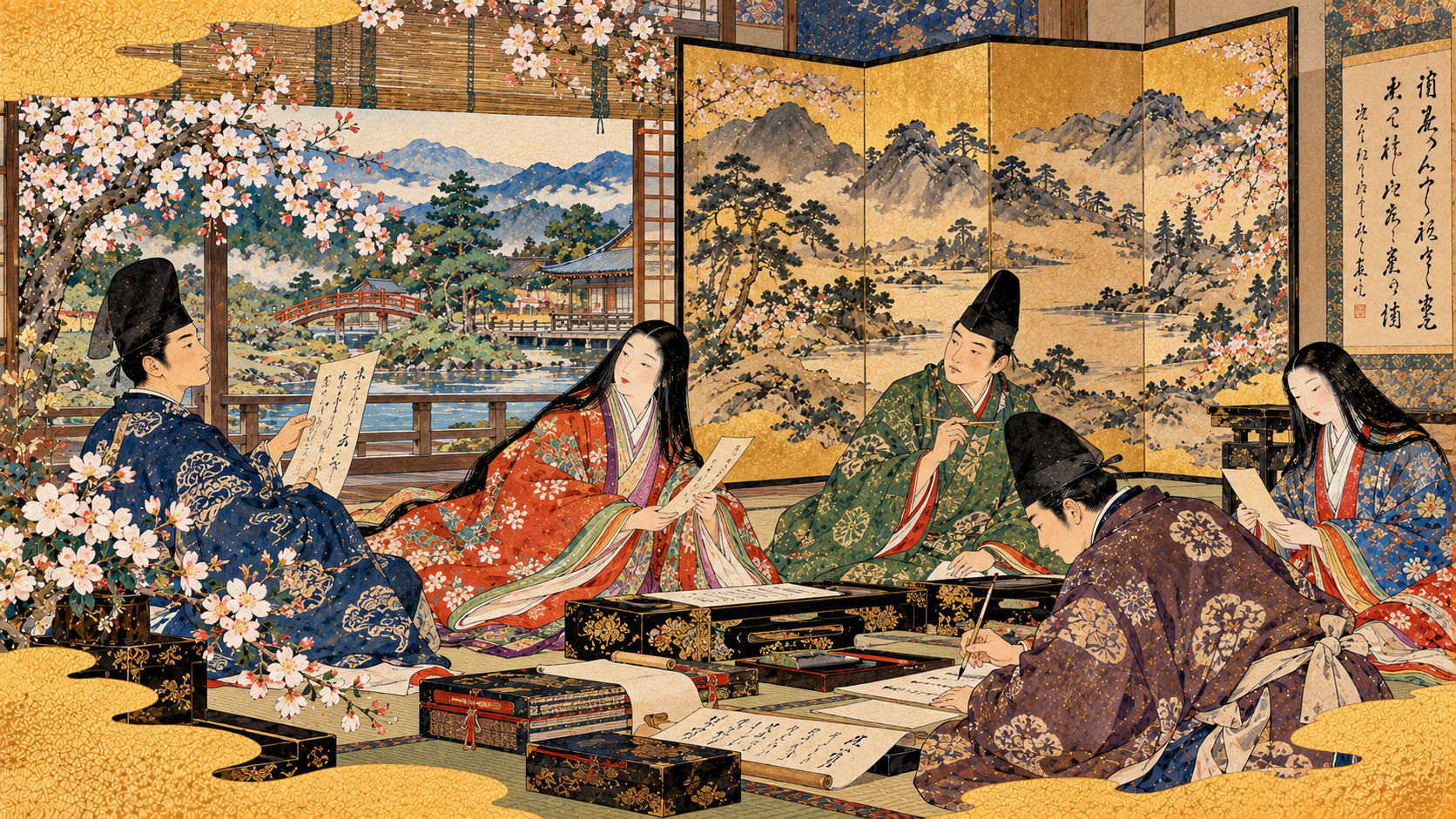
Imagine a gathering in medieval Japan: one participant supplies an opening verse, another responds, and a third changes the scene. The work grows not through a single author’s uninterrupted inspiration but through a series of attentive decisions. At Tokyo’s Gotoh Museum, a new exhibition explores how this shared literary practice, called renga, coexisted with painted screens, calligraphy and intricately decorated poetry sheets. “Muromachi-gokoro no fūkei—Hikari kagayaku shiki to renga kaishi no bi,” which opened October 27 and runs through December 6, asks visitors to read painting and look at poetry together.
What is actually on view
The exhibition’s announced focus is on Muromachi-period yamato-e folding screens and renga kaishi—sheets recording linked verse, sometimes embellished with seasonal designs in gold and silver pigment. Among the named objects are the Important Cultural Property Hamamatsu-zu byōbu, or Pine Beach Folding Screens, from the Tokyo National Museum; a 1423 offering of linked verse held by Atsuta Shrine; a 1432 renga manuscript from Enpukuji; and a manuscript of the anthology Shinsen Tsukubashū written by Sanjōnishi Sanetaka in the University of Tsukuba Library collection. The exhibition includes rotations, so the published list does not guarantee any particular object will be on display on every date.
How linked verse worked
A classical waka poem contains a 5-7-5 opening and a 7-7 conclusion. Renga grew into an art in which different people provided successive units, joining one image to another while finding ways to move forward rather than repeating a theme. The social setting mattered: the poet had to understand not only language and seasonal conventions but also the contribution of the person who came before. The resulting poem was a sequence of relationships. Its material record—a sheet of paper, a brush inscription, sometimes a painted underdrawing—made the gathering visible long after its voices disappeared.
A literary tradition centuries in the making
Japan’s National Institute of Japanese Literature traces linked verse back to exchanges associated with waka in the Heian period. The early anthology Tsukubashū was compiled during the Northern and Southern Courts era by figures including Nijō Yoshimoto. In the Muromachi period, poets such as Shinkei and Sōgi refined the form. The 1495 Shinsen Tsukubashū, compiled by Sōgi and others, assembled roughly 2,000 verses and stands as a landmark of renga’s literary sophistication. It is tempting to frame this as merely a precursor to haiku, but linked verse deserves recognition as a highly developed art in its own right.
A folding screen is a landscape of memory
The museum highlights the Hamamatsu-zu byōbu, an important cultural-property screen associated with Muromachi yamato-e. Its seasonal imagery provides a counterpoint to verses that rely on remembered flowers, birds, mist or moonlight. Such paintings did not simply photograph a place before cameras existed. They could arrange natural motifs into a visual field with literary associations. A modern viewer can move between the painting’s imagery and the poetry’s language, although the precise responses of historical viewers cannot be reconstructed from the announcement alone.
The extraordinary survival of a date
Atsuta Shrine’s Hōraku kasen renga carries a date corresponding to November 13, 1423. Another exhibit, Fu nanihito renga, is associated with September 13, 1432. Those are remarkably precise coordinates in cultural time. They remind us that medieval poetry was not just an anonymous body of canonical texts: it happened on particular days, among particular people, using tangible materials, sometimes in religious contexts. To encounter one of these sheets is to confront the survival of an event rather than merely the survival of an idea.
Sōgi and the art of answering someone else
Sōgi (1421–1502) occupies a central place in the history of renga. A Kyoto University catalogue describes a 1490 verse gathering involving Sōgi and other prominent poets, illustrating the collaborative structure of the genre. Later developments in haikai and haiku drew on this history, but renga had its own elaborate expectations about association and change. The most interesting question may be why a poetic culture placed so much artistic value on response—on an author’s capacity to make someone else’s phrase newly meaningful.
Why the Gotoh Museum matters
The museum was founded in Tokyo’s Kaminoge neighborhood on April 18, 1960, from the collecting ambitions of Keita Gotoh (1882–1959), a leading figure in the Tokyu business group. An admirer and collector of Japanese and East Asian art, Gotoh did not live to see the institution open. The museum today holds about 5,000 works, including celebrated national treasures, and is associated with the Daitokyu Memorial Library, an important research collection of historical books. That institutional background makes a show about the relation between verse, manuscript and painting particularly appropriate.
Gold, silver and the problem of translation
On decorated renga paper, gilded branches or a misty mountain may change how the written verse is encountered. The relationship is not necessarily illustration in the modern sense, where an image simply depicts a sentence. The design can provide a rhythm, a seasonal mood, or a point of tension. Translating a renga poem into another language can transmit its literal image while losing the formal play of connection and transformation. The physical artwork restores at least part of the experience that bare transcription cannot convey.
A different idea of authorship
Contemporary audiences tend to celebrate an identifiable creator. Renga complicates that instinct. A verse belongs to its writer, yet its full force is shaped by the line that preceded it and the line that follows. The exhibition provides an opportunity to think about collective creation without pretending that medieval renga was an early social-media platform or a form of modern artificial intelligence. Its historical world was distinct. The broader insight—that art can arise from disciplined listening as much as individual expression—still feels fresh.
Planning a visit
The exhibition is open October 27–December 6, 2026, at the Gotoh Museum, 3-9-25 Kaminoge, Setagaya, Tokyo, approximately five minutes on foot from Kaminoge Station on the Tokyu Oimachi Line. Hours are 10 a.m.–5 p.m., with last admission at 4:30 p.m. It closes Mondays except November 23, and closes Tuesday, November 24. Adult admission is ¥1,400; high-school and university students pay ¥1,100; younger children enter free. Gallery talks are scheduled for November 19 and 26, and reservations are required for some lectures. Check the museum site for display rotations and event registration.
Seeing the words again
The attraction here is not nostalgia for a quieter past. It is the discovery that a poem can be an event, an object and a shared landscape at once. A line of calligraphy has a place on paper. A flower painted beside it changes the air around the words. A second writer listens and answers. Six hundred years later, the room is silent, but the relationship among those things is still visible. That is what makes the Gotoh Museum’s new exhibition worth examining closely.
Sources and verification
Sources prioritize the Gotoh Museum and archival institutions. Works are subject to rotation. No firsthand gallery visit or independent curator interview is claimed.
- Gotoh Museum — official exhibition, works and programs
- Gotoh Museum — institutional history
- National Art Center — exhibition record
- Bunkamura — exhibition and renga introduction
- National Institute of Japanese Literature — Shinsen Tsukubashū
- Kyoto University Library — Fu nanihito renga
- Gotoh Museum — collections and library
- Tokyu — exhibition and visitor information