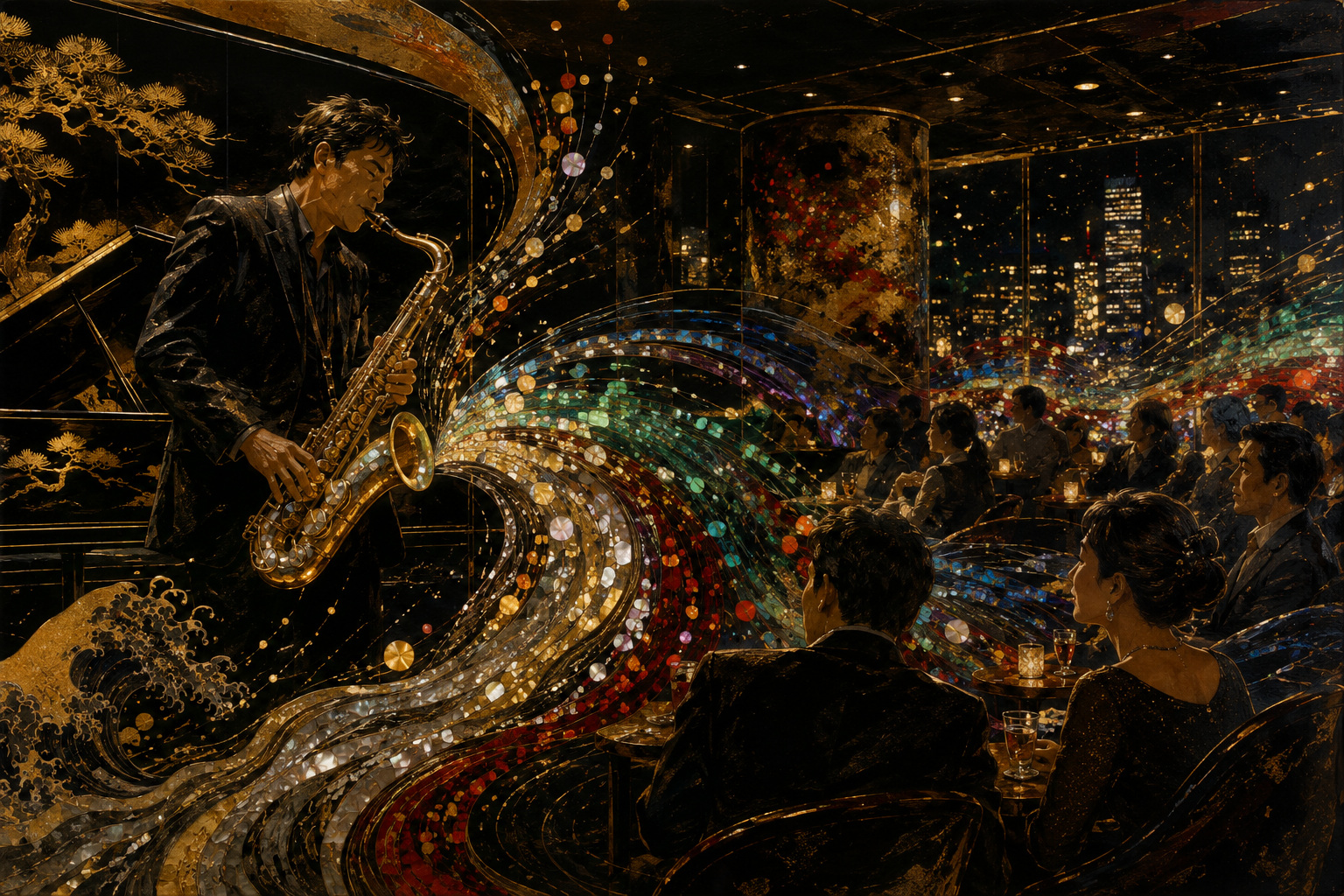
Darkness in a jazz club has a job. It narrows the room until a pianist’s fingers, a singer’s breath and the metal edge of a cymbal become the visible world. The players stand in the light. The listeners recede and answer from the shadows, usually with attention, laughter or applause.
For a moment this summer at Ginza Swing, that direction was reversed. Light traveled from the seats toward the band. Guests scanned a QR code and opened a page on their phones. No dedicated app was required. An operator changed the screens’ colors and motion, and the scattered rectangles became, in YEAAH’s description, a colorful wave moving through the audience. The Tokyo company said the effect created a new sense of togetherness inside the Ginza jazz club.
The protagonist was not a giant video wall or a global concert contractor. YEAAH was incorporated in 2016, is based in Ebisu-nishi and lists capital of just ¥1.5 million. Founder Keiji Mori studied mechanical information engineering and neuroscience information, worked at a patent office and a large consulting firm, then started the company. Its instrument is the most ordinary light source in the room: a display already in almost every pocket.
The lights were not fixtures. They belonged to the guests
“Penlight de YEAAH Cloud” avoids the first obstacle that kills many event interactions: asking a visitor to download software. A participant opens a web page from a QR code. From a separate management screen, the organizer can change the connected displays’ colors, flashing, logos and animation in real time. YEAAH says the control side also runs in an ordinary browser on a computer, tablet or phone.
The idea has been reduced and rebuilt over a decade. YEAAH released a consumer smartphone penlight app in 2016. Users could shake a phone to change its color, and a synchronization mode could make multiple phones display the same sequence. The company began implementation support for businesses in 2020, then released the browser-based cloud version in 2023. In 2025, it introduced a standard package priced at ¥50,000 for up to 500 people per event, later adding music-linked cues and a subscription aimed at recurring small events.
The Ginza case appears to advance from simple uniform color toward a spatial composition—a wave across the seats. But the August 5 announcement does not explain how individual seats or zones were assigned, whether software analyzed the music, or whether a human operator called each change. “Interactive” should therefore be read carefully. The audience supplied the pixels and chose to join; the available product documentation says the organizer, not each guest, centrally directs the final display.
- Known: guests enter through a QR code and browser; no dedicated app or physical penlight is required.
- Known: an operator can control screen color, flashing, logos and animation.
- Company claim: the Ginza jazz-club use produced a colorful wave and a stronger sense of unity.
- Not disclosed: the performance, repertoire, number of participating phones, seat-mapping method or connection failures.
- Not disclosed: data collected, cost of the case, audience or musician feedback, and whether it was a one-off or permanent installation.
A 50-year light that almost went out
Ginza Swing occupies the second floor of Ginza Inns 2, three minutes on foot from JR Yurakucho Station. Its official site dates the club to 1976. Jazz and Latin musicians have played there nearly every night in a room built around a grand piano, dinner tables and the intimacy that disappears in a concert hall. A player can read a listener’s face; the audience can hear not only the amplified note but the physical effort around it.
In 2026, the club prepared to close at the end of its 50th year. Then messages arrived. Patrons wrote that their youth would disappear with it and pleaded for one of Showa-era Ginza’s defining clubs to survive. Swing reversed course and announced that it would continue. Its renewal theme—“New Heritage New Swing”—promised support for younger musicians, changes to sound equipment, a clearer reservation system and a fan club. The goal was not to freeze the room as a museum but to carry its culture forward.
That chronology makes the phone lights more than a promotional novelty. The audience’s response had already helped keep the club alive. In the returning room, support became visible: people did not merely watch a heritage venue; their own hands helped illuminate it. The club lit the musicians, and the patrons lit the club back.
Ginza has been testing “new light” for 150 years
That this experiment happened in Ginza feels historically apt. The district’s name comes from the silver-coin mint established there in the Edo period. After the great fire of 1872 destroyed much of the area, the Meiji government used reconstruction to display a fire-resistant, Western-facing capital. Under British engineer Thomas Waters, brick buildings rose along a widened avenue.
Chuo City records say gas lamps were operating south of Kyobashi in 1873 and had become part of the district’s nightscape by the end of 1874. The brick buildings initially fit Japanese commercial life poorly and suffered vacancies, but newspapers and merchants moved in. Ginza became a showroom for bunmei kaika—“civilization and enlightenment.” Department stores, cafés, theaters, cinemas, electric signs and neon kept changing what modernity looked like after sunset.
A gas lamp did more than make a pavement safer. It was public media announcing that the district was connected to the future. A phone screen is usually a private window. Synchronized across a room, it briefly becomes civic or theatrical light. Where Meiji Ginza assembled a modern street one lamp at a time, the 2026 club assembled a temporary scene one palm at a time.
When jazz reached Japan, the audience danced
Jazz was not born as music for sitting silently in the dark. It developed in and around New Orleans’s African American communities from blues, ragtime, spirituals, brass-band music and other traditions, with improvisation at its center. In Japan, shipboard bands carried American dance scores home in the 1910s. In the early 1920s, professional local practice grew around dance halls in Kobe and Osaka, with visiting Filipino musicians among the important transmitters.
By the 1920s, “jazz” in Japanese urban culture could mean more than a precise musical form. It suggested motion, fashion, dancing and the unsettling speed of modern city life. Wartime pressure then treated American and British music as suspect. After 1945, occupation clubs, radio and imported records reopened the channel. Japanese players absorbed swing, bebop, modern and free jazz, and gradually made the vocabulary their own.
Japan also created a distinctive institution: the jazz kissa. Expensive imported records and serious audio equipment could be shared in a small café. Many kissa were dim, speaker-centered rooms where conversation was discouraged and listening approached a discipline. The walls might be lined with vinyl, but the main experience was invisible.
YEAAH’s illuminated audience sits in productive tension with that tradition. If every solo is accompanied by flashing screens, the visual mechanism can turn the music into background. Used briefly at an opening, transition, anniversary moment or finale, however, it can make the old jazz exchange—call, response, transformation—visible without replacing it. The important design question is not whether the system can light the room. It is whether the operator knows when not to.
| Period | Light after dark | Relationship between music and audience |
|---|---|---|
| 1870s Ginza | Brick street and gas lamps | The modern city displays itself in public |
| 1920s | Cafés, cinemas and electric light | Jazz carries dance and the speed of urban life |
| Postwar–1970s | Neon and dim jazz kissa | Live performance and concentrated record listening form parallel cultures |
| From 1976 | Stage lighting in an intimate club | Players and patrons share the room at close range |
| 2026 | Synchronized smartphone screens | The audience itself becomes a temporary visual surface |
Lighting changed not only in brightness, but in units of control
The history of theatrical lighting is partly a history of brighter sources—flame, gas, incandescent lamps and LEDs. It is also a history of finer control: where, when, in what color and at what intensity light appears. The DMX512 standard, developed in the 1980s, gave the entertainment industry a common digital language for connecting consoles, dimmers, luminaires and effects. A stage picture could be programmed instead of manually rebuilt at every instant.
YEAAH changes the method of distribution. Rather than purchasing and handing out hundreds of proprietary fixtures, an organizer borrows screens already owned by the audience. The cloud dashboard becomes a modest lighting console, the QR code an entrance, and the browser a receiver. That matters for a venue without an arena’s budget, storage, radio infrastructure or technical crew.
A phone is not a calibrated luminaire. Maximum brightness, color reproduction, battery state and network performance differ. Notifications can interrupt; a guest can close the page; a cellular network can congest. Screens cannot compete with stage fixtures for output. Yet the lack of uniformity also reveals the human element. This is not a flawless LED wall. Each slightly different rectangle is being held by someone who elected to join.
Three tests for an honest “participatory” experience
The first is restraint. Jazz depends on surprise and negative space. If every bar receives a programmed flash, the performance risks becoming the soundtrack to a gadget. The most credible uses are selective: the entrance, the end of an intermission, a chorus shared with the room, an encore or an anniversary acknowledgment.
The second is choice. Some guests do not own smartphones, need to conserve a battery, are sensitive to flashing light, or simply came to keep a screen closed. A good design makes nonparticipation ordinary. It controls height, duration, intensity and flashing speed so that one person’s involvement does not block another person’s sightline or create a health risk.
The third is transparency. What does the QR code connect to? What device or user information is logged, and for how long? If location and personal information are unnecessary, the organizer should say so plainly. If mobile data rather than venue Wi-Fi is required, guests should know. The simpler a technology looks at the front of the room, the more important its backstage explanation becomes.
- Agree cues and a stop procedure with musicians, especially when improvisation changes a song’s length.
- Set accessibility rules for flashing rate, brightness, color and duration.
- Protect the view and experience of guests who do not participate.
- Display the genuine destination of the QR code, data collected and retention period.
- Assume connection congestion, different devices and dead batteries; keep a non-phone alternative.
The gap a small company can see
Large event-technology companies can synchronize proprietary light sticks across a stadium with dedicated radio networks and precisely mapped seats. That is not what a room like Ginza Swing needs. A 50-year-old club does not need a miniature Olympic opening ceremony. It needs a tool that can be prepared quickly, stored nowhere, run by a small team and used for a few decisive minutes.
YEAAH’s bet is that the required equipment is already in the audience’s pockets. Small capitalization is not proof of reliability, and a press release is not independent evidence of success. But a small company can make venues uneconomical for an arena contractor central to its product. The published standard price, subscription option and app-free design point toward independent concerts, school events, neighborhood festivals and corporate ceremonies that previously had no lighting budget.
The innovation is less a new semiconductor than a reduction in friction. Do not force a download. Do not distribute hardware. Do not collect it afterward. Compress the guest’s task into one scan. Technological histories celebrate spectacular inventions, but adoption is often decided by this quieter labor of removing inconvenience one step at a time.
The next question is not whether it glowed, but whether it remained
A photograph can prove that a room lit up. It cannot prove that a club experience improved. The serious measures begin after the night: Did patrons remember the performance more vividly? Did musicians feel a clearer response from the room? Did participation lead to a return visit, membership or support for the venue? Anonymous participation rates, return rates and open-ended comments could turn the press release’s “sense of unity” into something more testable.
The club must also learn what not to illuminate: the quietest bar of a ballad, an unaccompanied bass line, the moment a singer steps away from the microphone. Choosing not to insert a screen is part of lighting design. Jazz improvisation does not promise to obey a software timeline; the best operator will not control the music but listen and wait.
Ginza accepted gaslight, adapted its brick district, turned neon into urban memory and repeatedly renewed old establishments. Swing, saved by its patrons, is trying to carry a 50-year light forward as “New Heritage” rather than nostalgia. YEAAH’s little rectangles offer one possible answer to that enormous assignment.
When the set ends, every screen returns to being a private device. Guests pass the ticket gate, read messages and open maps. But the seconds in which one person’s light joined the next person’s light form a kind of memory no studio recording contains. Jazz clubs have always sold precisely that: no performance happens twice. At Ginza Swing, for one night, no audience looked the same twice either.
Reporting notes and sources
This article reflects public information checked through August 5, 2026 at 9:41 a.m. Japan Standard Time. The installation outcome is a YEAAH company claim. Participant count, technical architecture, price paid and user evaluation were not disclosed. Official, administrative and primary materials were prioritized for the history.
- PR TIMES / YEAAH: A colorful wave of light spreads through the audience at a Ginza jazz club (August 5, 2026; Japanese)
- YEAAH: Penlight de YEAAH Cloud product page
- YEAAH: Company profile
- YEAAH: Standard package and published pricing (June 12, 2025)
- Ginza Swing: Official site, location, hours and 1976 founding
- Ginza Swing: Continuation announcement and “New Heritage New Swing”
- Chuo City: Historical digest
- Chuo City: Ginza fire, brick district and gaslight history
- Smithsonian National Museum of American History: What is Jazz?
- At Jazz: Ginza Swing venue information