- A new name in an intensely familiar business
- The supermarket as a collection of specialists
- An origin story far from Tokyo
- The economic logic of making what you sell
- Yokohama provided the first metropolitan rehearsal
- A large store on a former competitor’s footprint
- Competition is about where people choose to spend a routine hour
- What this Tokyo opening means for Gifu
- The 5-billion-yen ambition—and what to watch next
A new name in an intensely familiar business
In Tokyo, a supermarket has to earn the right to become a habit. Convenience, price and proximity often settle the decision before a shopper ever considers the name above the door. Yet on November 6, a grocer whose roots lie in the hills of Gifu Prefecture opened its first Tokyo store with a different proposition: people might travel farther for food if the experience and the products gave them a good enough reason.
The company is Valor, and its new Honhaneda supermarket occupies a former Olympic retail site in Ota Ward, near the Tama River. It is Valor's second supermarket in the Kanto region, following a November 2025 opening in Yokohama. That distinction matters. The wider group had operated businesses in the region before, but the Valor supermarket format itself is only now being tested in the country's largest consumer market.
Trade publication Ryutsu News reported that shoppers began lining up around 6 a.m. on opening day. With a line approaching 200 people, the store opened at 8:50 a.m., earlier than the scheduled 9:30 a.m.; the publication described later entry restrictions and a wait reaching two hours. These are figures from the trade reporter's visit, not observations independently gathered by JAPAN.co.jp. An opening-day crowd demonstrates curiosity. It does not yet prove loyalty.
That is the question at the heart of Valor's Tokyo experiment: can a retailer that built its identity outside the capital become a destination for customers whose options are already abundant?
The supermarket as a collection of specialists
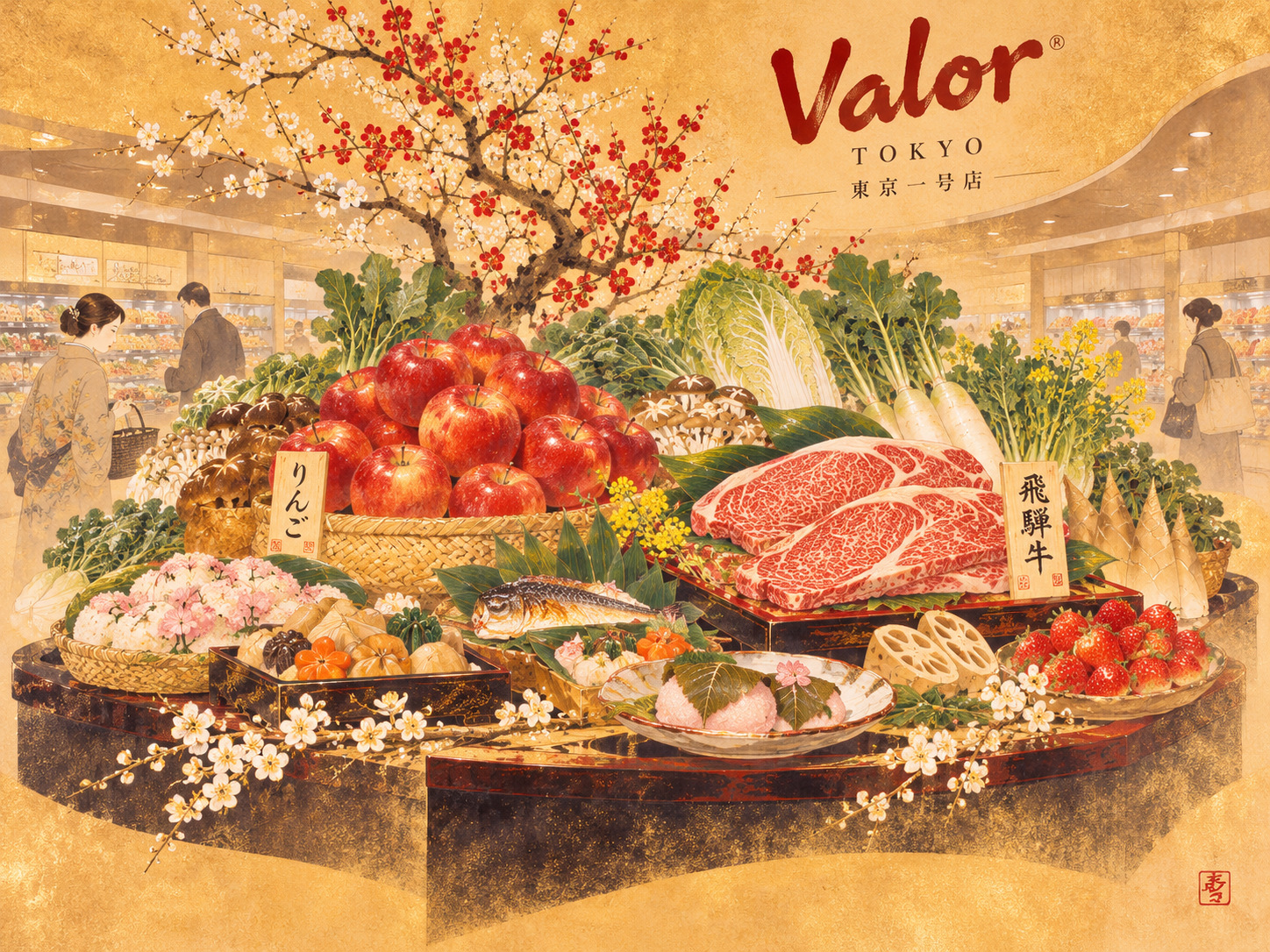
Valor Holdings' official opening announcement describes a “destination store”: somewhere people deliberately choose to visit rather than simply stop at because it is nearby. The concept is expressed through departments designed to feel more like a greengrocer, fishmonger and butcher working together than anonymous aisles of interchangeable packaged products.
At Honhaneda, the produce section emphasizes seasonal fruit and vegetables, along with flowers. The seafood department offers whole fish through counter service, sushi and seasonal prepared dishes. The meat section highlights Hida beef from the company's home prefecture, Japanese black-haired wagyu, and products such as in-house roast beef and roast pork. Bakery items and fresh-fruit desserts are part of the offer too. Valor's official store listing identifies dedicated corners for its Hokuo Club bakery, fishmonger's sushi and greengrocer's fresh-fruit desserts.
This strategy is not simply a claim to lower prices. It is a bet that expertise and distinctiveness can influence where customers shop. Industry coverage of the opening described the use of a live shellfish tank and counter displays that resemble a fish market. These details suggest an attempt to turn shopping into selection and discovery rather than a purely functional transaction.
A good fish counter is expensive to operate well. It needs knowledgeable staff, an appropriate supply chain and the discipline to manage perishable stock. What distinguishes the idea is not that anyone can offer beautiful seafood on opening morning, but whether the retailer can deliver that standard repeatedly at a price enough households will pay.
An origin story far from Tokyo
The supermarket started in Ena, a city in eastern Gifu Prefecture, in 1958. According to Valor Holdings' corporate history, founder Yoshimi Ito established a company called Shufu no Mise, or “Housewives' Store,” that July and opened its first supermarket in September. The idea of selecting food in one self-service shop offered a practical alternative to visiting separate specialists for fish, vegetables and other necessities.
In 1970 the business became Shufu no Mise Valor, and in 1974 it adopted the shorter Valor name. The company traces the name to the concept of courage. Its headquarters moved to Tajimi, also in Gifu, in 1977. Over the following years, the business expanded beyond selling goods across a counter: Chubu Foods was established in 1985, and a distribution center opened in Tajimi in 1989.
The important historical transition is from supermarket chain to integrated retail organization. Valor invested in purchasing, processing, manufacturing and logistics in addition to stores. Its own account of the 1990s and 2000s emphasizes the ability to source goods more broadly and reduce dependence on traditional supplier arrangements.
This history explains why Honhaneda is more than a change in postcode. The company is bringing a system developed in regional Japan into a metropolitan market where procurement capacity, merchandising discipline and repeatable execution matter as much as attractive signage.
The economic logic of making what you sell
Private-label products and prepared foods allow a retailer to compete on attributes that are harder for a neighboring store to duplicate exactly. In an integrated system, sourcing, manufacturing, distribution and retail merchandising can inform one another. A processor can build a product around available seasonal ingredients. A store can adjust display and assortment based on demand. Logistics operations can be designed for the freshness and frequency the offer requires.
Valor's corporate history supports the significance of manufacturing and distribution to its growth. Valor’s October 30 opening document lists approximately 700 private-label products as part of Honhaneda’s proposed assortment. The number is a point-in-time trade-report observation; it should not be confused with a guarantee that every one is always in stock.
The potential upside of vertical integration is differentiation. Its risks are complexity and cost. Running production capacity and carefully managed fresh-food departments may help product quality and consistency, but it also creates fixed commitments. Spoilage, waste, labor costs and inventory mistakes can erode margins quickly. None of the publicly accessible opening materials establishes Honhaneda's future profitability, and a crowded first day cannot answer the question.
Yokohama provided the first metropolitan rehearsal
The chain's first Kanto store, Yokohama Shimonagaya, opened on November 21, 2025. Valor's own announcement made clear that the move was a serious entry into the Kanto market, even though its broader group was already present there through other businesses. A case study published by store-equipment company Okamura describes Yokohama's merchandising: a seafood counter supplied substantially from Tokyo's Toyosu market, a live-fish or shellfish presentation, prepared regional specialties, and a substantial meat department.
Honhaneda builds on that earlier model. Its official retail sales area is 2,177.93 square meters, compared with approximately 2,041 square meters at Yokohama Shimonagaya. The company presents both as flagship-style locations intended to introduce the brand in Kanto, not merely additions to a national store count.
But the market environments are not identical. A store in suburban Yokohama faces different shopping patterns from a location in Ota Ward. The selection of neighbors, commuter movements, households' transportation options and the economics of fresh-food delivery all matter. Local preference cannot be copied as mechanically as a store floor plan.
The opening succeeds strategically only if the company learns which elements of its regional identity travel well and which must change in response to Tokyo shoppers.
A large store on a former competitor’s footprint
Honhaneda is located at 1-23-25 Honhaneda, Ota-ku, Tokyo, at the former Olympic Honhaneda property. Valor's October 30 corporate announcement provides unusually detailed store specifications. The supermarket's sales floor measures 2,177.93 square meters. Its back-of-house area adds 1,509.62 square meters, while the supermarket's total occupied area, including shared space, is 4,091.14 square meters. The wider building has four floors and parking for 304 vehicles.
Ordinary supermarket hours are listed as 10 a.m. to 8 p.m. The store advertised an exceptional 9:30 a.m. start for November 6–8; those special hours should not be mistaken for its permanent timetable. The wider retail property includes Pony Cleaning, which began operating November 6, with Nojima electronics scheduled for November 19 and Sugi Pharmacy, Seria and JINS scheduled for November 26. Those later tenant dates remain plans and can change.
Such details matter for the business case. Parking can support households making larger trips. Complementary tenants can create reasons to visit beyond groceries. But a four-floor property is not automatically a competitive advantage: how smoothly customers move between parking, groceries and other errands will influence whether convenience offsets the effort of getting there.
Competition is about where people choose to spend a routine hour
The site's previous tenant was Olympic Honhaneda, reported to have closed in December 2025. Nearby grocery competitors give residents alternatives. But the word “competitive” is not, by itself, an explanation. A shopper wanting affordable pantry staples may value a very different proposition from someone seeking a whole fish for dinner or a prepared meal after work.
Valor is trying to compete across those occasions without surrendering its identity as a food specialist. That is difficult. A differentiated fresh-food destination has to be appealing enough to attract a deliberate visit yet convenient enough to become routine. A store whose most impressive offerings matter only on holidays may struggle to achieve the steady weekday sales needed to support its investment.
There is also a tension between the theatre of a fish counter and the economics behind it. Extra service and assortment can raise staffing needs and waste exposure. A strong bakery or prepared-food program can improve shopping frequency, but only if customers continue buying at full prices after the novelty fades. These are testable propositions rather than established outcomes.
What this Tokyo opening means for Gifu
Valor's expansion makes the flow of commerce between regional Japan and the capital visible. The company began in Ena, grew its organizational roots in Tajimi, and now seeks to sell a particular understanding of quality and food culture in Tokyo. Hida beef on a metropolitan meat counter is a tangible example of how a local identity can travel. It does not, by itself, prove increased income for farmers in Gifu: that would require purchasing and sales data.
Regional economic success is often discussed as attracting investment back from big cities. This is the reverse story. A company rooted in a regional prefecture is exporting operational capability, supply-chain knowledge and retail formats outward. The question is whether that expansion creates enduring value for the home region as well as the new market.
If it works, the business model could strengthen brand recognition, support investment and create additional channels for some suppliers. If it fails, the challenge will not be that Gifu's food was insufficiently attractive, but that dense metropolitan retail markets punish costly miscalculations in site selection and execution.
The 5-billion-yen ambition—and what to watch next
In the opening-day report by Ryutsu News, Valor Holdings President Takayuki Koike described an ambition for annual sales of ¥5 billion at Honhaneda. That is a target attributed to management, not independently verified revenue, a forecast endorsed by JAPAN.co.jp or a measure of profits. At the user-supplied reference exchange rate of ¥158.45 per US dollar as of 7 a.m. Japan time on November 7, the ambition corresponds to roughly $31.6 million; the currency comparison is illustrative, not a live exchange-rate quote.
The more meaningful questions will emerge after weeks and months of trading. Will the crowds return on ordinary weekdays? Which products build repeat purchases? Can the store deliver high-quality seafood, meat and prepared foods while controlling waste and labor expenses? Will a larger Kanto distribution footprint help? Which neighborhoods could become plausible next locations? A company statement reported by Gifu Shimbun indicates interest in further expansion around western Tokyo and Yokohama, but site commitments have not been established by the sources reviewed.
In 1958, the innovation at Ena's Housewives' Store was putting many daily necessities within reach in one self-service location. In 2026, the Tokyo experiment asks a different question: can a regional retailer make people choose one food store in preference to many others? An impressive opening made the question visible. Only habitual shoppers will provide the answer.
Store information
| Opened | November 6, 2026 |
|---|---|
| Address | 1-23-25 Honhaneda, Ota-ku, Tokyo |
| Sales floor | 2,177.93 square meters |
| Parking | 304 spaces |
| Regular hours | 10:00 a.m.–8:00 p.m. |
| Telephone | 03-6423-2832 |
| Regional rollout | Second Valor supermarket in Kanto after Yokohama (2025) |
Opening hours and planned tenant dates may change. Check official store information before traveling.
Sources and reporting notes
Official corporate statements are distinguished from opening-day observations and management ambitions attributed to external reporting; target revenue is not actual revenue.
- Valor Holdings: Honhaneda opening announcement (October 30, 2026)
- Valor Holdings: corporate history
- Valor: Honhaneda store information
- Valor Holdings: first Kanto store announcement (2025)
- Ryutsu News: opening-day trade report (November 6, 2026)
- Diamond Chain Store: merchandising report (November 6, 2026)
- Gifu Shimbun: Tokyo opening coverage (November 7, 2026)
- Okamura: Yokohama Shimonagaya store case study