- A reassuring newborn test—and a problem that appeared months later
- The feedback loop that keeps thyroid hormones in balance
- The paradox of a missing brake
- Why the parent of origin matters
- A second missing gene complicates—and enriches—the finding
- How newborn screening changed pediatric medicine
- An old scientific question becomes a clinical one
- A collaboration across Gifu and Hiroshima
- What this single case can—and cannot—tell us
- The question a newborn test cannot finish answering
A reassuring newborn test—and a problem that appeared months later
An infant’s first thyroid results did not call for repeat testing. Yet, starting around five months of age, free thyroxine, or fT4, began falling. The usual biological response would be for the pituitary gland to raise thyroid-stimulating hormone, TSH, and urge the thyroid to produce more. That compensating rise did not occur. The mismatch pointed toward central hypothyroidism, a disorder of the regulatory system that controls the gland rather than simply a malfunction of the gland itself.
A group led by Gifu University investigators identified an unusual chromosomal deletion inherited from the father. Among the genes lost was DIO3, which normally helps deactivate thyroid hormones. Their report, published online October 24 in the American Thyroid Association journal Thyroid and announced by the university November 5, provides a first clinical connection between paternal DIO3 loss and delayed-onset central hypothyroidism. It is evidence from one patient, not a population study or a new therapy.
The feedback loop that keeps thyroid hormones in balance
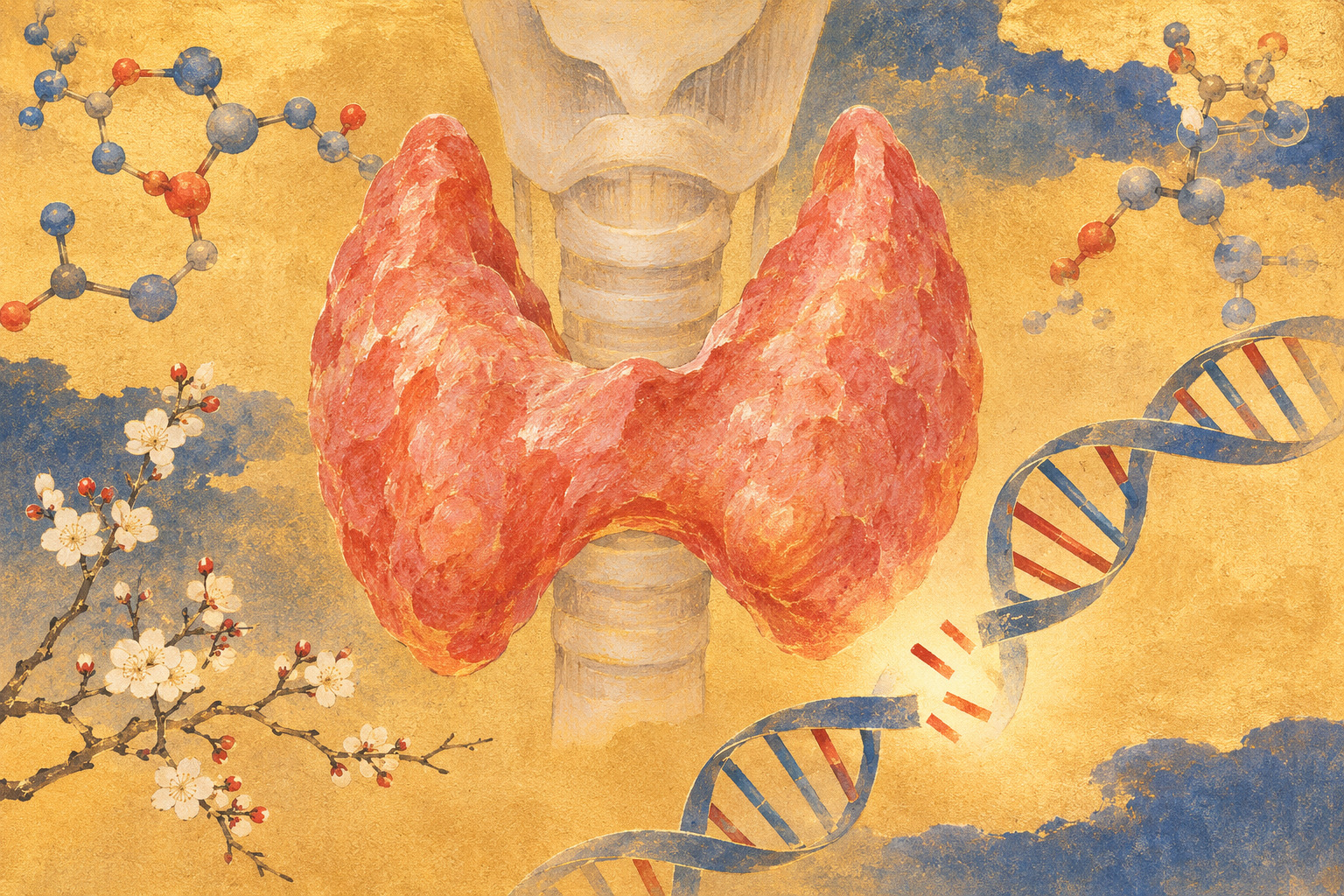
The thyroid, a butterfly-shaped gland at the front of the neck, makes hormones essential to metabolism and to normal growth and neurological development. Its output depends partly on instructions from the hypothalamus and pituitary gland. In a simplified feedback loop, lower thyroid hormone usually leads to greater TSH release; higher levels suppress that signal. Clinicians interpret both the output hormone and the regulatory signal when determining what has gone wrong.
That distinction is central to the case. In primary hypothyroidism, the gland fails to meet the body’s needs and TSH commonly rises. In central hypothyroidism, the higher-level signalling does not respond appropriately, so fT4 can be low without the expected TSH elevation. A screening program built mainly around elevated TSH is extremely valuable for detecting common primary cases but cannot be assumed to exclude every form of central disease. Japan’s Pediatric Endocrine Society explicitly notes that a small number of congenital hypothyroidism cases escape newborn screening.
The paradox of a missing brake
DIO3 encodes type 3 iodothyronine deiodinase, usually called D3. Unlike enzymes that help activate thyroid hormone, D3 inactivates it, converting T4 into reverse T3 and T3 into an inactive metabolite. The enzyme is particularly relevant during fetal life and early infancy, when developing tissues must be protected from inappropriate hormone exposure.
So why might a missing inactivation enzyme eventually be associated with too little thyroid hormone? Earlier experiments in Dio3-deficient mice produced a counterintuitive sequence: excessive thyroid-hormone action around birth, followed by central hypothyroidism. Scientists have considered whether disruption during a sensitive developmental period might alter the programming of the hypothalamic-pituitary-thyroid axis. The new human case is compatible with that idea. Crucially, the investigators have not demonstrated that the infant experienced the same early excess seen in mice, nor established the entire causal chain in humans.
Why the parent of origin matters
Most genes are inherited in two copies, one from each parent, and many are expressed from both. A smaller set is affected by genomic imprinting, which means gene expression differs according to parental origin. Previous human work has found preferential expression of the paternal DIO3 allele in neonatal skin. Losing a paternal copy might therefore matter differently from losing a maternal copy, although imprinting patterns can vary among tissues.
The researchers used chromosomal microarray analysis to identify a 14q32.31–q32.33 deletion that included DIO3. The published abstract traces this deletion to a paternal balanced translocation involving chromosomes 4 and 14. That inheritance pattern is a striking feature of the case and strengthens the biological hypothesis, but an association in one child does not prove that no other genes or pathways contributed. The precise molecular steps in the developing human brain remain open questions.
A second missing gene complicates—and enriches—the finding
The deleted chromosome segment also contained TRAF3, a gene involved in immune signalling. The patient had T-cell lymphopenia detected in the neonatal period. The researchers considered that finding consistent with TRAF3 haploinsufficiency, a condition in which one functioning copy of the gene is insufficient for normal activity. Thus, immune testing provided an early clue even before the later thyroid pattern became apparent.
The university’s Japanese release also discusses a possible hearing component and the idea that overlapping immune, endocrine and auditory features might eventually define a syndrome. That is a research possibility, not an already validated diagnosis applicable to a wider group. One contiguous chromosomal deletion can affect several neighboring genes; sorting out their individual contributions requires more patients, follow-up and functional work.
How newborn screening changed pediatric medicine
The broader medical context matters. Japan’s newborn mass-screening programs have made it possible to detect many cases of congenital hypothyroidism before clinical symptoms emerge. Earlier recognition and appropriate thyroid-hormone replacement have greatly improved the prospects for children who would otherwise face risks to development. The Japanese Society for Pediatric Endocrinology describes TSH testing as a mainstay, with fT4 measured in some regions as well.
This patient’s newborn TSH and fT4 did not meet repeat-testing criteria; the concerning hormone trajectory developed later. The finding suggests that selected infants with relevant genetic or immune abnormalities may need additional endocrine attention even after an initially reassuring result. It does not establish that every newborn requires repeated thyroid testing, and it cannot on its own support a nationwide change in screening policy. That question demands evidence about frequency, clinical benefit, costs and potential harm.
An old scientific question becomes a clinical one
For decades, the significance of thyroid hormones in childhood has been understood mainly through the consequences of insufficient supply and the value of prompt replacement. The DIO3 research broadens that story by asking whether the timing and local intensity of hormone action can shape the endocrine regulatory system itself. In a developing organism, simply measuring how much hormone circulates may not fully explain what particular tissues experienced months earlier.
The mouse experiments supplied a plausible sequence long before human evidence existed. The Gifu case now gives researchers a rare opportunity to link a naturally occurring genetic deletion with a clinical trajectory. It also sharpens the distinction between a mechanistic clue and a confirmed biological mechanism. Longitudinal hormone data, tissue-specific expression studies, and comparison with other patients will be needed to test the proposed developmental explanation.
A collaboration across Gifu and Hiroshima
The research was conducted by pediatric investigators including Tomohiro Hori and Professor Hidenori Ohnishi at Gifu University, alongside specialists at Gifu Prefectural General Medical Center and Hiroshima University. The paper’s author list includes clinicians and researchers with expertise spanning pediatric medicine, genetics, neonatal care and immunology. Japan’s Agency for Medical Research and Development, AMED, is among the funders named in the Japanese announcement.
The interdisciplinary nature of the work is one of its lessons. A neonatal immune finding, a later endocrine abnormality and a chromosome-level test might easily seem like separate stories. Bringing those observations together revealed a plausible shared genetic explanation. In rare pediatric diseases, collaboration between clinical services and research laboratories can matter as much as any single technical instrument.
What this single case can—and cannot—tell us
The journal abstract concludes that delayed-onset central hypothyroidism was most consistent with paternal DIO3 loss, while the associated T-cell lymphopenia was consistent with TRAF3 haploinsufficiency. The language is deliberately cautious. The observation concerns one patient with a deletion spanning more than one gene, not an isolated experiment removing only DIO3 in a human. Its frequency, variability, lifelong course and appropriate screening interval remain unknown.
Nor does the finding introduce a gene-editing treatment or imply that families should change medication based on a news report. Management of thyroid-hormone deficiency relies on established specialist evaluation and treatment. For research, the promising next step is identifying comparable cases and determining whether the predicted hormone trajectory repeats. Independent clinical replication would make the case for a specific syndrome substantially stronger.
The question a newborn test cannot finish answering
Newborn screening represents a snapshot, and it is often extraordinarily effective. But a child’s endocrine system is still developing after the sample is collected. The Gifu investigation asks whether genetic information and signs from other organ systems could help clinicians identify the small subset of infants whose thyroid function needs continued attention despite reassuring initial results.
That is why this is a meaningful discovery from regional Japan. It does not solve a common thyroid disorder in one stroke. Instead, it turns a carefully documented child’s medical trajectory into a question that investigators around the world can test: how can the loss of a hormone-deactivating enzyme in early life reshape the way the body regulates thyroid function later? The most valuable answer will come from sustained research, not from a larger headline.
Sources and scientific limitations
The original scientific abstract and Japanese primary sources ground the case details. The proposed mechanism is distinguished from observed patient data. A full independent re-analysis of laboratory values was not performed.