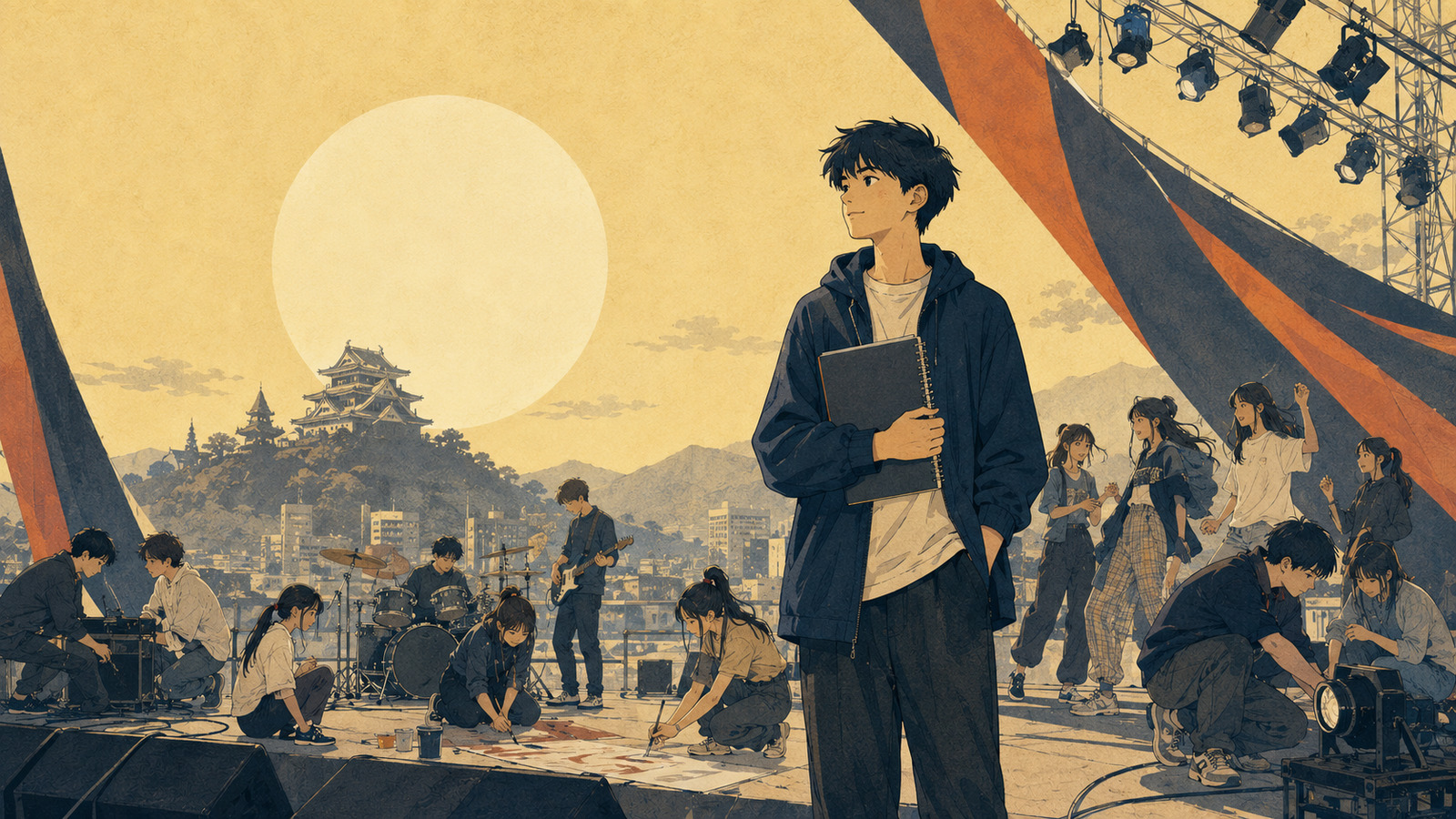
The lights are still imaginary. So are the hall, the running order and the names on the poster. But in Gifu, a 17-year-old high-school senior has already drawn a boundary around the audience: this stage is to belong to people aged 18 and under.
Kensuke Kamiya, founder and chief executive of the newly incorporated Liiivv Inc., announced on July 23 that the first CHAPTER18 festival is planned for March 10, 2027. The company describes it as an open, theater-style, genre-free youth-culture event in Gifu City, with professional artists and performers aged 18 or younger sharing a stage. It is not invitation-only; anyone inside the age limit is meant to be able to attend.
The idea is daring because the business behind it is so young. Liiivv was incorporated on June 8, 2026, with capital of ¥1 million. It is seeking ¥25 million to ¥30 million in sponsorship for the festival—25 to 30 times its stated capital. The latest detailed plan expects 1,000 to 1,200 participants. A venue is still being negotiated, and the artists, ticket terms and detailed program are to be announced later.
This is therefore not yet a report from a completed festival. It is the story of a promise entering the unforgiving passage from identity to execution. That passage—contracts, budgets, child protection, insurance, production schedules and ticket sales—is precisely what makes Kamiya’s project more revealing than another inspirational profile of a teenage founder.
A Festival About “How to Live”
CHAPTER18’s concept is “Beyond What You Know.” Liiivv insists that it is not merely an event “for students,” but a youth-culture brand intended to express the sensibility, culture and ways of living of teenagers. Music is central, but the word “genre-free” leaves room for art, performance and forms that do not fit a school club or music-industry category.
Kamiya’s stated grievance is not a shortage of entertainment. It is a shortage of places where teenagers can test an unfinished identity. Grades, entrance examinations, clubs, social-media presentation and adults’ expectations all produce answers about what a successful life should look like. CHAPTER18 proposes a place where uncertainty is not a defect and where a young performer does not appear as the student act before the professional act, but on the same bill.
The difference is subtle but important. Adults often construct youth events around improvement: learn a skill, hear a career lecture, win a pitch contest. Kamiya is trying to construct one around authorship. The audience is not being invited to prepare for culture later. It is being told that its culture exists now.
What Has—and Has Not—Been Announced
| Confirmed or stated | Still open as of the July 23 announcement |
|---|---|
| March 10, 2027; Gifu City; theater-style and genre-free; admission intended for ages 18 and under; professional and youth performers; open rather than invitation-only. | The specific hall, performers, ticket price and sales method, detailed timetable, age-verification method, minimum age, guardian arrangements, accessibility, transport and safeguarding rules. |
| The latest detailed table gives a scale of 1,000–1,200 and a sponsorship goal of ¥25–30 million. | The June founding announcement listed 1,200–1,500; the July release’s headline still says “up to 1,500.” The public materials need one reconciled capacity figure. |
| An organizing committee is being recruited, with production, booking, publicity and operations functions described in an earlier volunteer listing. | Final decision rights, paid versus volunteer roles, professional production supervision and the governance structure have not been publicly detailed. |
These are ordinary gaps for an event eight months away. They are also decisive ones. An announced date becomes a festival only after a venue contract, a finance plan and an audience-safety system meet. The fair way to cover CHAPTER18 is neither to dismiss it because the founder is 17 nor to certify it because the ambition is vivid. It is to make the milestones visible.
The Long Rehearsal Inside Japanese Schools
Teenagers running a festival is not alien to Japanese education. The school culture festival—bunkasai—is one of the country’s most recognizable forms of student production. Classes and clubs design exhibits, cafés, bands, plays, dance performances, publicity and crowd flow. Students negotiate scarce rooms and rehearsal time, divide labor and discover that a good idea can fail because no one ordered enough extension cords.
The institutional roots reach through Japan’s history of special activities. In the late Meiji period, schools developed trips, sports days and autonomous student associations outside ordinary lessons. The provisional 1947 curriculum introduced “free study”; when that subject proved difficult to administer, the 1948 revision reorganized it into non-subject and special educational activities. Later curricula formalized homeroom, student-council and school-event work as part of education.
Today the Ministry of Education explicitly treats collaboration across grades at sports and culture festivals as a place to learn human relationships, social participation and self-realization. The tradition is student-led, but it remains bounded by school: teachers supervise, the institution holds insurance and contracts, and participation occurs inside a known community.
CHAPTER18 takes the creative machinery of the bunkasai beyond the school gate. Its participants may come from different schools or none. Its budget depends on external sponsors, its artists may have agencies, and its public venue has professional obligations. It converts a protected educational exercise into a real cultural enterprise.
The Number 18 Changed Meaning
CHAPTER18 arrives after a decade in which “18” was rewritten in Japanese public life. The voting age fell from 20 to 18 in 2016. NHK began its 18 Fes that year, bringing 1,000 members of the 18-year-old generation together with a major artist for a one-night performance. In April 2022, the civil age of majority also fell from 20 to 18.
The festival’s phrase “18 and under” therefore crosses a legal border. An 18-year-old can generally enter contracts without parental consent and cannot cancel merely by claiming minority. At 17, Kamiya remains a minor under the Civil Code. The public announcements do not describe the consents or governance arrangements surrounding his corporate role, making a clear account of adult legal and professional support important. Government business records confirm Liiivv’s corporate number and Gifu address, but a registered company does not remove the practical asymmetry between youthful creative control and adult legal responsibility.
This makes the brand boundary conceptually rich. It joins children who may require guardians, high-school students with growing autonomy, and 18-year-olds whom the law now calls adults. A successful event must respect all three realities rather than treating “under 18” as a single, simple audience category.
From Business Plans to Real Balance Sheets
Japan has spent more than a decade building a pipeline for youth entrepreneurship. The Japan Finance Corporation launched its High School Business Plan Grand Prix in fiscal 2013. The first competition drew 1,546 plans from 151 schools. The 13th competition, held in fiscal 2025, received 5,640 plans from 639 schools. What was once an unusual extracurricular experiment has entered hundreds of classrooms.
The government’s 2022 Startup Development Five-year Plan called for expanded entrepreneurship education for elementary, junior-high and high-school students. The Ministry of Education emphasizes that entrepreneurship education is not simply instruction in how to form a company. It is the practice of identifying problems, mobilizing people and creating new social or economic value. Tokyo’s 2026 high-school program, for example, uses food, founders and a seven-session workshop to connect personal interests with venture-building.
Yet most youth programs stop at a presentation. Judges praise a plan, prizes are awarded and the student returns to school. CHAPTER18 has crossed into a harder category. It has a corporate entity, a public date, a fundraising target and future customers. The lesson is no longer only confidence. It is whether suppliers get paid, data are protected and the doors open safely on time.
That distinction matters in a country where the business startup rate has recently remained around 5 percent and official reviews still describe early entrepreneurship education as weaker than the international average. Japan does not lack ideas. It often lacks repeated, socially accepted routes from intention to first sale.
Why Gifu Is More Than a Backdrop
Liiivv says beginning in Gifu rather than Tokyo is a strategic choice. That claim should be tested against the geography. Gifu City’s population fell below 400,000 in 2024. Children under 15 numbered 46,175, or 11.6 percent of residents, while people 65 and older numbered 116,976, or 29.3 percent. A recent city planning document says roughly 80 percent of Gifu Prefecture’s high-school students who proceed to university go outside the prefecture; people in their twenties are consistently a net outflow, with the Nagoya area exerting the strongest pull.
A festival cannot reverse demography. It does not create a university place, a permanent job or affordable housing. But it can alter a young person’s mental map. If serious artists, sponsors and production work can be assembled locally, Gifu becomes not only the place one departs from, but a place from which something can begin.
That is the strongest regional case for CHAPTER18. The event need not persuade every attendee to stay. It can build networks that remain useful when students leave and make return or remote collaboration imaginable. Cultural infrastructure is part of economic infrastructure because people choose places partly by whether they can find peers, audiences and permission to attempt something.
A ¥30 Million Test of Credibility
The proposed sponsorship target—¥25 million to ¥30 million—is substantial for a company capitalized at ¥1 million. Capital is not the same as an event budget, and sponsorship can finance production without being recorded as equity. Still, the ratio reveals the scale of external trust Liiivv must earn.
A 1,000-person theater event can consume money quickly: hall and equipment rental, artist fees and travel, sound, lighting, video, stage labor, rehearsal, security, medical cover, event insurance, ticketing, rights clearances, signage, transport support, accessibility, marketing and contingencies. If many participants are minors, staffing and safeguarding cannot be the line item trimmed to protect the spectacle.
The company’s founding release also set extraordinary long-term aspirations: ¥500 million in sales by 2029, ¥25 billion by 2035 and ¥100 billion by 2040. These are company targets, not forecasts independently validated by Japan.co.jp. Ambition can attract collaborators; precision earns confidence. Near-term disclosure—a secured hall, named production partners, committed sponsor amounts and a realistic event budget—will matter more than distant revenue numbers.
The Sponsorship Paradox
CHAPTER18 promises an authentic youth-owned space while offering companies contact with Generation Z and Generation Alpha. Those ideas can reinforce each other: sponsors can make tickets affordable, pay young creators and bring equipment or expertise. They can also conflict. A space built to free teenagers from evaluation can become another place where adults study, segment and market to them.
The answer is not to reject sponsorship. It is to govern it. Young organizers should decide which categories of sponsor fit the event. Commercial messages should be labeled. Collection of attendee data should be minimal, consent-based and explained in language a teenager can understand. Photography, creator rights and the use of young performers’ images require explicit rules. No sponsor should buy access to private contact information or creative control disguised as mentorship.
Authenticity is not a visual style. It is the distribution of power: who sets the program, who owns the audience data, who is paid, who may say no and who receives credit.
Youth-Led Does Not Mean Adult-Absent
An age-limited audience does not remove adults from an event. Professional artists, venue employees, engineers, security staff, insurers, lawyers, parents and sponsors will necessarily be present backstage or institutionally. The useful distinction is between adult responsibility and adult domination.
Adults should hold the duties that law, safety and experience require: contracts, accounting controls, emergency planning, safe transport, harassment reporting and protection of minors. They should not use those duties to reduce young people to decorative advisers. Teenagers need actual authority over the program, design, language and atmosphere.
| Young people should control | Adults must reliably support |
|---|---|
| Theme, artist discovery, visual identity, social voice, performance mix, peer experience and the meaning of “18 and under.” | Contracts, budgets, insurance, venue compliance, medical and emergency plans, safeguarding, accessibility, data protection and professional technical standards. |
| Rules for sponsor fit and the boundaries of commercial presence. | Due diligence, written agreements, payment controls and a confidential route for complaints. |
| How success feels to participants—not merely attendance or social impressions. | Independent safety review, incident reporting and transparent post-event accounts. |
Designing a Truly Open Door
The company says the event will be open to anyone within the eligible age range, not invitation-only. Making that promise real requires choices that have not yet been published. Is there a lower age limit? May a younger child enter without a guardian, and if not, how can a guardian accompany them when the audience is age-restricted? What document proves age? What happens to a participant without standard identification?
Price is another boundary. A youth-only festival can still exclude teenagers through the ticket, the train fare, disability access or the expectation that everyone already understands concert culture. Students in mountainous or rural Gifu may need transport timed to the last train. Young people who work, care for family members, attend alternative schools or are not in education should be visible in the design.
A rule that keeps adults out is easy to print. A system that lets different kinds of young people in is the deeper work.
A Generation That Wants Agency but Doubts Its Power
In the Nippon Foundation’s 2026 six-country survey of 17- to 19-year-olds, 68 percent of Japanese respondents said they wanted to be useful to their country or society. Yet only 52.7 percent believed their own actions could change the country or society, the lowest share among the six countries surveyed. Just 15.6 percent expected Japan’s future to improve.
Surveys do not explain one teenager or guarantee the demand for one festival. But they illuminate the distance CHAPTER18 is trying to cross: from wanting to contribute to believing action matters. A stage offers unusually fast evidence. A poster produces an application. A rehearsal produces a relationship. A paid invoice proves that a youthful idea can enter the adult economy.
The danger is turning self-efficacy into another performance metric. Not every attendee needs to become a founder or leader. A young person who discovers a band, makes a friend or sees an unfamiliar life is not a failed outcome. Agency begins with the right to explore without converting every passion into a startup.
How March 10 Should Be Judged
The easiest measurements will be attendance, sponsor value and social-media reach. The more revealing ones are different. How many young people held real decision-making roles? Were youth performers paid or given transparent terms? How broad was the geographic and economic mix? Were disabled participants able to take part? Did the event finish without preventable harm? Were vendors and creators paid on time? Did participants want a second chapter?
- Venue contract and verified capacity
- Named production and safeguarding leads
- Ticket price, access policy and age-verification rules
- Artist and youth-performer terms
- Sponsor commitments and restrictions on youth data
- Transport, accessibility and guardian arrangements
- Post-event financial and impact reporting
If Liiivv publishes those details as they are secured, it will do more than market a festival. It will show other young founders what responsible execution looks like. Transparency is not the enemy of wonder; it is what allows wonder to happen in a room full of children and young adults.
The First Chapter
There is an appealing audacity in a 17-year-old telling companies, artists and a city to organize around the interior life of teenagers. Japan often asks young people what they will become. CHAPTER18 asks what they are already making.
But the date in March will not be saved by symbolism. A hall must be signed. Sponsors must commit. Artists must agree. A thousand journeys must be planned, and the last person must leave safely. The first chapter is not the press release; it is the long sequence of ordinary promises kept after it.
If Kamiya and his team accomplish that, Gifu will gain more than a festival. It will gain evidence that youth culture need not wait for Tokyo, adulthood or permission to become public. The lights that are imaginary today will switch on because teenagers conceived the room—and because a trustworthy structure was built around their right to fill it.
Sources and references
Current event and company details originate in Liiivv’s releases and are identified as company statements. Corporate existence, educational history, law, demographics and national youth trends were checked against government and institutional sources.
- Liiivv: July 23 CHAPTER18 launch announcement
- Liiivv: June 29 company-founding announcement and original event plan
- Liiivv corporate website
- Japanese government G Biz INFO: Liiivv corporate record
- CHAPTER18 organizing-committee recruitment description
- Ministry of Education: historical development of special activities
- Ministry of Education: high-school special activities and culture festivals
- NHK: history and purpose of 18 Fes
- Consumer Affairs Agency: age of majority and contracting at 18
- Japan Finance Corporation: first High School Business Plan Grand Prix
- Japan Finance Corporation: 13th competition, 5,640 plans from 639 schools
- Cabinet Secretariat: Startup Development Five-year Plan
- Ministry of Education: expansion of entrepreneurship education to high schools
- SME Agency: entrepreneurship education and Japan’s startup rate
- Gifu City: population, children and aging
- Gifu City: youth outflow and out-of-prefecture university progression
- Nippon Foundation: 2026 six-country survey of 17- to 19-year-olds
- Tokyo Metropolitan Government: 2026 high-school entrepreneur program