- The empty space that became a shared business
- How one parcel can travel across two rival networks
- Two transport histories meet
- Why Japan's 2024 logistics problem is still driving decisions
- A shared depot in Miyazaki shows how far the plan has gone
- The promise of savings—and the evidence still missing
- Automated trucks enter the experiment
- Recruiting internationally requires more than a driving license
- Cooperate in the middle, compete at the edges
The empty space that became a shared business
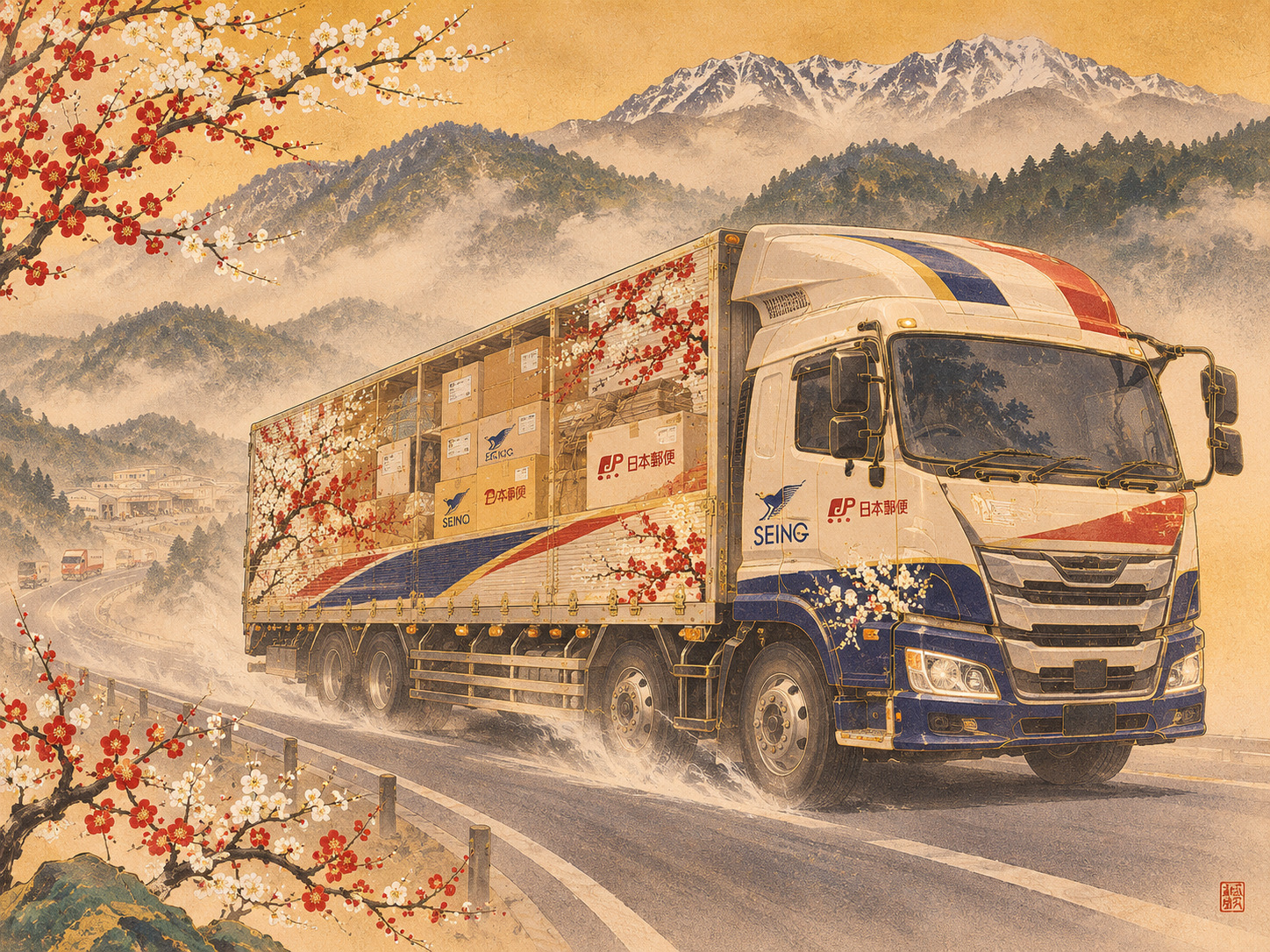
Some of the most valuable capacity in Japanese logistics is not a new truck. It is the unused space in one already scheduled to travel between two cities. Japan Post's transport network and Gifu-based Seino's freight system have spent more than two years experimenting with the consequences of that simple observation. At a November 5, 2026 briefing, the groups reported 10,049 shared trunk-line services and 16,322 joint local pickup-and-delivery services accumulated from May 2024 through September 2026, according to contemporary reporting by logistics trade publications. These are service counts, not parcels handled, distinct customers served or trucks permanently removed from the road.
The five participating companies' formal four-page statement confirms that shared long-distance transport, cross-contracted local deliveries, facility sharing, automated-truck trials and plans to recruit overseas drivers are under way. It does not itself print the 10,049 or 16,322 totals. That distinction is worth making: the operational initiatives can be verified directly against the joint release; the counts come from accredited industry coverage of the executives' briefing.
How one parcel can travel across two rival networks
A parcel typically passes through several different jobs. A driver collects it locally. A depot sorts and consolidates shipments. A long-distance vehicle carries it to another region, where local distribution begins. In Japanese logistics, the middle leg is called kansen yusō, or trunk-line transport. Seino and the Japan Post group have been putting freight from both networks into spare vehicle capacity, using each other's hubs and periodically returning roll pallets. In selected areas, one company also handles local collection or deliveries on behalf of the other.
The arrangement does not mean every Japan Post letter rides a Seino truck, nor that the two brands have merged. Their 2024 trials considered adjacent depots, weekend loads and relay facilities. A Japan Post investor presentation subsequently identified example movements in both directions, including Iwatsuki to southern Tohoku and Osaka to Tokushima using Seino capacity, as well as Fukui to Iwatsuki and Kofu to Tokyo in the reverse arrangement. Efficient routing depends as much on where a vehicle goes afterward as on where it starts.
Two transport histories meet
Japan's postal network began in 1871, when a modern public mail service connected Tokyo with Kyoto and Osaka. National coverage and uniform postage followed. The system helped bind distant places together through a common service, eventually transforming from horse and rail carriage toward modern road transport. Its legacy remains deeply associated with broad access across the country, including sparsely populated communities.
Seino has an altogether different origin. Its own history dates to 1930, when Rihachi Taguchi founded Taguchi Motor in what is now the Gero area of Gifu Prefecture. The company moved into Ogaki in 1933, adopted the Seino Unyu name in 1955, and built a network stretching across Japan's major islands by 1981. A 2005 corporate restructuring created the Seino Holdings structure while the operating freight business continued under Seino Unyu. The combination now brings together a nationwide mail tradition and a private commercial-freight network born in inland Gifu.
Why Japan's 2024 logistics problem is still driving decisions
For years, Japanese logistics adapted to the expectation that shipments would arrive promptly, often with demanding delivery windows. But an aging workforce, time lost waiting at loading docks and uneven freight demand exposed weaknesses in the model. In April 2024, a 960-hour annual cap on overtime for vehicle-driving work took effect, alongside changes to working-hour standards. The policy was meant to protect workers, not to create a shortage, yet it forced an industry long dependent on difficult schedules to reconsider capacity.
Japan's Ministry of Land, Infrastructure, Transport and Tourism warned in policy projections that, without countermeasures, transport capacity could fall short of demand by roughly 14% in fiscal 2024 and 34% by fiscal 2030. Those figures were conditional forecasts, not measured shortfalls for November 2026. The implications are nevertheless far-reaching: retailers and factories may need to consolidate dispatches, receive goods at different hours and reduce warehouse waiting times. Carriers can also collaborate instead of dispatching half-filled trucks in parallel.
A shared depot in Miyazaki shows how far the plan has gone
Sharing the highway leg is only one part of the partnership. In places where demand is thin, operating two overlapping last-mile networks can impose costs that neither carrier can easily ignore. The two groups are experimenting with assigning local collection and delivery to one operator in certain areas, including rural communities, under mutual contracting arrangements.
In March 2026, JP Logistics moved its Hyuga branch into Kyushu Seino's Nobeoka office, reopening it as JP Logistics' Nobeoka branch. The November joint statement says delivery operations were consolidated there as well. That is more consequential than parking vehicles in a shared yard. Staff must coordinate sorting, tracking, customer handoffs, liability and service standards. The practical question for rural Japan is whether such consolidation can keep reliable freight services available without transferring higher costs or lower quality to residents and small businesses.
The promise of savings—and the evidence still missing
Trade publication LNEWS reported that a Seino executive described current estimates of approximately 550 metric tons of annual carbon-dioxide reduction and cost savings on the order of several hundred million yen. The same report said Japan Post had not provided quantified improvement figures for load factors at the briefing. These estimates are not audited savings realized over a completed financial year; readers should not interpret them as proven reductions attributable to every shared service.
A meaningful assessment needs more than a cumulative trip count. Did the program reduce empty mileage? What happened to freight per vehicle, fuel use, waiting time and delivery reliability? Could more transfers offset some gains? If transit times remain stable while labor and energy requirements decline, shared capacity becomes commercially powerful. If quality deteriorates or cost shifts to subcontractors, the picture changes. The public release supplies an outline of operations, but not the full before-and-after dataset needed to settle those questions.
Automated trucks enter the experiment
The groups are also using automated vehicles supplied by the technology company T2. According to the five-company release, regularly scheduled runs carrying freight began in July 2025; the teams are checking mileage, the share of driving conducted in automated mode and transit times. Their longer-term ambition concerns Level 4 autonomous operation on expressway sections. That does not mean today's vehicles are already operating nationwide without human oversight.
For autonomous freight to become a dependable service, a carrier must solve more than vehicle navigation. It needs dispatch integration, safe transfers at terminals, maintenance procedures, fallback transport, clear responsibility during incidents and predictable customer delivery windows. A pooled freight system could give an automated truck more consistent cargo in both directions, potentially improving utilization. But that business case remains subject to safety, regulatory and operational testing.
Recruiting internationally requires more than a driving license
The November announcement also addresses foreign driver recruitment and training. The groups say they have begun considering recruitment channels, training, onboarding systems, housing and day-to-day support, particularly for trunk routes. Japanese industry reporting describes executives' hopes of beginning some recruitment the following spring. Neither the date nor the eventual headcount should be treated as completed or guaranteed outcomes.
Immigration policy, license conversion, language instruction, fatigue management, working conditions and safety training will all shape the results. International recruitment can widen the pool of drivers, but cannot replace responsible scheduling, better loading practices and adequate pay. A sustainable logistics system must work for the people behind the wheel as well as for customers waiting at the destination.
Cooperate in the middle, compete at the edges
The commercial tension is obvious: why would competitors share their most valuable operational assets? The answer is that the expensive middle of the delivery chain can sometimes be standardized without eliminating competition for customers. Seino and Japan Post retain distinct contracts, pricing structures, service promises and brands, even when cargo passes through common routes or buildings. Collaboration at the infrastructure layer can coexist with competition at the customer interface.
The test is whether that balance benefits shippers, rural businesses, drivers and consumers rather than simply reducing operating expenses within the networks. Future disclosure of actual reductions in vehicle mileage, emissions and transit costs would help answer that question. From a trucking business founded in Gifu in 1930 to Japan's postal network rooted in the Meiji era, the partnership connects two very different histories. Its real achievement will not be reaching another round-number total. It will be delivering the same essential services with less waste and a more sustainable burden on workers.
Sources and reporting notes
Corporate primary documents are cited separately from trade-media accounts of the November 5 press briefing, which reported numerical totals and estimates.
- 2026年11月5日・五社共同発表 / Five-company press statement
- 共同運行の基本合意(2024年5月9日) / Original 2024 agreement
- セイノーホールディングス・沿革 / Seino corporate history
- 日本郵政・沿革 / Japan Post history
- 国土交通省・物流2024年問題 / MLIT on driver-hour limits
- 日本郵政グループ決算説明会・協業試行例 / Trial route disclosure
- LNEWS・2026年11月5日会見報道 / Press conference reporting
- LOGI-BIZ online・会見報道 / Industry reporting
- JPロジスティクス:2026年ニュース / Company news