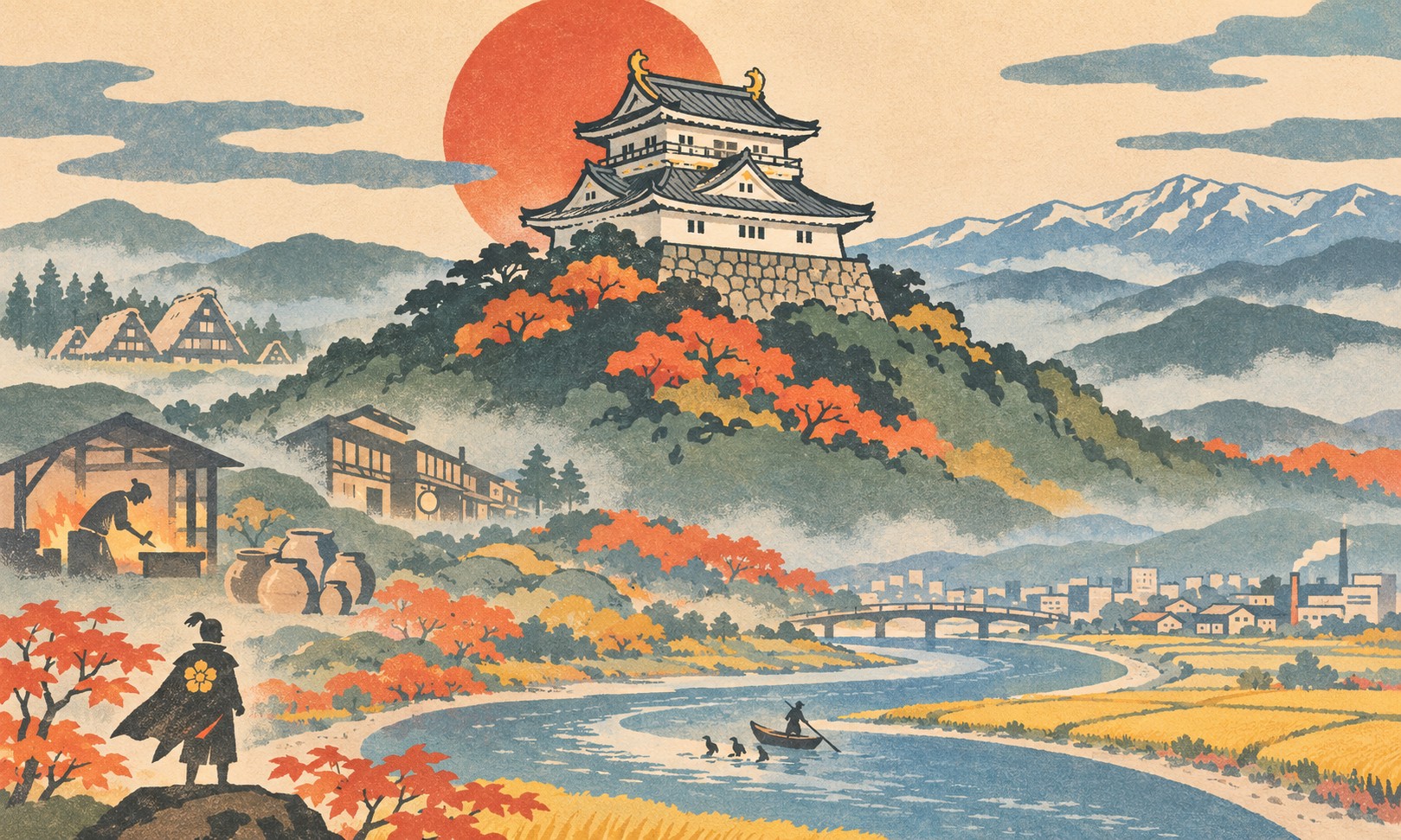
- One prefecture, two geographies
- Nobunaga’s Gifu was not yet the modern prefecture
- A population approaching 1.87 million—and still shrinking
- The age of the population is changing the shape of services
- Foreign residents are part of the future, not a statistical footnote
- Mino’s industrial web, Hida’s mountain economy
- The people who made—and interpreted—Gifu
- Shirakawa-go: a World Heritage site that is also a neighborhood
- The places worth seeing—and the stories they tell
- What Gifu tells us about Japan’s next 150 years
One prefecture, two geographies
From Gifu Castle, high above the Nagara River, the view suggests a familiar modern Japan: bridges, homes, transport corridors and an industrial city connected to the Nagoya metropolitan region. Head north into Hida, however, and the landscape changes. Distances stretch across mountains. Roads follow valleys. Timber, snow, farming, tourism and the management of remote settlements shape daily decisions in ways the plains seldom experience.
The challenge is to see these landscapes as parts of one political community without pretending they have always been culturally identical. In 2026, Gifu marks 150 years since Hida was joined administratively to the prefecture centered on Mino. This is not simply an anniversary of a line on a map. It is an opportunity to examine who lives here now, whose work sustains the region and which parts of its inherited landscape can survive another generation.
Nobunaga’s Gifu was not yet the modern prefecture
In 1567, Oda Nobunaga seized Inabayama Castle from the Saitō regime and renamed the fortress Gifu Castle, while giving the surrounding town its enduring name. He was from Owari, in present-day Aichi, rather than a native of modern Gifu Prefecture. His importance to Gifu rests in what he did here: he transformed a strategic castle and commercial settlement into a headquarters for national ambition. He remained based in Gifu until his move toward Azuchi in 1576.
Japan’s modern prefectures came centuries later. In 1871, the new Meiji government consolidated territories in Mino into Gifu Prefecture. Hida, previously administered through Takayama, was instead incorporated into Chikuma Prefecture, which also covered areas of today’s Nagano. On August 21, 1876, the abolition of Chikuma transferred Hida’s three districts into Gifu. The prefecture thus acquired approximately its familiar shape. A subsequent change in 2005 brought the former Nagano village of Yamaguchi into Nakatsugawa City.
The distinction matters. This is the 150th anniversary of the Hida–Mino union, not Gifu Prefecture’s 150th birthday. A history of Gifu that folds the events of 1567, 1871 and 1876 into one foundation story erases what makes the place interesting: political boundaries have repeatedly changed, while river routes, crafts, markets and local identities persisted.
Sources / 出典: Gifu Prefecture — the establishment of modern Gifu · Gifu City — Oda Nobunaga and Gifu Castle
A population approaching 1.87 million—and still shrinking
Official figures published October 9 place Gifu’s estimated population at 1,873,870 on September 1, 2026, in 801,161 households. Population fell by 1,098 over August, even as the number of households rose by 269. More households with fewer residents is a crucial part of the demographic story: a declining headcount does not automatically imply proportionately less demand for housing, utilities or transport.
The finalized 2025 Census counted 1,889,576 people, 4.5 percent fewer than in 2020. In the prefecture’s 2025 annual population accounting, deaths outnumbered births by 16,753 while the migration balance was positive by 874. The population decline was therefore overwhelmingly driven by natural decrease, not simply a mass departure to Tokyo.
Even those prefecture-wide numbers conceal contrasts. During August 2026, Gifu City lost 190 residents, Tajimi 86 and Toki 71, while a handful of towns recorded small increases. What a hill village needs to remain viable is different from what a growing industrial district needs to accommodate newcomers. Good demographic policy begins with that difference.
Sources / 出典: Gifu Prefecture Statistics Division — September 1, 2026 population estimate · Gifu Prefecture — final 2025 Census and population change
The age of the population is changing the shape of services
Gifu’s official aging data put the number of residents aged 65 or older at about 590,554—31.1 percent of the prefecture’s estimated population—on April 1, 2025. This figure uses a different reference date from the September 2026 population total and should not be treated as the precise age composition of that later population.
Its practical implications are nonetheless plain. Maintaining a bus route to a hospital, helping someone shop without a car, keeping a mountain road passable in snow and preserving the labor needed for farms and forests all become more difficult when communities grow older and smaller. The loss of a single service in a valley may matter more than an impressive prefecture-wide growth figure in tourism.
That presents a question bigger than how to reverse population decline: can Gifu design a dignified life for people even where a return to earlier population levels is unlikely?
Foreign residents are part of the future, not a statistical footnote
Immigration Services Agency figures reproduced by the prefecture show 77,301 foreign residents at the end of June 2025. They come from many places, notably the Philippines, Vietnam, Brazil, China and Indonesia. Because the date and population series do not align exactly, the roughly four-percent share often quoted for foreign residents should be treated as an approximate comparison rather than a harmonized census measure.
Communities in Minokamo, Kani, Ōgaki and elsewhere illustrate the gap between merely recruiting workers and welcoming residents. Multilingual schools, medical interpretation, disaster communication, housing and long-term opportunities for children matter as much as jobs on the production line. A foreign-resident figure is not interchangeable with a count of foreign workers; the former also includes spouses, children and people outside the workforce.
In this sense Gifu poses a national question. Can an aging industrial society treat those who help sustain it as neighbors with a stake in its long-term future?
Sources / 出典: Gifu Prefecture — foreign-resident statistics
Mino’s industrial web, Hida’s mountain economy
The broad Mino plain supports a formidable network of manufacturers, workshops and logistics operators linked to the Chūkyō industrial region. In the prefecture’s published manufacturing breakdown, the shipment value for 2023 was approximately ¥6.72 trillion. Transportation equipment accounted for 18.0 percent of that total. That is a manufacturing-shipment measure, not prefectural GDP or profit, but it demonstrates the scale of Gifu’s role in national supply chains.
Its manufacturing heritage is not a romantic prelude to modern industry; it is part of the industrial story. In Seki, swordsmithing traditions stretching back roughly seven centuries evolved into contemporary cutlery and tools. In Tajimi, Toki and Mizunami, ceramics and kiln industries remain central to the identity of eastern Mino. Elsewhere lie automotive components, machine tools, aerospace suppliers, wood products and countless specialized subcontractors.
Hida brings different strengths: mountain agriculture, forestry, timbercraft, wood furniture, hot springs, food traditions and tourism. Yet the simple contrast of “factories in the south, tourism in the north” is misleading. Both regions contain ordinary working towns, farms and industrial businesses. Their differences are a source of economic diversity, not a reason to reduce either to a stereotype.
Sources / 出典: Gifu Prefecture — industrial and manufacturing statistics · Seki City — 700 years of swordsmiths and cutlery
The people who made—and interpreted—Gifu
Oda Nobunaga is Gifu’s most globally recognizable historical associate, though he was born in Owari. Akechi Mitsuhide, Nobunaga’s eventual adversary, has several traditions linking him to Mino; his birthplace and early life remain contested, so no one castle should be stated as his definitively proven birthplace.
The painter Maeda Seison, by contrast, was born in Nakatsugawa in 1885. His modern nihonga practice made Japanese historical subjects newly vivid, from the details of armor to the personalities of warriors and birds. The novelist Shimazaki Tōson was born in Magome, today part of Nakatsugawa, and transformed the social world of the Nakasendō into literature, notably Before the Dawn.
Diplomat Chiune Sugihara, who issued transit visas to refugees in Lithuania during World War II, has a powerful connection with Gifu. His exact birthplace deserves caution: Yaotsu Town preserves traditions and personal recollections identifying Yaotsu, while the Sugihara Memorial Foundation cites documentary evidence pointing to present-day Mino City. The competing records do not undermine his deeds, but they should not be hidden behind an unqualified birthplace label.
Such distinctions are not pedantry. They show the many ways a person can belong to a place: by being born there, finding a home there, governing it, painting its stories or leaving an ethical legacy to its communities.
Shirakawa-go: a World Heritage site that is also a neighborhood
Shirakawa-go’s Ōgimachi settlement was inscribed on the UNESCO World Heritage List in 1995 as part of the Historic Villages of Shirakawa-go and Gokayama. The listing is shared with Ainokura and Suganuma in Toyama Prefecture. Distinctive steep-roofed gasshō-zukuri houses reflect climatic adaptation and the demands of earlier rural livelihoods, rather than a decorative style created for tourists.
UNESCO’s conservation account describes the continuing role of property owners, joint community maintenance and precautions against fire. Those details are essential to understanding the site’s value: safeguarding a living village is harder than preserving an empty architectural exhibit.
The popularity of photographs of the houses can obscure the fact that paths, gardens and buildings are part of residents’ everyday lives. Visiting respectfully is not an optional courtesy; it is a condition for keeping the heritage alive.
Sources / 出典: UNESCO World Heritage Centre — Shirakawa-go and Gokayama
The places worth seeing—and the stories they tell
Gifu Castle and the Nagara River form a natural starting point for the south. The castle connects the visitor to Nobunaga’s political project, while the river’s cormorant-fishing traditions reveal an older relationship between water, food, ceremony and tourism.
Farther north, Takayama’s preserved merchant districts and the Takayama Jinya recall the city’s role as an administrative and trading center of Hida. Gujō Hachiman’s water channels and famous dancing traditions show how public space can become an enduring cultural institution. Nakatsugawa’s Magome-juku, set on a steep stone-paved slope, makes the historic Nakasendō tangible; its Tōson memorial draws the line from a post town to modern Japanese literature.
In Seki, the history of blades can be followed through workshops and museum displays, while the ceramics towns of Tajimi, Toki and Mizunami tell a more domestic story of the bowls and plates used across Japan. Sekigahara’s battlefield offers an entirely different education in how terrain shaped national history in 1600. These are not interchangeable sightseeing stops. Each represents a different way geography and work produced Japanese culture.
Sources / 出典: Takayama City — historic streets and tourism · Nakatsugawa City — Magome-juku and Shimazaki Tōson
What Gifu tells us about Japan’s next 150 years
At first sight, the challenges of a shrinking population, an aging society, tourism pressure and industrial change seem unrelated. In Gifu they intersect. The availability of trained craftspeople determines whether a historic building can be repaired. Transport affects whether an older resident can remain in a mountain town. Immigration policy determines whether younger households can build lives near factories. Forest and river management connect cultural landscapes to disaster preparedness.
The Meiji government could change the map by decree in 1876. Modern Gifu cannot secure the lives inside that map by decree alone. That work happens in schools, workshops, clinics, municipal offices, farms and village associations. The most meaningful tribute to Gifu’s 150-year union is not another picture of a picturesque castle, but a serious account of the people who will make its next chapter possible.
Sources and verification
Primary prefectural, city and UNESCO records are listed below. The birthplace of Chiune Sugihara is disputed; neither version is presented as settled. Population, household, aging and immigration figures refer to different reporting dates.
- Gifu Prefecture Statistics Division — September 1, 2026 population estimate
- Gifu Prefecture — final 2025 Census and population change
- Gifu Prefecture — the establishment of modern Gifu
- Gifu City — Oda Nobunaga and Gifu Castle
- Gifu Prefecture — population aging statistics
- Gifu Prefecture — foreign-resident statistics
- Gifu Prefecture — industrial and manufacturing statistics
- UNESCO World Heritage Centre — Shirakawa-go and Gokayama
- Seki City — 700 years of swordsmiths and cutlery
- Nakatsugawa City — Magome-juku and Shimazaki Tōson
- Takayama City — historic streets and tourism
- Chiune Sugihara Memorial Foundation — documentary birthplace evidence
- Yaotsu Town — Sugihara biographical chronology
- Yaotsu Town Council record — competing birthplace claims
- JAPAN.co.jp — Maeda Seison profile
- JAPAN.co.jp — the Hida–Mino administrative merger